Pharmaceutical traceability software is bought to answer one question under pressure: this lot is suspect, so what did it touch, where did that go, and what else shares the same input? Any tool can show you that question answered on its own data. What separates the ones worth buying is whether four things are true on your lots: it walks both ways from any lot without being told the route, it shows the read behind every answer, it cannot write to a plant system, and every output it produces belongs to a named person. All four are testable in a morning with two closed batches and a recall notice from last year. Botminds' Manufacturing Batch Analytics is used on this page as the worked example of where that boundary falls — not as the answer to your buying question, which depends on your stack, your products and your people.
Two consultation drafts give the clearest current language for the last two tests, and they are drafts: the new Annex 22 on artificial intelligence and the revised Annex 11 were both put out for stakeholder consultation on 7 July 2025, in a consultation that closed on 7 October 2025, so they propose rather than require. For a cell therapy, the rule already in force that outlasts any tool you buy is older and plainer, and it is quoted below. The product examples are sample data on a fictional cell-therapy line — Corventa on Line C2 at Plant 3 in Leiden, with fictional suppliers, hospitals and people.
"The manufacturer should ensure that the following data is retained for a minimum of 30 years after the expiry date of the product, unless a longer period is provided for in the marketing authorisation"
EudraLex Volume 4, Part IV: GMP for Advanced Therapy Medicinal Products, §6.37 (2017)
What should pharmaceutical traceability software do? Six capabilities, not a feature list
Strip the category down and six capabilities do the work. First, hold the lot links: every goods receipt, issue and consumption that connects a supplied lot to a batch and a batch to a shipment. Second, walk them in both directions from any node, not only forward from a supplier lot. Third, carry the batch facts on the nodes — release results, deviations, stage, status — so a trace answers a quality question rather than drawing a graph. Fourth, reach the procedures, because the next action after a trace is always written in a document somebody has to find. Fifth, keep the evidence: what was read, when, and by whom. Sixth, produce something a person can sign.
What that list does not include is a decision. The rules put the decision with the quality unit and, in the EU, with the Qualified Person, and any tool that blurs that line is creating work for your validation team rather than saving it.
For advanced therapies the capability list has a hard edge that is easy to miss during a demonstration: retention. The ATMP guidelines, quoted at the top of this page, ask that traceability data — the donation code, the internal code and the batch numbers of critical raw materials — be kept for thirty years past the product's expiry, or longer if the marketing authorisation says so. A tool whose answer exists only as a view that cannot be exported, or whose data lives only in a vendor's environment, is a thirty-year problem being bought as a subscription.
How do you evaluate traceability software? Four tests, in the order that disqualifies fastest
Run them in this order, because each one is cheaper to run than the next and each eliminates more candidates. The point is not to score features; it is to watch the tool fail or pass on material you already know the answer to.
The four tests, how to run each one on your own lots, and what a pass looks like
| Test | How to run it in a morning | A pass | A fail |
|---|---|---|---|
| Both ways from any lot | Give it one closed finished batch and one supplied lot you have already traced by hand. Ask for inputs from the batch and finished product from the lot, without naming the path. | The same links your manual trace found, in both directions, plus anything your manual trace missed — and it can explain the extra. | Forward-only, or a trace that needs the route configured per product, or a graph that cannot say which shipment a dose went on. |
| Show me the read | Ask one data question and one procedure question, then ask for the query, the tables and the section and page behind each answer. | The query, the tables it read and a row count for data; a section and page for every sentence of a procedure answer. | "Our model determined", a confidence score instead of a source, or a citation to a document version that is not effective. |
| Read-only by architecture | Ask which account it uses, what permissions that account holds in each source system, and what happens when a user asks it to change a status. | No write permission anywhere, reads only, and anything returning to the quality system arrives as an unsigned draft. | Write access "not used in practice", a configurable switch, or status updates presented as a convenience feature. |
| A named person owns every output | Follow one output to the end: who signs it, what the signature means, what happens if they refuse, and where the correction goes. | A named signer, a recorded meaning, a refusal path, and corrections that are kept and fed back. | Outputs that become records on save, approvals with no recorded meaning, or an audit trail that cannot show who changed what. |
Two further checks belong in the same morning, and they are the ones buyers tend to forget. Scope: ask the tool a question about a line or plant the signed-in user should not see, and watch what comes back. And staleness: ask when the genealogy it just walked was last built, and insist the answer appears on the screen rather than in a conversation.
Both ways from any lot: what a lot traceability system must do
Many tools can answer "where did this lot go" because that is what a where-used report does. Far fewer can answer the question a recall actually poses, which is the backward half: this finished batch is implicated, so what went into it, and does any other lot in the store share that same input? The backward walk is what finds the second contaminated lot that the supplier's notice never named — a bottle lot that filled two cryomedium lots, of which only one was recalled.
A where-used report against a both-ways walk with its read shown
Where-used report: Which orders or batches consumed this lot.
Both-ways walk, with the read: What went into this batch, where its outputs went, and which other lots share an input with it.
Where-used report: Usually one level, sometimes two, within one system.
Both-ways walk, with the read: Every level reachable through the links, across material movements, shipments and supplier certificates.
Where-used report: Quantities and dates.
Both-ways walk, with the read: Release results, deviations, stage, market and where the unit is now.
Where-used report: A sibling lot filled from the same failed input, because that lot was never consumed by the batch you asked about.
Both-ways walk, with the read: Anything the links themselves do not record — which is why the links, not the tool, are the real asset.
Where-used report: A report, usually undated and unsourced once pasted into a document.
Both-ways walk, with the read: The walk itself: links read, read time, systems touched, numbered sources in the text.
Where-used report: Which batches to look at next.
Both-ways walk, with the read: Which doses are exposed, which are still at a treatment centre, and what the procedure asks you to do now.
If you buy nothing else, buy the backward walk. US recall guidance has asked firms for decades to "maintain such product distribution records as are necessary to facilitate location of products that are being recalled" (21 CFR 7.59), and the whole point of a traceability tool is that locating product is a query rather than a project. How the walk itself behaves is set out in tracing a batch backward and forward in one walk, and the drill that proves it works is a mock recall.
Show me the read: the query, the tables and the page behind every answer
This is the test that disqualifies the most impressive demonstrations. Ask any tool a question and it will produce an answer; ask it to show the read, and the differences appear immediately. For a data answer the read is the query, the tables and the row count. For a trace it is the links walked. For a procedure answer it is the section and the page, from a version that is effective today.
The effective-version point is worth testing deliberately, because it is both easy to get wrong and easy to check. Put a question to the tool whose answer changed between two versions of a procedure, where one version is still in review. On the product's sample data this is the stated behaviour: a draft of SOP-MFG-0214 is in review and is not cited, because the procedure specialist cites effective versions only and says so when no procedure covers the question.
A cited procedure answer: every statement with its section
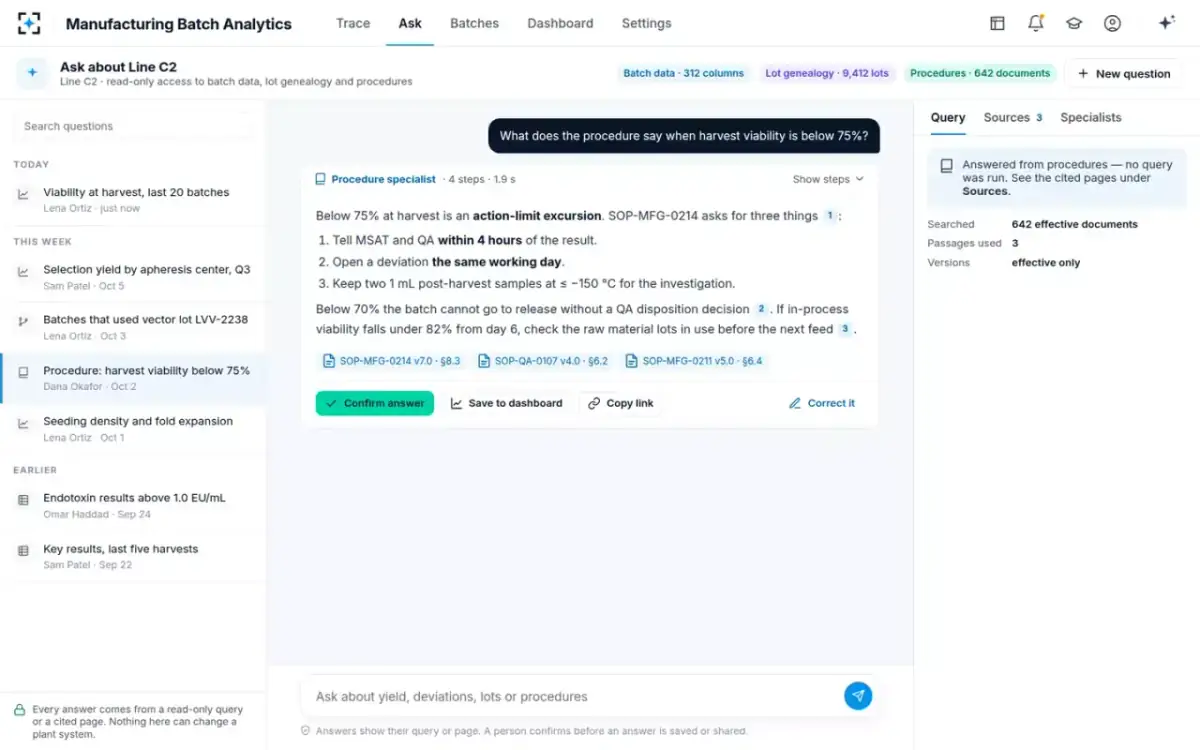
A second, harsher version of the same test: ask a question the data cannot answer. A tool that says so is more valuable than one that produces a plausible number, and this is a property you can only observe by trying it.
Should a traceability system be read-only, or allowed to write?
Read-only, with one controlled exception: it may propose. The argument is not that writing is forbidden — plant systems are written to all day — but that a reading tool which also writes multiplies your validation surface and your risk for a convenience nobody asked for. Every write it can perform is a path by which an analysis could change the record it is analysing.
The draft revised Annex 11 gives a usefully strict definition of read-only in passing, while discussing accounts: shared accounts are treated as a data integrity violation unless they are limited to read-only access, which the draft spells out as access through which no data and no settings can be changed (draft Annex 11, §11.1). No data or settings: that is the bar to hold a supplier to, and it is answerable in one sentence by any vendor who has built it that way.
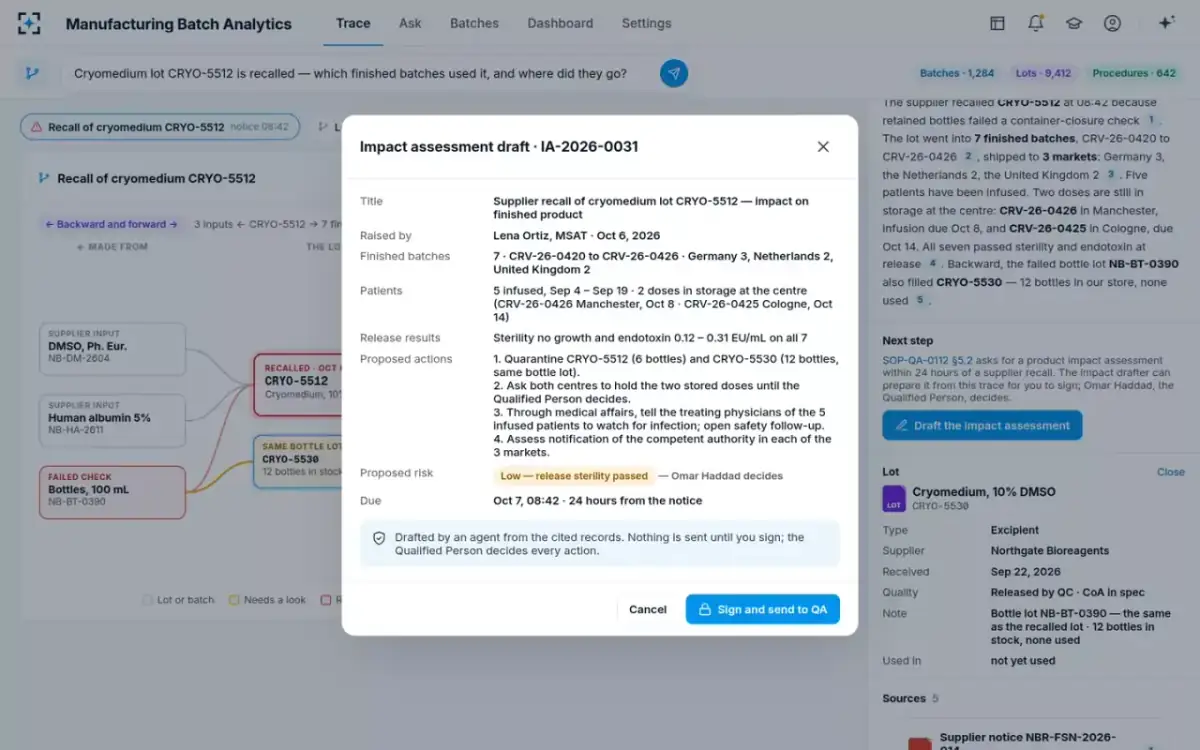
The controlled exception is the draft. A traceability tool is most useful when it also fills in the assessment the procedure demands — exposure, product status, proposed actions — because that is where the hours go after a trace. The test is what happens next. In the product the drafter drafts only, the classification is marked as a proposal, a named person signs the facts, and quality decides the class while the Qualified Person decides holds, quarantine, disposition and notification. Nothing is sent before the signature.
A drafted impact assessment, marked as a proposal
Can an AI feature make a GMP decision?
No, and the regulators have now written down why in terms a buyer can use. The EMA's reflection paper states the principle that survives whatever technology arrives: the sponsor, the marketing authorisation applicant or holder, or the manufacturer is responsible for making sure every algorithm, model, dataset and data pipeline it uses is fit for purpose and meets the legal, ethical, technical, scientific and regulatory standards of EU law, GxP and EMA guidance (EMA, Reflection paper on the use of AI in the medicinal product lifecycle, September 2024). The responsibility does not transfer to a supplier, and it cannot be bought.
The draft Annex 22 then makes the human's position something to be described rather than disclaimed. Under human-in-the-loop it proposes that where a model feeds a decision a human operator makes, and testing of the model has been reduced on that basis, the intended-use description should state the operator's responsibility — and the operator's training and consistency should then be monitored as for any other manual process (draft Annex 22, §3.3). Read that as a buying requirement: if a tool's outputs feed your decisions, your intended-use description has to say what the operator is responsible for, and you will be monitoring that person's performance. A vendor whose answer is "a human is always in the loop" has not met that bar; a vendor who can tell you exactly which decision the human makes, on what evidence, has.
The boundary to insist on: who establishes, who signs, who decides
Agent
Routes the questionTakes a plain-language question, asks one clarifying question when the batch or time range is unclear, and sends it to one specialist.
Never: writes to a plant system, or answers about a line the person cannot see
Agent
Traces, queries and citesWalks the lot links read-only, queries the batch columns with SELECT only and a 10,000-row limit, and quotes procedures with a section and page.
Never: quotes a version in review, or shows patient identity beyond a chain-of-identity code
Agent
Drafts the assessmentFills the exposure, product status and proposed actions the procedure asks for, from the cited records.
Never: sends, classifies or files anything: the classification is a proposal
A person decides
A named scientist signs the factsConfirms the facts are correct, with the meaning of the signature recorded, and corrections go back as examples.
Never: skipped, and not the same person who decides
A person decides
Quality and the Qualified Person decideThe deviation class, the hold, the quarantine, the disposition and any notification of authorities.
Never: delegated to the tool, whatever the tool proposes
No decrease: the tool has to beat what you do now, which you must measure first
The current Annex 11 sets the principle for any computerised replacement of manual work in its opening: the replacement must not lower product quality, process control or quality assurance, and must not raise the overall risk of the process (Annex 11, Principle). The draft Annex 22 applies the same logic to models in a clause headed "No decrease", and adds the uncomfortable implication: the performance of the process being replaced has to be known (draft Annex 22, §4.3).
Few plants know it. Ask how long a batch question takes today and you will get a range and an anecdote. So before an evaluation, measure three numbers on your own last six months: median days from question to signed answer for an investigation, median hours for a routine "which batches used this lot" request, and the proportion of answers that were later corrected. Those are your acceptance criteria. They are also the only defensible denominator for any claim a supplier makes, and for any claim you make internally afterwards.
On the product's sample data the comparable figures are stated as what they are: Botminds' own estimate is that a full outlier investigation took about 90 days by hand on the fictional Line C2, against a 5.5-hour median for a batch analysis on the sample dashboard this quarter, and the eight-times figure quoted for answers per analyst hour is a design target rather than a measurement. Your numbers are the ones that matter in your evaluation.
Does traceability software need to be validated, and who writes the requirements?
If it is used in GMP-regulated activities, yes — and the requirements are yours to write, not the supplier's. Annex 11 is specific: user requirements should describe what the system has to do, rest on a documented risk assessment and its GMP impact, and stay traceable through the whole lifecycle (§4.4). A requirement set copied from a vendor's feature list is not traceable to your risk assessment, and it will not help you when an inspector asks why you accepted a particular behaviour.
Validation effort should follow impact. A read-only tool that produces unsigned drafts for a person to confirm carries less risk than one that updates lot status, and the rules let you reason that way, because risk management applies across the lifecycle. What you cannot do is treat the analytics layer as outside the quality system because it does not write: the decisions it informs are inside it, and so is the data behind them. The data-integrity obligations that follow are set out in one number, end to end.
The supplier questions: responsibilities, oversight and what you keep
Annex 11 §3.1 requires formal agreements with any third party that provides, configures, validates, maintains or retains a computerised system or its data on your behalf, with the third party's responsibilities stated clearly in them. That clause is the backbone of a supplier discussion, and it turns a sales conversation into a list of named duties.
Twelve questions to put to a traceability supplier, and the answer that disqualifies
- Which account does it use in each source system, and what can that account do?
Disqualifying: write permission that is "not used". Annex 11's draft defines read-only as no data or settings being changeable.
- Show me a backward walk from a finished batch on our data.
Disqualifying: a route that has to be configured per product, or a trace that stops at the first supplier lot.
- Where is the query, the tables and the row count for that answer?
Disqualifying: a confidence score offered instead of a source.
- How does it know which version of a procedure is effective?
Disqualifying: it cites whatever is indexed, including drafts in review.
- What does it do when the data cannot answer the question?
Disqualifying: it always answers. Ask for a worked example of a refusal.
- Who signs an output, and what does the signature mean?
Disqualifying: outputs that become records on save, or approvals with no recorded meaning.
- What is recorded about every question and answer, and for how long?
Disqualifying: no trail of what was read. For advanced therapies, hold the thirty-year retention expectation against the answer.
- How is patient or donor identity handled?
Disqualifying: real identifiers visible by default where a code would do.
- What are the responsibilities of your company, in writing?
Annex 11 asks for formal agreements with clear statements of third-party responsibilities. A sales deck is not one.
- What is your position on the draft Annex 22 expectations?
Disqualifying: claiming compliance with a consultation draft. A considered answer describes intended use, acceptance criteria and the operator's responsibility.
- What do we keep if we stop paying you?
Disqualifying: the links and the answers live only in your environment and leave in a format nobody can read.
- Who do we call at 02:00 during a recall, and what do they commit to?
Disqualifying: an availability number with no path to a person. The 24-hour clock does not pause for a support queue.
A two-week evaluation that ends in evidence
Demonstrations prove that a tool works on the vendor's data. A fortnight structured like this proves something about yours, and leaves you with documents rather than impressions.
Ten working days, ending with three artefacts you keep
- Measure the baselineday 1
- Two traced lots, both waysdays 2–3
- Show-me-the-read on five questionsdays 4–5
- Scope and refusal testsday 6
- One trend, with its definition argueddays 7–8
- One drafted assessment, signed or refuseddays 9–10
End the fortnight by writing down what the operator is responsible for, in the words you would use in an intended-use description. If that sentence is hard to write, the boundary is not clear enough yet — and the roles behind it are worth settling first: who establishes the facts and who decides. To see the four tests on one line, start from Manufacturing Batch Analytics.
Questions people ask
What should a lot traceability system do?
Hold the lot links, walk them in both directions from any node, carry the batch facts on the nodes so a trace answers a quality question, reach the procedures that say what to do next, keep evidence of what it read, and produce something a named person can sign. What it should not do is decide: the quality unit approves or rejects, and in the EU the Qualified Person decides holds and release.
How do you prove a traceability tool is accurate?
By running it against lots you have already traced by hand and comparing link for link, in both directions, including a case where a sibling lot shares an input. Then ask for the read behind each answer and re-run it. Accuracy claims that cannot be reproduced on your own closed batches are not evidence, and the draft rules on replacing a manual process expect you to know how that manual process performs first.
Should a traceability system be read-only?
For analysis, yes. The strong form is architectural: no write permission in any source system, reads only, and anything going back to the quality system arriving as an unsigned draft. The draft Annex 11 defines read-only as access where no data or settings can be changed, which is a usable definition to hold a supplier to.
Does traceability software need to be validated?
If it is used in GMP-regulated activities, yes, with the effort proportionate to its impact. The user requirements are yours to write: Annex 11 asks that they describe the required functions, rest on a documented risk assessment and GMP impact, and stay traceable through the lifecycle. A requirement list copied from a feature sheet does not meet that.
Can an AI feature make a GMP decision?
No. Responsibility for models, datasets and pipelines being fit for purpose stays with the manufacturer or authorisation holder, as the EMA's reflection paper states. The draft Annex 22 goes further for tools that feed human decisions: the intended-use description should include the operator's responsibility, and that operator's training and consistent performance should be monitored like any other manual process.
What questions should you ask a GMP software vendor?
Start with the account and its permissions, a backward walk on your data, the read behind one answer, how effective procedure versions are determined, what happens when the data cannot answer, who signs an output and what the signature means, what is recorded and for how long, and what you keep if the relationship ends. Then ask for the responsibilities of the supplier in writing — Annex 11 asks for formal agreements that state them clearly.