MES, LIMS and ERP integration is the work of getting the batch record, the laboratory results and the material movements to answer one question together — and it is the reason a batch investigation is measured in weeks. The data is not missing. It sits in four systems with four owners, four release cycles and four vocabularies for the same metric, and the person asking has read access to some of them and a colleague in each of the rest. The European rules point at the fix and its limit in a single paragraph: critical data should move between systems on validated interfaces rather than by hand, which solves transport and leaves the harder work untouched. Botminds' Manufacturing Batch Analytics is built for the part that is left: read-only connections to the plant systems, one agreed definition per metric, and the query shown with every answer.
Where this page describes the product, it is describing sample data on a fictional cell-therapy line — Corventa on Line C2 at Plant 3 in Leiden. The 2011 Annex 11 and 21 CFR 211.68 are in force; the revised Annex 11 quoted here is a consultation draft, put out for comment on 7 July 2025 with a consultation that closed on 7 October 2025, so it proposes rather than requires, and is quoted as a draft throughout.
What one question has to reach across on a single cell-therapy line
4systems
crossed by a routine batch question: batch record, laboratory results, lot links, procedures
312
batch columns to pick the right metric from
9,412lots
linked through material movements, one walk at a time by hand
642
procedures holding the limits the answer has to be read against
Which systems does a batch investigation need? One question, four owners
Take the question a process scientist actually asks: why did viability at harvest fall below the action limit on this batch, and which other batches share the cause? Answering it needs the batch record from the manufacturing execution system, the harvest and release results from the laboratory system, the lot links from material movements in the resource planning system, and the limits and required actions from the document system. If a supplier is involved, add the certificates of analysis, which usually arrive as documents rather than data. If product has shipped, add shipments and chain of custody.
Each of those has a different owner, a different change process and a different idea of what a batch is. The cost of the question is not the reading; it is the crossing.
The plant stack behind one batch question: what each system owns, and who answers for it
Manufacturing execution
OwnsThe electronic batch record: steps performed, operators, equipment, in-process entries, timings.
ExposesBatch and step data per batch identifier.
Answers for itManufacturing, with the system owner in IT.
Laboratory information management
OwnsRelease and in-process results by test method, specifications and the analyst review behind each result.
ExposesResults by batch and by test code.
Answers for itQuality control.
Material movements in the resource planning system
OwnsGoods receipt, issue to order, consumption and the lot-to-lot links that make a genealogy.
ExposesLot links, quantities, locations.
Answers for itSupply chain, with quality for status.
Document management
OwnsProcedures, master batch records and test methods, with versions and effective dates.
ExposesEffective text by section and page.
Answers for itQuality assurance.
Quality management
OwnsDeviations, investigations, CAPA, change control and impact assessments.
ExposesRecords and status; accepts drafts.
Answers for itQuality assurance.
Shipments and chain of custody
OwnsWhere each dose went, when, and who holds it now.
ExposesConsignee and custody events per unit.
Answers for itLogistics, with quality for release-to-ship.
Supplier certificates
OwnsCertificates of analysis and supplier notices, usually as documents rather than data.
ExposesAttributes per supplied lot, once read.
Answers for itQuality control and procurement.
Two rows in that table are the ones that quietly decide how long an investigation takes. Material movements hold the lot links, and they were designed for stock accounting rather than for walking a genealogy, so the links exist but the walk is manual. Supplier certificates hold the attributes that explain input variability, and they are documents, so the attribute a scientist needs — an osmolality at the top of its range, say — is in a PDF nobody has indexed. That is the gap raw material variability keeps falling into.
What does Annex 11 say about transferring data between systems?
The current Annex 11, in force since June 2011, says two things about data moving between systems. On exchange: "Computerised systems exchanging data electronically with other systems should include appropriate built-in checks for the correct and secure entry and processing of data, in order to minimize the risks" (Annex 11, §5). On moving data to another format or system, validation has to include checks that the data are not altered in value and/or meaning during the move (§4.8).
The second phrase is the one to argue your architecture against. Not altered in value — that is a checksum problem, and it is solvable. Not altered in meaning — that is a definition problem, and no interface solves it. A viability column copied faithfully into a warehouse under a name that means something slightly different in the new context has been altered in meaning while every value survived intact.
US rules make the same demand from the equipment side, and they make the depth of checking a risk decision: what goes into and comes out of a computer system — formulas, records, data — must be checked for accuracy, with the degree and frequency of that checking set by how complex and reliable the system is (21 CFR 211.68(b)).
Interfaces or transcription: is manual transcription allowed between GMP systems?
It is not forbidden, and the draft revision is careful to say so while making the preference unmistakable. The consultation draft of Annex 11 proposes, under data transfer: "Where a routine work process requires that critical data be transferred from one system to another (e.g. from a laboratory instrument to a LIMS system), this should, where possible, be based on validated interfaces rather than on manual transcriptions. If critical data is transcribed manually, effective measures should be in place to ensure that this does not introduce any risk to data integrity" (draft Annex 11, §10.2, consultation draft of July 2025).
Read as an architecture instruction, that paragraph says: for anything routine and critical, build the interface; where you keep a human in the loop, own the controls that make it safe. The current Annex 11 already names one of those controls — a second check on critical data entered by hand, by a person or by validated electronic means — and the practical consequence is that transcription is rarely cheaper than the interface once the second check is staffed.
Transcription against a validated interface, on the same critical result
Transcribed by hand: Nothing. It is already happening.
Validated interface: Development, qualification and a change process on both sides.
Transcribed by hand: The transcription plus a second check on critical data, every time, for the life of the process.
Validated interface: Monitoring, and re-qualification whenever either system changes.
Transcribed by hand: Transposed digits, the wrong timepoint, a unit dropped, a value silently rounded.
Validated interface: Mapping errors, which are systematic: wrong once means wrong for every batch until found.
Transcribed by hand: The procedure and the second check, with evidence that it happens.
Validated interface: The interface, and checks that data is not altered in value or meaning in transit.
Transcribed by hand: The second-check record on the day the result was entered.
Validated interface: The interface specification, its test evidence, and the exchange checks.
Transcribed by hand: Acceptable where critical data is transcribed manually, with effective measures against data integrity risk.
Validated interface: Preferred for routine transfers of critical data, where possible.
Built-in checks: what has to be checked when data moves between computerised systems
Three checks, and they answer different questions. Transport asks whether everything arrived: row counts, completeness of the period, a reconciliation that fails loudly rather than silently returning fewer rows. Fidelity asks whether each value is unchanged, including its unit and its precision — the place where rounding does its damage. Meaning asks whether the receiving system interprets the field as the sending system did: same timepoint, same method, same definition of a batch.
Plants often build the first, assume the second and skip the third. The third is the one that produces a wrong answer that looks right, which is the only kind of wrong answer that is dangerous. A useful discipline is to write the check as a question with a number in it — "do the 20 batches in the answer match the 20 batches in the laboratory system for the same dates?" — and to run it on a schedule rather than at go-live.
What that discipline cannot do is cover the step after the exchange, where joins, filters and rounding happen on the way to a chart. That step belongs to the analysis, and it is governed by the same principles; following one number from the instrument to a signed finding sets out what has to travel with it.
The system description, the data flows and the inventory nobody has
Before an integration can be validated, somebody has to write down what exists. Annex 11 asks for two artefacts, and in many plants the first is partly true and the second is years old: "An up to date listing of all relevant systems and their GMP functionality (inventory) should be available," and "for critical systems an up to date system description detailing the physical and logical arrangements, data flows and interfaces with other systems or processes, any hardware and software pre-requisites, and security measures should be available" (Annex 11, §4.3).
The data flows are the part that matters for batch analytics, because a new read of plant data is a new data flow and a new interface, and the description is where it becomes visible to quality. The table below is the minimum a description has to carry per flow for it to be useful rather than decorative.
The data-flow inventory a system description has to carry, per flow
| Column | What it records | Why quality needs it |
|---|---|---|
| Source and destination | The sending and receiving systems, named as the inventory names them. | Without it, nobody can tell which flows a change to either system affects. |
| Data and criticality | Which fields move, and whether they are critical data or support a quality decision. | Criticality drives the depth of checking the rules ask for. |
| Direction and trigger | One way or both ways; on event, on schedule, or on request. | A nightly build and a live read fail differently and are qualified differently. |
| Transformation | Any mapping, unit conversion, rounding or aggregation applied in transit. | This is where meaning changes while values survive. |
| Checks | The built-in checks on entry and processing, and what happens when one fails. | Annex 11 asks for appropriate built-in checks on electronic exchange. |
| Access | Read or write, the account used, and the scope it is limited to. | A read-only scope is a claim that has to be visible somewhere to be believed. |
| Owner and approver | The process owner, the system owner, and who signs the description. | Annex 11 asks for close cooperation between process owner, system owner, Qualified Persons and IT. |
| Retention | What is kept of the exchange, where, and for how long. | An exchange nobody kept evidence of cannot be reconstructed later. |
The EU guide's warning about complexity sits over all of this: "Complex systems need to be understood, well documented, validated, and adequate controls should be in place" (EU GMP Part I, Chapter 4). A plant stack with seven connections is a complex system whether or not anyone has drawn it.
What an interface does not fix: four vocabularies for one metric
Here is the failure that survives every successful integration. The manufacturing system records a viability entry at harvest performed by the operator. The laboratory system holds a test result, VIAB-HARV by 7-AAD flow, with its own timestamp and its own specification. A process-development dataset has a viability column from a different assay. A supplier certificate reports viability on the material it shipped. All four are called viability. None of them is interchangeable with another.
Move all four into one warehouse and you have not resolved the ambiguity; you have given it a single address, which is worse, because now an answer can pick the wrong one without crossing a system boundary where somebody might have noticed. The only fix is an agreed definition per metric — test, timepoint, unit, and which column in which system is authoritative — approved once and used by every answer that names the metric. That is organisational work, not integration work: an afternoon of argument between MSAT, quality control and manufacturing per metric, and a list that is maintained.
In the product's sample data this is why the batch data specialist picks the metric by its approved definition out of 312 columns and prints the definition with the answer. The definition is the deliverable; the query is just how it is applied.
Can an analytics tool be read-only? Architecture, not a promise
Yes, and it is worth insisting on, because read-only is the one property that makes a new reader of plant data uncontroversial. The strong version is architectural: the account the tool uses has no write permission in the source system, the only statements it can issue are reads, and anything it produces for the quality system arrives as a draft that a named person has to sign.
The draft revised Annex 11 is interesting here, because it treats read-only access as the single exception to one of its strictest proposals: "All users should have unique and personal accounts. The use of shared accounts except for those limited to read-only access (no data or settings can be changed), constitute a violation of data integrity" (draft Annex 11, §11.1). The parenthesis is the useful definition — no data or settings can be changed — and it is a reasonable bar to hold a vendor to.
In the product every connection is read-only, data answers come from SELECT-only queries with a 10,000-row limit, patient identity is masked to chain-of-identity codes, and deviations and impact assessments go to the quality system as drafts only. Nothing in it writes to a manufacturing, laboratory or quality system. That is a boundary, not a compliance claim: the validation of whatever you deploy is still yours.
One question crossing four systems, with the read at each stop
Agent
Plant orchestratorReads the question, asks one clarifying question when the batch or time range is unclear, and routes it.
Never: writes to a plant system
Agent
Batch data specialist, over the laboratory and batch systemsApplies the approved metric definition across 312 columns and runs one read-only query, shown with the answer.
Never: anything but SELECT, with a 10,000-row limit
Agent
Genealogy specialist, over material movementsWalks the lot links backward to inputs and forward to finished batches and markets in one pass.
Never: leaves its permitted plant, or changes a lot status
Agent
Procedure specialist, over the document systemReturns the limits and required actions with a section and page for each sentence.
Never: cites a version that is not effective
A person decides
The scientist confirms, then quality decidesConfirms the facts; the quality unit decides class, hold and disposition, with any draft signed before it moves.
Never: bypassed: drafts do not become records on their own
Do you need a data warehouse for batch analytics?
It depends on which of three jobs you are buying, and the honest answer for investigation work is often no. Reading in place suits questions about specific batches and lots: the answer is current, the original stays where it is, and the query is reproducible against the source. A warehouse suits long-horizon statistics across years and sites, where scanning the source systems would be unkind to them and where the historical shape matters more than this morning's result. A copy also buys you survivability: an answer that does not depend on a plant system being up.
What a warehouse costs is the thing nobody prices at the start: every table in it is a copy that must be shown to be unaltered in value and meaning, kept in step, and retired when the source changes. Build one for a reason you can name, and keep the investigation path reading in place.
The lot genealogy is the interesting middle case. Walking material movements live is expensive and fragile, so a nightly build is the normal engineering answer — as in the product's sample data. That makes it a derived copy, with a staleness you have to state: a lot received this morning is not in last night's build, and anyone answering a recall question has to know that. How a genealogy walk works in both directions goes through the mechanics.
The read-only connections, and what each specialist may read
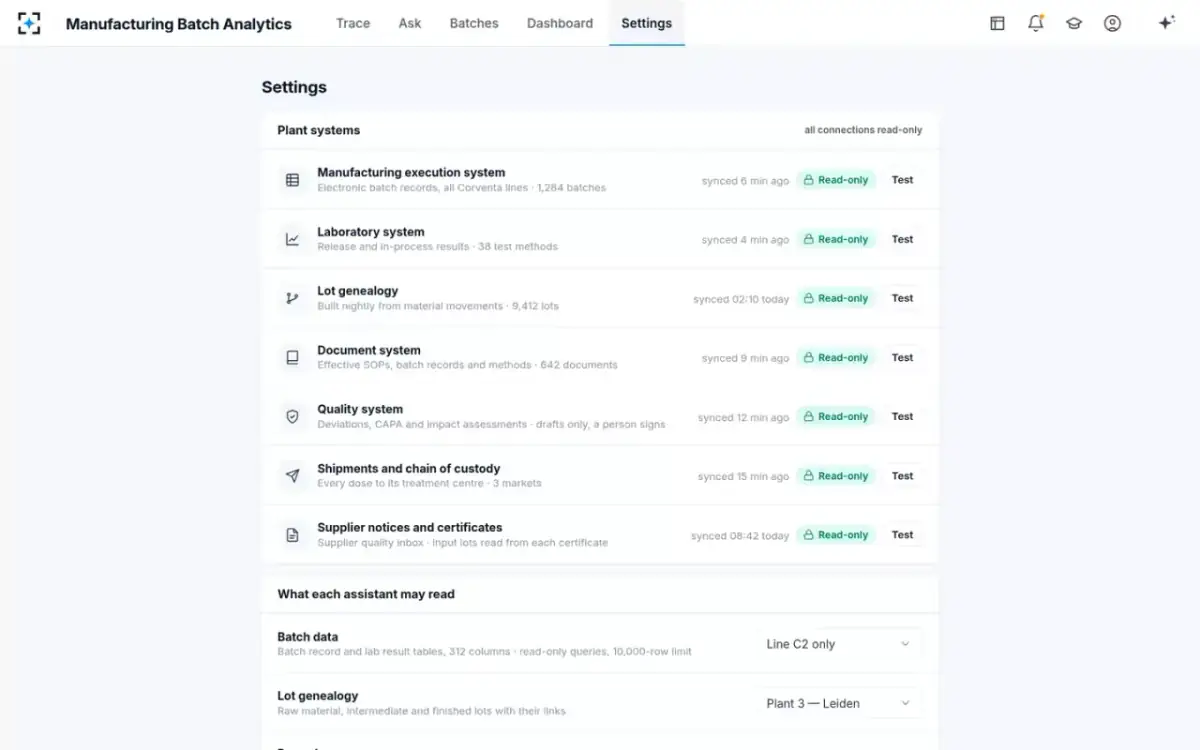
Costing it honestly: the integration, the validation, the definitions
An integration quote covers only the first of three pieces of work: the interface, its validation and the metric definitions. Budget the other two explicitly, or they will be absorbed by the people who can least afford it — the quality and MSAT teams who are also running the line.
Ten questions to answer before anyone quotes you an integration
- Which questions is this for, written as questions?
Five real ones from the last six months of investigations. They determine which systems you need and which you do not.
- Which systems are critical, and is the inventory current?
Annex 11 asks for an up-to-date listing of relevant systems and their GMP functionality. If it is out of date, that is the first deliverable.
- Does a system description with data flows exist for each one?
If not, writing it is part of the project, and it is the part that makes the new read visible to quality.
- Read or write, per connection?
Insist on read-only for analysis, with drafts the only thing that goes back, each signed by a named person.
- Which metrics need an agreed definition, and who approves it?
Count them. Each one needs test, timepoint, unit and an authoritative source, and an approver with the standing to settle an argument.
- In place or copied, and if copied, how stale?
State the staleness in the answer. A genealogy built overnight cannot see this morning's goods receipt.
- What are the built-in checks, and what happens when one fails?
Row counts, value fidelity and meaning. An exchange with no failure path is an exchange nobody is watching.
- Who validates it, against whose requirements?
Annex 11 asks that user requirements describe the required functions, be based on documented risk assessment and GMP impact, and stay traceable through the lifecycle.
- What is the baseline you will be measured against?
Time from question to answer today, per question type. Without it you cannot show an improvement, and you cannot meet the draft rules' expectation that the replaced process's performance is known.
- What happens on the day a source system is upgraded?
Name the owner of the regression test and the re-qualification. This is the recurring cost that surprises many plants.
The last three rows are where this page meets the buying question. A plant that knows its baseline, its definitions and its scopes can evaluate a tool in a fortnight; one that does not will evaluate demonstrations instead. The tests themselves are in what to test before you buy, and the whole stack reading one line is at Manufacturing Batch Analytics.
Questions people ask
What systems does a batch investigation need?
At minimum the manufacturing execution system for the batch record, the laboratory system for in-process and release results, material movements in the resource planning system for lot links, and the document system for the limits and required actions. Add supplier certificates where an input is implicated and shipments where product has left the site. On one fictional cell-therapy line that is four systems for an ordinary question and seven connections in total.
Is manual transcription allowed between GMP systems?
Yes, with controls. The current Annex 11 asks for an additional accuracy check on critical data entered manually, by a second operator or by validated electronic means. The July 2025 consultation draft proposes that routine transfers of critical data be based on validated interfaces rather than manual transcription where possible, and that effective measures be in place where data is still transcribed by hand. The draft is not law.
What has to be checked when data moves between systems?
That everything arrived, that no value changed, and that the meaning did not. Annex 11 asks for appropriate built-in checks on electronic exchange and, where data moves to another format or system, for validation to include checks that data are not altered in value and/or meaning. US rules require input and output to be checked for accuracy, with the degree and frequency based on the system's complexity and reliability.
What does a system description have to contain?
For critical systems, the physical and logical arrangements, the data flows, the interfaces with other systems or processes, any hardware and software prerequisites, and the security measures — kept up to date. Alongside it sits an inventory of all relevant systems and their GMP functionality. A new analytics read is a new data flow and belongs in both.
Do you need a data warehouse for batch analytics?
Not for investigations. Reading in place keeps the answer current, keeps the original where it is and keeps the query reproducible. A warehouse earns its cost for long-horizon statistics across years and sites, and for answers that must survive a source system being down. Every copy is a copy that has to be shown unaltered in value and meaning, and kept in step.
Can an analytics tool be read-only?
It can, and read-only should mean no data or settings can be changed — the definition the draft Annex 11 uses when it allows shared accounts for read-only access as its one exception to personal accounts. Test it rather than accept it: ask which account the tool uses, what permissions that account holds in the source system, and what happens when somebody asks the tool to update a status.