KYC for pension funds means verifying a pension plan, pension foundation or retirement scheme that subscribes to a fund: that the plan exists and is regulated as it claims, who controls it, who may sign for it and commit its money, and whether any of those people or the sponsor raise a flag. The beneficial-ownership work that dominates a family holding company's file shrinks, because a plan's beneficiaries are its members, and US, UK and EU rules all treat pension money as low risk for laundering. The work does not disappear; it moves to proving the plan's identity and the authority of the people acting for it. Botminds' Investor KYC/AML Onboarding builds that file from document rules for each investor type, so a pension foundation is asked for its statute and board resolution, not a passport for each member.
The sample investor below, Fundação Atlântica de Previdência, is a fictional Brazilian pension foundation in the solution's sample data, subscribing to a fictional Quillfield fund. The rules are quoted from FinCEN, the eCFR, UK legislation and EU law.
A pension foundation's 11 KYC documents: none of them is about owners
Fundação Atlântica de Previdência · 11 documents
- Existence and regulation: statute, registry card, supervisor’s authorisation, audited accounts · 36%
- Authority: board of trustees, minutes approving the investment, signatory list · 27%
- Tax status: W-8BEN-E, CRS · 18%
- The people: IDs of 3 executive directors · 9%
- The deal: subscription agreement · 10%
What KYC is needed for a pension fund?
A pension fund investor needs the same four conclusions as any other: it exists, its controllers are known, no party is sanctioned or unexplained, and its risk is rated. What changes is the evidence. For a pension plan the strongest proof of identity is its constitution, its regulator's authorisation and its audited accounts; the strongest proof that the subscription is genuine is a board or trustee resolution approving it and a current list of who may sign.
The US rules say less than people expect. A mutual fund's identification program must verify each customer, using documents that show an entity exists, such as "a partnership agreement, or trust instrument" (31 CFR 1024.220(a)(2)(ii)(A)). The beneficial-ownership rule reaches only "legal entity customers", defined as entities created by filing a public document with a Secretary of State or similar office, general partnerships and their foreign equivalents (31 CFR 1010.230(e)(1)). A pension plan set up as a trust under a deed is not created by such a filing, and a public pension system that is a state agency, or a body exercising governmental authority, is excluded from the definition outright.
That does not leave the file empty. Where a fund cannot verify a non-individual by documents and checks alone, its identification program must obtain information about the individuals with authority or control over the account, including those who may transact in it. For a pension plan those are the trustees, the investment committee and the authorised signatories, and they are where the screening effort belongs.
Are pension funds low risk for AML?
Yes, in the view of US, UK and EU regulators, with a precise reason: the money comes from payroll and employer contributions, members cannot freely move or assign their interests, and the plan is supervised. FinCEN made the point while explaining why it left pension consultants out of its 2024 adviser rule. Pension money raises a separate question for a private fund, the ERISA 25% test, worked in the ERISA 25% plan asset rule.
“…these plans, whether defined benefit plans or defined contribution plans, are less likely to be misused to obscure illicit proceeds generated from a separate criminal scheme.”
FinCEN, final adviser AML rule, 89 FR 72156 (September 4, 2024)
The same passage is careful about the limits. FinCEN notes that misuse of employee benefit plans "has been linked to certain types of financial crime, such as fraud or account takeover activity", which is a payment and authority risk, not a laundering one. And it adds, for defined benefit plans that invest in private funds, that "there is not the same uncertainty as to beneficial ownership and source of wealth as with other private fund investors," because the money "typically" comes from employer contributions (89 FR 72156).
The UK and EU lists of lower-risk factors make the same argument in statutory form. Both name, as a lower-risk product, "a pension, superannuation or similar scheme" that provides retirement benefits to employees, where contributions are made by deduction from wages and the scheme rules do not permit a member's interest to be assigned (MLR 2017, reg. 37(3)(b)(iii); Regulation (EU) 2024/1624, Annex II). Strictly, that is a factor for a firm providing such a scheme. For a fund taking a scheme's subscription it is an analogy, but a strong one: the features that make the product low risk are the same features that make the investor low risk.
Is a defined contribution plan treated like a defined benefit plan?
For laundering risk, largely yes; for source of wealth, no. FinCEN groups both kinds of plan as "less likely to be misused," but its footnote confines the certainty about source of wealth to defined benefit money: the absence of uncertainty "is the case only when the investment in a private fund comes from a defined benefit plan" (89 FR 72156, note 111).
Two low-risk plan types, and the one question that separates them
Defined benefit plan: Typically employer contributions to the plan, as FinCEN describes it.
Defined contribution plan: Employee and employer contributions credited to individual accounts.
Defined benefit plan: No real uncertainty, in FinCEN’s words: no need to trace a member’s wealth.
Defined contribution plan: Not covered by FinCEN’s footnote; a pooled subscription is still payroll money, but the certainty is not stated.
Defined benefit plan: Trustees or an investment committee for the whole plan.
Defined contribution plan: Often members choosing among options; a plan-level subscription is still decided by fiduciaries.
Defined benefit plan: Authority and fraud: whether the signatories may commit the plan, and whether payment instructions are genuine.
Defined contribution plan: The same, plus how individual accounts reach the fund if the subscription is not plan-level.
The practical rule follows. A defined benefit plan's subscription needs its source of funds confirmed, the contribution account it is paid from, but not a source-of-wealth narrative. A defined contribution plan investing at plan level is close to the same. Where individual members' money reaches a fund through their own choices, the fund is looking at a different relationship, and the file should say which it is.
What do you identify instead of a pension plan's members?
Usually nobody in the 25% sense, and the rules say what to identify instead. In the EU from July 2027, for pension schemes within the IORP II Directive, "only the class of beneficiaries and its characteristics shall be identified" (Regulation (EU) 2024/1624, Art. 59(2)(a)). The recital explains why: such schemes are "regulated products which are subject to stringent supervisory standards and present low risks," and naming each member "would not be proportionate."
UK rules reach a similar place through the trust definition. For a trust, beneficial owners include the settlor, the trustees, the beneficiaries and anyone with control; where the individuals benefiting "have not been determined", the class of persons in whose main interest the trust operates (MLR 2017, reg. 6). For a pension trust that usually means identifying the trustees, the sponsoring employer and anyone with control powers, and describing the membership as a class.
In the US, if the plan is not a legal entity customer, there is no beneficial-ownership certification to collect, and if it is a governmental body exercising governmental authority it is excluded from the definition outright (31 CFR 1020.315(b), by cross-reference). The control person still matters, because a fund's program has to understand who directs the relationship. Does a trust need beneficial ownership? works through the trust cases under the US rule, and who is the beneficial owner of a pension fund takes the ownership question for an asset manager's institutional clients.
What to identify for a pension investor, regime by regime
| Regime | Owners to identify | Controllers and signatories | Simplified measures |
|---|---|---|---|
| US mutual fund | None, unless the plan is a filed legal entity; governmental bodies excluded | Individuals with authority or control over the account where documents and checks are not enough | No formal tier; the program is risk-based. Accounts opened to participate in an ERISA plan are outside the identification rule |
| US adviser (2028 rule, CIP still a proposal) | Not required by the 2028 rule | Part of understanding the customer relationship | None in the rule; the 2024 identification proposal did not exclude ERISA accounts |
| UK | Trust: settlor, trustees, beneficiaries or the class, and anyone with control | Directors and senior persons of a body corporate; anyone acting for the customer | Allowed where the risk is low: extent, timing or type adjusted, never skipped (reg. 37(2)) |
| EU from 10 July 2027 | For IORP II schemes, only the class of beneficiaries and its characteristics | The ownership and control structure understood, and owners and controllers checked against targeted financial sanctions (Art. 20(1)) | Pension schemes funded from wages, without assignment, are a lower-risk factor (Annex II) |
Can simplified due diligence apply to a pension scheme?
In the UK and EU, yes, if the firm has assessed the relationship as low risk, and simplified does not mean absent. A UK firm applying simplified measures must still meet the customer due diligence regulations, "but it may adjust the extent, timing or type of the measures it undertakes," and it must monitor the relationship well enough "to detect any unusual or suspicious transactions" (MLR 2017, reg. 37(2)).
In practice the adjustment is to depth and refresh, not to identity. A low-risk pension investor can be refreshed on the slowest cycle, with fewer documents re-collected, but its constitution, its authorisation and the authority of its signatories must still be on file at the start. A low rating earned without those documents is not a simplified file; it is an incomplete one.
US mutual fund rules contain no separate simplified tier, but the identification program is "risk-based" throughout, and accounts opened for participation in an ERISA plan are not "accounts" for identification at all (31 CFR 1024.100(a)(2)(ii)). The joint SEC–FinCEN proposal for advisers took the opposite approach in 2024 and did not carve ERISA accounts out, to match the adviser AML rule (89 FR 44571); it remains a proposal.
What documents does a pension fund provide for KYC?
The constitution and evidence of regulation first, then authority, then the people and the tax forms. A request that asks for anything else, such as members' IDs, is the kind of overreach that costs a week and an annoyed pension administrator.
A pension investor's KYC file, item by item
- Constitution
Trust deed, statute or rules, certified, in the version currently in force.
- Evidence of regulation
The supervisor’s registration or authorisation, and for a public plan the law or ordinance that creates it.
- Registry or tax identity
The plan’s registration number in its home country, so the entity can be matched to an official source.
- Latest audited accounts
Confirms the plan is operating and roughly what size it is, which tests whether the subscription is plausible.
- Trustees or board
A current list, so each can be screened, including any who hold or recently held public office.
- Resolution approving the investment
Minutes or a written resolution naming this fund and amount: the best single proof the subscription is genuine.
- Authorised signatory list
With specimen signatures where the plan uses them; IDs for the signatories who sign the subscription.
- Tax self-certifications
W-8BEN-E or W-9, and the CRS self-certification, consistent with each other.
- Payment source
The account the subscription comes from, in the plan’s name, matching the bank details on file.
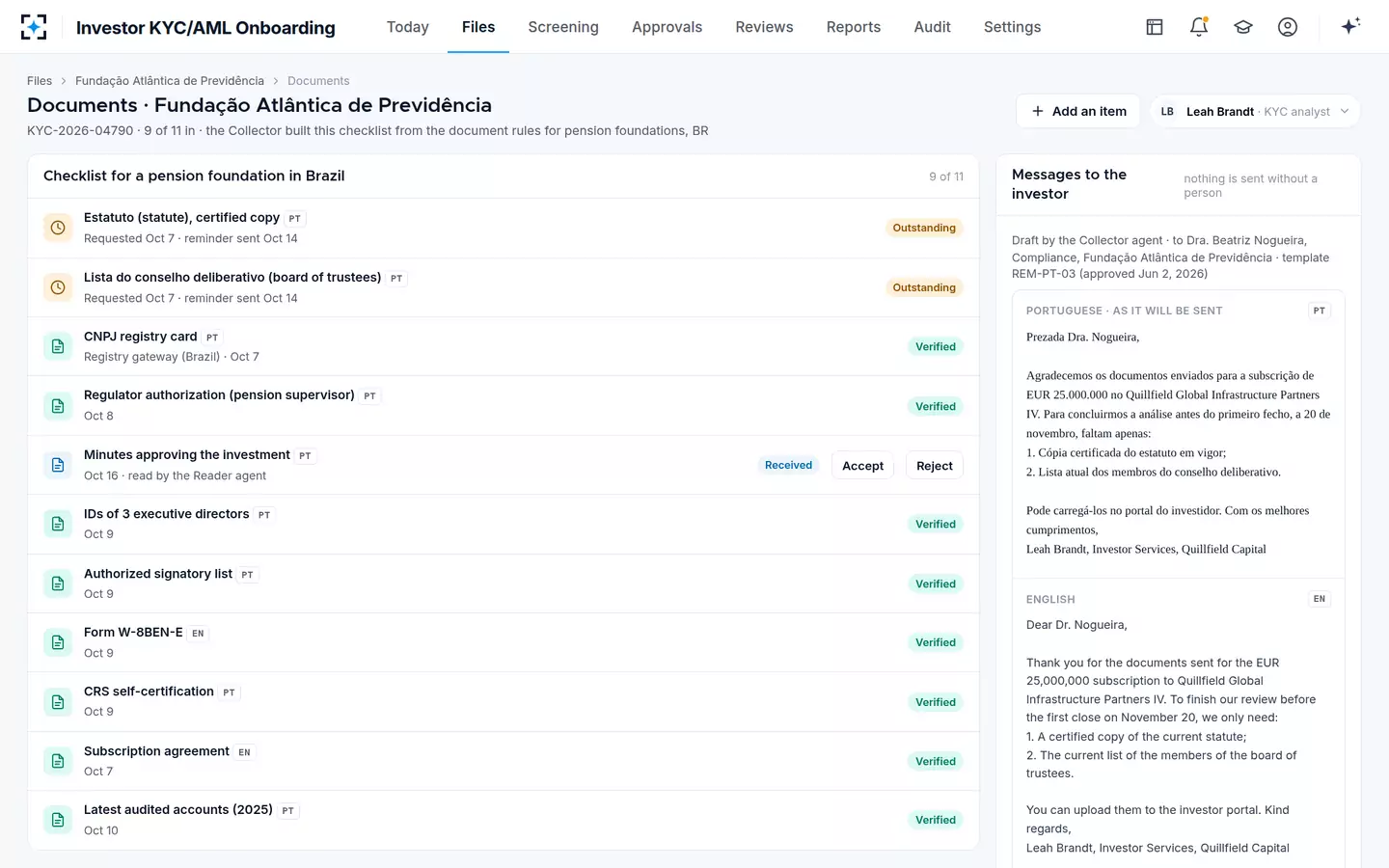
The document checklist for a pension foundation, built from the rules for that investor type
Where the risk in a pension file actually sits
The live risks in a pension investor's file are authority and payment, not laundering. A forged board resolution, a signatory who left last year, or a change of bank details on a redemption are how pension money goes missing, and they are the same patterns FinCEN connects to plan misuse: fraud and account takeover. A file that has every member's class described but no current signatory list has its effort in the wrong place.
Two checks earn their time. Screen the trustees and the investment committee, because public pension boards can include appointed officials, and some appointments make a person politically exposed under the regime that applies; the PEP definitions in the US, EU and UK differ on exactly that. And treat any change to payment details as a trigger for a call-back to a number already on file, never to the one in the request.
A bank-detail change at an endowment, held for a call-back, among the week's trigger events
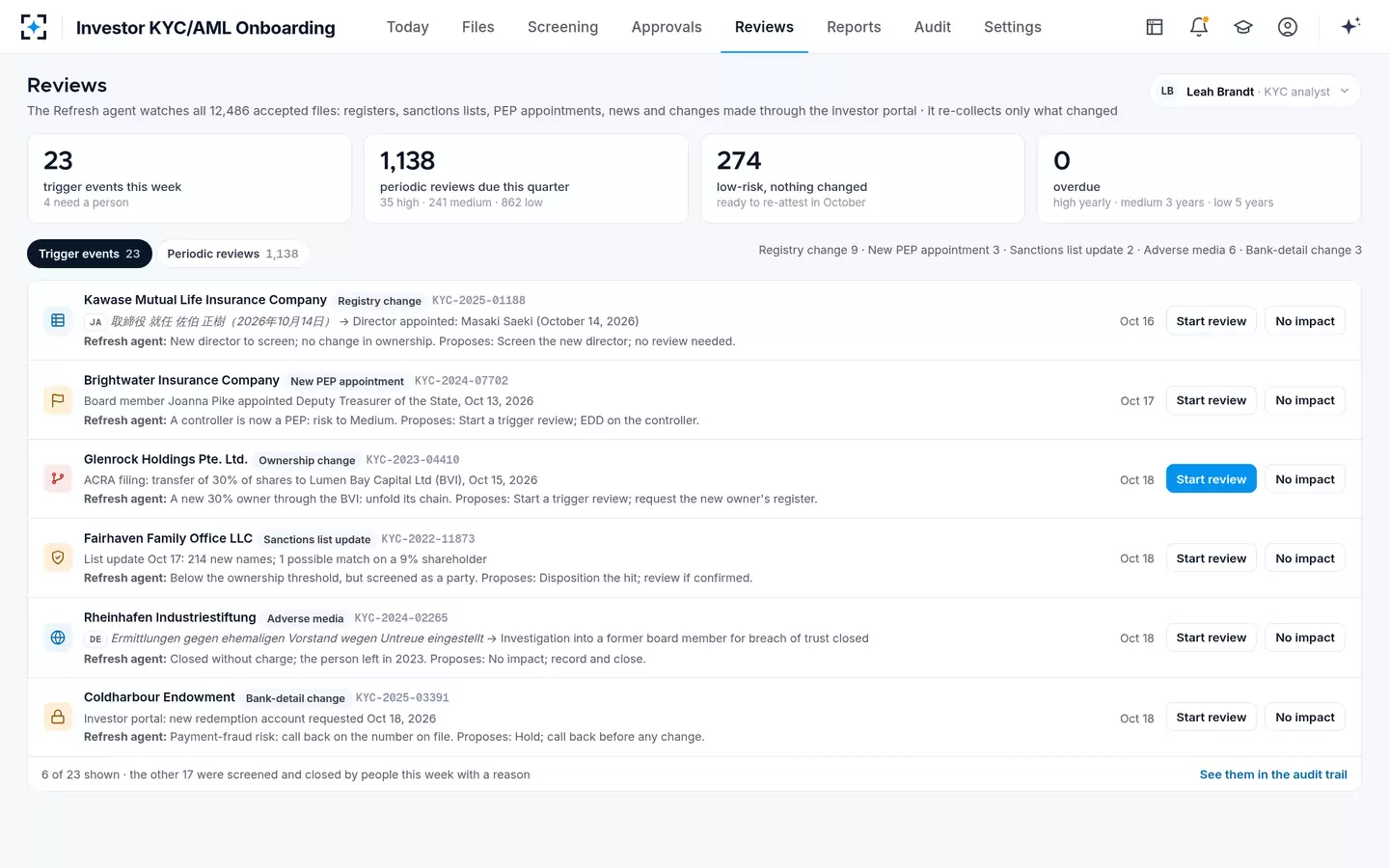
In the sample firm's settings, low-risk files are reviewed every five years and high-risk files every year, with trigger events opening a review in between; those cycles match the EU Regulation's outer limits of one and five years. A pension foundation therefore spends most of its life in the cheapest band, which is the point of rating it low, and its file is touched again only when something changes. The investor due diligence checklist shows what the higher-risk end of the same model demands, and mutual fund AML requirements covers the ERISA carve-out in its US context.
Where Investor KYC/AML Onboarding fits a pension investor
Investor KYC/AML Onboarding starts from the investor type. For a pension foundation the Collector agent builds the checklist from the firm's document rules for that type and country, asks for it in the investor's language once a person approves the message, and checks dates and certification as documents arrive. The Reader agent reads the statute and the supervisor's letter in their own language and pins each field to its page; the Screening agent screens every trustee and signatory; the Risk agent proposes a rating on the firm's model, and a person confirms it.
What it will not do is rate a pension investor low because the type is low risk: the rating builds as the analyst confirms each item, and an unverified signatory or a missing resolution keeps the file open. To see a pension file beside a high-risk one, start from Investor KYC/AML Onboarding.
Questions people ask
What are the KYC requirements for pension funds in the USA?
A US mutual fund must verify a pension plan that opens an account under its identification program, usually from the trust instrument or governing documents. The beneficial-ownership certification applies only if the plan is a filed legal entity, and governmental plans exercising governmental authority are excluded. Accounts opened to participate in an ERISA plan are outside the identification rule entirely.
What are the KYC requirements for pension funds in the UK?
The Money Laundering Regulations 2017 require customer due diligence on the scheme, identification of the trust's beneficial owners (trustees, settlor or sponsor, beneficiaries or their class, and anyone with control) and verification of the people acting for it. Where the firm assesses the relationship as low risk, regulation 37 lets it adjust the extent, timing or type of the measures, but not skip them.
Do you need to identify every member of a pension scheme?
No. From 10 July 2027, the EU AML Regulation requires only the class of beneficiaries and its characteristics for IORP II pension schemes, and UK rules allow a class where beneficiaries have not been determined. US rules do not ask for members at all where the plan is not a legal entity customer.
Is a sovereign or public pension fund a PEP?
The fund itself is not a person, so it cannot be a PEP. Its trustees or board members can be, depending on the office they hold and the regime's definition, which is why every trustee and signatory should be screened. A public fund may also be excluded from US beneficial-ownership rules as a governmental body.
How often should a pension investor's KYC be refreshed?
On the firm's slowest cycle if it is rated low risk, within the EU Regulation's five-year maximum for customers not subject to enhanced measures, and at once on a trigger such as new trustees, a change of signatories or new payment details. How often KYC should be updated compares the US, EU and UK answers.