Investor AML software is the system a fund manager, administrator or transfer agent uses to run investor KYC and anti-money-laundering checks: collecting documents, identifying and verifying investors, unfolding beneficial owners, screening every party, rating risk, routing approvals and keeping files current. The way to choose one is to ask what an examiner will test and whether the software makes that test easy to pass, because most products demo well on a clean individual investor and fail on a trust two layers up. Botminds' Investor KYC/AML Onboarding answers these questions with seven AI agents that do the reading, unfolding, screening and rating, and with people who confirm, check and sign; its answers appear beside each question below, so a buyer can hold any other product to the same standard.
Where the questions refer to sample files, those are fictional people and companies from the solution's sample data, including a Danish family holding company, a Jersey trust and a Brazilian pension foundation. The rules cited are linked where they appear.
Twelve questions to put to any investor AML software, and why each matters
- 1. Does it multiply ownership through every layer, and show the arithmetic?
The EU Regulation multiplies each path and adds them, at every level; the US rule counts direct and indirect ownership. A tool that shows "owner: yes" without "62% × 50% = 31%" cannot be checked.
- 2. Does it know the trust and foundation rules of each regime you use?
The US names the trustee; the UK names settlor, trustees, beneficiaries and controllers; the EU allows a class of beneficiaries for regulated pension schemes. One rule set for all is a wrong answer for most.
- 3. Does it read documents in their own language, and pin each field to its page?
Registers, deeds and IDs arrive in Danish, French or Portuguese. A translation with no link back to the original is an unverifiable claim.
- 4. Is there a second, independent reading?
A checker that re-derives owners and percentages from the documents, by a different method, catches the errors a reviewer skimming the first reading will not.
- 5. Does every screening decision carry identifiers, a reason and a decider?
A discount without the date of birth, nationality and document compared is a guess. Ask how low-score discounts are sampled.
- 6. Does it screen owners, controllers and signatories, and test control as well as 50%?
OFAC fined GVA Capital the statutory maximum where the owner on paper was not the designated person.
- 7. Does it rescreen every party every night, and before money moves?
An investor designated after the first close is a blocked-property problem at the next capital call; OFAC’s report is due within 10 business days.
- 8. Are thresholds, the risk model and review cycles your settings?
Versioned, approved by your MLRO, and applied by an administrator if one runs the files; the EU Regulation requires providers to apply the firm’s own policies.
- 9. Which decisions can it never make?
Ask for the list in writing. Risk profile and acceptance cannot be outsourced in the EU from July 2027; a true sanctions match should never be cleared by software.
- 10. Can you produce every file without the vendor or the administrator?
A US adviser must be able to demonstrate its program to examiners and give FinCEN and the SEC access to records; UK reliance requires prompt access to copies of the documents.
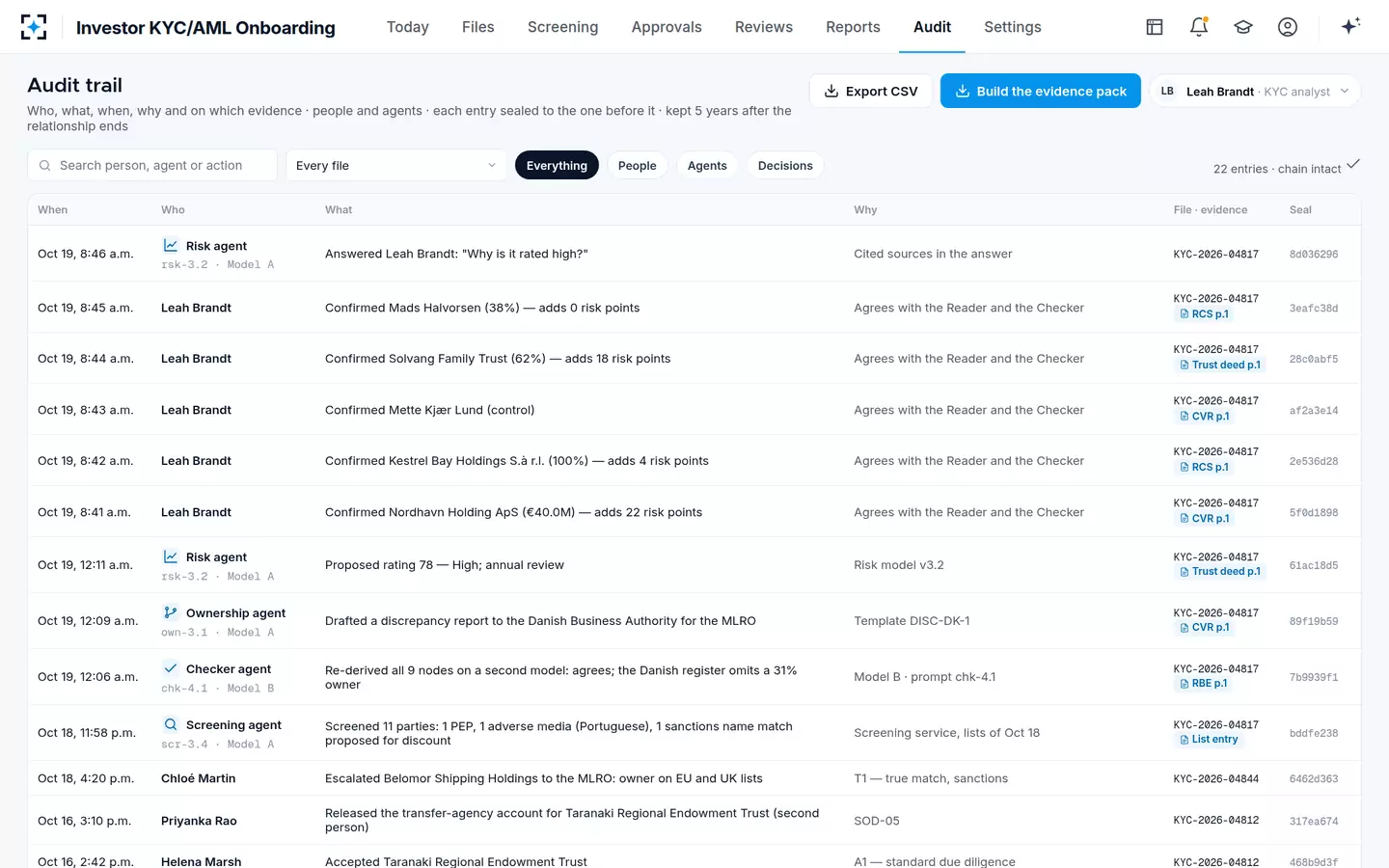
- 11. Does the trail record the agent, model and prompt behind each proposal?
FINRA lists tracking agent actions and decisions among the controls for AI agents. Five years after the relationship ends is the retention floor in the US, UK and EU.
- 12. Is it ready for the next rule?
The EU AML Regulation from 10 July 2027, the US adviser rule from 1 January 2028, an adviser identification rule still to come, and FinCEN’s 2026 relief on repeat ownership checks.
What should investor AML software do? The requirements, from the rules
It should produce, for every investor, the file the rules describe: identity verified, owners and controllers identified through every layer, purpose understood, every party screened, risk rated, approvals by the right people, and the whole thing kept and refreshed. The EU AML Regulation's Article 20(1) is the most complete statement of those parts, and it applies to funds and their managers from 10 July 2027 (Regulation (EU) 2024/1624).
A requirements list written that way has two advantages over one written from a product brochure. It is testable, because each requirement can be checked against a past file. And it survives a change of vendor, because it describes the file, not the screens. The investor due diligence checklist turns the same rules into fourteen checks a reviewer can pass or fail.
Which investor AML software vendors are there, and how do they differ?
Broadly four kinds of offer, often combined: screening data services, which supply sanctions lists, PEP data and news; KYC workflow platforms, which route documents and approvals; administrator and outsourced services, which do the work for you; and agent-based software, which reads documents and proposes decisions for people to confirm. No regulator publishes a list of approved providers, and none endorses one, so the comparison has to be made on your own files.
Two ways to run investor AML, and what each leaves the manager to do
Workflow platform plus a screening service: Done by analysts; the platform stores the PDFs.
Agent-based software with people deciding: Agents read each document in its own language and pin each field to its page; analysts confirm.
Workflow platform plus a screening service: Drawn and calculated by hand; the result is typed in.
Agent-based software with people deciding: Unfolded and multiplied by an agent, re-derived by a second model; disagreements block.
Workflow platform plus a screening service: Returned as a queue of scores for analysts to work.
Agent-based software with people deciding: Each hit comes with the identifiers compared, a proposed decision and its reason; people decide.
Workflow platform plus a screening service: Assembled by hand from the platform, email and exports.
Agent-based software with people deciding: Each conclusion already linked to its document and decider on a sealed trail.
Workflow platform plus a screening service: The manager receives a memo or a spreadsheet and signs on trust.
Agent-based software with people deciding: The manager sees the same file the administrator works, and can re-perform any part of it.
Does investor AML software handle trusts and foundations?
Ask the vendor to load a real trust deed and show you who it names under each regime you operate in. Under the US rule, where a trust owns 25% or more of a legal entity customer, "the beneficial owner ... shall mean the trustee" (31 CFR 1010.230(d)(3)). Under UK rules, a trust's beneficial owners are the settlor, the trustees, the beneficiaries, or the class where they are not yet determined, and anyone with control, defined to include powers to add or remove beneficiaries or appoint trustees (MLR 2017, reg. 6). Under the EU Regulation, a regulated pension scheme needs only its class of beneficiaries.
In the sample file, a Jersey trust's deed gives two beneficiaries fixed halves of a 62% holding and names a protector "whose consent is required for any addition or removal of a Beneficiary". A US answer names the trustee; a UK answer names settlor, trustee, both beneficiaries and the protector. Software that gives one answer for both has not been built for a fund with investors on both sides of the Atlantic. KYC for pension funds covers the low-risk end of the same question.
Can AML software read documents in other languages?
Many can translate; the question is whether a reviewer can check the translation against the original line by line, and whether doubtful readings stop before they are used. In Investor KYC/AML Onboarding, the Reader agent shows each registry extract, deed or ID beside its English with the passages it used highlighted, pins each field to its page with a confidence, and sends any field under 92% confidence to the analyst before anything relies on it.
Language also matters for screening. An adverse-media article in Portuguese about a beneficiary's spouse is either relevant or not depending on what it says, and a browser translation pasted into a note is not evidence. Ask the vendor to show the original article, its translation and the reason for the decision on one screen.
Will it work with our administrator's records?
It must, because the rules make the manager answer for files the administrator holds. FinCEN's adviser rule lets an adviser delegate its program but requires it to be able to show examiners that the program complies and to ensure FinCEN and the SEC can obtain its records (89 FR 72156); UK reliance requires the relying firm to obtain the customer information immediately and to be able to get copies of the documents without delay (MLR 2017, reg. 39(2)).
Three working answers exist: the manager runs the software and the administrator feeds documents into it; the administrator runs it and the manager has access to the same files; or both work in it, the administrator preparing and the manager deciding. The wrong answer is software the manager can see only through the administrator's monthly report. AML outsourcing to a fund administrator sets out the contract clauses that make any of the three work.
How does investor AML software prove a decision to an examiner?
By showing, for any conclusion, the document and page it rests on, the person who decided, when, and on whose proposal. That is the US identification rule's own idea of a record, which requires a description of each document relied on, the methods and results of other checks, and how each substantive discrepancy was resolved (31 CFR 1024.220(a)(3)).
The risk rating, factor by factor, each with its source and an edit that needs a reason
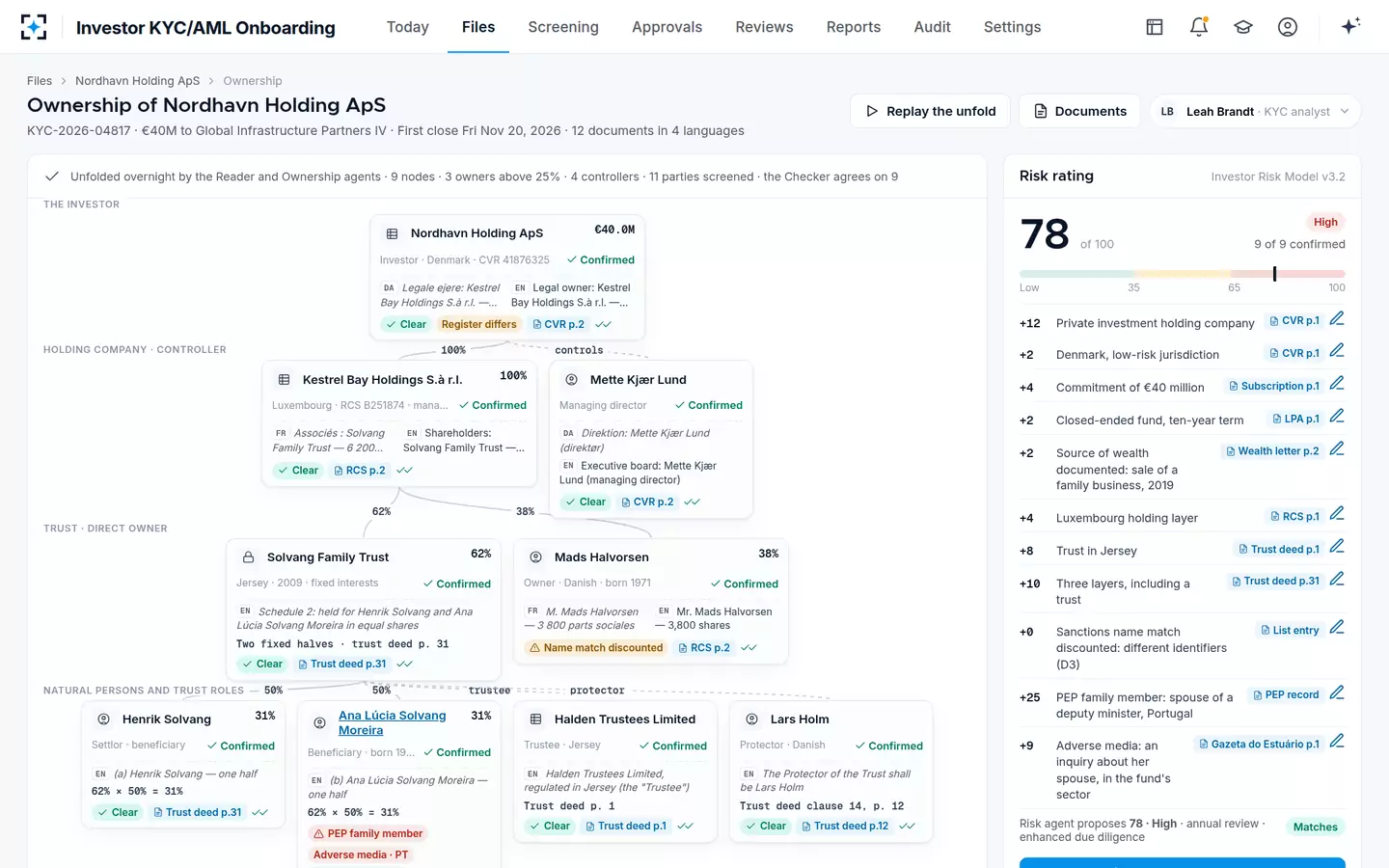
For agent-based software, the trail also needs the agent's identity. FINRA's 2026 oversight report suggests that firms using AI agents consider how they track what each agent does and decides, and where a person stays in the loop to oversee it (FINRA, 2026 Annual Regulatory Oversight Report). A trail that records "system" as the author of a proposal fails both.
“This enforcement action also demonstrates the importance for non-bank financial institutions, including venture capital firms and investment advisers, of developing and maintaining effective, risk-based sanctions compliance controls.”
OFAC, enforcement release on GVA Capital Ltd., June 12, 2025
Is it ready for the 2028 adviser rule?
Ready means configurable, because the 2028 rule is still under review. FinCEN delayed it to 1 January 2028 so it could review the rule and tailor it to different kinds of adviser (91 FR 36), the identification rule for advisers is still a proposal, and FinCEN's February 2026 order already lets institutions identify a legal entity's owners at its first account rather than every account (FIN-2026-R001). Software that hard-codes any of these will need a release for each change.
The test question is simple: show us where the threshold, the document list for a given investor type, the review cycle and the approver for each risk band are set, who may change them, and where the change is recorded. In Investor KYC/AML Onboarding those are settings: an administrator proposes a change, the MLRO approves it, and both are on the audit trail. The investment adviser AML rule explains what the 2028 rule requires and what FinCEN is reviewing.
What does investor AML software cost, and how should you price it?
Vendors do not publish their prices, and no regulator or independent study publishes what an investor KYC file costs, so the only reliable comparison is one built on your own files. The method is the same whichever products are on the shortlist.
How to price investor AML software on your own files
| Measure | How to count it | What it tells you |
|---|---|---|
| Files by risk band | Last twelve months of new investors, split low, medium and high | Where the volume is; high-risk files usually take most of the hours |
| Hours per file, by role | Analyst, reviewer and approver time on a sample of recent files in each band | The baseline any tool must beat, at your own loaded hourly cost |
| Days to accept | Business days from a complete package to release, by band | Whether files are late for fund closes, and where they wait |
| Rework | Files returned by the reviewer, and why | Errors a second reading would have caught before the reviewer did |
| Refresh load | Periodic reviews due and trigger events handled per quarter | The ongoing cost after onboarding, often larger than the first file |
| Oversight time | Hours the manager spends checking an administrator’s work | The cost outsourcing does not remove |
The fairest trial is a replay. Take forty or so past files with known outcomes, including the hardest ones, run them through each candidate, and compare owners, screening decisions and risk bands with what your analysts concluded. In the sample firm's setup, 40 past files ran through the solution before go-live: owners matched on 40 of 40 and the risk band on 39 of 40, a result on sample files that shows the method rather than a promise. The fund KYC software go-live plan builds the replay into an eight-week rollout.
The trail an examiner reads: each confirmation, proposal and approval, with its evidence and version
What Investor KYC/AML Onboarding does and does not do, as a buyer should hear it
Investor KYC/AML Onboarding is agent-based investor KYC for asset managers, private markets firms and fund administrators. Seven agents collect, read, unfold, check, screen, rate and refresh each file; an analyst confirms each fact, a second reviewer re-performs the file and the MLRO signs every high-risk investor. It connects to the systems a fund already runs: the investor portal, company registry gateways, the screening service, the transfer agency system, the document archive and CRM, and the fund administrator.
It does not supply sanctions lists or PEP data, replace a transfer agency system, or take a manager's regulatory responsibility; it will not approve an investor, clear a true match or file a report. The way to judge it is the way to judge any of them: on a sample of your own past investor files, answered question by question. To start, see Investor KYC/AML Onboarding.
Questions people ask
What is the difference between AML software and KYC software?
KYC software handles identifying and verifying customers and their owners; AML software usually also covers screening, risk rating, transaction monitoring and suspicious activity reporting. For fund investors, where transactions are few and large, most of the AML work sits in the KYC file and its refresh, so the two overlap heavily.
Do we need separate software for sanctions screening?
You need a screening data source, the lists, PEP data and news, which KYC tools usually take from a specialist provider. What you choose separately is whether the hits are worked in the screening provider's queue or in the investor's file, beside the owners and documents they concern.
Can investor AML software be used by the fund administrator and the manager together?
Yes, if each sees the same file and the roles are separated: the administrator's analysts prepare and confirm, the manager's MLRO decides. That arrangement also meets the EU Regulation's bar on outsourcing the risk-profile and acceptance decisions from July 2027.
How long does it take to evaluate investor AML software properly?
Long enough to replay a sample of past files with known outcomes, around forty in the sample firm's setup, and compare the results with your analysts' decisions. Most of the effort goes into choosing the files, including the hardest, and agreeing the comparison in advance. A demo on the vendor's sample data proves much less.
What should the contract with an AML software vendor include?
Data location and retention, access to every file and its evidence on exit, the list of decisions the software never makes, change control for models and settings, and audit rights. Where an administrator runs the software for you, the outsourcing terms in your administration agreement apply as well.