Investor screening is the check of every party in an investor's file, the investor, its beneficial owners, its controllers and the people who sign for it, against sanctions lists, politically exposed person (PEP) data and adverse media, before a subscription is accepted and continuously afterwards. For a fund it is harder than it sounds: the parties sit several layers up an ownership chain, names arrive transliterated from other alphabets, the news that matters is in the investor's own language, and an investor who was clean at the first close can be designated before the last distribution. Botminds' Investor KYC/AML Onboarding gives the reading to a Screening agent that proposes a decision on every hit with its reasons, and keeps the decisions that carry risk with people: it never clears a true match, and any match above 90% goes to a person.
The hits shown come from the solution's sample data on fictional people and companies; the rules and the enforcement case are real and linked.
One screening hit in Investor KYC/AML Onboarding: where the agent proposes, and where it must stop
Agent
Screen every partyInvestor, owners, controllers and signatories against US (OFAC), EU, UK and UN lists, PEP data and adverse media in any language, at onboarding and every night.
Never: Reads sources; never searches social media.
Agent
Compare identifiersDate of birth, nationality, passport or registry number, address and role, against the list entry or the article.
Agent
Propose with reasonsA proposed decision and reason code: discount, true match, relevant or not relevant, with the article shown beside its English.
Never: Never discounts a match above 90% without a person.
Agent
Re-checkThe Checker agent re-checks every screening decision on a second model and flags any disagreement.
A person decides
DecideThe analyst accepts the proposal or decides differently with a reason; below the 80% threshold, discounts can be accepted in bulk, with one in twenty sampled by a second reviewer.
A person decides
Escalate true matchesEvery true match goes to the MLRO, who decides on blocking, reporting and the relationship.
Never: No agent clears a true match.
What is the investor screening process?
Four steps repeated for every party in the file: screen the names and identifiers, compare each potential match with the person or entity in the file, decide, and record the decision with its reason. What makes a fund's process different from a bank's is the cast. A bank screens its customer and the parties to each payment; a fund screens the investor and everyone behind it, because the risk usually sits two or three layers up.
The rules require more than one kind of check. A US mutual fund's identification program must determine within a reasonable time whether a customer appears on any government list of known or suspected terrorists designated by Treasury (31 CFR 1024.220(a)(4)). OFAC's sanctions apply to every US person, including funds and their managers. The EU AML Regulation, from July 2027, requires firms to verify whether the customer or its beneficial owners are subject to targeted financial sanctions and whether sanctioned persons control the customer or hold more than 50% of it (Regulation (EU) 2024/1624, Art. 20(1)(d)).
PEP screening and adverse media complete the picture, and both feed the risk rating rather than a yes-or-no decision. Who counts as a PEP's relative or close associate is set out rule by rule on the bank side, where the definitions are the same.
When must investors be screened, and what happens when an existing investor becomes sanctioned?
At onboarding, whenever a list changes, and before money moves: a capital call, a distribution, a redemption or a transfer of an interest can each be a dealing in blocked property if an investor has been designated since the last check. That last point is the one funds learn the hard way, because a closed-end fund may hold the same investors for ten years or more.
“…participants in these industries should understand the sanctions risks present where—as was the case here—an existing investor becomes sanctioned. Failing to properly block and report assets subject to sanctions, and continuing to transact or deal in those assets, can result in significant monetary penalties for U.S. persons.”
OFAC, enforcement release on GVA Capital Ltd., June 12, 2025
GVA Capital's investor came in before any designation, in 2016: a $20,000,000 subscription through a Guernsey partnership, answered by a capital call the same day. The investor's principal was designated in April 2018. Over the next three years the firm assigned the interest to another entity under the same trust, tried twice to sell it and prepared a distribution in kind, keeping in contact throughout with the man it knew spoke for the designated investor. OFAC treated all four as prohibited dealings or attempts and imposed the statutory maximum, $215,988,868 (OFAC, June 12, 2025).
GVA Capital: a subscription before any designation, then three years of dealings in a blocked interest
- Subscription and capital call, Sep 201619 mo
- Designation Apr 2018; assignment Dec 2018; sale attempts 2019 and 2020; distribution prepared 202137 mo
- Blocking notice to the trust Jun 2022; penalty Jun 202549 mo
Blocking has a clock. A US person holding blocked property must report it to OFAC within 10 business days from the date it becomes blocked, and must file an annual report by 30 September on all blocked property held at 30 June (31 CFR 501.603). A fund that rescreens its investor base only at year-end can be months late on both. The red flags of a proxy owner walks through the GVA chronology in detail.
Can AI clear a sanctions or PEP hit?
It can propose clearing one, with its reasons, and in a well-designed system it should never be the last word on a match that could be true. The question is not whether software is capable of comparing a date of birth; it is who answers for the decision. The SEC's examination staff now describe registrants adopting what they call "super intelligence (SI)", including for compliance monitoring and surveillance (SEC Division of Examinations, FY2027 priorities), and its September 2026 transfer agent proposal expects transfer agents that use AI or automation to keep controls around it, describe its capabilities accurately and oversee what it does (SEC, transfer agent proposal, a proposal; read in full in the SEC transfer agent proposal).
FINRA's 2026 oversight report suggests that firms using AI agents decide where a person stays in the loop to oversee them and how each agent's actions and decisions are tracked (FINRA, 2026 Annual Regulatory Oversight Report). FINRA supervises broker-dealers, not funds, but its list is a fair specification for any screening agent: say where the agent stops, keep a trail of what it did, and put a person where the risk is.
One night of screening on the sample firm's book, and the rules that keep people in the decisions
342
parties screened across 61 files overnight, sample data
46
hits open the next morning, each with the agent’s proposal and reasons
80%
match threshold: at or above, an analyst decides
1 in 20
low-score discounts sent to a second reviewer
How do you stop an agent guessing a name match?
Make it compare identifiers instead of names, require a reason code for every proposal, and have a second model check the first. A name match without identifiers is a coincidence until proved otherwise; a proposal without a reason is a guess. The sample hits below show what the difference looks like in practice.
Five sample screening hits, what the agent proposed, and why
| Hit | Score | What the agent proposed | What a person does |
|---|---|---|---|
| A sanctions entry named “HALVORSEN, Mats” against a 38% owner, Mads Halvorsen | 81% | Discount (D3): different date of birth, nationality and passport | Above the 80% threshold, so the analyst decides; here she agreed |
| A PEP record for a 31% beneficiary through a trust | 97% | True match: she is the spouse of a Portuguese government official | Analyst confirms; the file becomes high risk and goes to the MLRO |
| A Portuguese article about that official’s office | 88% | Relevant, an allegation (M2): an inquiry, no one charged, in the fund’s own sector | Analyst accepts; adverse media adds to the rating |
| A French article naming an Antoine Verdier | 74% | A namesake, with three reasons | Below the threshold: can be accepted in bulk, with one in twenty sampled |
| A sanctions entry for an owner of a shipping holding company | 99% | Escalated: the owner is on the EU and UK lists | True match: the MLRO decides; no agent can clear it |
Screening hits across all files, each with a proposal, its reasons and the source beside its English
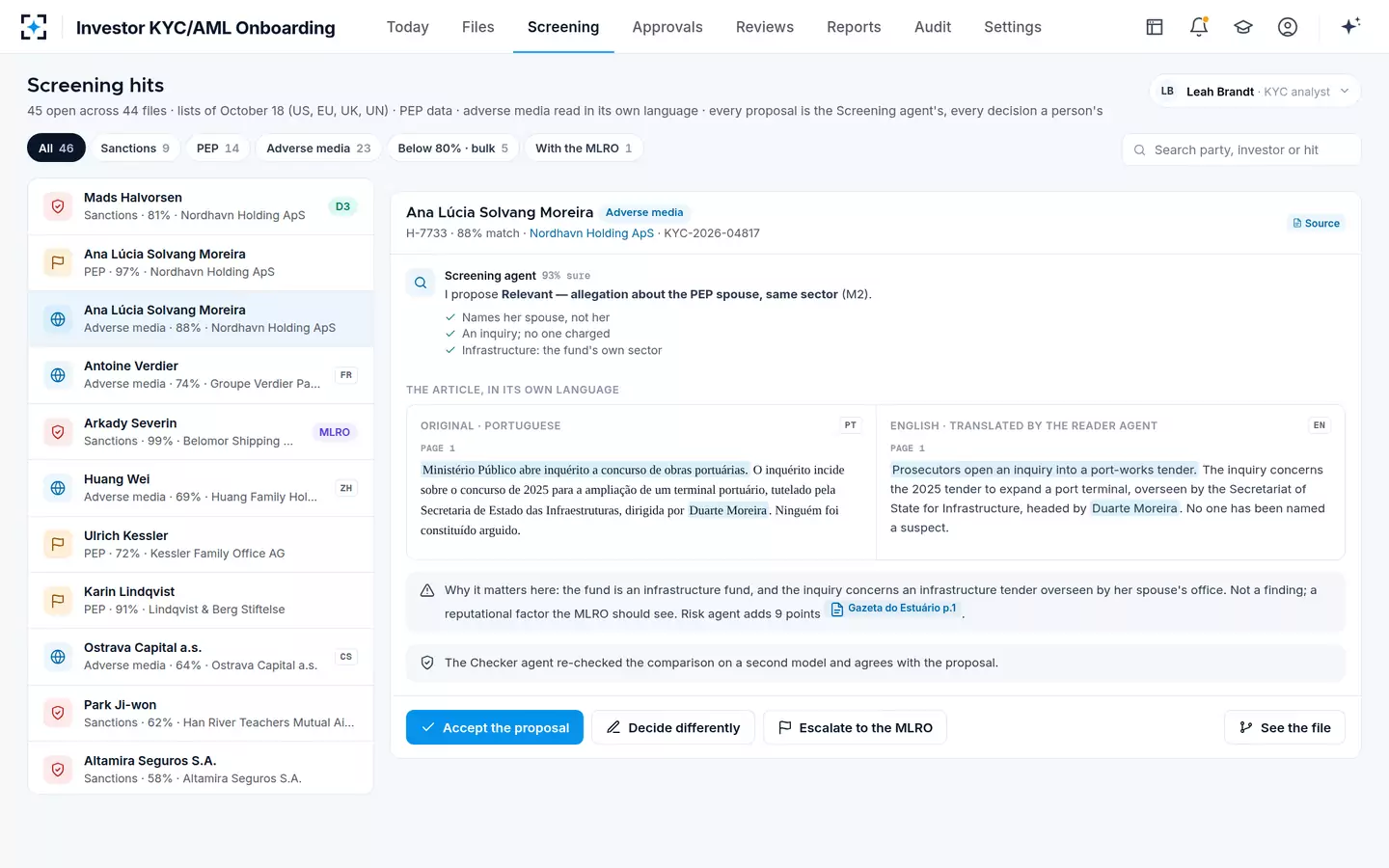
Adverse media screening for fund investors: read the article, then weigh it
Adverse media is the screen where reading matters most, because the match is only the start: the question is whether the article is about this person, whether it alleges or proves anything, and whether it touches the fund's own risk. A name in a headline proves nothing; an allegation about a family member in the fund's own sector is a reputational factor the MLRO should see.
The sample file shows the weighing. A Portuguese article of 14 March 2026 reports that prosecutors opened an inquiry into a port-works tender overseen by the office of a beneficiary's spouse, and that no one has been charged. The Screening agent proposes "relevant, an allegation" for three stated reasons: it names her spouse, not her; it is an inquiry, not a charge; and it concerns infrastructure, the fund's own sector. The risk model adds 9 points, the analyst accepts the proposal, and the MLRO sees the article beside its English before signing. A French article naming a different Antoine Verdier, by contrast, is proposed as a namesake and handled in the bulk queue with sampling.
Two limits keep this honest. The agent reads published sources and never searches social media, and an article it cannot read with confidence goes to a person instead of becoming a proposal. Adverse media changes a rating; it does not decide the relationship.
What should an agent do when an owner can't be traced?
Stop, say what is missing, and ask for the one document that would settle it. The worst behaviour in a screening system is silence: an untraceable owner who is simply not screened, because there was no name to screen. In the sample firm's book, a Swedish foundation's register and its charter disagree on a 26% beneficiary, and the file waits for the analyst to settle which document is right before the owner is screened as final.
The same rule applies to trusts. The Ownership agent in Investor KYC/AML Onboarding "never treats a trust as owned by nobody": a trust with no identified beneficiaries is a question for the analyst, not an empty branch of the chain. UK rules make the fallback formal: a firm that has exhausted every means of identifying a company's owner may treat its senior manager as the owner, but must record each step it took. A screen run on that senior manager is the floor, not a finish.
Language is the other place agents must not guess. The Reader agent sends any field it reads with under 92% confidence to the analyst before anything uses it, and the Screening agent reads each article in the language it was published in. A match proposed from a machine translation the system itself doubts is the kind of decision that belongs with a person in the loop.
Who decides a true match?
A person, and for a true sanctions match the MLRO. In the sample firm, an analyst confirms a true match, the file is escalated to the MLRO, and the MLRO then decides, with counsel where needed, on blocking and reporting, on the relationship and on any suspicious activity report. The audit trail shows one such escalation: a shipping holding company whose owner is on the EU and UK lists, sent to the MLRO with reason code T1.
The screening rules are settings the MLRO approves, not the vendor's defaults
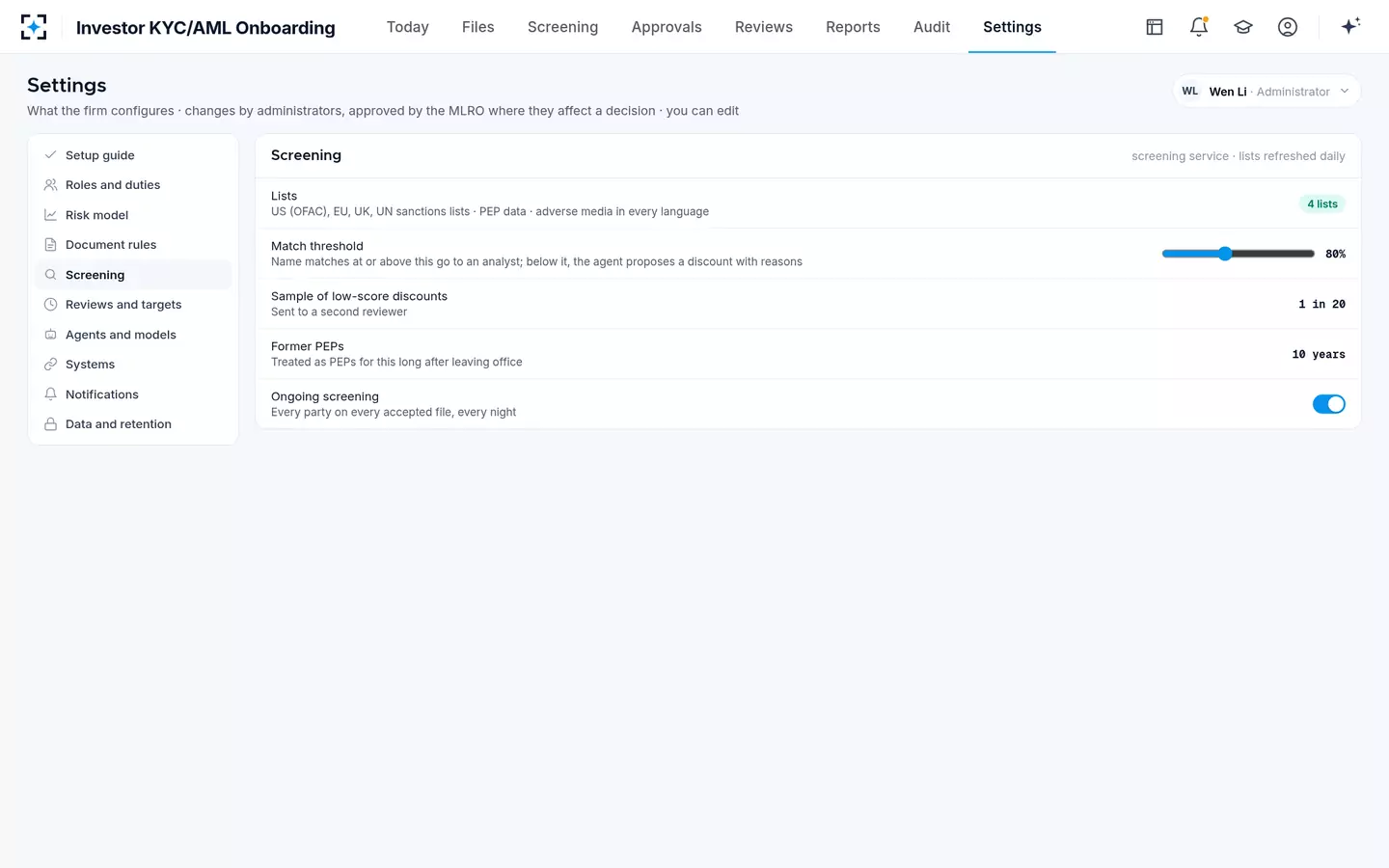
The settings are where the firm's risk appetite lives, and they should be argued about once, in writing, not case by case. A threshold set too low floods the analysts; set too high, it lets a transliterated name through. Treating former PEPs as PEPs for a fixed period is a policy choice above the legal floor. The investor due diligence checklist shows how each screening decision becomes evidence in the file, and the MLRO function covers who signs the decisions that matter.
Where Investor KYC/AML Onboarding fits investor screening
It does not replace the screening service: the lists, PEP data and news feeds come from the provider a firm already uses. It does the work around each hit. The Screening agent runs every party in the chain, not just the investor; reads articles in their own language; compares identifiers; proposes a decision with a reason code; and the Checker re-checks every decision on a second model. The analyst decides, the MLRO takes every true match, and the Refresh agent rescreens every party on every accepted file each night, so a designation after the first close is caught before the next capital call.
What it adds for an examiner is the trail: each hit with its score, the identifiers compared, the proposal, the reason, the person who decided and the agent and model version behind the proposal. To see the screening queue on sample data, start from Investor KYC/AML Onboarding, or read 12 questions to ask investor AML software before choosing a tool.
Questions people ask
What is an investor screening tool?
Software that checks investors and the people behind them against sanctions lists, PEP data and adverse media. Some tools only return matches; others, including agent-based ones, also compare identifiers, read the source and propose a decision. Either way, the decision on a possible true match should rest with a named person.
What lists are fund investors screened against?
At minimum the sanctions lists that bind the fund and its manager, such as OFAC's in the US, the EU's and the UK's, plus the UN's; a US mutual fund must also check Treasury-designated lists of known or suspected terrorists under its identification program. PEP data and adverse media are added because the rules require risk-based enhanced measures, not because a single list exists.
How often should investors be rescreened?
Whenever a list changes, which in practice means nightly against every party on every accepted file, and before any capital call, distribution, redemption or transfer. A designation can come at any time; OFAC's 10-business-day blocking report runs from the day property becomes blocked, not from the fund's next review.
What happens if a fund investor is sanctioned after investing?
For a US person, the investor's interest becomes blocked property: it must not be transferred, paid or dealt in without OFAC authorisation, it must be reported within 10 business days, and it must appear in the annual blocked-property report due each 30 September. Capital calls, distributions and transfers then need legal advice and may need a licence from OFAC.
Does a PEP hit mean the investor is refused?
No. A PEP is a risk factor, not a prohibition. It brings enhanced due diligence, source of wealth and source of funds, enhanced monitoring and senior management approval; in the sample firm, any PEP among the owners sets the rating to High and sends the file to the MLRO.