Relatives and close associates of a PEP, often shortened to RCAs, are the PEP’s close family and the people tied to the PEP by business or by a legal vehicle. In the UK they are the PEP’s spouse or civil partner, children and their spouses or civil partners, and parents, to which FCA guidance adds siblings; a known close associate is someone known to share beneficial ownership of a company or trust with the PEP, to have any other close business relations with the PEP, or to own a vehicle set up for the PEP’s benefit. They are not PEPs themselves, but the bank applies the PEP measures to them, and that is where screening grows fastest: the 15 firms in the FCA’s 2024 review held 10,989 UK relatives and close associates against 8,234 UK PEPs. Botminds’ PEP Screening finds family members and close associates among the bank’s customers and sets each person’s own end date.
The examples below come from the solution’s fictional sample bank, Corvane Bank UK, and from illustrative people; the rules are the regulators’ own texts, linked where they appear.
The circle around a PEP is bigger than the PEPs, and ends on its own day
10,989
UK relatives and close associates held by 15 firms, against 8,234 UK PEPs
4 of 15
firms in the FCA’s review used a family or associate definition broader than its guidance, or not clearly risk-based
0days
after a UK PEP leaves office before a family member’s PEP measures may stop (regulation 35(11))
12months
minimum the EU will apply to family and associates of a former PEP from 10 July 2027
Who counts as a relative or close associate of a PEP?
Each regime publishes a short list of family relationships and two or three tests for close associates, and none of them says the list is the whole answer. UK law says a family member “includes” a spouse or civil partner, children and their spouses or civil partners, and parents; a known close associate is “an individual known to have joint beneficial ownership of a legal entity or a legal arrangement or any other close business relations with a PEP” or the sole beneficial owner of a vehicle “known to have been set up for the benefit of a PEP” (regulation 35(12)). The FCA reads the family list as “not a complete list” and adds siblings (FCA FG25/3).
The EU regulation that applies from 10 July 2027 has the same core, adds partners in a registered partnership or similar arrangement, and limits siblings to the most senior roles. US rules have no PEP definition, but the private banking rule’s senior foreign political figure includes immediate family and close associates, and its family list is the widest of all (31 CFR 1010.605(p)). FATF leaves the scope to each country, “as this depends to some extent on the social-economic and cultural structure of the country of the PEP” (FATF Guidance on PEPs, paragraph 46).
Relatives and close associates of a PEP, regime by regime
| United Kingdom | European Union (from July 2027) | United States (private banking) | FATF | |
|---|---|---|---|---|
| Spouse or partner | Spouse or civil partner | Spouse, or a person in a registered partnership, civil union or similar arrangement | Spouses | Left to countries |
| Children | Children and their spouses or civil partners | A child and the child’s spouse or partner | Children | Left to countries |
| Parents | Parents | A parent | Parents, and a spouse’s parents | Left to countries |
| Siblings | Yes, for every PEP (FCA guidance) | Only for heads of state or government, ministers and deputy or assistant ministers, unless a Member State widens it | Siblings, and a spouse’s siblings | Some cultures include them, FATF notes |
| Close associates | Known joint beneficial owner or close business relations; sole owner of a vehicle for the PEP | Same two tests; the vehicle is set up for the PEP’s de facto benefit | Widely and publicly known, or actually known to the bank | Closely connected socially or professionally |
| What the bank must know | Information it holds, or credible public information | Guidelines on identifying close associates due from the EU authority by 10 July 2027 | Public knowledge, or the bank’s own | Working definitions, neither too narrow nor too wide |
Is a PEP’s sibling a PEP?
No relative is a PEP by virtue of the relationship; a sibling is at most a family member who carries the PEP’s measures. FCA guidance is explicit: “A family member of a PEP is not a PEP themselves purely as a consequence of being associated with a PEP.” Whether a sibling is a family member at all depends on where the bank sits and which PEP the sibling belongs to.
In the UK the answer is yes for every PEP. The FCA’s 2017 guidance said it considered the definition to include “brothers and sisters”; its 2025 guidance changed the words to siblings, and its list now ends “We consider that this includes siblings of PEPs.” In the EU from July 2027 the answer is yes only “for the functions referred to in point (34)(a)(i)”, which are heads of state, heads of government, ministers and deputy or assistant ministers. The regulation’s recitals explain the line: sibling relationships may be abused “particularly” by PEPs “who hold senior central government posts”, and Member States may widen the rule where their social and cultural structures justify it. Under US private banking rules a sibling, and a spouse’s sibling, are immediate family of any senior foreign political figure.
So the sister of a foreign member of parliament is a family member to a UK bank, not to a French bank in 2028 unless France widens the sibling rule, and to a US private bank only if it treats the member as a senior official. A screening system with one global sibling setting will be wrong in at least one of those places. The politically exposed person definition in each regime sets out the four lines this follows from.
Is a business partner a close associate?
A business partner is a known close associate under UK and EU law if the bank knows they share beneficial ownership of a company or trust with the PEP, or have “any other close business relations” with the PEP. The second test is the open one. It reaches a co-investor or a long-standing business adviser, but it does not reach every fellow director, shareholder or party colleague. FATF’s guidance gives examples that run wider, from partners outside the family unit to “prominent members of the same political party, civil organisation, labour or employee union as the PEP”, and stresses that “it is the links between the close associate and/or family member with the PEP that determine the level of risk” (FATF, paragraphs 49–50).
UK law also limits what the bank must know. Regulation 35(15) says a firm “need only have regard to information which is in its possession, or to credible information which is publicly available”. That is not a licence to ignore what a register shows, but it does mean a bank is not expected to map a PEP’s private friendships. The FCA has also shown where it thinks firms go too far: in its 2024 review one firm “included political party candidates and union representatives as known close associates by virtue of a professional connection to the PEP”, which the FCA counted among definitions that were broader than its guidance or not clearly risk-based (FCA multi-firm review, 2024).
In the EU the test will get a written standard. The regulation requires the new Anti-Money Laundering Authority to issue guidelines on “the criteria for the identification of persons known to be close associates” by 10 July 2027, the day the regulation applies.
What about a former spouse?
A former spouse is outside every family list in this guide: the UK, the EU and the US all say spouse, and none mentions a former one. That leaves two routes by which a former spouse can still carry PEP measures. One is the close-associate test, if the former spouse still shares beneficial ownership of a company or trust with the PEP. The other is the bank’s own risk assessment, which may look at a wider circle where the PEP is higher risk.
FCA guidance puts a limit on the second route. Firms may include “a wider circle of family members (such as aunts and uncles) where a firm has assessed a PEP to pose a higher risk. This would not apply to lower risk PEPs. In low-risk situations, a firm should not apply any EDD measures to someone who is not within the definition above”. The firm’s chosen definition and its rationale belong in its policies. The FCA’s 2024 review found firms that did the opposite as standard practice: one used a category of “distant family members (e.g. in-laws, uncles, aunts, grandparents, cousins, etc)” and another extended family members to “aunts, uncles, nieces and nephews” without explaining a risk-based reason.
Five questions that decide whether a relative or associate counts
- Is the PEP confirmed, and is the PEP still in office?
No confirmed PEP, no relatives to treat. In the UK, once the PEP leaves office, family and associates may stop at once.
- Is the relationship on the list for this regime and this kind of PEP?
A sibling counts for every UK PEP, for the most senior EU roles only, and for every senior foreign political figure in US private banking.
- If not, is the PEP higher risk, and does the bank’s written policy reach wider?
Aunts, uncles and in-laws only where the PEP is assessed as higher risk, and only if the policy says so.
- For an associate, what does the bank actually know?
A shared company or trust on a public register, or a close business relationship in the bank’s own records; not a guess.
- Is the person a customer, or a beneficial owner of one?
The measures apply to the bank’s own relationships. A relative who banks elsewhere needs no action.
Is a company owned by a PEP treated as a PEP?
Not automatically. FCA guidance treats a company as a PEP only where the PEP clearly has significant control over it (what else FG25/3 changed is in FCA PEP guidance 2025). Where the PEP is only a figurehead, even a board member or non-executive director, customer due diligence may be enough; where the PEP has significant control or can use their own funds through the entity, the measures follow. The FCA also says a firm “should not automatically treat other beneficial owners/shareholders of the customer as a PEP or known close associate”. UK law makes the link from the other side: a business relationship with a company of which the PEP is a beneficial owner counts as a relationship with the PEP for the approval, source of wealth and monitoring duties (regulation 35(13)).
The US and EU tests start from the vehicle. The senior foreign political figure definition includes a “corporation, business, or other entity that has been formed by, or for the benefit of” the official, and the EU’s close-associate test covers the sole owner of an entity “set up for the de facto benefit” of a PEP. In the solution’s sample data, a company whose 40% owner and director is a PEP brings PEP measures, while its other owners are not treated as associates; a former minister’s 0.2% holding in a company brings nothing.
How do you identify close associates?
Close associates are found mostly in registers, not in PEP databases, because the test is a legal or business tie the bank can see. FCA guidance lists the sources it expects firms to use: parliament and government websites, reliable news, the work of anti-corruption groups such as Transparency International and Global Witness, and “Reliable Public Registers – in the UK this includes Companies House’s register of companies and persons of significant control (PSC) and those maintained by the Electoral Commission”. Commercial databases are optional, and a firm that uses one must check that what it flags fits the legal definition.
FATF warns that the set is unstable: “the number of persons who qualify as family members and close associates is fluid, and may change significantly over time”. For a foreign PEP it suggests asking other parts of the same group that do business in the PEP’s country. The Wolfsberg Group adds the screening angle, that the parties to screen are those subject to identification requirements: account holders, beneficial owners and people with control over the account (Wolfsberg Guidance on PEPs, 2017).
For a lower-risk PEP the search should stop early. FCA guidance says that in lower-risk situations a firm may “Seek to make no enquiries of a PEP’s family or known close associates except those necessary to establish whether such a relationship does exist.” In the solution the agent that finds family and associates carries the same limit: in a lower-risk case it never asks about family beyond whether the relationship exists.
The household of one former minister in PEP Screening, each person with an end date of their own

Do RCAs need the same treatment as the PEP?
They need the same kinds of measure, at a level set by their own risk. UK law applies senior management approval, source of wealth and source of funds, and enhanced ongoing monitoring to “a PEP, or a family member or a known close associate of a PEP” alike, and since 10 January 2024 the lower-risk starting point for a domestic PEP extends to that PEP’s family and associates too (regulation 35(3A)). The EU regulation applies its PEP measures to family members and close associates in Article 46, and FATF’s Recommendation 12 does the same for every type of PEP.
The level, though, follows the person. FCA guidance says a family member or close associate “may pose a lower risk if the PEP themselves poses a lower risk”, and lists what makes one higher risk regardless of the PEP: wealth from government licences or the privatisation of state assets, wealth from sectors with high barriers to entry, wealth or lifestyle inconsistent with known sources, credible allegations of financial misconduct, and “Appointment to a public office that appears inconsistent with personal merit”. A bank that rates every relative as high risk because the PEP is a PEP misses that distinction; the FCA found one firm that “classified all PEPs and their RCAs as high-risk because of an ‘override’ mechanism”.
When does a family member stop being treated as a PEP relative?
In the UK, on the day the PEP leaves office; in the EU from July 2027, no earlier than 12 months after; under US private banking rules, the definition sets no end. Regulation 35(11) says that once a PEP is no longer entrusted with a prominent public function, the firm “is no longer required to apply the requirements in paragraphs (5) and (8) in relation to a family member or known close associate of that PEP (whether or not the period referred to in paragraph (9) has expired)”. The FCA reads that as a duty to move quickly: firms should review a former PEP’s relatives “without waiting for the minimum 12 months to expire, as this only applies to PEPs”.
EU law is changing on this point. Under the current directive, the 12-month rule for a former PEP sits in Article 22, and Article 23 extends only Articles 20 and 21 to family members and close associates (Directive (EU) 2015/849, consolidated). The regulation that replaces it extends the former-PEP rule itself: Article 46 applies Articles 42, 44 and 45 “to family members or persons known to be close associates”, so from 10 July 2027 they too carry measures “for not less than 12 months” after the PEP leaves office (Regulation (EU) 2024/1624, Arts. 45–46).
One two-year term in office, and four different end dates for the people around it
- In office24 months
- At least 12 months after leaving12 months or more
- While the PEP is in office, ending the day the PEP leaves24 months, then nothing
- While the PEP is in office24 months
- Not less than 12 months after12 months or more
- While the official is current24 months
- Former, no end in the definitionopen-ended
Firms often get this wrong in the safe-looking direction. The FCA’s 2024 review found one firm whose policy was “to continue to perform EDD for 5 years on the RCAs of the PEP, after they have left the prominent public function”, another that did the same for five years where the PEP had been high risk, one that would never consider declassifying the relatives of a PEP who had held a function such as head of state or national government, and one that waited at least 12 months. Each was inconsistent with the Regulations and the FCA’s guidance. How long someone remains a PEP sets out the PEP’s own end date, rule by rule.
A household worked person by person
Take the sample bank’s former junior minister, Gareth Pryce-Whitlow, a UK member of parliament who left both offices on March 14, 2025, and add two illustrative relatives and one associate to the people the solution found. Each person gets the answer UK rules give, on the morning the case was opened, October 22, 2026.
One former minister’s circle, under UK rules, on October 22, 2026
| Person | Relationship | Counts? | Treatment ends | Why |
|---|---|---|---|---|
| Gareth Pryce-Whitlow | The PEP: former MP and junior minister | Yes, a former domestic PEP | From March 14, 2026, 12 months after leaving office | Regulation 35(9); no higher-risk factor in seven checks, so no longer period |
| Helena Pryce-Whitlow | Spouse, a customer | Yes, until he left office | March 14, 2025: 587 days before the case was opened | Regulation 35(11): family measures end when the PEP leaves office |
| Rhodri Pryce-Whitlow | Son, banks elsewhere | No action | Not applicable | Measures apply to the bank’s own customers and their beneficial owners |
| A brother (illustrative) | Sibling, a customer | Yes, until he left office | March 14, 2025 | FCA guidance includes siblings; regulation 35(11) ends it with the office |
| A former wife (illustrative) | Divorced before he took office | No | Not applicable | Not on the family list; no shared company or trust |
| A co-owner of his holding company (illustrative) | Joint beneficial owner, a customer | Yes, until he left office | March 14, 2025 | Known joint beneficial ownership on the company register |
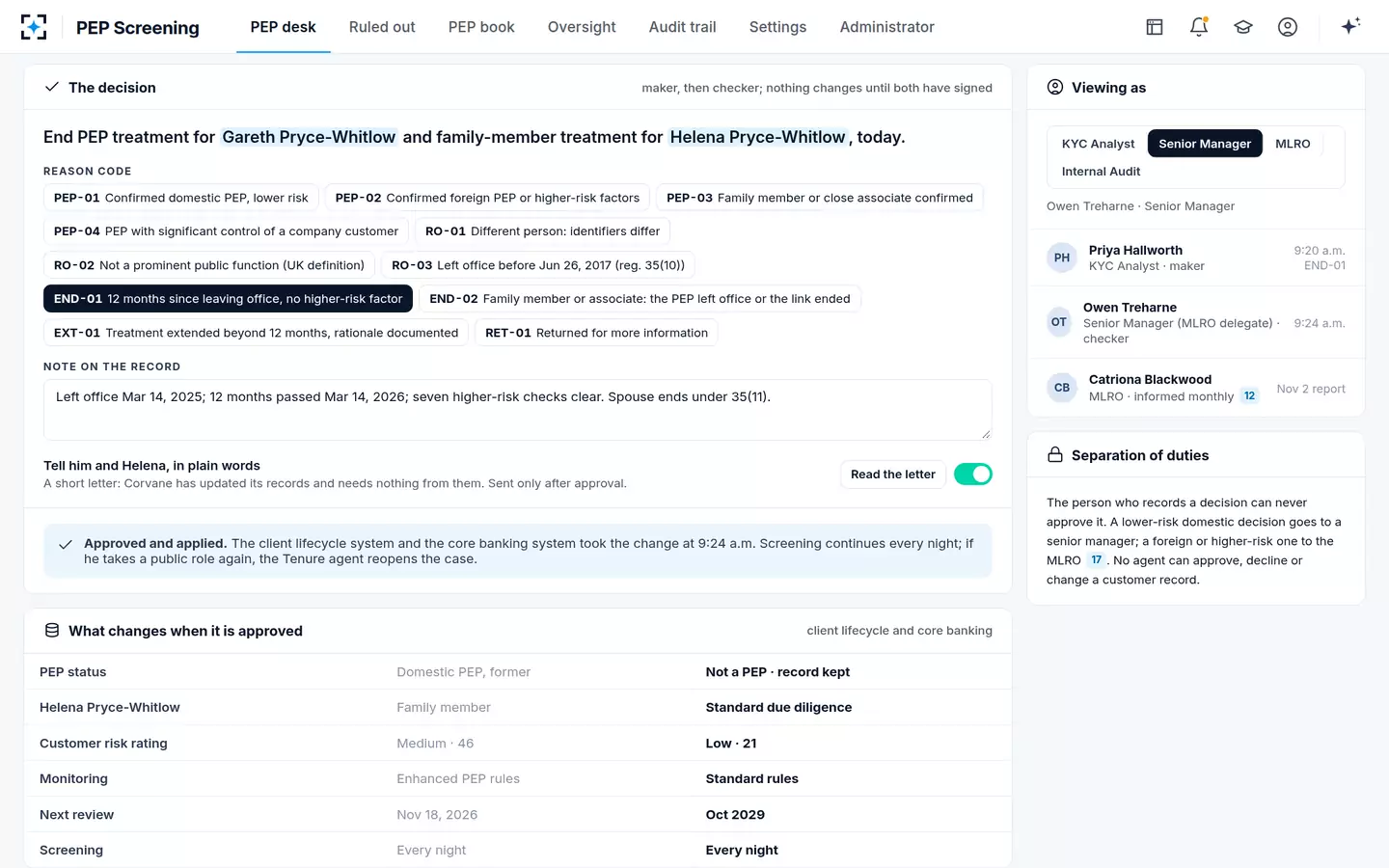
The spouse’s row is the one most banks get wrong, and the error is easy to make: her flag was set when his was, and nothing in a two-yearly review cycle asks when his office ended. In the solution the household is one decision with two reason codes, one for him and one for her, recorded by an analyst and approved by a senior manager before either flag changes.
Approved and applied in PEP Screening: his PEP status and her family-member status end together
Questions people ask
Are a PEP’s grandchildren relatives for PEP purposes?
Not under the UK, EU or US lists, which stop at children and their spouses. FATF notes that in some cultures “grandparents and grandchildren might also be included”, so a bank may reach further for a higher-risk PEP from such a country if its written policy explains why.
Is a PEP’s son-in-law a family member?
Yes in the UK and the EU, which both include the spouse or civil partner of a PEP’s child. Under the US private banking definition he is not on the immediate-family list, which covers spouses, parents, siblings, children and a spouse’s parents and siblings.
Must a close associate be known to the bank?
Yes. The UK test is a “known” close associate, judged on information the firm holds or credible public information, and the US test is someone widely and publicly known, or actually known to the bank, to be a close associate. A bank is not expected to discover private friendships no register or record shows.
Do relatives of a UK PEP get the lower-risk starting point?
Yes. Regulation 35(3A) applies the lower-risk starting point to a domestic PEP’s family members and known close associates as well, and FCA guidance expects them to be treated as lower risk unless there are circumstances to suggest otherwise, such as wealth gained from government licences.
Are relatives and close associates on PEP databases?
Commercial PEP databases usually carry them, which is one reason lists are long, and the Wolfsberg Group counts the sheer number of relatives and associates on PEP lists among the causes of diluted screening. A database entry is a lead; the bank still has to confirm the relationship and test it against its own definition.