How long someone remains a PEP depends on the law the bank works under. UK law requires PEP measures for at least 12 months after a person stops holding a prominent public function, and the FCA expects them to stop then unless the bank has assessed the person as higher risk and written down why. EU law sets the same 12-month floor, Spain holds the status for two years, and from July 2027 the EU applies the floor to family and close associates too. FATF sets no fixed period, and the US definition of a senior foreign political figure says “current or former” with no end. In practice many former officials stay PEPs for years because nobody recorded when the office ended. Botminds’ PEP Screening reads each role’s dates from public records, works out when treatment may end for each person, and proposes the end, with the date and the rule, on the morning it falls due.
Worked examples below come from the solution’s fictional sample bank, Corvane Bank UK; every rule is linked to its text.
The law sets a floor; banks set the ceiling, and often forget to
12months
minimum period of PEP measures after leaving office in the UK and the EU
2years
Spain’s period before a former PEP’s residual risk is reassessed
5 of 15
firms in the FCA’s 2024 review lacked suitable policies to review and declassify PEPs after they left office
222days
a former minister at the sample bank was still treated as a PEP past the date his treatment could end
How long is someone a PEP after leaving office?
At least 12 months under UK and EU law, after which the bank must look again; for a foreign official in US private banking, there is no stated end. The answer differs because each regime asks a different question. The UK and the EU set a minimum period and then require a risk assessment; FATF requires only the risk assessment; the US definition keeps a former official inside it with no clock at all.
How long someone remains a PEP, rule by rule
| Regime | The rule | For family and close associates |
|---|---|---|
| United Kingdom | At least 12 months after ceasing the function, or longer if the firm considers it appropriate; FCA: longer only for a higher-risk PEP, with the rationale documented | Measures may stop the day the PEP leaves office |
| European Union, until 9 July 2027 | “For at least 12 months”, then appropriate and risk-sensitive measures until no further PEP-specific risk | The 12-month article is not among those extended to them |
| European Union, from 10 July 2027 | Until the continuing risk no longer exists, and “in any case for not less than 12 months” | The same rule applies to them |
| Spain, Italy, Portugal, Hungary | Spain: two years, then an analysis of residual risk; Italy and Portugal: the previous year or last 12 months; Hungary: at least one year, longer at the firm’s choice | As each national law provides |
| United States (private banking) | Senior foreign political figure means a “current or former” official; no period | Immediate family and known associates follow the official, with no period |
| FATF | No prescribed time limit; the treatment of a former PEP rests on an assessment of risk | Not addressed separately |
Once a PEP, always a PEP?
Not under UK or EU law, and not in the view of the Wolfsberg Group; FATF leaves the door open but asks for a risk assessment rather than a rule of thumb. FATF’s guidance reads its own definition, which covers people who are or have been entrusted with a prominent function, as consistent with a possibly open-ended approach, and then says the handling of a former official should rest on an assessment of risk, not on prescribed time limits (FATF Guidance on PEPs, paragraphs 44–45). The factors it names are the informal influence the person could still exercise, the seniority of the role, and whether the old and new functions are linked.
The Wolfsberg Group, writing as a standard-setter for large banks, is blunter: “The Wolfsberg Group does not believe that the approach known as “once a PEP, always a PEP” is consistent with an RBA to managing financial crime risk.” It accepts that some higher-risk PEPs may warrant indefinite classification, and for the rest lists the considerations, among them “Length of time in office and likelihood of return to office in future” and “How politically connected they remain once they have left office” (Wolfsberg Guidance on PEPs, 2017).
UK firms have tried the open-ended approach and been told it does not fit the law. In its 2024 review the FCA found that “Two firms had policies which would never consider declassifying, as a PEP, any individual who has held a prominent public position”. In its 2025 guidance it went further: “It would not be in line with the Regulations to permit firms to continue to treat someone as a PEP where the regulations require them to be declassified” (FCA FG25/3, paragraph 2.21).
The UK rule: twelve months, then a decision
Under regulation 35(9), when a person stops being entrusted with a prominent public function the firm “must continue to apply” the PEP measures “(a) for a period of at least 12 months after the date on which that person ceased to be entrusted with that public function; or (b) for such longer period as the relevant person considers appropriate to address risks of money laundering or terrorist financing in relation to that person” (regulation 35). The clock starts on the day the function ends, not the day the bank notices.
The FCA reads paragraph (b) narrowly. A firm may keep the measures longer, “but we consider this will only be necessary in the cases of PEPs where a firm has assessed that PEP as posing a higher risk, in line with this Guidance and the firm should document this rationale.” So for a lower-risk former PEP, the UK answer is in practice 12 months, and the decision to go beyond it needs a written reason.
One exception sits in regulation 35(10). The 12-month rule does not apply to someone who was not a PEP under the 2007 Regulations and who left office before the 2017 Regulations came into force on 26 June 2017; the FCA’s examples are “a former MP, retired member of the House of Lords or a former UK ambassador where they ceased that office before 26 June 2017”. A bank still treating a UK member of parliament who stood down in 2015 as a PEP is applying measures the Regulations do not require.
Do former PEPs remain subject to EDD for 12 months in the EU?
Yes, at least. The directive in force until 9 July 2027 says that when a PEP is no longer entrusted with a prominent function, obliged entities “shall, for at least 12 months, be required to take into account the continuing risk posed by that person and to apply appropriate and risk-sensitive measures until such time as that person is deemed to pose no further risk specific to politically exposed persons” (Directive (EU) 2015/849, Art. 22).
The regulation that replaces it on 10 July 2027 keeps the floor and tightens the wording. Article 45 requires “one or more of the measures referred to in Article 34(4)” until the continuing risk no longer exists, “but in any case for not less than 12 months following the time when the individual ceased to be entrusted with a prominent public function”, and Article 46 extends that to family members and close associates (Regulation (EU) 2024/1624, Arts. 45–46). The new EU anti-money laundering authority must also issue guidelines, by the same date, on how to assess the risk of a person who is no longer entrusted with a prominent function.
Member States have already filled the gap differently. In the lists the Commission published in November 2023, Spain says classification as a PEP “is maintained for two years after leaving the relevant position; after that two-year period an analysis of the politically exposed person must be conducted to determine whether the residual risk warrants the continued application of the enhanced due diligence measures”; Italy covers those entrusted with a function “in the previous year”; Portugal “during the last 12 months”; and Hungary sets “at least one year”, with firms free to set a longer period in their internal rules (C/2023/724). A group with branches in Madrid and Lisbon can hold the same former minister to two different dates.
Do family members stop being PEPs at the same time?
In the UK they stop earlier: on the day the PEP leaves office. Regulation 35(11) says the firm is no longer required to apply the PEP measures to a family member or known close associate once the PEP leaves the function, even if the PEP’s own 12 months are still running (who counts as a relative or associate is in relatives and close associates of PEPs). FCA guidance says family members “should be treated as ordinary customers, subject to customer due diligence obligations from the point that the PEP leaves office”.
The EU is moving the other way. Today’s directive extends its general PEP articles to family and associates but not the 12-month article; from July 2027 Article 46 extends the 12-month floor to them as well. US private banking rules include immediate family in the definition of a senior foreign political figure and set no end for anyone. The relatives and close associates of a PEP guide works those clocks on a whole household.
Former foreign officials in US private banking
US rules give a former foreign official no end date. The private banking rule applies to any nominal or beneficial owner who is a senior foreign political figure, and the definition begins “A current or former” senior official (31 CFR 1010.605(p)). A bank can stop treating the account as higher risk; it cannot stop the person from meeting the definition.
The federal agencies allow time to count in the risk rating instead. Their 2020 statement says that “For a PEP who is no longer in active government service, banks may also consider the time that the customer has been out of office, and the level of influence he or she may still hold” (joint statement on PEPs, 2020). A US bank’s written policy can turn that into a review rule: re-rate a former official at each review on time out of office and remaining influence. What follows for the due diligence file is covered in PEP enhanced due diligence under US rules.
Why the end date is usually missing
Most banks know when a customer became a PEP, because that is when the flag was set. Far fewer record when the office ended, and without that date no rule in this guide can be applied. The FCA found that five of the 15 firms it examined in 2024 had no suitable policy to review a PEP’s status after the person left office, and its file reviews found one firm with no evidence it had considered declassifying three of eight PEPs “despite these having left their public position years earlier”, and another that kept a customer as a PEP “despite the individual having been inactive in their role for 4 years” (FCA multi-firm review, 2024).
Firms’ own declassification rules, against the law’s 12-month minimum
Commercial data rarely fills the gap. The Wolfsberg Group lists the identifying data a PEP record should hold, and the sixth item is the “Date or year that the PEP left their position (where applicable)”, a field that is blank whenever the provider has not caught the departure; FATF’s guidance warns that commercial lists cannot be relied on to be current. The FCA’s 2025 guidance points firms to trigger events such as planned elections, and allows them to ask customers to tell them when their circumstances change. For UK elections it considers firms “will be aware of these outcomes as they will be in the public domain”.
Working out the date on one record
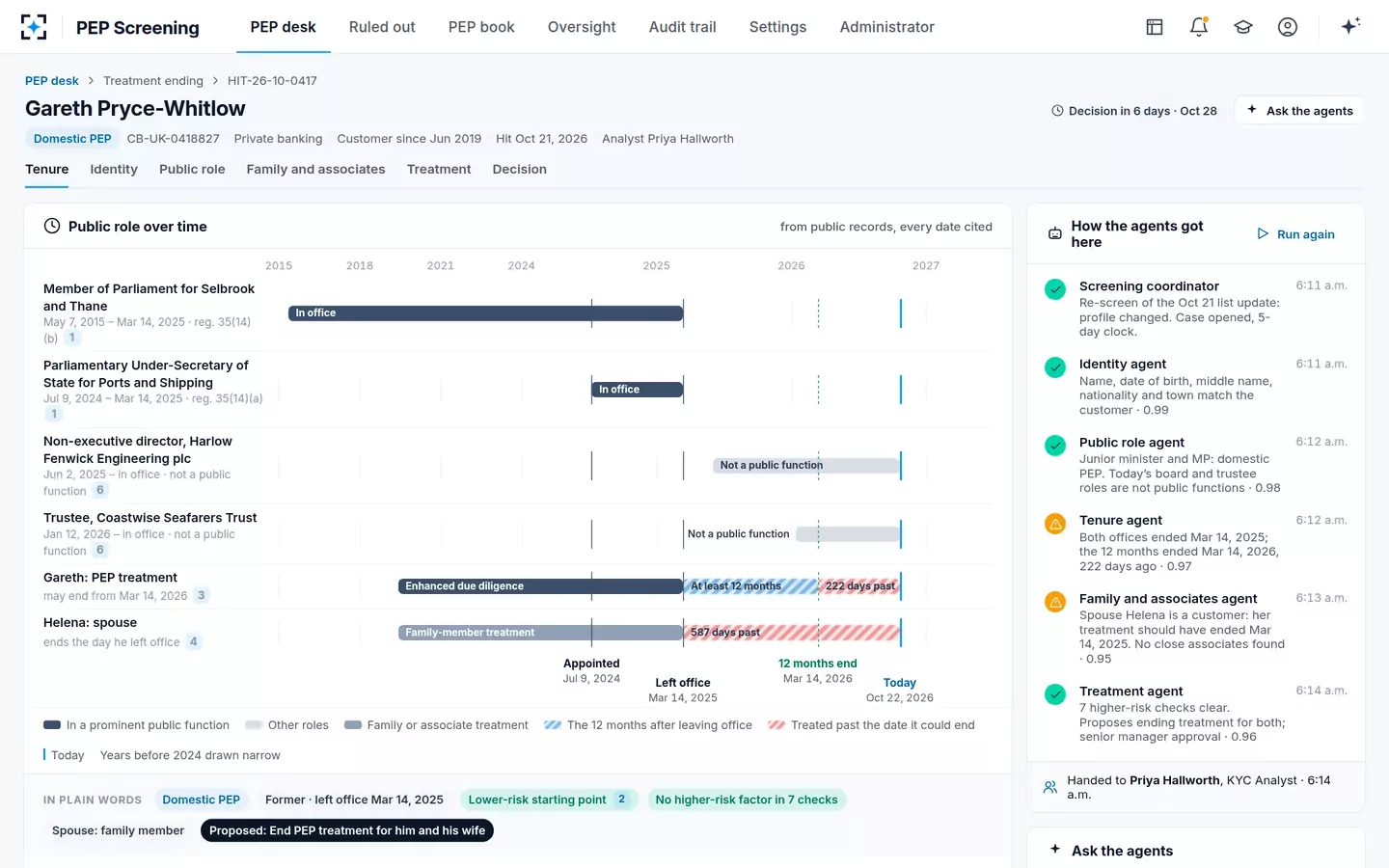
The end date is arithmetic once each role is dated: the last day in a prominent function, plus 12 months for the PEP, plus nothing for the family in the UK. Take the sample bank’s private banking customer Gareth Pryce-Whitlow, a member of parliament from May 7, 2015 and a parliamentary under-secretary of state from July 9, 2024, who left both on March 14, 2025. His wife Helena banks with the same firm.
One former minister and his wife: when treatment could end, and how long it ran on
- The 12 months after leaving office12 months · to Mar 14, 2026
- Treated past the date it could end222 days past
- Treated past the day he left office587 days past
The 222 days are the time since his 12 months ran out on March 14, 2026. The 587 days are the whole period since he left office, because her treatment had no 12-month tail to run. Neither number is a breach of a deadline in the Regulations, which set a minimum and not a maximum. Both are time in which the bank applied enhanced monitoring, senior sign-off and a two-yearly review cycle to people the law no longer required it for, the burden the FCA’s review was set up to examine.
PEP Screening draws each public role on one bar, with the 12 months after and the days past
Who decides to end PEP treatment?
A person at the bank, with enough seniority and the evidence in front of them. The Wolfsberg Group says “Any declassification of a PEP should be subject to an appropriate level of senior management review and approval. This review should be documented. Once a PEP has been de-classified, their prior PEP status should be noted for investigatory purposes”. The FCA’s 2024 review recorded as good practice a firm that weighed ongoing links to businesses more susceptible to corruption, adverse information, ongoing political connections and the likelihood of a return to office.
In the solution, the agent that dates the roles never ends treatment itself; it proposes the end with the date and the rule, and an analyst records the decision with a reason code, “12 months since leaving office, no higher-risk factor” in Gareth’s case. A senior manager approves a lower-risk domestic PEP; the money laundering reporting officer approves any extension beyond 12 months, with the rationale written down; and the record of the person’s past status is kept. Who that approver should be, and what the signature should rest on, is the subject of PEP senior management approval. How software can find the date in the first place, and what it should do when the source is silent, is set out in PEP screening software that asks when the role ended.
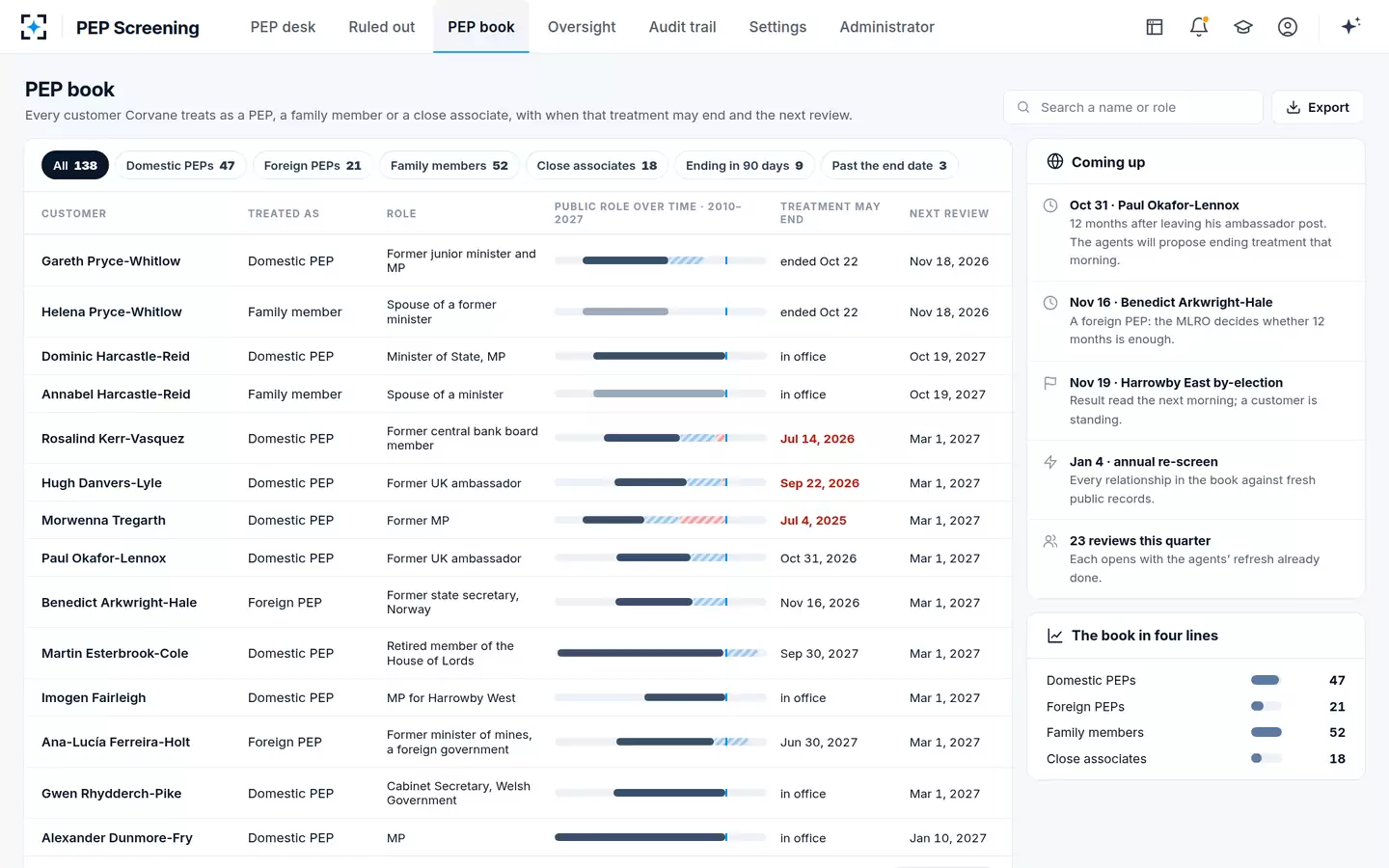
A whole PEP book in PEP Screening, with the date each person’s treatment may end
Questions people ask
What is PEP declassification?
Declassification is the decision to stop treating a former PEP, or a PEP’s relative or associate, as one and return them to ordinary customer due diligence. In the UK it can happen 12 months after a PEP leaves office, or on the day of leaving for family and associates; the Wolfsberg Group recommends senior management approval, a documented review and a note of the prior status.
Can a bank keep someone as a PEP for longer than 12 months?
Yes, under regulation 35(9)(b), for as long as the firm considers appropriate to address the risk. FCA guidance expects that only for PEPs assessed as higher risk, and since July 2025 it says the firm must clearly document the rationale.
Does a former PEP who takes a new public role become a PEP again?
Yes, if the new role is a prominent public function, and the clock starts again from the day the new role ends. A private board seat or a charity trusteeship is not such a function under UK rules, so it neither restarts nor extends the period.
What about someone who left office before June 26, 2017?
Regulation 35(10) disapplies the 12-month rule for a person who was not a PEP under the 2007 Regulations and left office before the 2017 Regulations came into force. The FCA’s examples are a former MP, a retired member of the House of Lords or a former UK ambassador who left before that date.
Is a deceased PEP still a PEP?
No, but the family may still need attention. The Wolfsberg Group says that where a deceased PEP was the source of funds or wealth for close family or associates, the bank should make a risk-based assessment of whether those relationships still merit enhanced measures on their own merits or should be declassified.
How long is someone a PEP in the EU?
For at least 12 months after leaving office, and until the bank judges no PEP-specific risk remains, under Article 22 of the current directive; from 10 July 2027, not less than 12 months under Article 45 of the regulation, for family members and close associates as well. National law can set more: Spain sets two years before a residual-risk analysis.