A PEP screening API returns possible PEP matches for a name and details, priced by the provider per call or per monitored record. It is one of four ways to buy PEP screening: the API with the bank’s own analysts behind it, a screening platform with matching and case management, an outsourced review service, or agents that work each case after the hit with the bank’s analysts and approvers deciding. No government, academic or non-profit source publishes the prices of these services, and the quotes a bank receives will differ by volume and contract. What can be modelled in public is the part every option shares: the people-hours behind each settled decision, which in the solution’s own estimate are most of the cost. Botminds’ PEP Screening is priced against that line, because its agents settle what an analyst would otherwise settle by hand, and leave the decision with the analyst and the approver.
The worked figures below use the solution’s fictional sample bank, Corvane Bank UK, its estimate of hours per case, and US Bureau of Labor Statistics wages. They are estimates, and every input is shown so a reader can replace it with their own.
What an analyst hour costs, and how many of them one PEP case takes
$94,090
mean annual wage of compliance officers in credit intermediation, May 2025
$45.24
per hour at 2,080 paid hours a year, before benefits and overhead (our arithmetic)
7.25h
estimated analyst hours on one possible-PEP case worked by hand
1.4h
estimated hours on the same case with the solution’s agents doing the assembly
How much does a PEP screening API cost?
The per-call price is a quote, and usually the smaller part of the cost. There is no neutral published benchmark: the regulators, standard-setters and researchers this series cites do not publish prices for PEP data or screening services. FATF’s guidance notes only that subscription costs “may be (too) high for many institutions” and that “the costs of such systems are necessarily passed on to the clients, which will ultimately increase the cost of accessing financial services” (FATF Guidance on PEPs, paragraph 61).
What a bank can price precisely is its own time. An API answers the question “who might this be?”; the questions that follow, whether it is this customer, whether the role counts, when it ended, who the relatives are and who signs, are answered by people unless something else answers them. In the solution’s estimate, a possible-PEP case worked by hand takes about seven and a quarter analyst hours. At US compliance officers’ mean wage in banking that is about $328 of wage cost per case before benefits and overhead, which for most banks is more than the data behind the hit.
What does a PEP screening API not include?
The decision, and most of the evidence for it. A PEP data response is a candidate record; the six identifiers the Wolfsberg Group says a PEP record should hold are name and aliases, date or year of birth, country of political exposure, gender where available, each role with its appointment date, and the date the person left their position (Wolfsberg Guidance on PEPs, 2017). Even a complete record leaves five pieces of work with the bank.
The bank must test the role against its own definition, because FCA guidance requires a firm using a commercial database to ensure that what it flags falls within the definition in the Regulations (FCA FG25/3). It must date the role and work out when treatment ends, for the PEP and separately for each relative. It must find relatives and associates among its own customers. It must assess the risk and propose measures. And it must obtain senior management approval, which UK law requires for every PEP relationship (regulation 35(5)(a)). FATF adds that a database on its own does not meet its standard, and that a bank using one still owns the risk assessment.
The cost per settled decision, term by term
The fair way to compare options is the total cost of settling one hit to a recorded, approved decision, divided over the decisions the option actually settles. Data fees and software fees are quotes; people-time and rework are the bank’s own numbers, and they are where the options differ most.
Total cost per settled PEP decision, term by term
Data and API fees
lookups or monitored records × price
The provider’s quote at your volume, including re-screening when the list changes.
Procurement
Software or service fees
licence, or cases × outsourcing price
Platform licence, outsourcing per-case fee, or the solution’s subscription, plus integration.
CIO and procurement
People-time
cases × hours per case × loaded hourly cost
Analysts settling hits, approvers signing, and reviewers checking samples.
Head of KYC
Errors and rework
reopened cases × hours + over-treatment
Hits reopened, files redone, and PEPs and relatives kept past their end dates.
MLRO
What are the analyst costs behind each option?
The analyst hours depend on how much of each case the option settles before a person sees it. The solution’s estimate splits a possible-PEP case into six steps. By hand, the biggest items are clearing namesakes and roles the law does not count, finding when each role started and ended, and the higher-risk checks; with the agents assembling the case, the remaining hours are mostly the checks a person still makes and the rationale and approval.
Estimated analyst hours on one possible-PEP case, by step
Turned into money for one month at the sample bank, the model is simple arithmetic. In the month, 41 cases needed a person. By hand that is 41 × 7.25 = 297 analyst hours, or about $13,450 at $45.24 an hour; with the solution it is 41 × 1.4 = 57 hours, or about $2,600. Two things are left out on purpose, and both should be added from the bank’s own data. By hand, the other 801 hits of the month would also need someone’s look, so the by-hand figure is understated. With the solution, analysts check samples of the 760 hits the agents ruled out before any group closes, which takes time the per-case estimate does not include.
The wage is a floor for the hourly cost. BLS counts 417,070 compliance officers in the US, with a mean annual wage of $88,400 across industries and $94,090 in credit intermediation; the hourly figure here divides the latter by 2,080 paid hours and leaves out benefits and overhead (BLS, Compliance Officers, May 2025). A UK bank should substitute its own loaded cost per hour; the hours are the comparable part.
Build on an API or buy a platform?
Build on an API if the bank wants to own its rules and can maintain them; buy a platform if it would rather rent the matching and the workflow. Either way, three things stay with the bank: its PEP definition, its approval matrix and its evidence. The definition is the expensive one to keep current, because it is regime by regime: the FCA’s 2024 review found 12 of the 15 firms it examined running under group or international PEP policies, four of which needed changes to reflect UK requirements, and seven using definitions wider than the guidance (FCA multi-firm review, 2024).
A build also means writing the rules a platform ships with: close matching on name variants, discounting clear mismatches on reliable identifiers, and a no-match list kept for each pairing of PEP and customer, not for the customer alone, as the Wolfsberg Group recommends. And unless an option is built or bought to date roles and compute end dates, that work stays with analysts: the 1.5 hours per case on the chart above.
Is outsourcing PEP screening cheaper?
It can be cheaper per case; it cannot move the responsibility. UK law still requires the bank’s own senior management to approve each PEP relationship, and FATF’s guidance is clear that the risk assessment cannot be handed to a provider. An outsourced review therefore adds a step, the bank’s acceptance of the provider’s work, and its value depends on what the contract says the provider does.
A sanctions case shows how much rides on that contract. In a 2022 finding of violation, the US Treasury’s Office of Foreign Assets Control described a bank whose vendor screened new customers and changed records daily but its whole existing customer base only once a month; the bank had misunderstood the scope of the contract, believing the daily runs covered everyone (OFAC, MidFirst Bank, 2022). The same question applies to PEP outsourcing: which records are re-screened when the list changes, who records end dates, and who is told when a customer becomes a PEP between reviews.
How do the options compare at our volume?
At low volume, the cheapest option is often the simplest; as hits grow, the per-case hours decide. The Wolfsberg Group accepts manual PEP screening where it suits “the size of the business and the materiality of the inherent risk posed by PEPs”, and a bank with a few hundred customers and a handful of hits a month may need nothing more than a list and a careful analyst. A bank like the sample bank, screening 380,412 customers nightly and settling 842 hits a month, is in a different place.
Four ways to buy PEP screening, and where each leaves the work
| API and your analysts | Screening platform | Outsourced review | Agents and your analysts | |
|---|---|---|---|---|
| What you pay for | Lookups or monitored records | A licence for matching, rules and case management | Cases reviewed by the provider’s staff | A solution that works each case after the hit; the PEP data is bought separately |
| Who clears namesakes | Your analysts, or rules you build | Rules plus your analysts | The provider’s analysts | Agents, on a differing identifier; your analysts check samples |
| Who dates roles and end dates | Your analysts | Your analysts, unless the platform dates roles | The provider, if the contract says so | Agents from public records, proposing; a person where the source is silent |
| Who approves | Your senior management | Your senior management, through workflow | Still your senior management | Your senior management; the analyst records, never approves |
| Watch for | The provider’s definition is not yours; blank end dates | Tuning on names alone; suppressing customers instead of pairs | The contract’s scope; outsourcing the risk assessment | Model governance, sample checks, and the data service still needed |
A month of PEP Screening at a mid-sized private bank, in one sentence
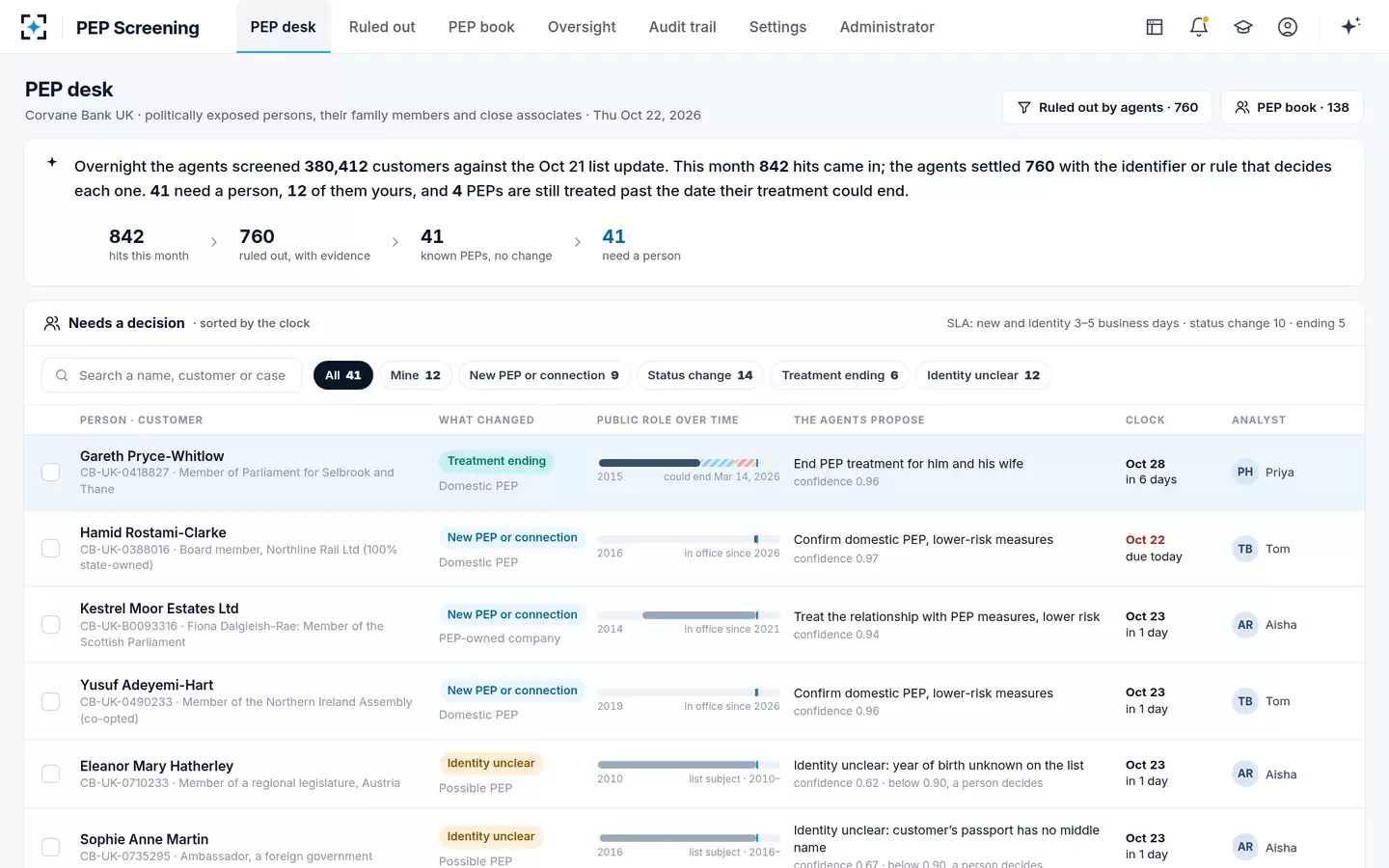
The hidden line: treatment past the end date
Every option is usually priced on hits; the most expensive error never produces one. A former PEP kept on enhanced treatment costs approvals, enhanced monitoring and more frequent reviews long after the law stopped asking for them. At the sample bank, ending treatment for one former junior minister moved his risk rating from Medium 46 to Low 21, his monitoring from enhanced PEP rules to standard ones, and his review cycle from every two years to every three. He had been treated past his end date for 222 days, and his wife for 587.
The FCA counts the customer side of this cost too. Its 2024 review warned that PEPs and relatives who are not declassified keep meeting PEP requirements for longer than is proportionate, and reminded firms of the Consumer Duty and its expectation that firms avoid foreseeable harm and put it right when it occurs. The solution’s design target is zero days of treatment past the date the rules allow, which makes this line measurable instead of hidden.
What the MLRO sees in PEP Screening: decisions, overrides and the clock, as a cost record
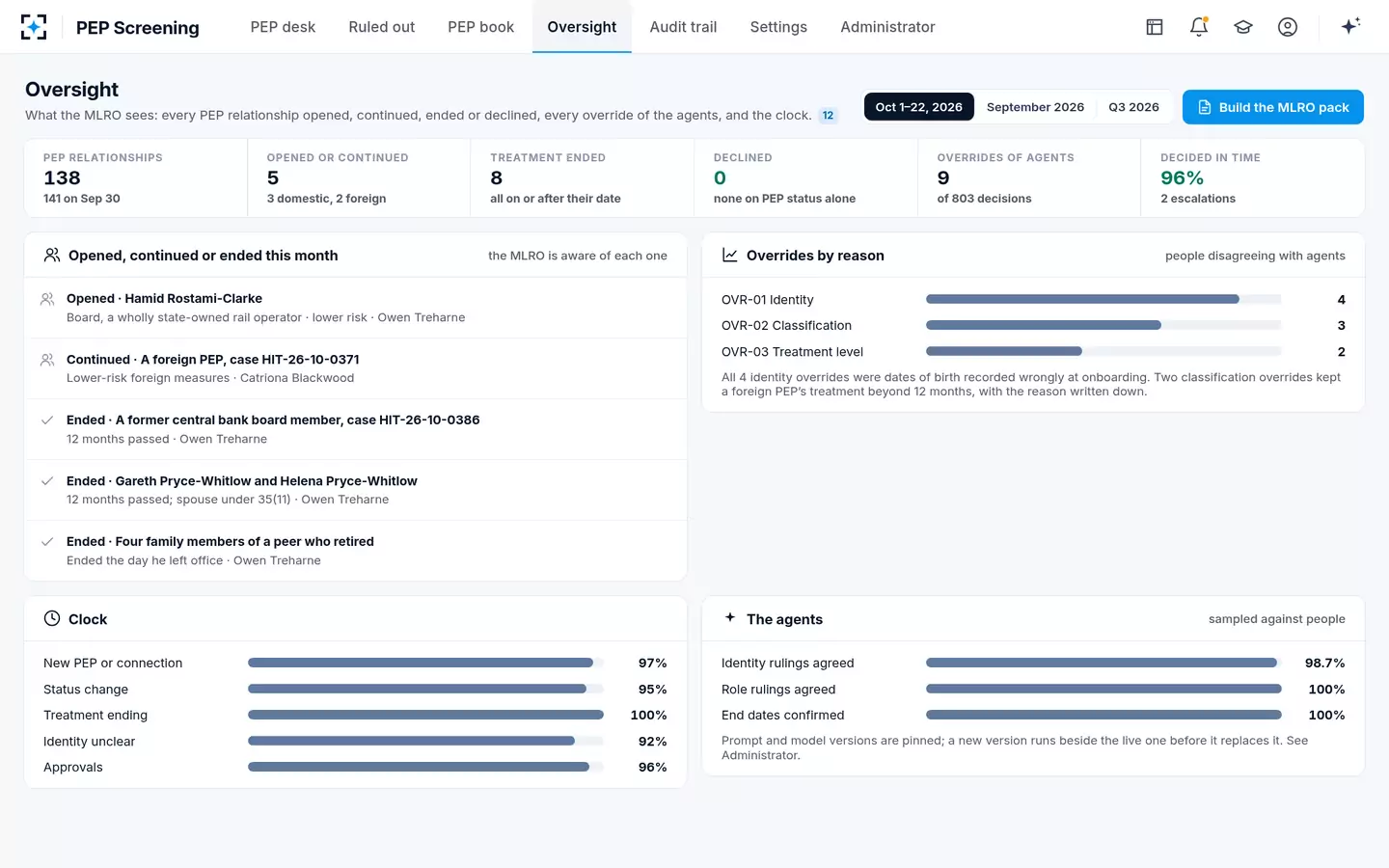
Where agents pay, and where they do not
Agents pay where hits are many, roles need dating and relatives need finding: a private bank, a wealth manager or any bank with a large book of foreign or political customers. They pay least where hits are rare and simple, and where the bank’s own volume makes a list and one analyst the honest answer. They also do not replace the PEP data service; Botminds’ PEP Screening takes the bank’s existing data as its input and checks it against public records.
The way to find out is to price the bank’s own month. Take a sample of past hits, time them by step, run the same sample through the option being considered, and compare cost per settled decision with the miss test held fixed. A measurable way to tell false positives from true PEPs gives the scorecard for that test, what to ask PEP screening software gives the questions, and a go-live plan in four stages shows the order to switch on in.
Questions people ask
Is there a free PEP screening API?
Not from a US, UK or EU authority as a list of names. The EU publishes lists of prominent public functions, and many of the records that confirm a role, such as parliament membership pages and company registers, are public; a bank that builds on them has to do the collecting and dating itself.
What should a PEP check API return?
At minimum, enough to settle identity and status: the Wolfsberg Group’s six identifiers, which are names and aliases, date or year of birth, country of political exposure, gender where available, each role with its appointment date, and the date the person left the role. A response without dates of office leaves the end of treatment to the bank.
Who pays for PEP screening in the end?
Customers, in part: FATF’s guidance notes that the costs of commercial PEP systems are passed on to clients and increase the cost of financial services. Over-treatment adds a non-financial cost for the PEPs and relatives themselves, which the FCA has asked firms to weigh under the Consumer Duty.
Do we still need analysts if agents settle most hits?
Yes. In the solution, analysts check samples of every group of ruled-out hits, decide every case the agents could not settle with confidence, and record every decision; a second person approves it. The agents remove assembly work, not the judgement or the signature.
How should a business case for PEP screening be built?
On cost per settled decision for the bank’s own month, with data and software fees from quotes, people-time from timed samples at a loaded hourly cost, and rework and over-treatment counted. Hold the miss test fixed, so that a cheaper option is not cheaper because it finds fewer PEPs.