PEP screening software matches a bank’s customers and beneficial owners against PEP data at onboarding, at periodic review and when something changes, and turns each match into a decision someone can defend. The matching is the part most tools do well. The work that decides whether the decision is right comes after the hit: confirming identity on identifiers, testing the role against the bank’s definition, dating the role, finding the relatives, and proposing measures a senior person can approve. The field that most often defeats software is the end date of a public role, because lists record appointments promptly and departures late or never, and every rule about how long someone remains a PEP runs from that date. Botminds’ PEP Screening is built for the work after the hit: seven agents rule hits out with the evidence that decides them, date every public role from public records and propose when PEP treatment ends, stopping for a person wherever the evidence runs out; a KYC analyst records each decision and a senior manager or the money laundering reporting officer approves it.
Examples come from the solution’s fictional sample bank, Corvane Bank UK, a UK private bank. Figures from the solution are sample data or design targets and are labelled as such.
What the solution is designed to hit, and where it stops
90%
of hits settled by agents with the identifier or rule that decides, checked by people on a sample (design target)
0days
of PEP treatment past the date the rules allow (design target)
0.90
confidence below which an agent rules nothing out and a person decides (the sample bank’s setting)
7
agents, none of which can approve, decline, end treatment, change a customer record or send a letter
What does PEP screening software do?
At its narrowest, it compares names and details against a PEP list and raises alerts; at its broadest, it carries each alert to an approved, recorded decision. The Wolfsberg Group describes the screening part: PEP screening “is the screening of customer names and associated details against PEP information at certain points during the customer relationship”, at least at onboarding, at periodic review and on a trigger event, and “Where deemed to be an appropriate control, PEP screening should be automated” (Wolfsberg Guidance on PEPs, 2017). It also says manual screening may be acceptable for a small business, and that automated screening “is not necessary in all circumstances”.
The regulators describe the rest. UK law requires “appropriate risk-management systems and procedures to determine whether a customer or the beneficial owner of a customer” is a PEP, a family member or a known close associate, then an assessment of the risk, then approval, source of wealth and source of funds, and enhanced monitoring (regulation 35). FCA guidance makes the PEP database itself optional, and makes the firm responsible for checking that what it flags fits the definition (FCA FG25/3). Software that stops at the alert leaves all of that with the analyst.
The field most tools leave blank: when the role ended
The end date is the field that decides how long a PEP stays a PEP, and the one most likely to be missing. The Wolfsberg Group’s minimum data for a PEP record ends with the date or year the person left their position, “where applicable”; FATF’s guidance warns that turnover among public officials makes commercial lists unreliable as a current record. A list that records an appointment the day it is announced may record a departure months later, or not at all.
The cost shows up in the bank’s book, not in its alert queue. In the FCA’s 2024 review, five of 15 firms had no suitable policy to review a PEP’s status after the person left office, and file reviews at two of them found PEPs kept for years after leaving (FCA multi-firm review, 2024). The sample bank’s problem statement is the same in miniature: a PEP flag set at onboarding and reviewed every two years, with nobody recording when the office ended. How long someone remains a PEP sets out the rules that run from that date.
Can software date a public role?
Yes, from the same public records an analyst would use, provided each date carries its source. FCA guidance lists them: “websites of parliaments and governments, reliable news sources” and the work of anti-corruption groups, plus reliable public registers such as Companies House’s register of companies and persons with significant control. Membership of a parliament, a ministerial appointment, an ambassador’s posting and a board seat at a state-owned company all have a start and an end in an official record.
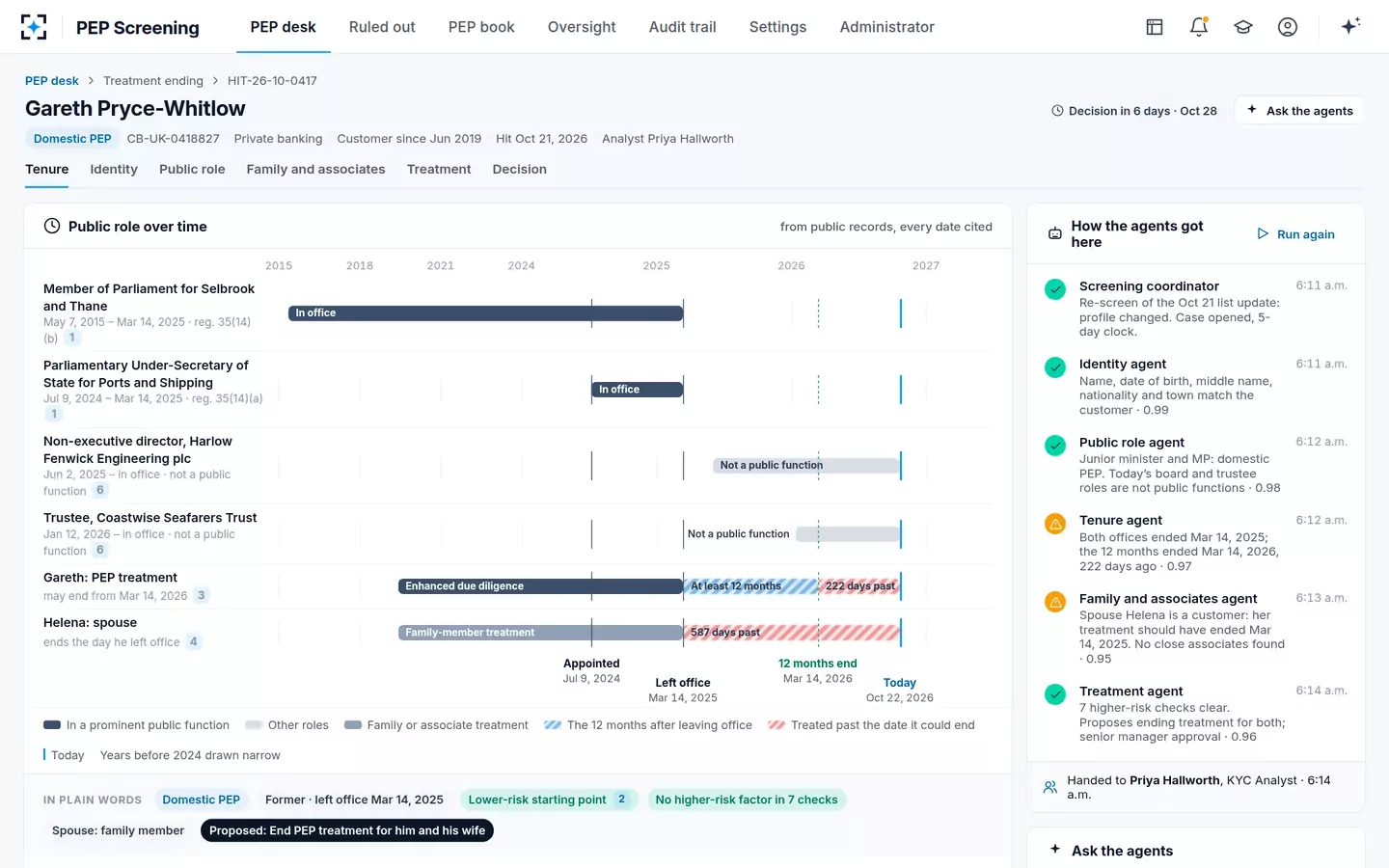
In the solution, one agent does this job. It records each role with its dates from parliament, appointment and company records, works out when treatment may end for each person, and watches elections, reshuffles and list updates. Every date it shows opens its source passage. For the sample bank’s former junior minister, it found a seat in parliament from May 7, 2015 and a ministerial post from July 9, 2024, both ending on March 14, 2025, and drew them on one bar with the 12 months that followed.
A public role over time in PEP Screening, each date opening the record it came from
What if the source doesn’t give an end date?
Then the software should say so and hand the question to a person, not fill the gap. A guessed end date fails in one of two directions. Guess late, or not at all, and the PEP is never declassified, which the FCA has said is not in line with the Regulations. Guess early, and a sitting minister is treated as a former one. Either error lands on a decision someone senior has signed.
In the solution the rule is the bank’s confidence floor. Any agent ruling below 0.90 goes to a person, the agent that dates roles never ends treatment itself, and its proposals carry the date and the rule they rest on. The analyst then has the same options the FCA’s guidance gives: check the public record for a planned election or reshuffle, or ask the customer, since firms may invite customers to tell them about a change of circumstances.
Where the agents stop and a person answers, on every PEP case
Agent
Is it this customer?Opens a case from a hit, a list update, an election or a reshuffle, then compares date of birth, full name, nationality, residence and dates of office, and names the identifier that differs.
Never: Rules a hit in or out on a name alone. Below 0.90 confidence it stops and a person decides.
Agent
Does the role count?Tests each listed role against the bank’s definition and classifies the PEP as domestic or foreign, citing the paragraph.
Never: Treats a role outside the definition as a PEP without a person’s documented decision.
Agent
When did it start and end?Reads each role’s dates from parliament, appointment and company records, and works out when treatment may end for the PEP and for each relative.
Never: Ends treatment itself. It proposes, with the date and the rule.
A person decides
Answer what the agents could notThe KYC analyst settles what the agents stopped on, a year of birth missing from the list or a role the record does not date, agrees or overrides each step, and records the decision with a reason code.
A person decides
ApproveA senior manager or the money laundering reporting officer, by the bank’s rules, approves or returns it. Only then do the bank’s systems change.
Can AI decide PEP status?
It can propose it, with its evidence; it should not decide it, and in the UK and the EU the law already puts the decision with senior management. Regulation 35(5)(a) requires senior management approval for any relationship with a PEP, family member or known close associate, so a status set by software alone would lack the approval the Regulations require. FATF’s work on new technology makes the general point: the tools can steer compliance effort toward the real risks, but a person’s review remains essential (FATF, Opportunities and Challenges of New Technologies for AML/CFT, 2021).
Standard-setters ask for the controls that make a proposal trustworthy. The Wolfsberg Group’s principles for artificial intelligence and machine learning ask banks to understand the impact of these technologies before use, so that the results are fair, effective and explainable, and to monitor them for consistent performance afterwards (Wolfsberg AI and ML principles, 2022). US banks should note that the Federal Reserve’s 2026 model-risk guidance, SR 26-2, leaves generative and agentic AI outside its scope, while expecting a bank’s own risk management and governance to set the controls it applies (SR 26-2).
In the solution, agent and model versions are pinned, a new version runs beside the live one before the MLRO approves a switch, people check samples, and every override carries a reason code. The agents may never approve, decline, end treatment, change a customer record or send a letter.
Who approves the agent’s proposal?
A person the bank has named as senior management for that kind of case, never the person who prepared it. At the sample bank, a KYC analyst records each decision with a reason code; a senior manager acting as the MLRO’s delegate approves lower-risk domestic PEPs; the MLRO approves foreign and higher-risk PEPs and any extension beyond 12 months. The client lifecycle and core banking systems change only after the approver signs. PEP senior management approval sets out who may sign in each regime and on what evidence.
How does software handle relatives?
It should find them among the bank’s own customers, give each their own end date, and ask no more than the risk requires. Relatives and close associates are found in joint accounts, ownership registers and the bank’s records more than in PEP lists. In the UK their PEP measures may stop the day the PEP leaves office, not 12 months later, so a system that copies the PEP’s date onto the spouse is wrong by a year. FCA guidance also limits the enquiry for lower-risk PEPs to what is needed to establish whether the relationship exists at all.
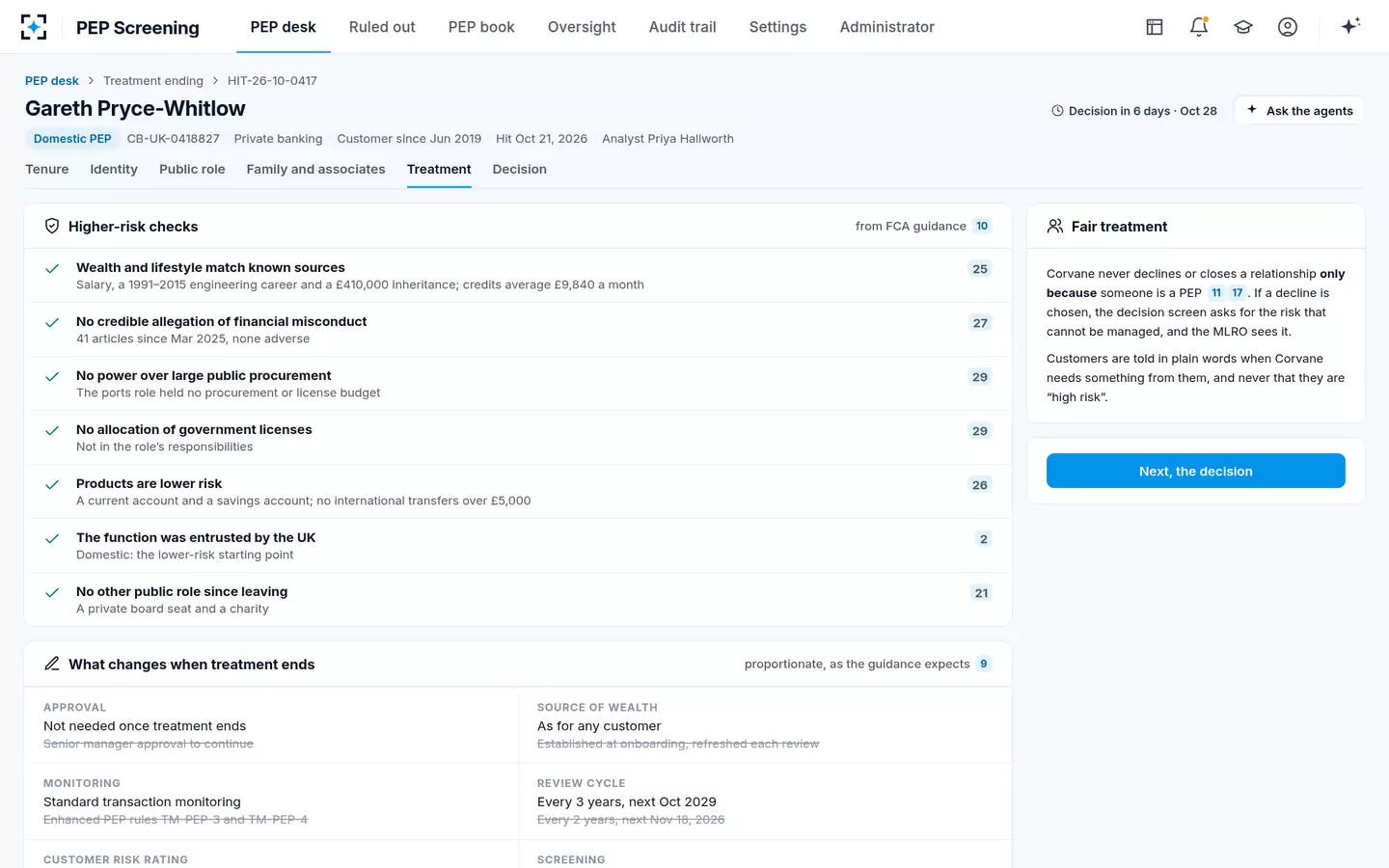
The solution’s family agent searches joint accounts, the persons with significant control of linked companies and the customer record, and sets each person’s own end date; in a lower-risk case it never asks about family beyond whether the relationship exists. Before proposing any treatment, the treatment agent runs the FCA’s higher-risk indicators, each with its source.
Seven higher-risk checks, each cited, before PEP Screening’s agents propose a treatment
What should I look for in PEP screening software?
Look past the match rate to the decision the software leaves behind. The questions below are the ones that separate a tool that produces alerts from one that produces defensible decisions, and each can be tested on a sample of the bank’s own past hits before a contract is signed.
Ten questions to put to any PEP screening software
- Does it apply your definition, or the data provider’s?
It should rule out roles your regime does not count, citing the passage, and let you configure categories by regime.
- What does it need before it rules a hit out?
A differing identifier or a rule, never a name alone, with a confidence floor you set.
- Does every role carry a start and an end date with a source?
Not a flag. The end date is what ends treatment.
- What does it do when the source is silent?
Stop and ask a person, rather than guess an end or keep the PEP open by default.
- Does each relative and associate get their own end date?
In the UK, the day the PEP leaves office; in the EU from 2027, not less than 12 months after.
- Does it propose measures and the approver your rules require?
And keep the decision with the analyst and the approver, maker never checker.
- Can people check its rulings by sample before they close?
With agreement reported by kind of ruling, and disagreements reopened.
- What does the MLRO see?
Relationships opened, continued, ended and declined, overrides by reason, and the clock.
- Can an auditor export the trail?
Who, what, when, why and the evidence, append-only, with redaction.
- How are its models governed?
Pinned versions, a parallel run before a switch, and an owner who approves it.
Software that guesses and software that asks, compared
The difference shows on the hard cases, not the easy ones. On a clean namesake both kinds of software do well. On a role with no end date, a relative of a former PEP, or a customer who has just been appointed a minister, one fills the gap and the other surfaces it.
Six hard cases, handled by guessing and by asking
Software that fills the gap: Keeps the PEP open by default, or applies a fixed period from the last known date.
Software that asks: Searches the public record and, below its confidence floor, puts the case to a person with what is missing.
Software that fills the gap: Flags it because the list does, and leaves the analyst to clear it.
Software that asks: Rules it out with the paragraph that excludes it, and people confirm a sample.
Software that fills the gap: Matches on name and nationality and raises or clears the hit.
Software that asks: Stops below its confidence floor and names the missing identifier.
Software that fills the gap: Copies the PEP’s end date onto the spouse.
Software that asks: Gives the spouse the date the law sets, in the UK the day the PEP left office.
Software that fills the gap: Waits for the provider’s next update or the next periodic review.
Software that asks: Opens a case from the reshuffle or the list update, with the higher-risk indicators checked.
Software that fills the gap: An alert with a name, a list record and a free-text note.
Software that asks: Identity, role, dates, relatives, risk checks and the proposed measures, each with its source.
Where Botminds’ PEP Screening fits, and where it does not
It fits after the PEP data the bank already buys, and before the enhanced due diligence file. The solution takes hits and profile updates from the bank’s PEP data service, customer records from the core banking and client lifecycle systems, and public records from parliaments, government appointments and company registers. It returns a dated, cited status for each person, a recorded and approved decision, hand-offs to enhanced due diligence for higher-risk PEPs, and export packs for supervision, internal audit and the MLRO.
It is not a PEP list; it relies on one and checks it. As shown on its sample bank, it applies the UK definition, regulation 35 read with FCA guidance, and the bank’s own PEP Standard; a bank under US or EU rules would need its definitions written into that Standard and tested on its own hits. It does not write the enhanced due diligence file itself, which is the work covered in PEP enhanced due diligence, and it is not a sanctions screening engine. On cost, the question is less what the software charges per lookup than what each option leaves to analysts; the total cost per decision sets the options side by side, and a measurable way to tell false positives from true PEPs is the test to run in any trial.
Questions people ask
What is the difference between PEP screening and PEP due diligence?
Screening finds candidates and settles who is a PEP, a relative or an associate; due diligence is what the bank then does about the confirmed ones, chiefly establishing source of wealth and source of funds and monitoring the relationship. Under UK law both sit in regulation 35, with approval from senior management joining them.
How often should PEP screening run?
At least at onboarding, at periodic review and on a trigger event, in the Wolfsberg Group’s guidance, with lower-risk businesses free to screen less often. With delta screening, as the Wolfsberg Group describes it, every change to the PEP data is screened against the whole customer base; the sample bank re-screens nightly, with an annual re-screen of every PEP relationship against fresh public records.
Can PEP screening be fully automated?
The matching can, and auto-discounting of clear mismatches is accepted where it rests on reliable information. The decision cannot be in the UK or the EU, where senior management must approve a PEP relationship, and standard-setters expect human review of what automated tools produce.
Does PEP screening software need to cover relatives and close associates?
Yes, wherever the law covers them, which is the UK, the EU and FATF’s standard; the measures apply to family members and known close associates as well as to PEPs. The software should find them among the bank’s own customers and set their end dates separately from the PEP’s.
How do you test PEP screening software before buying?
Run it on a sample of the bank’s own past hits and known PEPs, including variant spellings, relatives and former officials, and compare its rulings and end dates with what the bank decided. Measure identity, status and relationship rulings separately, and count misses as well as false positives.