There is no politically exposed person definition in US regulation. The Bank Secrecy Act rules define a “senior foreign political figure”: a current or former senior official of a foreign government, a major foreign political party or a foreign government-owned enterprise, with immediate family and known close associates, and they attach duties to that term only for private banking accounts of $1 million or more held for non-US persons. “PEP” in the US is industry usage. FATF, the EU and the UK define PEPs in standards and law, and each draws the circle differently, which matters to a screening team because the definition decides which hits are hits at all. Botminds’ PEP Screening is software for KYC teams that confirms or rules out politically exposed persons, their family members and close associates; it tests every listed role against one written definition and cites the paragraph that decides it.
This guide sets the four definitions side by side and works them on four customers. Examples from the solution come from a fictional UK private bank, Corvane Bank UK, and its sample data; the rules come from the regulators’ own texts, linked where they appear.
Four regimes, four different lines around the same people
0
definitions of a PEP in US anti-money-laundering regulations; the agencies call the term industry usage
$1M
minimum deposit that makes an account “private banking”, the only place US rules attach duties to senior foreign political figures
50,000
inhabitants: from July 2027 the EU counts heads of local authorities of that size as PEPs; UK guidance excludes UK local government
27
EU Member States whose lists of prominent public functions the Commission published in one notice in November 2023
What is the US definition of a politically exposed person?
The US has no regulatory definition of a PEP; the federal banking agencies and FinCEN treat it as an industry term for foreign officials and their circle. Their joint statement of August 21, 2020 says so in its second paragraph: “BSA/AML regulations do not define PEPs, but the term is commonly used in the financial industry to refer to foreign individuals who are or have been entrusted with a prominent public function, as well as their immediate family members and close associates” (joint statement on PEPs, 2020).
Two consequences follow. The agencies state that they do not read the term to include US public officials, so a senator, a governor or a federal judge is not a PEP for US regulatory purposes. And the examination manual reminds examiners that “there are no Bank Secrecy Act (BSA) regulations specific to foreign individual customers who the bank has designated as PEPs”; the manual’s own term is “bank-identified PEPs” (FFIEC BSA/AML Examination Manual, PEPs). A US bank’s PEP definition is therefore its own policy, and the examiner tests the bank against that policy and its risk assessment.
The same 2020 statement withdrew the agencies’ January 2001 guidance on enhanced scrutiny for transactions that may involve the proceeds of foreign corruption. What remains binding is narrower: the customer due diligence rule, suspicious activity reporting, and one definition in the private banking rule.
Senior foreign political figure: the one definition US rules do contain
A senior foreign political figure is a current or former senior official of a foreign government’s executive, legislative, administrative, military or judicial branch, elected or not; a senior official of a major foreign political party; or a senior executive of a foreign government-owned commercial enterprise. The term also covers any entity formed by or for such a person, their immediate family, and anyone “widely and publicly known (or is actually known by the relevant covered financial institution) to be a close associate” (31 CFR 1010.605(p)). “Senior” means substantial authority over policy, operations or the use of government-owned resources.
The rule bites in one place. A bank’s due diligence program for private banking accounts must take reasonable steps to “ascertain whether any person identified under paragraph (b)(1) of this section is a senior foreign political figure”, meaning any nominal or beneficial owner, and must apply enhanced scrutiny “reasonably designed to detect and report transactions that may involve the proceeds of foreign corruption” (31 CFR 1010.620). A private banking account, under the same part, needs a minimum aggregate deposit of $1,000,000, is held for one or more non-US persons, and is managed by a bank officer acting as liaison.
Three features set the US term apart from every PEP definition below. It has no end: “current or former”, with no period after which a former official drops out. Its family circle is the widest of the four, because immediate family means “spouses, parents, siblings, children and a spouse’s parents and siblings”. And its close-associate test is about knowledge, public or the bank’s own, rather than about a business tie.
The US term is narrower in scope and wider in family than FATF’s PEP
US: senior foreign political figure: Foreign governments, major foreign parties and foreign government-owned enterprises only.
FATF: politically exposed person: Foreign, domestic and international-organisation officials, each with different measures.
US: senior foreign political figure: Substantial authority over policy, operations or the use of government-owned resources.
FATF: politically exposed person: Prominent public functions; middle-ranking and more junior officials are excluded.
US: senior foreign political figure: Spouses, parents, siblings, children, and a spouse’s parents and siblings.
FATF: politically exposed person: Left to each country’s working definition; FATF warns it should be drawn neither too narrowly nor too widely.
US: senior foreign political figure: Widely and publicly known, or actually known to the bank.
FATF: politically exposed person: Closely connected socially or professionally; examples run from business partners to party colleagues.
US: senior foreign political figure: Never stated: the definition says current or former.
FATF: politically exposed person: No fixed period; the treatment of a former PEP follows an assessment of risk.
US: senior foreign political figure: Private banking accounts of $1 million or more for non-US persons.
FATF: politically exposed person: Every business relationship: systems to identify foreign PEPs; domestic and international ones where the risk is higher.
Is PEP screening required in the US?
No US regulation requires a bank to screen all its customers for PEP status. The 2020 statement says the customer due diligence rule does not require a bank to determine whether a customer or a legal entity’s beneficial owner is a PEP, although a bank may choose to ask at account opening when the answer is needed for the customer’s risk profile. The obligation that does exist is the private banking one: for those accounts the bank must ascertain whether any owner is a senior foreign political figure, which in practice means screening that population.
A bank that screens more widely does so for reasons the rule does not supply: a parent group’s policy, a correspondent bank’s questionnaire, a foreign branch’s local law, or the bank’s own risk assessment. That is a legitimate choice, but it moves the definition into the bank’s policy, and the bank has to say in writing which categories it screens for and why. Screening for PEPs is also a different control from sanctions screening, which enforces legal prohibitions rather than a risk judgement; the two can share data, but not a rulebook.
“Examiners are reminded that no specific customer type automatically presents a higher risk of money laundering, terrorist financing (ML/TF), or other illicit financial activity.”
FFIEC BSA/AML Examination Manual, Politically Exposed Persons
How does the FATF define a PEP?
FATF defines three kinds of PEP and gives each a different duty. Foreign PEPs are individuals entrusted with prominent public functions by a foreign country, for example heads of state or government, senior politicians, senior government, judicial or military officials, senior executives of state-owned corporations and important political party officials. Domestic PEPs hold the same kinds of function at home. International-organisation PEPs are “directors, deputy directors and members of the board or equivalent functions”. The definitions “do not cover middle ranking or more junior individuals” (FATF Guidance on PEPs, 2013, paragraph 11).
Recommendation 12 then splits the duties. For foreign PEPs a bank needs risk-management systems to identify them, senior management approval, reasonable measures to establish source of wealth and source of funds, and enhanced ongoing monitoring. For domestic and international-organisation PEPs it needs reasonable measures to identify them, and the other three measures only “in cases of a higher risk business relationship”. The requirements “should also apply to family members or close associates of such PEPs” (FATF Recommendation 12).
Two details in the guidance are easy to get wrong in a screening system. The type of PEP follows the country that gave the function, and “other factors, such as country of domicile or nationality, are not relevant in determining the type of PEP”: a British citizen who sits in a foreign cabinet is a foreign PEP to a UK bank. And FATF’s guidance states that “Foreign PEPs are always considered high risk” (paragraph 23), a position the US agencies, the UK’s Financial Conduct Authority and the Wolfsberg Group do not share; FCA guidance says a domestic PEP’s lower starting point “does not mean that a foreign PEP will always be higher risk”.
Who counts as a PEP in the EU and the UK?
The EU and the UK start from the same eight categories, inherited from the same directive, and then move apart: the EU is widening the list to local office from July 2027, while UK guidance narrows it to a small number of national roles. Under the EU’s Anti-Money Laundering Regulation a PEP is “a natural person who is or has been entrusted with prominent public functions”, including heads of state and government, ministers, members of parliament, governing bodies of political parties, supreme and constitutional courts, courts of auditors and central bank boards, ambassadors and high-ranking officers, and the bodies of state-owned enterprises (Regulation (EU) 2024/1624, Art. 2(1)(34)).
The regulation adds what the directive did not. It names “heads of regional and local authorities, including groupings of municipalities and metropolitan regions, with at least 50 000 inhabitants”, party governing bodies that hold seats in regional or local bodies representing at least 50,000 people, and the boards of medium-sized and large enterprises controlled by regional or local authorities. Member States must issue lists of the exact functions that qualify, and the Commission has already assembled the lists of all 27 Member States and the EU institutions in one notice of November 2023 (C/2023/724). It lists functions, not names.
UK law uses the same eight headings in regulation 35(14) and defines a domestic PEP as one “entrusted with prominent public functions by the United Kingdom” (Money Laundering Regulations 2017, regulation 35). The FCA’s guidance then reads them narrowly for UK roles: firms should “not to apply the definition to local government, more junior members of the senior civil service or anyone other than the most senior military officials”, so “in practice it is unlikely that a large number of UK customers should be treated as PEPs” (FCA FG25/3). Only judges of the Supreme Court count; only the most senior officers, which the FCA pegs at Vice Admiral, Lieutenant General or Air Marshal; only public servants at Permanent or Deputy Permanent Secretary level; only for-profit state-owned enterprises more than 50% owned, or controlled, by the state. Non-executive board members of government departments are out. The FCA’s 2025 PEP guidance sets out each of those lines and what changed in July 2025.
The politically exposed person definition, regime by regime
| United States | FATF standard | European Union (from 10 July 2027) | United Kingdom | |
|---|---|---|---|---|
| Legal text | No PEP definition; senior foreign political figure in 31 CFR 1010.605(p) | Recommendation 12 and Glossary; 2013 guidance | Regulation (EU) 2024/1624, Art. 2(1)(34)–(36) | Money Laundering Regulations 2017, reg. 35; FCA FG25/3 |
| Own officials | Not PEPs for US purposes | Domestic PEPs, measures where higher risk | Covered, no domestic distinction | Domestic PEPs, lower-risk starting point in law since 10 January 2024 |
| Local office | Not named | Not among FATF’s examples | Heads of local authorities of 50,000 or more inhabitants | UK local government excluded |
| Family | Spouses, parents, siblings, children, a spouse’s parents and siblings | Left to countries | Spouse or partner, children and their spouses, parents; siblings only for heads of state or government, ministers and deputy or assistant ministers | Spouse or civil partner, children and their spouses, parents; FCA adds siblings |
| Close associates | Widely and publicly known, or known to the bank | Closely connected socially or professionally | Joint beneficial ownership or close business relations; sole owner of a vehicle for the PEP | Same two tests as the EU, on information the firm holds or credible public information |
| When status ends | Not stated | Assessment of risk, no fixed period | Risk-based, not less than 12 months after leaving office | At least 12 months; longer only for a higher-risk PEP, rationale documented |
Are heads of international organisations PEPs?
Under FATF, the EU and the UK, yes: the directors, deputy directors and board members of an international organisation hold a prominent function. The US definition does not mention international organisations at all; it names foreign governments, foreign parties and foreign government-owned enterprises. FATF treats international-organisation PEPs like domestic ones, with enhanced measures only where the relationship is higher risk.
The question that matters in practice is which organisations count. The FCA’s guidance limits the term to international public organisations “such as the UN and NATO”, points firms to a government list, and repeats that the definition does not extend to international sporting federations. The EU regulation names “the highest ranking officials, their deputies and members of the board or equivalent functions of an international organisation” and also their representatives to a Member State or to the Union, and it obliges each Member State to ask the organisations on its territory for a list of their prominent functions.
Sport is where definitions most often overreach. In its 2024 review of how firms treat PEPs, the FCA found one firm that included “senior executives entrusted with a prominent function by an international sports organisation” and another that included international sporting officials, both beyond its guidance (FCA multi-firm review, July 2024).
One customer, four answers: the definition worked on four people
The fastest way to see the difference is to run four realistic customers through the four definitions. The people below are illustrative, not customers of the sample bank; the answers follow the texts above and assume no extra category written into a bank’s own policy.
The same four customers, a PEP under some regimes and not others
| Customer | US bank | FATF standard | EU bank, from July 2027 | UK bank |
|---|---|---|---|---|
| A former US senator who left office last year | Not a PEP: US officials are outside the term, and the senior foreign political figure rule is about foreign officials | A foreign PEP for any non-US bank | A PEP: a third-country function equivalent to a member of parliament | A non-domestic PEP for at least 12 months after leaving office, with no lower-risk starting point in law |
| The mayor of a French city of 80,000 people | A judgement: the rule says senior official of a foreign government and sets no level | Not among FATF’s examples, which are national-level roles | A PEP: head of a local authority of 50,000 or more inhabitants | Not a PEP by default; FCA guidance says local government abroad may be included where a firm assesses higher risk |
| The sister of a sitting foreign finance minister | Immediate family of a senior foreign political figure; duties attach in private banking | A family member under most national definitions | A family member: siblings count for ministers | A family member: the FCA includes siblings |
| The brother of a member of a foreign parliament | Immediate family, if the bank treats the member as a senior official | Depends on the country’s working definition | Not a family member, unless the Member State has widened the sibling rule | A family member: the FCA includes siblings for every PEP |
Two rows deserve a second look. The senator is the clearest case of one customer with two statuses inside one group: a US bank may hold no PEP flag at all while its London branch must treat the same person as a non-domestic PEP for at least a year after leaving office. FCA guidance expects UK groups to apply UK treatment of PEPs through group-wide policies, and its 2024 review found that 12 of the 15 firms it examined ran under group or international PEP policies, four of which needed changes to reflect UK requirements. The brother row shows the family circle moving in opposite directions: the EU narrows siblings to the most senior roles while the UK, through FCA guidance, includes them for every PEP. Who counts as a relative or close associate works through those rules person by person.
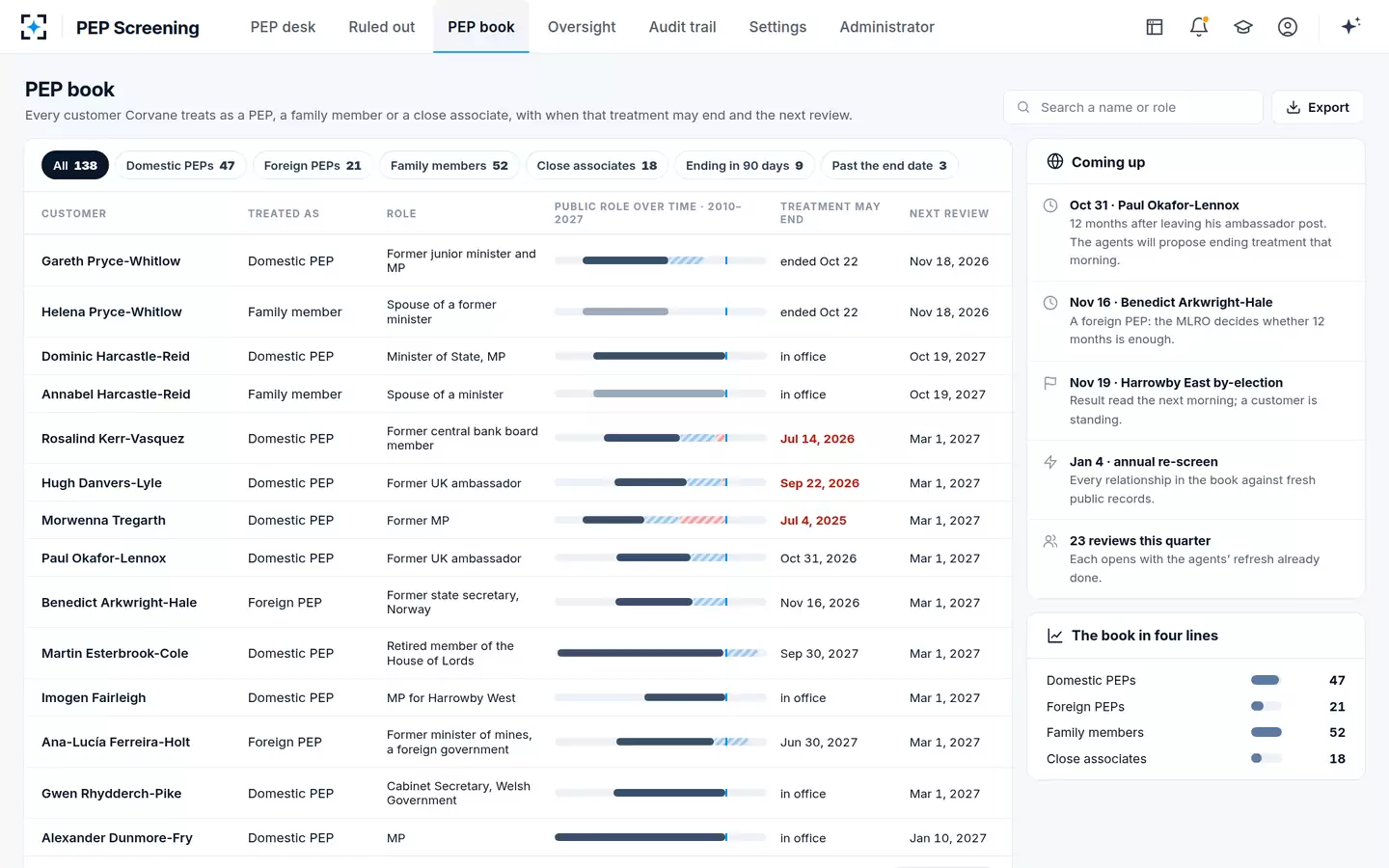
One bank’s book in PEP Screening, split the way the UK definition splits it
What the definition does to a screening queue
Every category a bank adds to its definition becomes hits in its queue, and every hit becomes analyst time. The Wolfsberg Group, writing as a standard-setter, blames long lists of PEPs and their relatives and associates for diluting the effectiveness of PEP screening, and states that “there is no requirement to screen information concerning positions which sit outside of an FI’s PEP definition” (Wolfsberg Guidance on PEPs, 2017).
Regulators see the cost from the customer’s side. Seven of the 15 firms in the FCA’s 2024 review used a definition of PEPs or of their relatives and close associates wider than expected, from international sporting officials to the boards of government-funded charities and labour group officials. The FCA’s point was that over-wide definitions push people into enhanced checks they should not face, and spend compliance effort on people who pose no extra risk.
In the solution, the definition is applied hit by hit, and the role that falls outside it is ruled out with the paragraph that excludes it. At the sample bank this month, 58 of the 760 hits the agents ruled out were roles UK law does not count, from council leaders to judges below the Supreme Court, each group tied to the passage that excludes it. An analyst checks a sample of each group before confirming it.
PEP Screening tests each listed role against the UK definition, and nothing wider
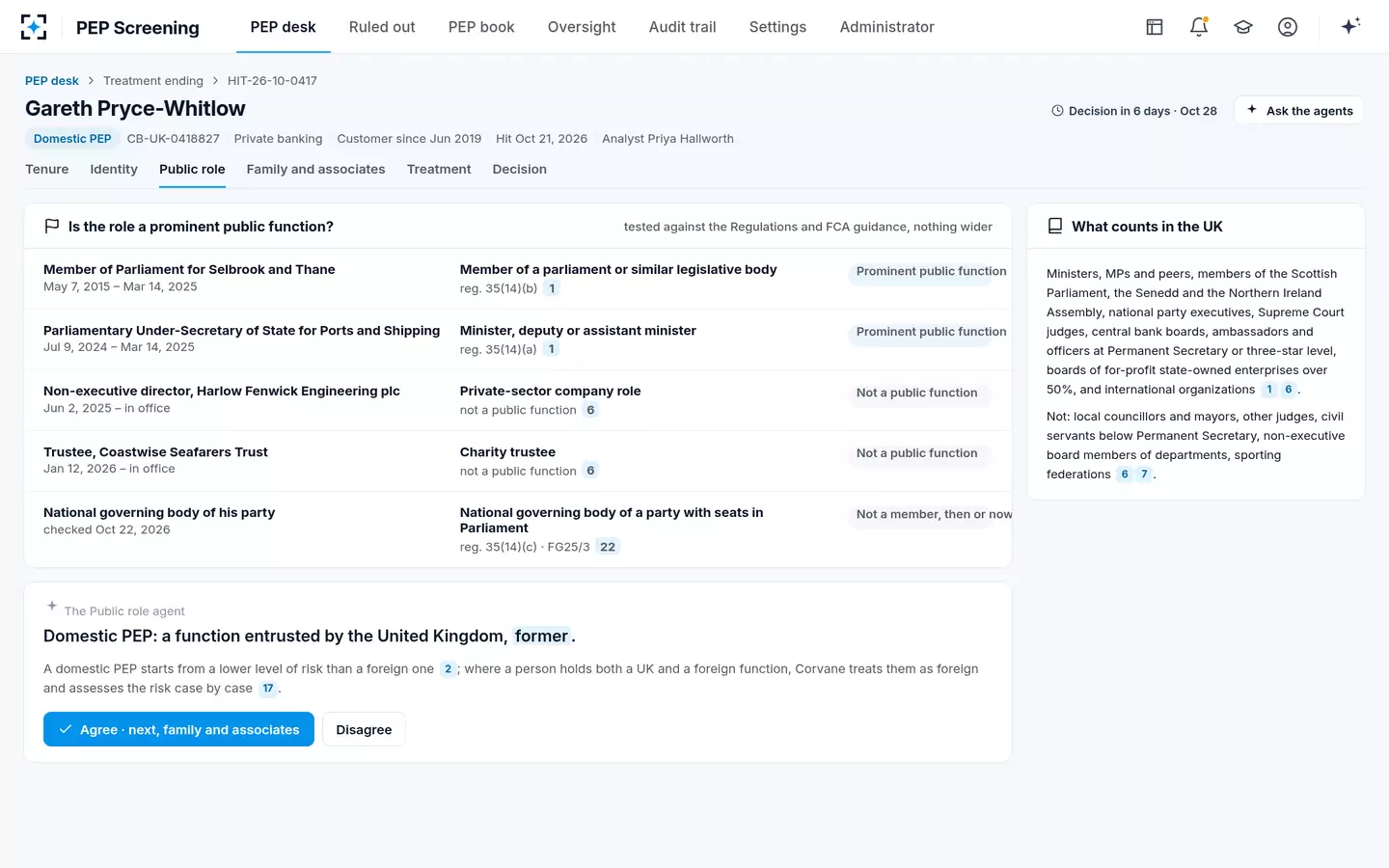
The sample bank is a UK bank, so the role test is regulation 35(14) read with FG25/3. The solution is not shown here applying the US senior foreign political figure test or the EU’s 2027 list; a bank that needs those would have to write them into its own PEP Standard, and should test the result on its own hits before relying on it. What follows a confirmed status, the enhanced due diligence file itself, is a separate piece of work; PEP enhanced due diligence under US rules covers that side.
Writing the definition down before the first hit
A definition that lives in an analyst’s head produces a different answer on every shift. Each regulator in this guide expects the bank to have written its choice down, with the reason for anything beyond the legal minimum: the FCA asks firms to “clearly document decisions to go beyond the functions set out in the Regulations”, and to record the rationale where a role more junior than Permanent Secretary is treated as a PEP.
Six choices a PEP definition has to make in writing
- Which regimes apply, and which wins inside the group
A UK branch of a US bank needs UK treatment; FCA guidance says a person who is both a domestic and a foreign PEP is treated as foreign.
- Which categories are screened, and which are not
The categories outside the definition generate hits and no duty; say whether local office, sport or charities are in or out, and why.
- How far the family circle goes
Siblings, a spouse’s parents, aunts and uncles: each regime differs, and the FCA allows a wider circle only for higher-risk PEPs.
- What makes someone a known close associate
UK law asks only about information the firm holds or credible public information; the US asks what is widely and publicly known.
- Which international organisations count
Public organisations such as the UN and NATO, from a published list; not sporting federations.
- When status ends, and who decides
At least 12 months in the UK and the EU, open-ended in US private banking; write who may approve an end and on what evidence.
The last item is the one most often left blank, and how long someone remains a PEP follows it through each regime to a date.
Questions people ask
Is a US politician a PEP?
Not for US regulatory purposes: the federal agencies say they do not read the term to include US public officials, and the senior foreign political figure rule covers foreign officials only. A bank outside the US, or a US bank’s foreign branch, will usually treat a US senator or cabinet member as a foreign PEP under its own law.
What is the difference between a PEP and a senior foreign political figure?
A senior foreign political figure is a legal term in 31 CFR 1010.605(p) and, as the agencies put it, a subset of PEPs. It carries a duty only in private banking accounts of $1 million or more for non-US persons, where the bank must ascertain whether any owner is one and apply enhanced scrutiny for the proceeds of foreign corruption.
Does nationality make someone a foreign PEP?
No. FATF’s guidance says the type of PEP depends on the country that entrusted the function, and that domicile and nationality are not relevant to the type, though they may bear on the risk. A dual national who sits in a foreign parliament is a foreign PEP to a UK or EU bank.
Can a bank refuse an account because someone is a PEP?
Not for that reason alone in the EU or the UK. The EU regulation’s recitals say refusing a relationship “simply on the basis of a determination that they are a politically exposed person” is “contrary to the letter and spirit of this Regulation”, and FCA guidance expects firms not to decline or close a relationship merely because a person meets the definition.
Is there an official list of PEPs?
Not of names in the US, the UK or the EU. The EU publishes lists of functions: the Commission’s November 2023 notice sets out the prominent public functions of all 27 Member States and the EU institutions, and from 2027 the regulation requires a single list in the Official Journal. Names come from commercial databases or a bank’s own research, with the limits any PEP database carries.
Are domestic PEPs high risk in the UK?
No. Since 10 January 2024, regulation 35(3A) makes the starting point for a domestic PEP, and for their family and close associates, a lower level of risk than a non-domestic PEP, and requires less extensive enhanced measures when no other risk factor is present. A domestic PEP with a higher-risk factor, such as influence over large public procurement, can still be assessed as higher risk.