A core deposit study is an analysis of an institution's own account history that estimates how its non-maturity deposits behave: what share is stable "core" money, how fast balances run off (decay), how much of a market rate change is passed to depositors (beta), and the resulting average life of each account type. Its outputs become the deposit assumptions in the ALM model. A study is usually commissioned every few years; a back-test checks every quarter whether depositors still behave the way the last study said. The regulators require supported, documented and tested assumptions, not a study on a fixed cycle, so the practical question is when the evidence says the study has gone stale. Botminds' Interest Rate Risk (IRRBB) Management answers it by back-testing every assumption each quarter on your own extracts.
The examples come from a fictional sample credit union in the solution, Norrell Federal Credit Union. Durations for the pilot are design targets, not a customer's measured result.
What a deposit study is asked to carry
8
kinds of analysis the OCC lists as typical support for deposit assumptions, from decay vintages to seasonality
10yrs
of observed volume changes the Basel standardised framework uses to separate stable from non-stable deposits
1/yr
minimum review of key assumptions for reasonableness in the OCC booklet; more often when markets move fast
30days
design target for a pilot that back-tests last year's assumptions on your own extracts
What is a core deposit study?
A core deposit study is a historical analysis of the institution's own deposit accounts, used to set and support the behavioural assumptions its interest rate risk model needs for deposits that have no maturity. The OCC lists it first among the sources for assumptions: "a historical trend analysis of portfolio and individual account behavior (i.e., deposit studies)" (OCC Comptroller's Handbook, Interest Rate Risk). A study may be built in-house or bought from a third party; either way it is the institution's assumption once the model uses it.
"Core" has a specific meaning. The Basel Committee's standard defines core deposits as "the proportion of stable NMDs which are unlikely to reprice even under significant changes in the interest rate environment", and asks banks to separate the stable and non-stable parts of each category "using observed volume changes over the past 10 years" (BCBS, Interest rate risk in the banking book, 2016). A community bank is not bound by that method, but it describes the question every deposit study answers: how much of this money is really staying, and on what terms.
What does a core deposit study measure?
A core deposit study measures, for each type of non-maturity account, how balances and accounts run off over time, how deposit rates moved relative to market rates, and how those patterns differ by segment and season. The OCC's examination request letter describes the expected support for deposit assumptions in one sentence: it "typically includes a historical trend analysis, a decay vintage analysis, driver rate sensitivity (beta), a segmentation analysis, a regression analysis, demographic analysis, seasonality, and market competition" (OCC booklet, request letter item 20).
What a core deposit study measures, and which assumption each part supports
| Analysis | What it measures | Assumption it supports |
|---|---|---|
| Historical trend analysis | How balances of each account type moved over several rate cycles | Core share and overall stability |
| Decay vintage analysis | How accounts opened in each period ran off, cohort by cohort | Decay rate and average life |
| Driver rate sensitivity (beta) | How much of a market rate move reached the deposit rate | Deposit beta, rising and falling rates |
| Segmentation analysis | Behaviour by balance tier, customer type, channel or product | Separate assumptions per segment |
| Regression analysis | The statistical link between rates and balances or pricing | Beta and rate-dependent decay |
| Demographic analysis | Age, tenure and relationship depth of depositors | Stability of the base |
| Seasonality | Regular swings in balances within a year | Separating seasonal flows from runoff |
| Market competition | Competitors' rates and the institution's position | Whether past behaviour will hold |
Two inputs from the OCC's reporting expectations are often missing from studies and matter most when rates rise. The booklet asks for reports that track "accounts opened in certain periods and how they have acted (vintage analysis)" and "accounts added during published promotions and how they behaved after the promotions ended." A study fitted only to aggregate balances cannot tell a promotional inflow that will leave from a core balance that will stay.
Do examiners require a deposit study?
No rule requires a deposit study by name or on a fixed cycle. What the regulators require is that deposit assumptions be reasonable, supported by the institution's own data where possible, documented, and tested against what happened. For credit unions, NCUA's appendix asks management to "rely on assumptions that are reasonable and supportable" and to "document any changes to assumptions based on observed information" (12 CFR Part 741, Appendix A). For banks, the OCC's examination procedures ask "whether management performs any analysis on the bank's deposit base to support the NMD assumptions", with deposit studies named as one of the information types.
The regulators are wary of borrowed assumptions. The FDIC says management "should use NMD assumptions that reflect institution-specific factors and avoid overreliance on industry estimates or default assumptions contained in off-the-shelf IRR models", because industry averages "are often not the most accurate estimates because they are not tailored to the bank's products, pricing strategies, market, and experience" (FDIC RMS Manual 7.1). The 2012 interagency FAQ allows industry estimates as "a starting point until sufficient internal data sets can be developed", adds that an institution "can contract with an outside vendor to assist", and closes the answer with the rule that covers studies too: "For any key assumptions, back-testing should be performed to determine whether assumption estimates are reasonable" (Interagency IRR FAQ, 2012, question 11).
So a study is one acceptable way to support deposit assumptions, and often the best way to set them. It is not evidence that they still hold. That evidence is the back-test.
How often should a deposit study be updated?
No regulator sets a cycle for deposit studies; what they set is a cycle for reviewing assumptions. The OCC asks for key assumptions to be evaluated at least once a year, and more often when markets move fast or something material changes. The FDIC asks for the process behind material assumptions to be assessed at least annually for critical ones. A study done every three years can satisfy that only if the years in between include a documented check that the study still describes depositors.
A study can also be the problem rather than the answer. The Federal Reserve's review of Silicon Valley Bank found that in April 2022 the bank "made a poorly supported change in assumption to increase the duration of its deposits based on a deposit study conducted by a consultant and in-house analysis" (Federal Reserve, SVB review, April 2023). A new study that lengthens deposit lives just as rates rise deserves more challenge, not less. What happened next is told in SVB's gap assessment against the 2010 advisory.
How much does a deposit study cost?
We have found no public, independent source for what a core deposit study costs, and providers price them differently, so this page does not quote a figure. A buyer can compare offers on what they deliver rather than the headline price: which of the eight analyses above are included, how many account types and segments, how many years of data, whether the provider re-tests the assumptions afterwards, and what the next refresh costs.
The cost that is easier to see is internal. On our estimate for the sample credit union, taking one broken assumption from back-test to a cited memo in front of the validator takes about 15 business days by spreadsheet and email; the solution's design target is about two. An institution that back-tests only once a year before the exam pays that cost rarely and discovers broken assumptions late. One that back-tests every quarter needs the cost to be small, which is the case for automating the back-test rather than buying studies more often.
A study and a quarterly back-test, side by side
A study and a back-test answer different questions: the study asks what depositors' behaviour is, from years of history; the back-test asks whether last year's depositors did what the study said. Most institutions need both, at different frequencies.
A core deposit study sets the promise; a back-test checks it
Core deposit study: What are our deposit decay rates, betas and core shares?
Quarterly back-test: Did depositors do what the current assumptions said?
Core deposit study: Several years of account history, ideally across rate cycles
Quarterly back-test: The last twelve months, on a fixed cohort, tied to the general ledger
Core deposit study: Every few years, or after a material change
Quarterly back-test: Every quarter, on a calendar
Core deposit study: A set of assumptions with their support
Quarterly back-test: For each assumption: held, drifting or broke, with causes and the NEV and NII impact
Core deposit study: Statistical depth; segments; rising and falling rates
Quarterly back-test: Speed; sees a change in behaviour within a quarter
Core deposit study: Describes the past; may lag a fast market
Quarterly back-test: One year of data; cannot by itself set a new long-run value
Core deposit study: An assumption change through review and ALCO
Quarterly back-test: A re-affirmation, a change memo, or a decision to commission a study
Interest Rate Risk (IRRBB) Management: every assumption, every quarter, with escalations
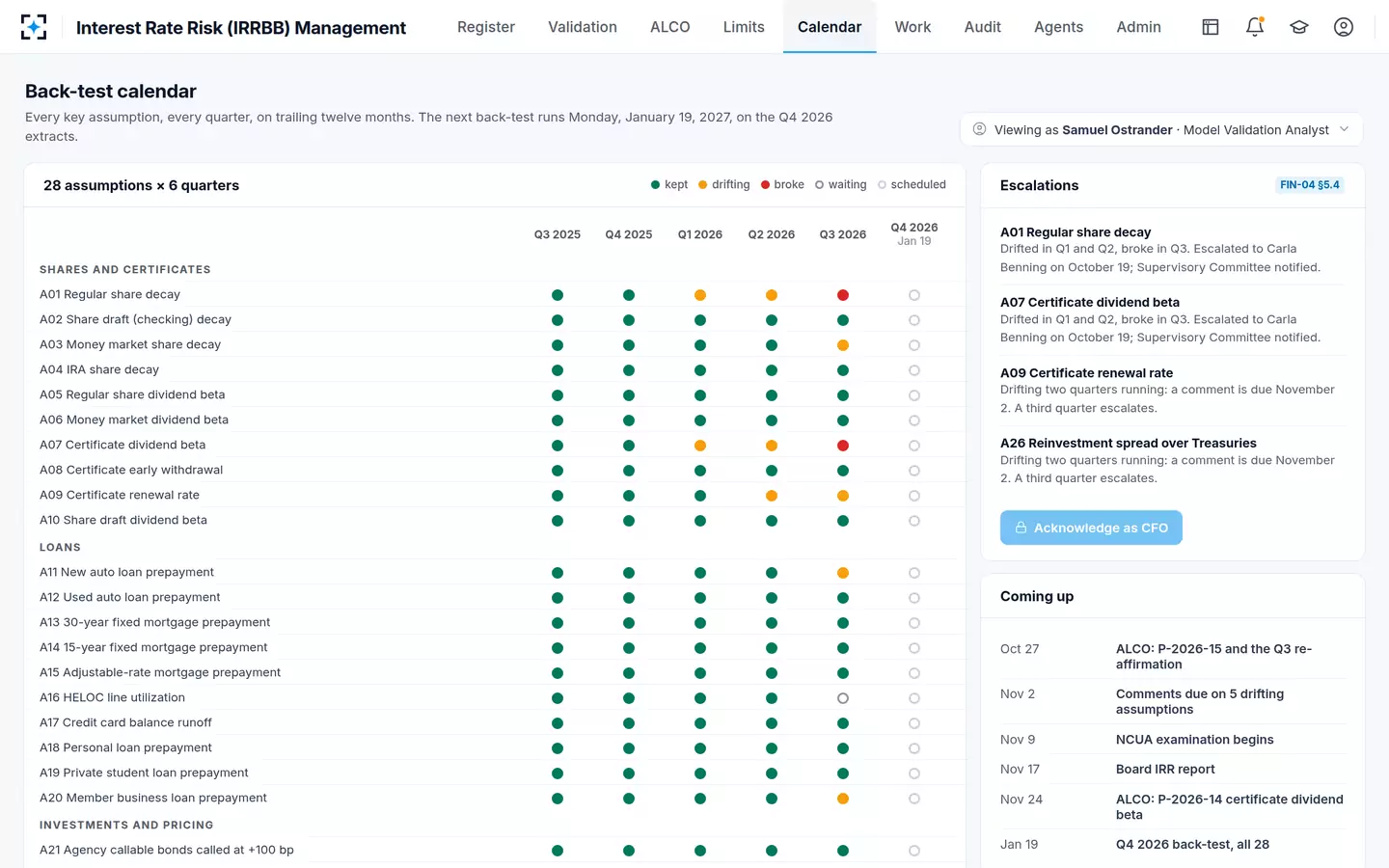
Can you back-test deposit assumptions without a study?
Yes. A back-test needs your own account-level extracts, the assumptions the model currently uses and a method for each; it does not need a new study. The FDIC describes the discipline as assumption variance analysis: institutions "should have formalized procedures for periodically identifying material differences between assumed and realized values", and "key assumptions should be checked against actual behaviors on a regular basis." Nothing in that requires an outside engagement.
What a back-test needs is data that most institutions already hold but rarely assemble: the core and loan servicing extracts at the start and end of the period, the general ledger balances to tie them to, and the assumption set with the study or analysis behind each value. The checklist below is what Interest Rate Risk (IRRBB) Management asks for on day one of a pilot.
What you need to back-test last year's deposit assumptions
- Core extracts at the start and end of the year
Regular shares or savings, share drafts or checking, money market and certificates, at account level.
- Loan servicing extracts for the same dates
Auto, mortgage, HELOC, credit card and business loans, for prepayment and utilisation assumptions.
- General ledger balances for both dates
Every extract is tied to the general ledger before anything is measured.
- The assumption set the model used, and when ALCO approved it
The promise being tested, value by value.
- The deposit study or analysis behind each value
Including how it measured decay: by balances or by accounts.
- Product and promotion calendar for the year
So a promotion's inflow and outflow can be separated from core behaviour.
- The interest rate risk policy and its limits
So each broken assumption is priced against the limits it affects.
A 30-day pilot on last year's data
The cleanest way to decide between a new study and a quarterly back-test is to back-test last year's assumptions on last year's data and look at the result. A closed year has a known answer, so the pilot also tests the tool: its numbers should match what your own team would compute for the assumptions you already know well.
A 30-day pilot on a closed year, week by week (target)
- Extracts in, tied to the general ledgerdays 1–7
- Every assumption back-testeddays 8–14
- Re-runs and causesdays 15–20
- Memos and validator challengedays 21–25
- Readout and study decisiondays 26–30
The readout should end in a decision, and the decision should be written down before the pilot starts. The sheet below is the one we suggest; your thresholds will differ.
Pass or fail: what the pilot has to show
| Test | Pass | What a fail means |
|---|---|---|
| Extracts tie to the general ledger | Every extract within your tolerance, differences shown | Data work comes before any assumption work |
| Known assumptions reproduce | For three assumptions your team already measured, the numbers match | Method or cohort definitions need agreeing first |
| Every figure opens its source | A validator can trace each number to an extract line or a model run | The output cannot go to the second line as it stands |
| Failures are shown, not filled in | A missing extract or failed run is reported and that step stops | The tool estimates where it should stop |
| The validator's recompute agrees | The second line's independent number matches within a stated tolerance | One of the two methods is wrong; find out which |
| The study question is answered | You can say which assumptions held, drifted or broke, and why | Repeat on a second year, or commission the study |
When a new study is still the right call
A new core deposit study is the right call when the back-test shows the old one no longer describes depositors and one year of data cannot say what the new long-run values are. Several broken or drifting deposit assumptions with causes that will recur, a deposit mix that has shifted, a merger, a new product line, or a market the institution has not seen are each a reason. The FDIC recognises the data problem directly: some institutions "have difficultly measuring decay rates on NMDs due to limited historical data, acquisitions, mergers, or a lack of technical expertise", and may engage third parties.
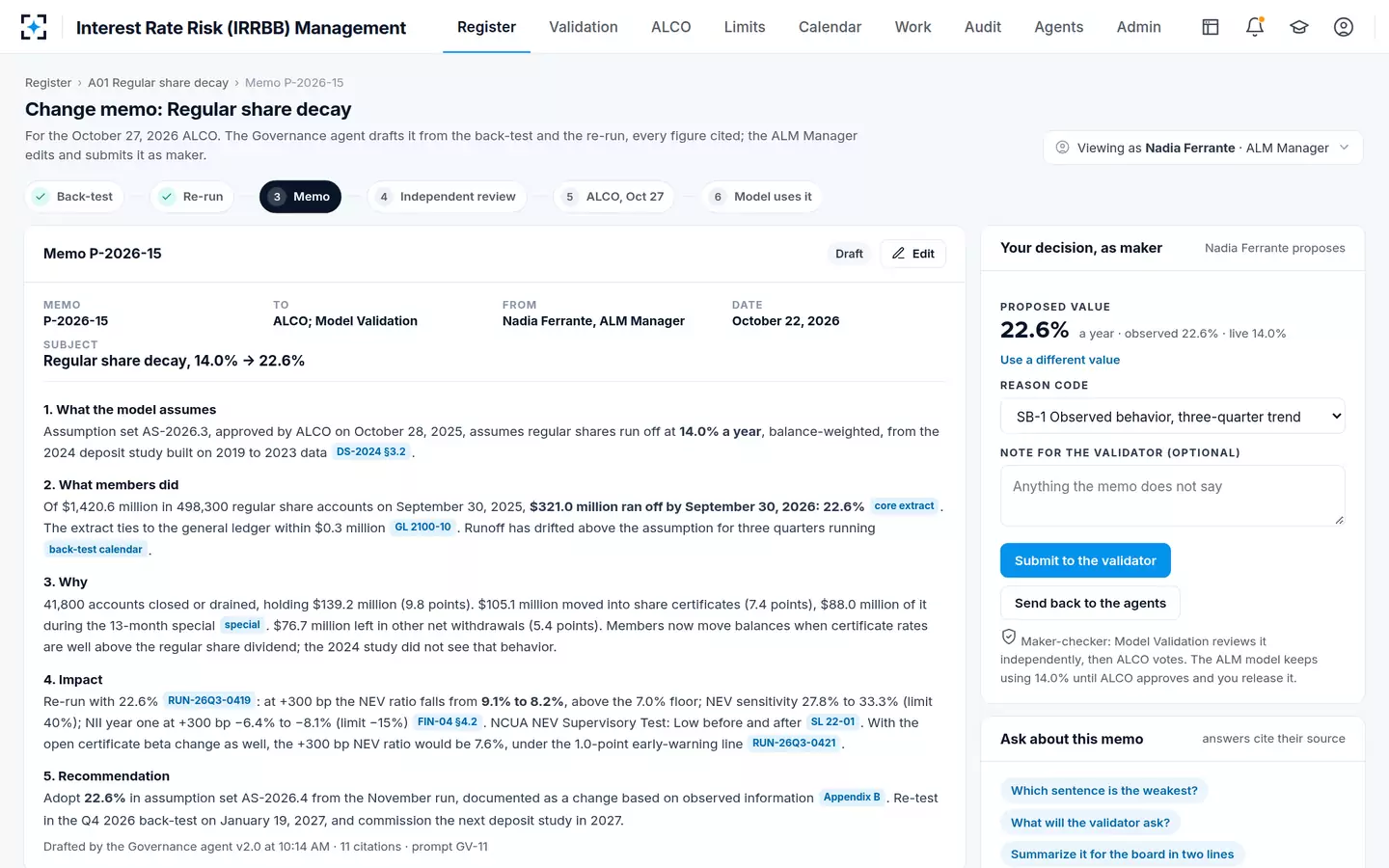
The sample credit union's own memo reaches that conclusion. Its recommendation adopts the observed 22.6% regular share decay for the next assumption set, re-tests it next quarter, and commissions the next deposit study in 2027. The back-test did not replace the study; it showed when to buy the next one and what it must explain. What the stale rate cost in the meantime is set out in the deposit decay rate guide.
The memo that adopts the observed value and schedules the next study
For institutions deciding what else to look for in tools that run these back-tests, interest rate risk management software sets out the questions to ask.
Questions people ask
What is the difference between a deposit study and a back-test?
A deposit study estimates deposit behaviour from years of history and produces assumptions. A back-test compares those assumptions with what depositors did over the latest period and reports which held. The 2012 interagency FAQ asks for back-testing of any key assumption, including one taken from a study.
What is a deposit study for banks?
It is the same analysis as a core deposit study: a review of the bank's own deposit history that estimates decay rates, betas, average lives and the stable share of each account type. The OCC lists deposit studies among the information examiners expect behind deposit assumptions.
Can a credit union use a third party's deposit study?
Yes, but the assumptions must be reasonable and supportable for that credit union, as NCUA's Appendix A requires. The FDIC and the 2012 FAQ warn against relying on industry estimates or vendor defaults, and expect the institution to test them on its own data.
How long does a core deposit study take?
That depends on the provider and the data; we have no public benchmark to cite. The internal work is predictable: account-level history for each deposit type, several years long, cleaned and tied to the books. A back-test of one closed year can be run in weeks on data the institution already holds.
What data do you need for a deposit study?
Account-level balances and rates for each non-maturity deposit type over several years, the market rates they are compared with, account open and close dates for vintage analysis, and a promotions calendar. The Basel standardised framework uses ten years of volume changes to separate stable from non-stable deposits.