Tow truck insurance fraud is any scheme in which a tow operator, or someone using a tow company, deceives an insurer: documenting tows that never happened, staging crashes with vehicles the company controls, being paid to steer crash victims to clinics and lawyers, or arriving at crashes uninvited to capture the work. It matters to fraud analysts for a second reason. Tow yards, like hospitals and large law firms, appear on thousands of honest claims, so on any link chart they look like the centre of every ring, and a team that cannot tell a busy yard from a ring's yard will either accuse the innocent or stop trusting its charts. Botminds' Fraud Network Analysis handles that by setting aside national dispatch lines and other hubs before it scores, weighting a shared tow yard low, and drawing a yard into a ring only when the claims it shares with others also share callers, clinics, lawyers or accounts.
The worked example comes from a fictional sample carrier, Keywater Insurance Company, and its South Florida SIU; the tow yard, claims and people are invented. The cases and research are cited from prosecutors, statutes and peer-reviewed work.
One sample tow yard: every tow it made sits inside one ring
Pinecrest Towing's tows in the 24-month look-back (8)
- On claims inside Ring R-14 · 100%
Those 8 tows, by dispatch time
- Dispatched before the claim was called in · 75%
- Dispatched after · 25%
Ring R-14's 11 claims
- Towed by Pinecrest · 73%
- Not towed by Pinecrest · 27%
What is tow truck insurance fraud?
Tow truck insurance fraud covers four patterns: paper tows that never happened, crashes the operator staged, payments for steering crash victims, and solicitation at crash scenes. All four have appeared in prosecutions or statutes, and all four leave records an insurer already holds.
The paper tow is the simplest. In San Francisco, a tow company operator was indicted in 2024 on a scheme in which a wrecked, undrivable car was insured and then reported as a single-car crash; the indictment alleges he agreed "to falsely document that his towing company had towed the wrecked car from the purported accident location", and the insurer paid $47,856.34 on the claim (U.S. Attorney, N.D. Cal., 2024). In a second case he admitted staging a crash with a vehicle carrier loaded with four cars. According to his plea agreement, he "generated fake tow records concerning at least 18 vehicles involved in iterations of the scheme to defraud and orchestrated at least another nine iterations", and he received 27 months for the insurance fraud, concurrent with a 60-month sentence for a separate scheme to burn competitors' tow trucks (IRS Criminal Investigation, 2026).
How do tow truck scams work against insurers?
Tow truck scams work by exploiting the tow operator's position: first at the scene, holding the vehicle, and trusted to document what happened. The four patterns use that position differently.
The referral pattern uses it to feed clinics. In a 2011 New York no-fault case, prosecutors described runners who found patients by, among other means, "paying tow truck operators to refer occupants of vehicles that had been involved in collisions" to the clinics that billed insurers (FBI New York, 2011). California makes it unlawful to employ "runners, cappers, steerers, or other persons" to procure clients or patients for insurance claims (Cal. Ins. Code § 1871.7), and its Department of Insurance tells drivers to be "cautious of any auto body or repair facility that makes referrals to medical or legal offices" because the practice may indicate capping (CDI).
The scene pattern uses it to capture work. California makes it a misdemeanor for a tow operator to stop at a crash scene to solicit towing unless a law enforcement officer or public agency requested it or the vehicle's owner or operator summoned it, and a tow operator who says it was summoned by the driver must hold, in writing and before arriving, "The first and last name and working telephone number of the person who summoned it to the scene" (Cal. Veh. Code § 22513). That rule is useful to an SIU as well as to the police: it puts a phone number on the tow record, which can be compared with the phones on the claim.
Why do tow companies appear in fraud rings, and on every other claim?
Tow companies appear in fraud rings partly because some rings use them, and mostly because tow companies appear on a large share of all auto claims. In network terms they are hubs: nodes with so many links that they connect people who have nothing to do with each other.
The research measures how large hubs get. In a network built from a couple of million claims at one insurer, KU Leuven researchers found the most connected garage on 10,436 claims, the most connected broker on 19,830 and the most connected expert on 125,951, while the typical policyholder appeared on one (Óskarsdóttir et al., 2020). In Italy's national antifraud archive, roughly 4,000 subjects were involved in more than 100 accidents each; the busiest were professionals who "play a technical role in the claim process" (Tumminello et al., Journal of Risk and Insurance, 2023).
How busy a hub gets: the most connected parties in one insurer's claims network
Put a hub like that on a chart and it joins everything. A tow dispatch line that serves a whole state will link a fender-bender in one county to a rollover in another, and a ring detector that leaves it in will draw rings around it every night. That is the false ring investigators learn to distrust, and the reason the fictional sample unit sets aside twelve national tow and glass dispatch numbers, plus anything linked to more than 400 claims, before the ring finder scores anything.
What is a hub in fraud network analysis, and should it be removed?
A hub in fraud network analysis is a person, business, phone, address or account linked to so many claims that its links carry little information on their own. Most hubs are innocent and should be set aside before rings are scored; a few are the centre of a scheme and must not be. Choosing between those is the analyst's job.
The Italian study is direct about the trap. Dropping highly connected nodes at the start would be convenient, but "some professionals (e.g., lawyers and doctors) are at the core of the fraud network and represent the link among seemingly unrelated accidents and subjects", and eliminating them "will reduce our ability to identify structured criminal networks" (Tumminello et al., 2023). Its answer is not to delete hubs but to test each link against what a node of that size would produce by chance.
An innocent hub and a ring's tow yard, side by side
A busy tow yard (an innocent hub): Hundreds or thousands across the look-back.
A ring's tow yard: Few, often a handful, most of them inside one group.
A busy tow yard (an innocent hub): Different callers, clinics and lawyers on almost every claim.
A ring's tow yard: The same caller, clinic and law firm on claim after claim.
A busy tow yard (an innocent hub): After the police, the driver or a motor club call it.
A ring's tow yard: Often before the claim is reported, sometimes with no police report.
A busy tow yard (an innocent hub): A dispatch log, an officer's request, or the driver, by name and phone.
A ring's tow yard: A name and phone that also appear on first-notice calls or intake forms.
A busy tow yard (an innocent hub): Stores the car, bills the owner or insurer for towing and storage.
A ring's tow yard: Refers the occupants on, or documents tows that did not happen.
How do you tell an innocent tow yard from a fraud ring?
You tell them apart by asking whether the yard's link to a group of claims is larger than its size would explain, and whether the group shares other links too. A big yard will turn up in many groups by chance. A small yard whose every tow sits inside one group, alongside one caller and one clinic, will not.
The arithmetic is short. Take an illustrative busy yard that appears on 1,500 of 212,406 claims. In any group of eleven claims you would expect it on about 0.08 of them; it will appear on one claim in roughly one group in thirteen, on two in about one in 380, on three in about one in 18,000. Now take the sample's Pinecrest Towing, on eight claims in the whole book, all eight inside the same eleven-claim group. The probability of that by chance is effectively zero. On a chart both look the same: a tow yard shared by several claims. Only one is a signal.
Two cautions keep the arithmetic honest. A book contains an enormous number of possible groups, so one-in-18,000 events will happen somewhere; the Italian study corrects for that by testing at a 1% level with a Bonferroni adjustment for the number of tests. And chance tests answer only whether a link is unusual, not why. The sample yard's pattern is consistent with a tow company that only works for one organizer; it is also consistent with a small yard near a single dangerous intersection that one clinic happens to serve. The second explanation is what the investigator checks next.
What is a statistically validated network?
A statistically validated network is a link map that keeps only the links too frequent to be explained by chance, given how busy each node is, and drops the rest. The Italian study built one from the national antifraud archive by modelling each pair's co-occurrences with a hypergeometric distribution and keeping a link only when the count was too large to be consistent with "the null hypothesis of random co-occurrences" (Tumminello et al., 2023).
The effect is to filter hubs without deleting them. A lawyer on 10,000 claims who shares one claim with a driver keeps no link to that driver, because one shared claim is what you would expect. The same lawyer sharing nine of a driver's ten claims keeps the link, because nine is not. Tested on three groups of cases reported by prosecutors and enforcement authorities, the method rated six of seven, 60% and 42.2% of the accidents involved as highly anomalous. Fraud Network Analysis scores weighted shared links after setting hubs aside, which keeps every point of a score traceable to a named link; a formal chance test like this one is a useful companion to any score. The two approaches can be run together, as five tests a detected ring must pass recommends.
Six questions that separate a busy tow yard from a ring's yard
- What share of the yard's claims sit inside this group?
A handful of claims, all in one group, is a different animal from thousands spread across the book.
- Was it dispatched before the claim was reported?
Compare the dispatch time on the invoice with the first-notice call. Six of eight before the call is a pattern.
- Who summoned it, and is that phone anywhere else?
Where state law requires the summoner's name and phone on the tow record, compare it with the claim's callers and referrals.
- Where did the occupants go next?
The same clinic within days, the same law firm within a week, across the yard's claims.
- Did the tows happen?
Check scene photographs, police reports and storage records against the invoice. Paper tows leave no car in the yard.
- Is it a dispatch line, not a yard?
Motor club and national dispatch numbers connect everything. They belong on the hub list, not in a ring.
Do body shops commit insurance fraud?
Some do, and the patterns overlap with tow fraud because the same vehicle passes through both. California's Department of Insurance lists the common ones: reporting parts as damaged that were not, final costs above the estimate, unauthorized repairs, "Charging for genuine parts when aftermarket or used parts from a junk yard were used", and repair facilities referring customers to medical or legal offices (CDI). Most of those are estimate and invoice questions; reading a repair estimate line by line is covered in how to read a body shop estimate.
For a link analyst the body shop is another potential hub, with the same test. In the fictional sample unit, the ring finder has drawn a group around a body shop, one tow yard and one appraiser inbox on seven collisions; whether that is a ring or a busy shop with a regular tow partner is exactly the question the six checks above are for.
Who handles a tow yard that appears in a ring
Today
Sees the same yard on dozens of charts and cannot say which links mean anything.
With agents
Keeps national dispatch lines on the hub list, weights a shared tow yard low, and reviews the yards that recur inside drawn rings.
Still theirs: The hub list and the tow weight.
Today
Pulls tow invoices by hand to check dispatch times.
With agents
Opens each tow link at the invoice, sees the dispatch time beside the first-notice call, and decides whether to look further.
Still theirs: Whether the yard becomes part of a lead.
Today
Pays towing and storage on each claim alone.
With agents
Gets an alert if a watched yard or phone appears on a new claim; keeps paying what is owed.
Still theirs: Every claim decision.
How do insurers investigate tow companies?
Insurers investigate tow companies from their own records first: tow invoices and dispatch times, storage bills, scene and vehicle photographs, police reports, the summoner details state law requires, and the other claims the yard appears on. Only then do they go outside, to recorded statements, examinations under oath where the policy allows them, and referral to the state fraud bureau.
The San Francisco case shows why records come first. According to the plea agreement as the U.S. Attorney describes it, the insurer in the staged vehicle-carrier crash denied the operator's own claim as fraudulent, yet still paid one of his towing companies $5,210 to recover, tow and store the vehicles from that same crash (U.S. Attorney, N.D. Cal.). The claim and the tow bill were handled separately, and the tow bill was paid. A link map that put the tow company and the denied claimant on the same node would have flagged that payment.
A tow yard on the Fraud Network Analysis link map, with its badge for other claims
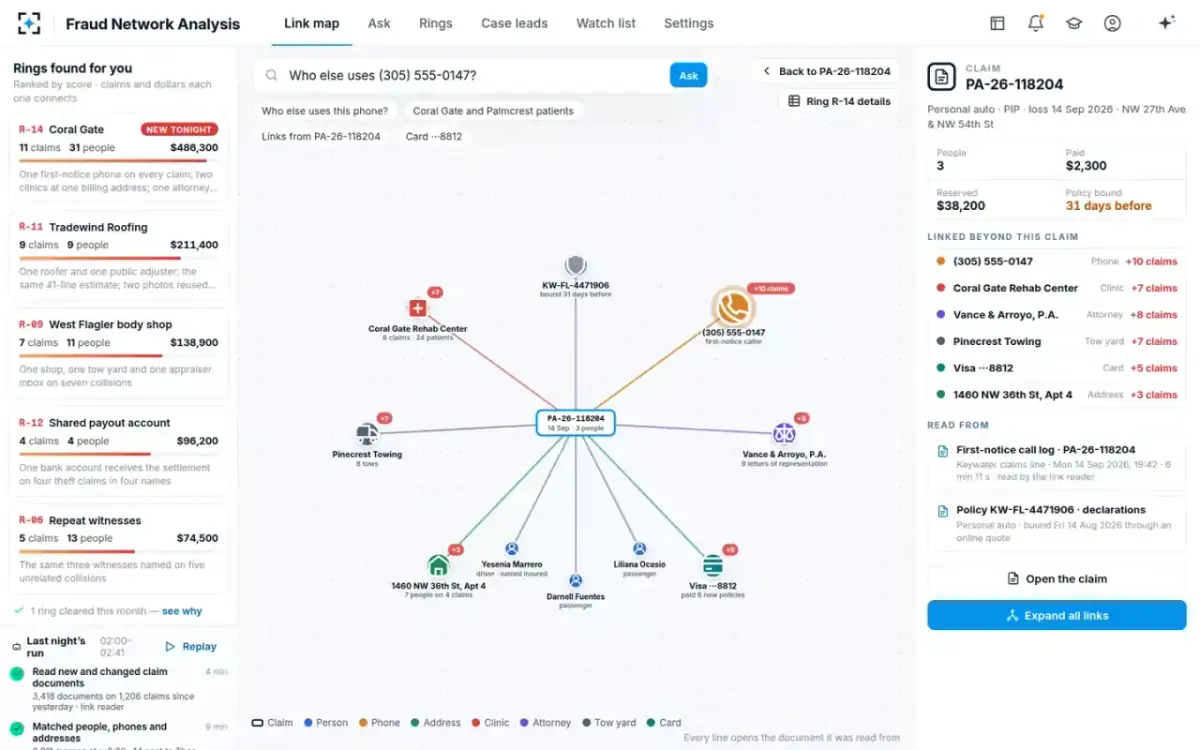
What Fraud Network Analysis does with a tow yard
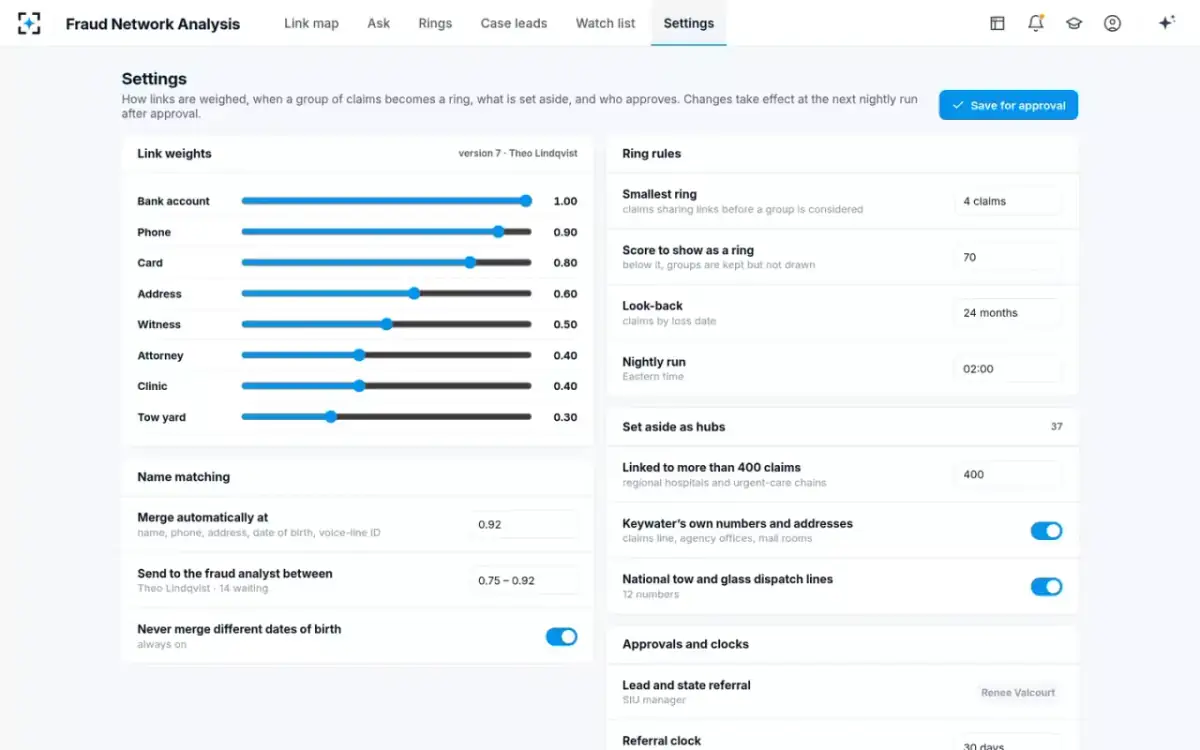
Fraud Network Analysis treats a tow yard as a weak link that becomes strong only in company. Its link reader takes the tow company, invoice number and dispatch time from each tow invoice, with the line it came from. The ring finder sets aside national tow and glass dispatch lines and any node linked to more than 400 claims, then scores groups of at least four claims by the weights the analyst sets, where a shared tow yard counts for 0.30. A yard on its own will never draw a ring; a yard that shares claims with one caller, one clinic and one firm adds to a ring that those links have already started.
When it does appear in a ring, it appears with its evidence. In the sample, the ring page puts each claim against each shared link and the lead writer notes that the tow yard towed eight vehicles, six of them dispatched before the claim was reported. The investigator decides what that means; the agents never call the yard part of a fraud, never contact it and never hold its bills. The rest of the sample ring is described in staged accident indicators that only show up across claims; the controls an analyst uses are shown in the settings below, and the whole solution at Fraud Network Analysis.
Where the tow weight and the hub list are set
Questions people ask
Is it illegal for a tow truck to show up at an accident uninvited?
In California, a tow operator who stops at a crash scene to solicit towing commits a misdemeanor unless it was requested by a law enforcement officer or public agency, or summoned by the vehicle's owner or operator. Other states have their own rules. In any state, a tow that arrives before anyone reported the crash is worth a question.
Can a tow company be part of a staged accident ring?
Yes. In San Francisco a tow company operator admitted staging a crash with a vehicle carrier and generating fake tow records for at least 18 vehicles; in New York, prosecutors described runners paying tow truck operators to refer crash occupants to no-fault clinics. Most tow companies on most claims are doing honest work, which is why the link has to be tested, not assumed.
Why do national dispatch lines get set aside?
Because one motor club or national dispatch number can appear on thousands of claims across a state, linking crashes that have nothing in common. Left in, it draws false rings every night. The fictional sample unit sets aside twelve national tow and glass dispatch numbers before the ring finder scores anything.
What should I check on a tow invoice?
The company, the dispatch time, the pickup location, who summoned the tow and their phone where the law requires it, the storage yard, and the charges. Then compare the dispatch time with the first-notice call and the pickup location with the police report, and check whether the same company appears on other claims with the same caller or clinic.
Does a tow yard on many claims mean fraud?
No. A yard on many claims is usually just busy, and research on insurers' claim networks finds the busiest repair and towing parties on thousands of claims. The signal is a yard whose claims cluster inside one group that also shares callers, clinics or lawyers, which is far less likely by chance.