Staged accident indicators are the facts that suggest a crash was planned to collect insurance money: a sudden stop with no reason, passengers or witnesses who were not there, injuries out of proportion to the damage, an attorney who calls before anyone asked. Regulators publish lists of them, and adjusters are trained on them. But nearly every one of those indicators also describes honest crashes, which is why a single claim rarely proves anything. The indicators that separate a staged-accident ring from bad luck sit across claims: the same callback number on many first-notice calls, the same clinic seeing every passenger within two days, the same law firm, tow yard or card on claim after claim. Botminds' Fraud Network Analysis is built to read those cross-claim indicators out of claim documents and draw them as rings for an investigator to judge.
The worked example below is a fictional ring from the solution's sample data, at Keywater Insurance Company's South Florida SIU; its people, clinics and phones are invented. The real cases and rules are cited from prosecutors, regulators and statutes.
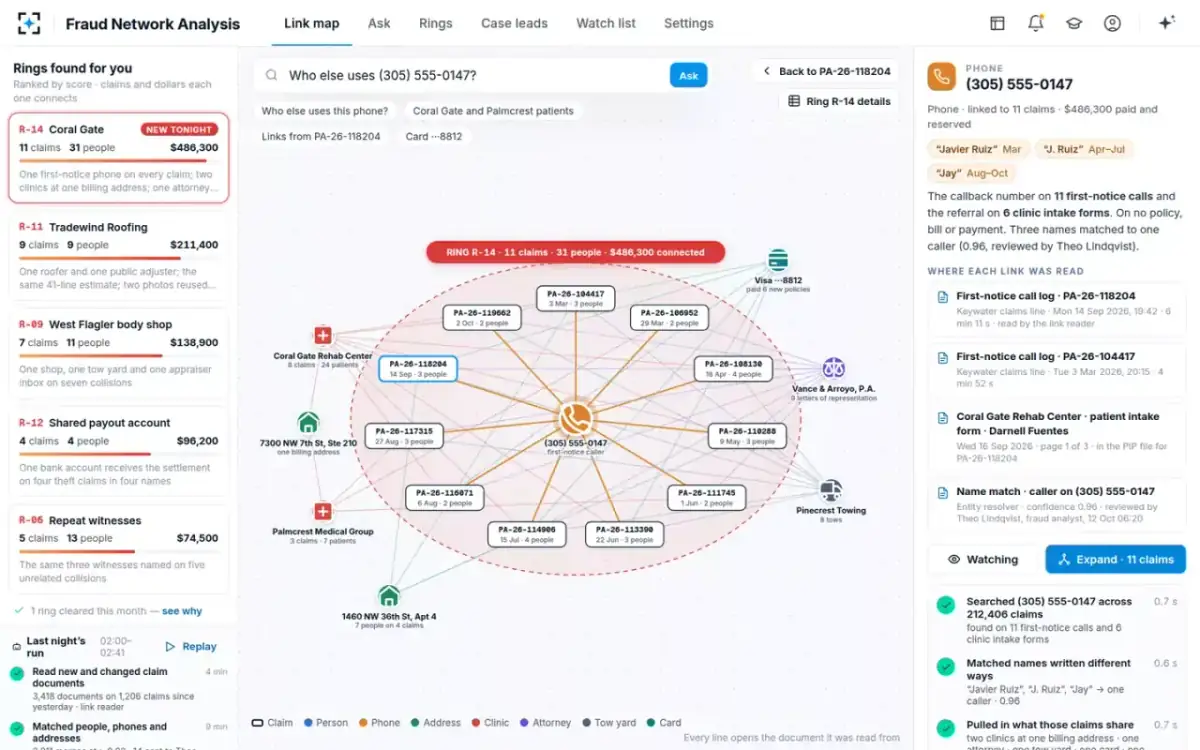
One staged-accident ring, drawn: eleven claims, one phone, four shared links
What are staged accident indicators?
Staged accident indicators are facts, patterns or behaviours that support an inference that a crash was deliberate or never happened, and they come in two kinds. Single-claim indicators can be seen in one file: how the crash happened, who was in the car, what was claimed. Cross-claim indicators can only be seen when several files are read together: the same people, phones, providers or accounts recurring.
Most published lists are of the first kind, because they are written for adjusters and consumers who see one claim at a time. The second kind is where organized rings give themselves away, because a ring's whole business is repetition: it reuses the drivers, passengers, runners, clinics, lawyers and tow operators that make the scheme pay. The California Department of Insurance names the cast as the people in the crash, the stagers and cappers who organize it, and the attorneys, doctors, chiropractors and body shops who profit from it (CDI, Automobile Fraud).
The single-claim indicators regulators list, and why honest crashes share them
The Department's consumer guide lists the classic signs: "Suddenly stopping for no apparent reason", "Intentionally disregarding the right-of-way", "Giving up the right-of-way in order to cause an accident", passengers and witnesses listed who were not there, "Injuries claimed are excessive compared to vehicle damage", a temporary registration, prior damage to the other vehicle, and "Contact by an attorney without being solicited" (CDI, auto insurance guide). Researchers who built one of the first network systems for auto fraud added a profile: staged crashes "occur in late hours and non-urban areas in order to reduce the probability of witnesses", with many passengers, the police always called, and participants with injuries "when there is almost no damage on the vehicles" (Šubelj, Furlan and Bajec, 2011).
Every item on those lists is useful and none is enough. Real drivers brake suddenly, real crashes happen at night on empty roads, real passengers hurt their necks in low-speed impacts, and some lawyers advertise hard. California's own definition of a red flag in its SIU regulations, facts that singly or in combination support an inference of fraud, is careful to include patterns and trends as well as facts present on a claim (10 CCR § 2698.30). A single-claim flag is a reason to ask questions. It becomes evidence when it repeats.
It was just a good, old-fashioned case, conducting interviews and reviewing documents—such as police reports and insurance company records—looking for patterns.
Special Agent Daniel Curtin, FBI New Haven, on a Connecticut ring that staged about 50 crashes
What is a swoop and squat accident, and what are the other types of staged accidents?
A swoop and squat is a staged rear-end collision: a car cuts in front of the target and brakes hard, so the target rear-ends it and appears to be at fault; sometimes other cars hem the target in. New York's regulator described a 2024 Queens collision in which participants "using four cars, targeted an unsuspecting vehicle and intentionally caused a collision" (NY DFS, 2025 health insurance fraud report), and a Belt Parkway case in its 2025 enforcement report: organizers met participants inside an East New York medical clinic, and on the Belt Parkway a car pulled in front of the victim's moving car, "suddenly stopping, and then reversing into it", all recorded on the victim's dashcam (NY DFS, 2025 CPFED Annual Report).
The other common types follow the same logic of manufacturing fault. In a wave-on or drive-down, the stager gives up the right of way, waving the target out, then hits it and denies the wave; California lists "Giving up the right-of-way in order to cause an accident" for this reason. In truck sideswipes, a driver swerves into a tractor-trailer or bus to sue a commercial defendant; New Orleans' Operation Sideswipe convicted dozens of people for them. In single-car staged crashes, a group drives a car off a remote road and blames the conditions, as the Connecticut ring did: a deer in autumn, a snowy street in winter (FBI, 2017). And in a paper accident nothing happens at all: "Often these accidents only exist on paper (referred to as paper accidents), and no innocent parties are involved" (CDI). Paper accidents are the hardest to spot in one file, because there is no scene, and often the easiest to spot across files, because the same names keep appearing.
The indicators that only show up across claims
The indicators that expose rings are repetitions: the same identifier, or the same timing, recurring on claims that should have nothing in common. They do not appear on consumer lists because no consumer and few adjusters can see them.
The same ring, seen in one claim and seen across eleven
In one claim file: "Jay", a friend of the driver, called it in. Unremarkable.
Across the eleven sample claims: One callback number on all eleven first-notice calls, under three names: "Javier Ruiz", "J. Ruiz", "Jay".
In one claim file: Three occupants treated at a rehab clinic two days later.
Across the eleven sample claims: All 31 claimants first seen within two days, at one of two clinics that bill from the same suite.
In one claim file: A letter of representation on day five.
Across the eleven sample claims: The same firm on nine of eleven claims, each letter within a week.
In one claim file: A tow invoice from a local yard.
Across the eleven sample claims: The same yard on eight claims, six dispatched before the claim was called in.
In one claim file: Bound 31 days before the loss.
Across the eleven sample claims: Seven of eleven policies bound under 60 days before the loss; six paid with one card in six names.
In one claim file: A crash on a Monday evening in September.
Across the eleven sample claims: A loss roughly every three weeks from March to October.
Timing deserves its own line. The sample ring's eleven losses fell 26, 20, 21, 23, 21, 23, 22, 21, 18 and 18 days apart, and a twelfth was called in nine days after the eleventh. Honest crashes do not keep a schedule. A ring that needs a steady flow of patients for its clinic does.
A loss about every three weeks: the gaps between the sample ring's claims
- 1 → 226 d
- 2 → 320 d
- 3 → 421 d
- 4 → 523 d
- 5 → 621 d
- 6 → 723 d
- 7 → 822 d
- 8 → 921 d
- 9 → 1018 d
- 10 → 1118 d
- 11 → new call9 d
What is a spotter, a runner and a capper in a staged accident?
A spotter follows the staging driver in a separate car and handles the getaway; a runner recruits participants or patients; a capper steers people to a lawyer or clinic for a fee. The words come from prosecutions and statutes, and each role leaves a different trace in the claim files.
The roles in a staged-accident ring, and where each shows up
| Role | What the record says | Where it shows up in claims |
|---|---|---|
| Spotter | In Operation Sideswipe a paid spotter followed the staging driver in a second car as he set up crashes with 18-wheelers, and collected him afterwards (U.S. Attorney, E.D. La.). | Rarely on paper. Visible as a driver who switches seats, or a vehicle that left the scene. |
| Driver and passengers | Recruited and paid: the Michigan ring "recruited and paid cash to individuals to stage automobile accidents and obtain police reports" (U.S. Attorney, W.D. Mich.). | The same people as claimants, drivers or witnesses on several claims, often under varied spellings. |
| Runner or capper | California defines a runner or capper as anyone acting for consideration as an agent for a lawyer "in the solicitation or procurement of business" (Bus. & Prof. Code § 6151), and makes it unlawful to employ runners, cappers or steerers to procure clients or patients for insurance claims (Ins. Code § 1871.7). | A "referred by" line on intake forms; one phone calling in claims for strangers. |
| Clinic | In Michigan, clinic managers coached participants on which symptoms to describe to a physician working with the ring (W.D. Mich.). | First visits within days of every loss; one billing address, phone or tax ID under several clinic names. |
| Lawyer | In New York's largest no-fault case, prosecutors alleged that clinic controllers referred patients to personal injury lawyers, who paid kickbacks for the referrals (FBI New York, 2012; charges are accusations). | The same firm on most claims, letters within days. |
| Tow operator | New York prosecutors alleged that some no-fault runners paid tow truck operators to refer crash occupants to clinics (FBI New York, 2011). | The same yard, dispatch times before the claim call. |
Florida writes the roles into its fraud statute. It is a second-degree felony, with a two-year minimum term, to "organize, plan, or knowingly participate in an intentional motor vehicle crash or a scheme to create documentation of a motor vehicle crash that did not occur" for PIP or tort claims, and a felony to solicit crash victims for those claims by direct contact within 60 days of the crash (Fla. Stat. § 817.234(8)–(9)). The "referred by" line on a clinic intake form dated two days after a crash is, in Florida, a line worth reading carefully.
Do staged accidents involve doctors and lawyers?
The large ones usually do, because the medical bills and the injury claims are where the money is. In New York in 2012, federal prosecutors charged 36 people, including 10 licensed doctors and three lawyers, in what they described as the largest no-fault auto insurance fraud ever charged (FBI New York, 2012). In Michigan, the ring ran three therapy clinics. In Operation Sideswipe, the participants in one staged crash with a tractor-trailer went to a lawyer's office a day or two later, and another staged crash, into a bus, settled for about $677,500 (U.S. Attorney, E.D. La.).
That is also why professionals are the hardest indicators to read. Most doctors, chiropractors and personal injury lawyers on auto claims are doing honest work, and the busiest of them appear on thousands of claims. The indicator is not that a clinic or firm appears, but that it appears on a group of claims that share other links too: the same caller, the same address, the same timing. The difference between an innocent hub and a ring is worked through on a tow yard.
How do insurance companies investigate staged accidents?
Insurers investigate staged accidents by connecting the claim to others first, then testing the facts that connection raises: recorded statements, examinations under oath, scene and vehicle inspections, provider records and, where warranted, a referral to the state fraud bureau. Investigating does not suspend the law on paying claims. Florida's PIP statute lets an insurer with a reasonable belief that a fraudulent insurance act was committed notify the claimant in writing within 30 days that the claim is under investigation, then take an additional 60 days, but it must pay or deny within 90 days of submission and report claims denied for suspected fraud to the Division of Criminal Investigations (Fla. Stat. § 627.736(4)(i)). California extends its 40-day decision period to 80 days where specific information supports a suspected fraudulent claim (10 CCR § 2695.7).
Those windows are short, which is the practical case for reading claims together. An investigator who learns on day three that a new claim's caller, clinic and attorney match ten others can ask the right questions inside the window. One who learns it after the eleventh claim has been paid is investigating history. In the sample unit, Fraud Network Analysis's watch list caught a new call from the ring's phone about six hours after the ring was drawn, and alerted the investigator and the PIP adjuster with the source; nothing was held, and the adjuster kept the claim under the PIP rules.
In Fraud Network Analysis, eleven claims pull into one ring when the phone is expanded
How Fraud Network Analysis reads cross-claim indicators
Fraud Network Analysis turns cross-claim indicators into links by reading the documents where they are written. Its link reader takes every phone, name, address, card, account, plate and provider out of first-notice call logs, PIP applications, clinic intake forms, bills, letters of representation, tow invoices and billing records, with the page and line each came from. The entity resolver joins the same person or business written different ways. The ring finder rebuilds the map each night over a 24-month look-back, sets aside hubs that link everyone, and draws groups of claims whose shared links score above the unit's threshold, each labelled with why it was drawn.
The indicators then come back to people in a form they can use: a ring page that lays the losses out in time and puts each claim against each shared link, a cited answer to "who else uses this phone?", and a drafted lead in "linked to" wording with numbered exhibits. The agents never call a ring fraud or name a suspect; a ring is a reason to look. How those links are read on a chart, and what to ask before believing one, is the subject of link analysis chart: how to read one, link by link, and the prosecutions behind these patterns are collected in staged accident rings, case by case. To see the solution end to end, start from Fraud Network Analysis.
Questions people ask
How do you know if an accident was staged?
From one claim you usually cannot know, only suspect: the regulators' lists of signs, such as a sudden stop for no reason or injuries out of proportion to the damage, fit many honest crashes. Confidence comes from repetition across claims, such as the same caller, clinic, attorney or tow yard on several unrelated crashes, and from what statements, examinations and records then show.
What is a capper?
A capper, or runner, steers accident victims to a lawyer or clinic in return for payment. California defines a runner or capper as anyone acting for consideration as a lawyer's agent in soliciting or procuring business, and its Insurance Code makes it unlawful to employ runners, cappers or steerers to procure clients or patients for insurance claims. The California Department of Insurance calls capping a felony.
What is a spotter in a staged accident?
A spotter accompanies the staging driver in a second car, watches for the moment, and helps afterwards. In Operation Sideswipe in New Orleans, a spotter admitted following the driver as he prepared to stage crashes with 18-wheelers and picking him up after he left the vehicle; he was sentenced to 21 months.
Are staged accidents common?
They are a recognized category of organized fraud in every large auto market. California's Fraud Division assigned 65 new organized automobile fraud cases in fiscal year 2023-24, and New York's 2025 reports describe several staged-collision investigations with the NYPD. Single-claim counts are unreliable because most staged crashes are never proven; the rings that are proven usually involve dozens of claims.
What should I do if I think someone staged an accident with me?
Stay safe, call the police, and record what you can: photographs of the scene, how many people were in the other car, and any witnesses. Report it to your insurer and, if you suspect fraud, to your state's insurance fraud bureau. The insurer's special investigations unit will treat your account as one claim among the others it can connect it to.