Staged accident rings are organized groups that cause or invent car crashes to collect insurance money, and they are caught, when they are caught, because the same people, clinics, lawyers, phones or vehicles turn up on claim after claim. Read in the prosecutors' and investigators' own releases, nine cases from the last two decades, from South Florida's chiropractic clinics to a San Francisco tow operator's fake records, follow one pattern. The ring repeated itself for years; the repetition was written in police reports, claim files and medical bills; and the case began when someone looked across them. That is the gap Botminds' Fraud Network Analysis is built to close: it reads an SIU's claim documents each night, links the claims that share people, providers and accounts, and draws the rings for an investigator to judge.
Every case below is quoted from a U.S. Attorney's release, an FBI release or story, the IRS's copy of a Justice Department release, or New York's Department of Financial Services. Charges are allegations until proven; where a release reports a sentence, it is a conviction. Names of individuals are left out: the roles are the lesson.
Nine staged accident rings: years of activity, and when the law caught up
South Florida chiropractic clinics (Operation Sledgehammer)
2006–2012 · first charges, June 2011
New York no-fault clinic organization (RICO)
2007–2012 · 36 charged, 2012
Brooklyn and Queens no-fault clinics
24 charged, 2011
Connecticut single-car crashes
2011–2014 · ringleader sentenced, 2017
West Michigan therapy clinics
2012–2015 · leaders sentenced, 2017
New Orleans truck crashes (Operation Sideswipe)
2015–2017 · 37 convicted by 2022
San Francisco tow records
2017–2021 · operator sentenced, 2026
Louisville chiropractic clinics
four sentenced, 2023
Queens and Belt Parkway collisions
arrests reported, 2025
What are staged accident rings?
A staged accident ring is a group that manufactures crashes, or the paperwork of crashes, and profits from the claims that follow, usually through medical bills and injury settlements rather than vehicle damage. California's Department of Insurance describes the range, from "'paper' collisions to actually targeting vehicles on streets and freeways to cause an accident for the purposes of collecting settlements from insurance carriers" (CDI, Automobile Fraud).
The cases below show three business models. Some rings are built around clinics, which bill for treatment the staged "patients" do not need or never receive. Some are built around lawsuits, which target defendants with deep pockets such as trucking companies. And some are built around vehicles, which are insured, crashed and towed on paper. All three need many claims to pay, which is why all three leave a trail across files.
Nine prosecutions, read in the prosecutors' own words
Each case below is summarized from its release, with the link that tied the claims together and the evidence the release itself names. The third column is the question an SIU could have asked of its own files.
The casebook: what linked the claims, and what an SIU could have seen
| Case | What the release says | The link an SIU could have seen |
|---|---|---|
| South Florida, 2006–2012 | Clinics with "nominee owners"; 21 clinics took part; 92 defendants charged across six operations, 56 federally, with court-ordered restitution of more than $5 million. | Many clinics, few real owners: shared staff, addresses and billing behind changing names. |
| New York, charged 2011 | Alleged in the charges: runners paid to recruit patients; doctors faking clinic ownership; clinics that changed their names or locations to avoid detection; a patient coached before her examination under oath. | Runner phones on claim calls; one doctor across "different" clinics. |
| New York, 2007–2012 | An alleged scheme to defraud insurers of more than $279 million; 36 charged including 10 doctors and three lawyers; the first no-fault case charged under RICO; insurers' investigative units thanked for "invaluable assistance". | The same straw-owner doctors, modality clinics and law firms recurring. |
| Connecticut, 2011–2014 | About 50 crashes, $10,000 to $30,000 paid on each; late-night single-car crashes on remote roads; recorded claim calls. | The same participants in different seats, crash after crash. |
| West Michigan, 2012–2015 | Three therapy clinics; recruited, paid participants; scripted symptoms; blank treatment forms signed; restitution of $675,066.96. | Every claimant at the same three clinics, soon after the crash. |
| New Orleans, 2015–2017 | Crashes into tractor-trailers and a bus; a "spotter" in a following car; driver and passenger switched seats; claimants at a lawyer's office within days; 37 convicted by 2022. | The same staging driver behind several claimants' crashes; the same attorneys. |
| San Francisco, 2017–2021 | A tow operator generated "fake tow records concerning at least 18 vehicles" and staged a vehicle-carrier crash. | One tow company documenting tows on unrelated single-car claims. |
| Louisville, sentenced 2023 | Five conspirators recruited people for fake accidents and treatment at certain chiropractic clinics; restitution of $343,832.41. | Recruits sharing clinics across claims. |
| Queens and the Belt Parkway, 2024–25 | Organizers briefed participants inside a clinic, told them to send scene photos to a co-conspirator and to attend a specific clinic; one crash was caught on the victim's dashcam. | The same clinic and the same organizer phone on several claims. |
How are staged accident rings caught?
Staged accident rings are caught by people noticing repetition in records that already exist: claim files, police reports, recorded calls, medical bills. Not one of these nine releases describes a ring exposed by a single suspicious claim. Each describes a pattern assembled from many.
The Connecticut case is the clearest statement of method. A group of friends staged crash after crash from 2011 to 2014, mostly "late-night, single-car crashes on remote roads without witnesses", with insurers paying $10,000 to $30,000 a time. The repeat crashes raised red flags for insurers, and the National Insurance Crime Bureau, which the FBI describes as a liaison between law enforcement and insurance companies, shared crash data with the FBI and the U.S. Attorney. The case agent described what followed as an old-fashioned case of interviews and document review, and added the detail that made the charges: "the fraudsters made interstate telephone calls to file the insurance claims, and the calls were recorded, forming the foundation for many of the wire fraud counts" (FBI, 2017). The first-notice call was the evidence.
With a lot of these staged crashes, the fraudsters made interstate telephone calls to file the insurance claims, and the calls were recorded, forming the foundation for many of the wire fraud counts.
Special Agent Daniel Curtin, FBI New Haven
New York's 2025 cases show the newer evidence. One staged collision on the Belt Parkway was caught on the victim's dashcam; in a Bronx case, "The surveillance footage showed the conspirators in discussion on the street moments before one conspirator entered his car and repeatedly drove into the side of the other conspirator's car", and the claimants "provided false testimony in their examinations under oath" (NY DFS, 2025 CPFED Annual Report). Video proves a crash was staged. Only the claim files show which other crashes the same people were in.
What happened in Operation Sideswipe?
Operation Sideswipe was a federal investigation in New Orleans into crashes staged with tractor-trailers and buses so that the occupants could sue the commercial vehicles' owners and insurers. By May 2022 the U.S. Attorney counted 37 defendants convicted (U.S. Attorney, E.D. La., 2022). The releases describe a staging driver who rammed commercial vehicles with recruited passengers aboard, then switched seats so a passenger appeared to have been driving, and a "spotter" who followed the staging driver in a separate car as he set up crashes with 18-wheelers, then picked him up afterwards (U.S. Attorney, E.D. La., 2021).
Two crashes show the money. A staged collision with a bus on Interstate 10 in October 2015 settled for about $677,500; a staged collision with a tractor-trailer in September 2017 settled for $30,000. After the 2017 crash, the occupants went to an attorney's office "for the purpose of collecting money from the insurance and trucking company" within a day or two, sought treatment, and later gave false testimony in depositions (U.S. Attorney, E.D. La.). The link across those claims was the staging driver, who appears in the releases as the same "former co-defendant" behind different claimants' crashes. In a commercial carrier's files, each crash was one claim against one truck; across carriers and years, it was one man at the wheel.
What role do clinics play in staged accident rings?
Clinics are where most rings make their money, so they are also where most rings can be seen. Five of the nine cases centre on clinics, and the releases describe the same three moves.
First, the clinic hides its owner. In South Florida, the true owners recruited licensed chiropractors "to act as 'nominee owners' of the clinics" (U.S. Attorney, S.D. Fla.); in New York in 2012, prosecutors alleged that controllers paid doctors to act as straw owners of the professional corporations that billed (FBI New York, 2012). Second, the clinic scripts the patients. In West Michigan, clinic managers "told the accident participants what symptoms to present to a physician affiliated with the ring", and participants later "would sign blank therapy treatment forms" so that treatment appeared to have been given (U.S. Attorney, W.D. Mich.). Third, the clinic feeds the lawyers: New York's 2012 indictment alleged that personal injury lawyers paid clinic controllers kickbacks for referrals.
The judge in the Michigan case put the stakes in one sentence, calling the conduct "an attack on the no-fault automobile insurance system in the state of Michigan that is reliant upon the truth of the claims made" (U.S. Attorney, W.D. Mich.). For an SIU, the practical lesson is that a clinic is a link, not a verdict. The busiest honest clinic in a city will appear on hundreds of claims; a ring's clinic appears on a group of claims that also share a caller, an address or a law firm. Staged accident indicators that only show up across claims sets out those combinations.
How long do people go to prison for staged accidents?
Sentences in these cases ranged from probation to more than eleven years, and the longest went to the organizers who ran clinics. Recruited participants and passengers drew the shortest terms, often probation with restitution; the people who organized, owned or billed drew years.
The longest sentence reported in each case, in months
Restitution is the other half of the sentence, and it is small against what the schemes billed. West Michigan's leaders were ordered to repay $675,066.96; Louisville's defendants $343,832.41 jointly; one South Florida chiropractor $2,446,906.79. That is the arithmetic behind a point made in this series' guide on New York no-fault fraud: money recovered after a conviction is a small fraction of what a ring unit can stop before it is paid.
What evidence convicts a staged accident ring?
The evidence that convicts a ring is mostly ordinary paperwork read together: claim calls, police reports, medical and billing forms, tow records, testimony and bank records. The releases name each of these.
Evidence the releases name, and where it sits before anyone looks
- Recorded first-notice calls
The foundation for many wire fraud counts in Connecticut. They sit in the claims line's call records.
- Police reports and claim files, read for patterns
The Connecticut case agent's own description of the method.
- Treatment forms and bills
Blank forms signed in bulk in Michigan; billing for unnecessary or non-rendered services in South Florida.
- Examinations under oath and depositions
False testimony became evidence in New Orleans and the Bronx; a coached patient in New York in 2011.
- Tow records
Fake tow records for at least 18 vehicles in San Francisco.
- Video
Dashcams on the Belt Parkway; street surveillance in the Bronx.
- Money trails
Checks cashed through check-cashers and shell companies in New York's 2012 case; money laundering counts in Louisville and San Francisco.
- Ownership records
Nominee and straw owners behind clinics in Florida and New York.
How do police and insurers work together on staged accidents?
They divide the work: insurers see the claims and the patterns, and police and prosecutors can compel testimony, search, arrest and charge. The releases are explicit about the handoff. In Connecticut, the FBI credits suspicious-accident data shared by the National Insurance Crime Bureau, which works between insurers and law enforcement, with helping investigators "hone in on the worst offenders" (FBI, 2017). In New York's 2012 case, the U.S. Attorney thanked "the investigative units of the insurance companies that provided invaluable assistance with the investigation" (FBI New York, 2012). In Louisville, the Kentucky Department of Insurance investigated alongside the FBI, IRS and Postal Inspection Service (U.S. Attorney, W.D. Ky.); in New Orleans, the Metropolitan Crime Commission assisted the FBI and Louisiana State Police.
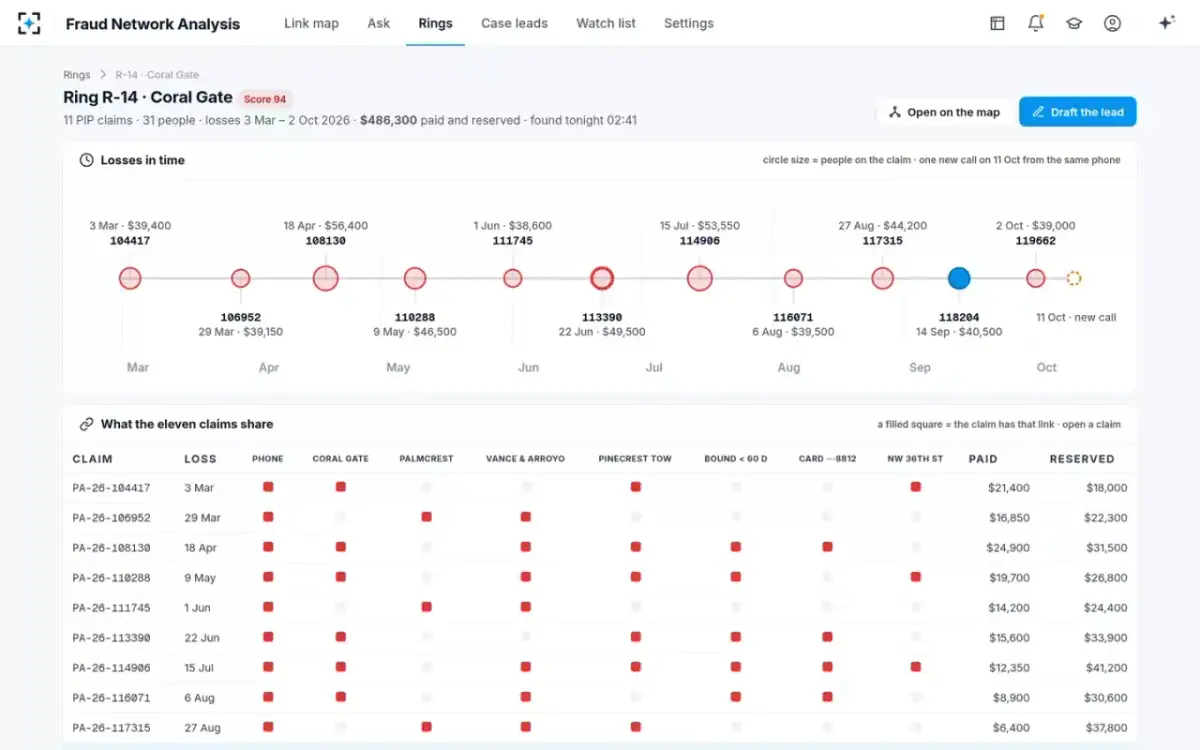
The insurer's side of that partnership is a referral, and a referral is only as good as what it can show. A list of suspicious claims is a start. A referral that shows the same caller on eleven first-notice calls, the clinic intake forms that name him, the dates, and the documents behind every link is something a prosecutor can build on. Federal releases show cases taking years from crash to sentence: about three years from the end of the Connecticut crashes to the ringleader's sentence, and about five years from the 2017 New Orleans crash to the passengers' sentences in 2022.
A ring laid out in Fraud Network Analysis: losses in time, and each claim against each shared link
What the casebook means for an SIU
Read together, the nine cases say three things to an SIU. First, rings run for years: the Connecticut crashes spanned 2011 to 2014, the Michigan clinics 2012 to 2015, the San Francisco tow scheme 2017 to 2021. Every month a ring runs is a month of paid claims. Second, the links that convicted them were in documents insurers already held: recorded claim calls, clinic bills, tow records, examination transcripts. Third, the people who connected them were reading across files, by hand, after something unusual had already been noticed.
Fraud Network Analysis automates the reading across files, not the judgement. Its agents read first-notice call logs, intake forms, bills, letters of representation, tow invoices and payment records every night, join the same caller written three ways, and draw the claims that share more than the unit's threshold as a ring, labelled with why. They never call a ring fraud or name a suspect; the investigator decides what is a lead and the SIU manager approves the referral, which goes out with a dated timeline and numbered exhibits.
A drafted lead in Fraud Network Analysis: dated timeline and numbered exhibits
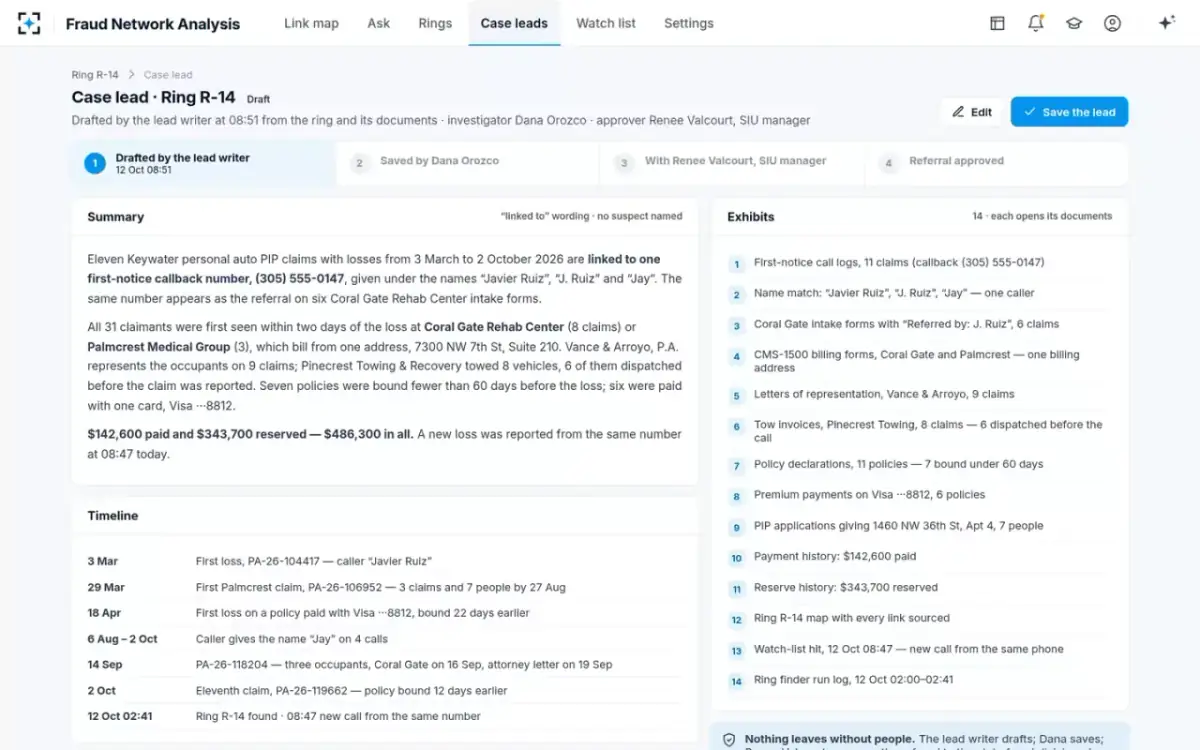
The casebook also shows what software cannot do. No tool would have proved the Connecticut crashes without the interviews, or the Michigan clinics without the testimony about blank forms. What it can do is shorten the years at the front of each bar in the chart above, the time a ring runs before anyone looks across the files. To see how a ring is drawn and checked, read five tests a detected ring must pass, or start from Fraud Network Analysis.
Questions people ask
How many crashes did the Connecticut ring stage?
About 50, according to the FBI, from 2011 through 2014, with insurers paying $10,000 to $30,000 on each. Most were late-night single-car crashes on remote roads, blamed on a deer in autumn or snow in winter. The ringleader was sentenced to four years in prison, and six others were charged and convicted.
Were lawyers involved in Operation Sideswipe?
The releases cited here describe occupants going to an attorney's office within days of a staged crash and lawsuits filed on their behalf; the spotter's co-defendants received $43,000 from those suits. Whether particular lawyers were charged is outside the releases quoted on this page, which concern drivers, passengers and the spotter.
Is staging an accident a felony?
In the states covered here, yes. California makes it unlawful to knowingly cause or take part in a vehicle collision to present a false claim, and Florida makes organizing or knowingly taking part in an intentional crash for PIP or tort claims a second-degree felony with a two-year minimum term. Federal cases are charged as mail fraud, wire fraud, health care fraud or conspiracy.
Why do staged accident cases take so long?
Because rings are proved claim by claim, through testimony, records and money trails, often across several agencies. In the cases here, the gap from the end of the activity to sentencing ran from about two years to about five. Most of the delay is after the pattern is noticed; the earlier an insurer notices, the more of the ring's claims are still unpaid.
Do staged accident rings target trucks on purpose?
Some do, because commercial defendants carry larger policies. Operation Sideswipe targeted tractor-trailers and a bus; one bus collision settled for about $677,500 against $30,000 for a later truck collision. Other rings avoid other vehicles altogether, staging single-car crashes or paper accidents to keep police and witnesses out of it.