New York no fault insurance fraud is the billing of auto insurers for injuries, treatment and tests that were staged, exaggerated or never given, through the state's no-fault system, which pays medical and other basic economic loss to people hurt in a crash regardless of who caused it. It is the largest single category of insurance fraud the state sees: of 51,419 suspected-fraud reports filed with the Department of Financial Services in 2025, about 72%, or 36,835, concerned no-fault auto insurance. The money is lost through rings, clinics and runners that bill many claims at once, under clocks that require insurers to pay or deny within 30 days. That is why a unit fighting it should be measured by the payments it stops before they leave, not by what it claws back. Botminds' Fraud Network Analysis is built for that work: it links claims through the phones, clinics, attorneys and accounts they share and draws the rings each night, while every claim decision stays with the adjuster.
The New York figures on this page come from the Department of Financial Services, the Insurance Law and the no-fault regulations, linked where they appear. The worked example comes from a fictional sample carrier in a personal injury protection state, Keywater Insurance Company; its claims and people are invented.
What New York insurers' SIUs reported for 2024: savings dwarf recoveries
How big is New York no fault insurance fraud?
No-fault is the bulk of what New York's fraud bureau sees, and the volume grew through the first half of the decade. DFS's Insurance Frauds Bureau received 23,279 no-fault fraud reports in 2021, 28,145 in 2022, 33,646 in 2023 and 38,846 in 2024, before 36,835 in 2025 (NY DFS, 2025 CPFED Annual Report, Appendix 1). Insurers file almost all of them; about 1,400 of the 51,419 reports in 2025 came from other sources such as consumers and anonymous tips.
The bureau's view of the cost is blunt: "Deceptive health care providers and medical mills that bill insurance companies under New York's no-fault system cost New York drivers hundreds of millions of dollars" (NY DFS). DFS does not publish a single loss figure for no-fault fraud, and a carrier should be wary of any that claims precision. What the reports do show is where the work falls.
New York no-fault fraud, 2025, in the regulator's own figures
36,835
no-fault fraud reports received by DFS
72%
of all suspected insurance fraud reports in the state
57
no-fault investigations opened by the state fraud bureau
93%
of the healthcare fraud reports DFS received concerned no-fault
Fifty-seven state investigations against 36,835 reports is the number to sit with. The state's bureau takes the cases it can prosecute; everything else, the analysis of which claims belong together and the decision to pay or deny, stays with the insurer's own special investigations unit. A carrier that waits for the state to find its rings will mostly wait.
What is a medical mill, and why is it the heart of no-fault fraud?
A medical mill is a clinic, or a cluster of clinics, that exists to bill no-fault insurers for treatment that is unnecessary, inflated or never given, usually with patients supplied by paid recruiters. It is the heart of no-fault fraud because no-fault lets an injured person assign their benefits to the provider, so the clinic bills the insurer directly and the money flows to whoever controls it.
New York closes one door in its regulations: a provider "is not eligible for reimbursement" if it fails to meet the state's licensing requirements (11 NYCRR 65-3.16(a)(12)). That is why mills hide their owners. In a 2012 indictment the Manhattan U.S. Attorney charged 36 people, including 10 licensed doctors and three lawyers, in what it called "the largest single no-fault automobile insurance fraud ever charged", alleging a scheme to defraud insurers of more than $279 million through clinics whose real controllers paid doctors to act as "straw owners" (FBI New York, 2012). A year earlier, a separate case described how runners found patients: by "using radio scanners to locate accidents", by paying hospital employees for crash victims' details, by paying tow truck operators for referrals, or by staging accidents (FBI New York, 2011).
Each of those roles leaves a trace in a different document of a different claim: the runner's phone on a first-notice call, the clinic on an assignment of benefits, the doctor on a bill, the attorney on a letter of representation, the tow operator on an invoice. None is suspicious alone. The mill shows up only when the claims are read together, which is the case for indicators that only show up across claims.
The clocks a no-fault ring is built around
New York's no-fault rules give the insurer little time and the claimant a lot, and rings use that asymmetry. The insurer must ask for verification within days, decide within 30 days of proof of claim, and pay interest on anything late; the provider has 45 days from each service to bill, and the applicant 120 days to answer a verification request.
One no-fault claim against New York's clocks, in calendar days
- Notice of the accident≤ 30 d
- Bill for each service≤ 45 d after service
- Send verification forms10 business d
- Ask for more verification15 business d
- Pay or deny after proof of claim30 d
The statute's penalty is the lever. No-fault benefits "are overdue if not paid within thirty days" after proof of claim, "All overdue payments shall bear interest at the rate of two percent per month", and the claimant can also recover attorney's fees (N.Y. Ins. Law § 5106). A unit that suspects a clinic but cannot show why within the verification window often pays. A ring that bills many small claims across many carriers knows that each one, alone, is cheaper to pay than to fight.
The regulation does give the insurer a tool, if it moves in time: where verification is an examination under oath or a medical examination, the verification counts as received on the day the examination was held (11 NYCRR 65-3.8). The constraint is speed of knowledge. An examination requested on the first claim of a ring, because the SIU already knows the clinic and the runner from ten others, is a different conversation from one requested on the twelfth, after eleven have been paid.
Why recoveries are the wrong yardstick for a ring unit
Recoveries understate what a ring unit does by two orders of magnitude, because most of its value is money that never leaves. New York's own reporting shows it: insurers' SIUs reported about $3.5 billion in savings and about $40.3 million in recoveries for 2024 (NY DFS). Of that, accident and health insurers, HMOs, life insurers and other health carriers accounted for about $3 billion in savings and $30.6 million in recoveries (NY DFS, health insurance fraud report), which leaves roughly half a billion dollars of savings for property and casualty and other carriers. Whatever the split, recovered money is about one dollar in 87.
Recovery is slow because it runs through courts. Restitution follows a conviction, and civil recovery from a clinic follows a lawsuit, often years after the payments. Savings happen on the clock: a bill denied because the provider is not eligible, a claim withdrawn after an examination under oath, a reserve released when a ring is confirmed. A ring unit judged on recoveries will chase old money; one judged on what it stops will move earlier.
Savings are also easier to inflate, which is why they need guard rails. A unit can claim large savings by denying honest claims, and New York's clocks make wrongful denials expensive. That is why the KPI set below pairs every money measure with a precision measure.
What KPIs should a fraud ring unit track?
A fraud ring unit should track six numbers: money stopped, money paid before the ring was seen, how many claims a ring reached before detection, precision, clock compliance, and recoveries. The first three measure speed, the fourth measures fairness, the fifth keeps the unit inside the law, and the sixth stays on the report without driving it.
Six KPIs for a no-fault ring unit, and why each is there
Stopped
Reserves and open bills on ring claims when the ring was found, later denied or withdrawn
The money a ring unit exists to keep in the carrier. It maps to what New York carriers report as savings.
Paid before seen
Paid on ring claims before the ring crossed the threshold
The cost of finding it late. Falls as detection moves earlier.
Claims to detection
Number of the claim at which the ring was first drawn
A ring drawn at its fourth claim costs a fraction of one drawn at its fifteenth.
Precision
Rings confirmed or referred ÷ rings investigated
Guards against a unit that stops payments by flagging honest providers.
Clock compliance
Verification requests and decisions inside the regulation's days
A late request can cost the defence; overdue claims carry 2% a month.
Recovered
Money returned after payment, by civil action or restitution
Real, but small and slow. Report it; do not run the unit on it.
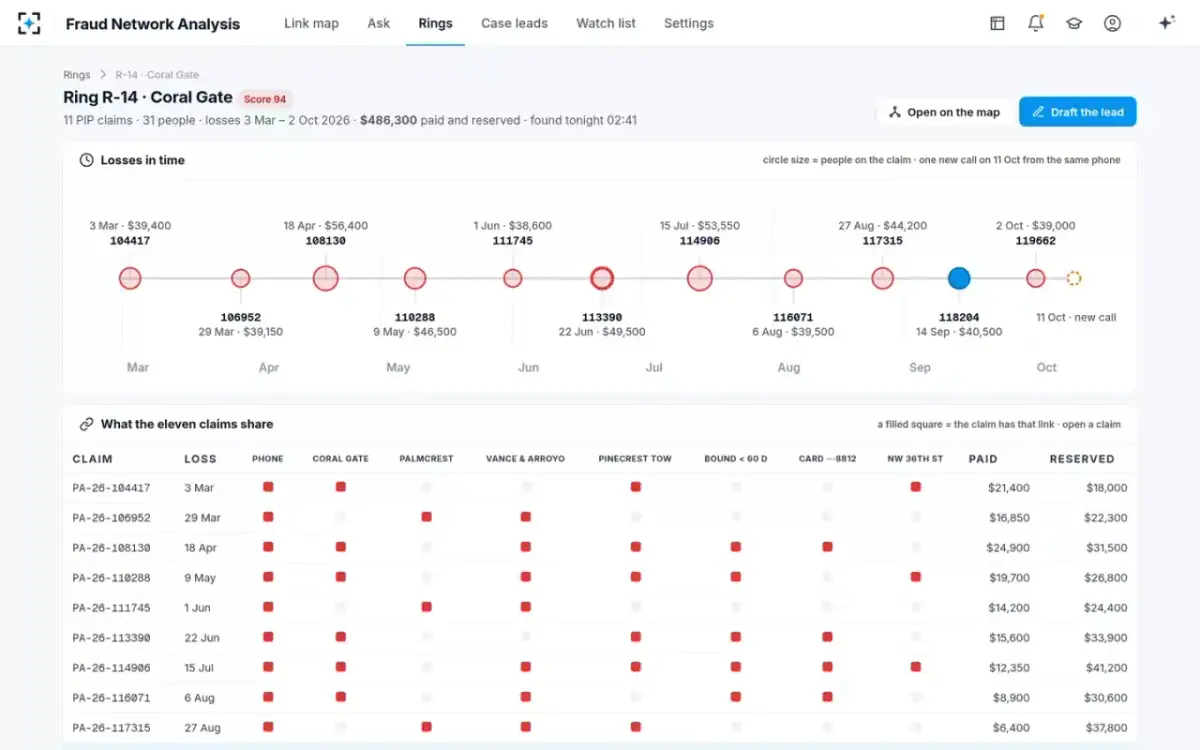
Take the sample ring as it looked the morning Fraud Network Analysis drew it. Eleven personal injury protection claims, first loss on 3 March, eleventh on 2 October: $142,600 already paid and $343,700 still reserved. On the scorecard, $142,600 is "paid before seen" and the ring reached eleven claims before detection. The $343,700 is the most a unit could stop on those claims, and only what is later denied or withdrawn on evidence counts as stopped. About six hours after the ring was drawn, the same phone reported a new loss that would make a twelfth claim, which is the cheapest saving of all: a claim the SIU knows about on day one.
The sample ring in Fraud Network Analysis: losses in time, and what each claim shares
How do insurers fight no-fault fraud without breaking the 30-day rule?
Insurers fight no-fault fraud lawfully by knowing earlier, not by paying later. The regulation lets them request verification, including examinations under oath, inside fixed windows, and it lets them deny bills from ineligible providers. Both work only if the SIU can connect a new claim to what it already knows within days of the first bill.
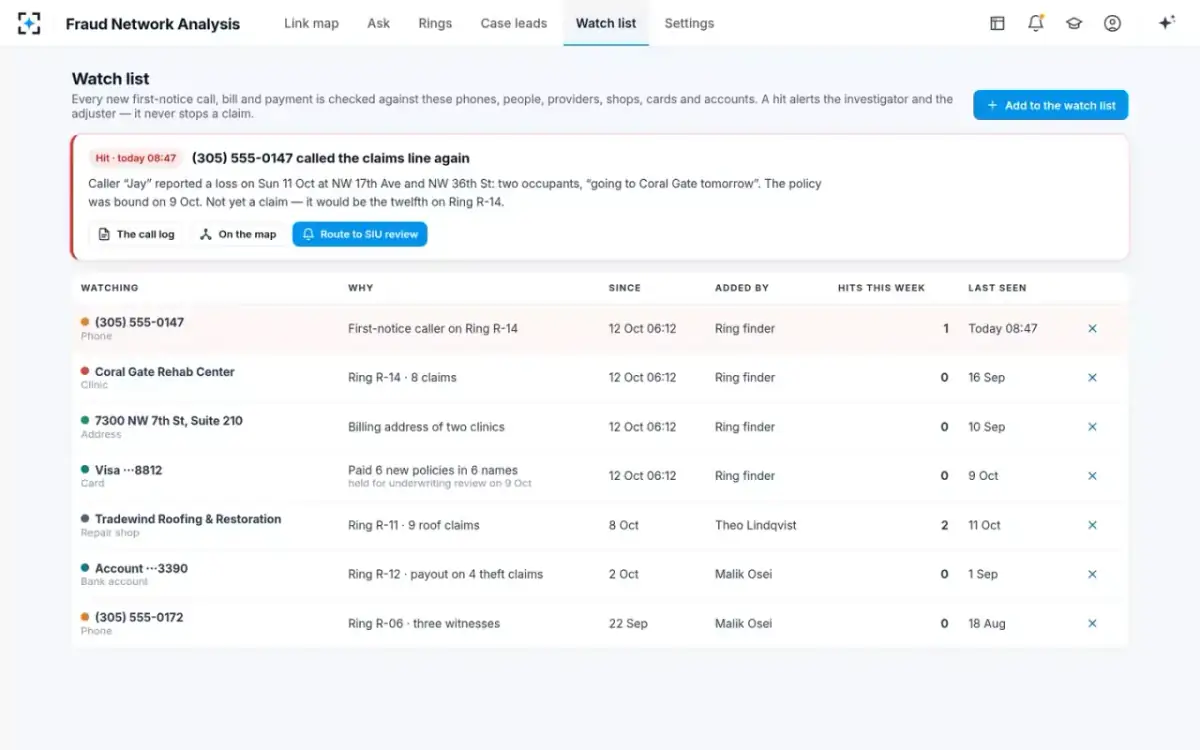
In practice that means three habits. Watch the identifiers of known rings, so a new claim from a known runner's phone or to a known clinic is flagged on arrival rather than at the next quarterly review. Request verification on the first claim of a pattern, inside the 15 business days, with reasons tied to documents. And keep paying what is owed on everything else: an alert should change what the adjuster asks for, not stop the clock. Fraud Network Analysis's watch list works this way. When a watched phone calls in, it alerts the investigator and the adjuster with the source, and nothing is held.
Referral has its own clock. New York requires anyone who determines that a transaction appears fraudulent to report it to the Superintendent within thirty days of that determination (N.Y. Ins. Law § 405). The SIU manager's approval of a referral, with the clock visible, is the last step of a ring unit's work and the start of the state's. The state reporting clocks are compared in detail in insurance fraud reporting requirements by state.
A watched number calls the claims line again
Where Fraud Network Analysis fits in a no-fault SIU, and where it does not
Fraud Network Analysis does the reading and the linking that make early verification possible; it does not decide verification, denial or payment. Its agents read the first-notice call logs, applications for benefits, clinic intake forms, bills, letters of representation, tow invoices and payment records; join the same caller or clinic written different ways; and rebuild the link map each night, so a ring is drawn as soon as its claims share more than the unit's threshold. The investigator decides what is a lead, the SIU manager approves each referral with the state's clock shown, and the adjuster keeps every claim decision.
Three limits are worth stating plainly. The solution does not run the no-fault arbitration or the examination under oath; those stay in the claim and legal process. It does not calculate savings: the scorecard's money comes from the claim system's payments and reserves, and the unit decides what counts as stopped. And it reads only what is in the claim file, so a clinic's ownership, the heart of an eligibility defence, still needs records the SIU obtains itself. What it changes is the date on which the SIU knows that a new bill belongs to a pattern, which in a 30-day system is most of the battle.
How do you measure SIU ROI in a no-fault state?
Measure SIU return in a no-fault state as money stopped plus money recovered, net of the cost of the unit and of any wrongful denials, and report it beside precision so the number cannot be bought with false positives. New York already asks carriers for part of this: plans under § 409 must be reported on each year, "describing insurers' experience, performance, and cost effectiveness in implementing the plan" (NY DFS).
Before a ring unit reports a return, check these
- Count stopped money only on evidence
A reserve released because a claim was denied on documents or withdrawn after an examination, not because a ring was drawn.
- Subtract interest and fees on lost disputes
At 2% a month plus attorney's fees, a denial that loses in arbitration can cost more than paying on time.
- Report precision beside every dollar
Rings confirmed or referred, divided by rings investigated.
- Report claims to detection
The ring's claim number when it was first drawn, tracked quarter on quarter.
- Separate rings from single claims
Organized savings and opportunistic savings answer different questions about where to invest.
- Keep recoveries, but on their own line
Restitution and civil recoveries arrive years later and belong to the cases that earned them.
The cost side is where link analysis earns its place. Every claim a ring adds after it is drawn is a claim the SIU sees from its first bill, inside the verification window, with requests that can be specific. Moving detection from the eleventh claim to the fourth makes a cheaper unit, not just a more effective one. How a unit can test whether its ring detection deserves that trust is set out in five tests a detected ring must pass; to see the rings, the watch list and the referral clock together, start from Fraud Network Analysis.
Questions people ask
What is no fault insurance fraud?
It is fraud against the no-fault part of an auto policy, which pays medical bills and lost earnings after a crash regardless of who caused it. The usual forms are staged or invented accidents, treatment that is unnecessary or never given, and billing by clinics that are not lawfully owned. In New York it made up about 72% of all suspected insurance fraud reports in 2025.
How common is no fault fraud in New York?
DFS received 36,835 no-fault fraud reports in 2025, down from 38,846 in 2024 but up from 23,279 in 2021. A report is a suspicion, not a finding: the state's fraud bureau opened 57 no-fault investigations in 2025, and insurers' own SIUs handle the rest.
What is the difference between fraud savings and recoveries?
Savings are money not paid because an investigation stopped it: a claim denied, withdrawn or reduced. Recoveries are money returned after it was paid, through restitution or civil action. New York insurers' SIUs reported about $3.5 billion in savings and $40.3 million in recoveries for 2024.
How much does no fault fraud cost?
No public source gives a reliable total. DFS says medical mills billing under the no-fault system "cost New York drivers hundreds of millions of dollars", and one 2012 federal indictment alone alleged a scheme to defraud insurers of more than $279 million under the no-fault law. Figures that claim more precision usually come from industry groups and should be read as estimates.
How long does a New York insurer have to pay a no-fault claim?
Benefits are overdue if not paid within 30 days after the insurer receives proof of claim, including any verification it asked for, and overdue payments carry interest at 2% a month. Verification must be requested inside fixed windows of 10 and 15 business days, and an examination under oath counts as verification received on the day it is held.
Does the same approach work in Florida and other PIP states?
The mechanics are the same: assignment of benefits, clinic billing and short payment clocks. Florida's PIP statute, for example, makes benefits overdue after 30 days but lets an insurer that gives written notice of a fraud investigation take up to 90 days in all. The worked example on this page is a fictional Florida PIP ring for that reason.