Basel 3.1 reporting begins in the UK on 1 January 2027, and for most banks it will run through a regulatory reporting platform: the system that turns a bank's general ledger and risk data into the returns its supervisor requires, checks them against the published rules and produces the filing. For a UK bank in late 2026, one set of dates decides how to choose and run one. The PRA's final Basel 3.1 rules "will take effect on Friday 1 January 2027", and "the Basel 3.1 reporting requirements will take effect from Friday 1 January 2027" (PRA PS1/26). Quarterly returns are due on 12 May, 11 August, 11 November and 11 February (PRA Rulebook), so the first quarterly COREP under the new rules, for 31 March 2027, is due by close of business on 12 May 2027. Botminds' COREP & FINREP Reporting is built for exactly this change: agents read the Bank of England's Basel 3.1 taxonomy, propose the mappings, explain the parallel run and keep the evidence, while people approve every decision.
This guide lays out the dates and templates that fix the plan, a milestone calendar back from 12 May, what to demand of any platform before then, and where this solution fits and where it does not.
The four UK dates that fix a Basel 3.1 reporting plan
1 Jan 2027
Basel 3.1 rules and reporting requirements take effect
PRA PS1/26
11 Feb 2027
Last quarterly COREP under today's rules, for 31 December 2026
PRA Rulebook
12 May 2027
First quarterly COREP under Basel 3.1, for 31 March 2027
PRA Rulebook
1 Jan 2028
Internal model approach for market risk
PRA PS1/26
When does Basel 3.1 apply in the UK?
From 1 January 2027, with market risk internal models a year later. The date has moved. On 17 January 2025 the PRA, with HM Treasury, "announced a delay to the implementation of the Basel 3.1 standards in the UK by one year, to 1 January 2027", citing "uncertainty over when other major jurisdictions would adopt the standards" and competitiveness (PRA PS1/26, 20 January 2026). The final policy statement then fixed the rest: the rules take effect on 1 January 2027 and "the internal model approach for market risk will come into effect on Saturday, 1 January 2028".
The market risk piece is still moving. On 19 June 2026 the PRA consulted on adjustments to the internal model approach, "the final piece of Basel 3.1's implementation in the UK", and said "no other changes are being proposed and all other rules come into force in January 2027, as previously planned" (PRA, 19 June 2026). The EU is on a different track: its market risk own funds rules were postponed by two years in all, to 1 January 2027, and in June 2026 the Commission adopted temporary adjustments to apply "for three years from 1 January 2027", subject to scrutiny by the Parliament and Council (European Commission, 4 June 2026). A group reporting in both places runs two timetables.
What are the PRA Basel 3.1 reporting templates?
They are the COREP templates redrawn for the new rules and renumbered with an OF prefix, published as Appendix 17 to PS1/26 with a mapping of codes in Appendix 18. The mapping notes that "templates have been updated to include OF before the numbering where relevant" and marks deleted templates "N/A" (PS1/26 Appendix 18). A platform's template library, mapping rules and validation set all have to move with them.
Selected Basel 3.1 template codes in the PRA's final mapping
| Code consulted on (CP16/22) | Final code | Status in the mapping |
|---|---|---|
| CAP 02.00 Own funds requirements | OF 02.00 | Edited |
| CAP 02.01 Output floor | OF 02.01 | New |
| CAP 07.00 Credit risk, standardised approach | OF 07.00 | Edited |
| CAP 08.01 to CAP 08.07 Credit risk, IRB | OF 08.01 to OF 08.07 | Edited |
| C 10.01, C 10.02 Equity, IRB | None | Deleted |
| C 16.00, C 17.01, C 17.02 Operational risk | None | Deleted |
| CAP 16.00 Operational risk | OF 16.00 | Added |
| C 25.00 Credit valuation adjustment risk | None | Deleted; CVA moves to OF 25.01 to OF 25.03 |
| CAP 25.01 to CAP 25.11 Market risk, alternative standardised approach | OF 91.01 to OF 91.10 and OF 90.00 | Added |
| C 24.00 Market risk internal models | C 24.00 | Reinstated for the transitional year only |
| PRA101a to PRA103a Capital+ | PRA112 to PRA114 | Edited |
PS1/26 also deletes template C 15.00, on losses from lending secured by immovable property, with Article 430a of the Reporting (CRR) part, "as these will become redundant following the revocation of CRR Article 124(2)" (PRA). Each of these changes is a set of cells whose mappings the bank must write, test and approve before the first live return.
What is the Bank of England banking taxonomy 4.1.1?
It is the XBRL taxonomy UK banks file Basel 3.1 returns against. The PRA published version 4.0.0 on 27 February 2026, "setting out the technical implementation of the reporting requirements expressed in PS1/26" and PS4/26 on small domestic deposit takers, with "eight new reporting modules" (PRA Regulatory Digest, March 2026). Version 4.1.1, published on 27 August 2026, "is a corrective update to taxonomy version 4.0.0 ... to address technical defects detailed in the latest known issues log", and consolidates 4.0.0 and 4.1.0 as "the technical implementation of three policy statements intended to take effect from Friday 1 January 2027": PS1/26, PS4/26 and PS9/26 on MREL reporting (Bank of England).
Two practical points follow. A platform must load the Bank's package, not the EBA's: the Bank says later EBA taxonomies apply to UK firms only if the PRA says so in a consultation. And the known issues list, last updated on 27 August 2026, is part of the specification, because a corrective release can change cells a team has already mapped. How an agent reads a taxonomy release down to the cells that matter is shown in EBA reporting framework 4.4: inside the agent that reads a release.
A milestone calendar back from 12 May 2027
The plan has a fixed end and a hard middle. The return for 31 December 2026 is still filed under today's rules, by 11 February 2027, on whatever the bank runs now; the first Basel 3.1 return follows three months later. A platform chosen in late 2026 is therefore first used in parallel, on real quarter-end data, before it carries a live return. The calendar below is our planning estimate for a mid-size bank on the standardised approach, not a regulatory requirement.
From today to the first Basel 3.1 return, week by week
- Load taxonomy 4.1.1, map C to OF, approve interpretationsNov–Dec
- Parallel run on 31 December data; file old rules by 11 FebJan–Feb
- Fix, freeze mappings, dry runMar
- First live quarter: prepare, validate, attest, submitApr–12 May
Some work cannot wait for the platform at all. PS1/26 says firms "must carry out an assessment of whether a real estate exposure is materially dependent on the cash-flows generated by the property for all residential and commercial real estate exposures", and "will need to undertake an assessment by 1 January 2027 for all existing exposures at that date" (PRA PS1/26). That assessment is an input every Basel 3.1 credit risk mapping depends on.
What is a Basel 3.1 parallel run?
It is a bank's own run of the new templates beside the current ones, on the same reference date, to see the difference before it counts. No PRA rule we found requires one; banks run it because the CFO wants the capital effect explained before the first live return, and because it is the only full rehearsal of new mappings on real data. Its output stays inside the bank.
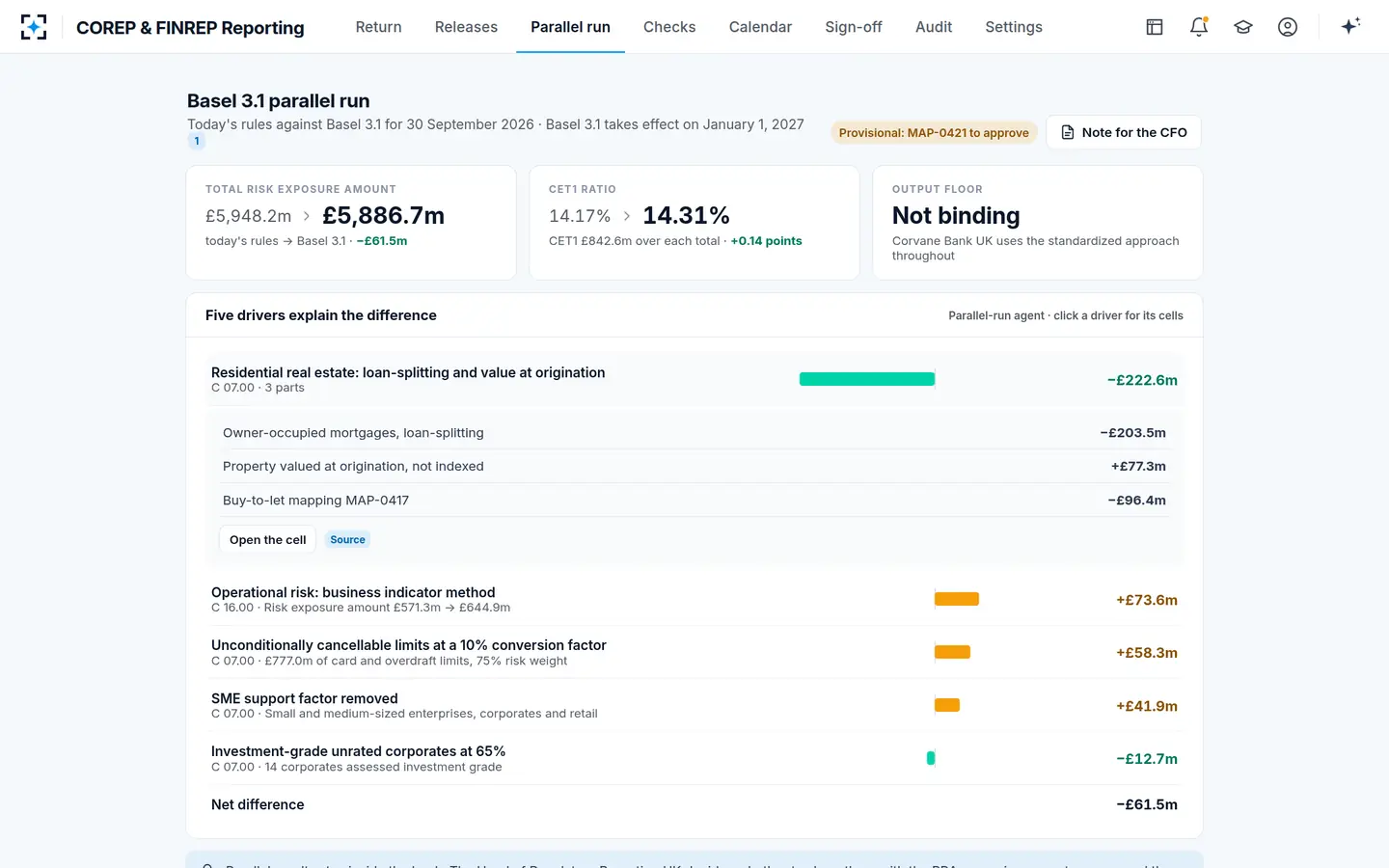
Take the solution's sample bank, a fictional UK lender on the standardised approach, at 30 September 2026. Its total risk exposure amount is £5,948.2 million under today's rules and £5,886.7 million under Basel 3.1, so its CET1 ratio moves from 14.17% to 14.31% on CET1 of £842.6 million. The Parallel-run agent attributes the £61.5 million to five drivers in the sample, from residential real estate (−£222.6 million) to operational risk under the new approach (+£73.6 million), each opening its cells and source. The output floor is not binding for a bank that uses the standardised approach throughout.
The Basel 3.1 parallel run, explained by driver for the CFO
How long does a regulatory reporting platform take to implement?
Longer than the time left to 1 January 2027, if the job is a full replacement of the reporting stack. There is no public benchmark, and the honest drivers are scope and data: how many templates and entities, how many source systems, how clean the mapping from general ledger accounts and product codes already is, and how much of the bank's interpretation of the rules is written down rather than built into code. The PRA's skilled person reviews found the last one wanting at many firms (PRA, 2021).
What can be done in the time is narrower and more useful: put the Basel 3.1 templates, mappings and checks on a platform beside the existing one, prove it in parallel on 31 December 2026 data, and go live for 31 March 2027. The comparison below sets out the two approaches.
Two ways to be ready for the 12 May 2027 return
Replace the reporting stack first: Every template, entity, feed and submission route moved at once.
Add the Basel 3.1 layer beside it: Basel 3.1 templates, their mappings, checks and evidence; filing stays on the existing route.
Replace the reporting stack first: Hard to start before the new stack is complete.
Add the Basel 3.1 layer beside it: Runs on 31 December 2026 data, beside the return being filed.
Replace the reporting stack first: Concentrated on one date.
Add the Basel 3.1 layer beside it: Spread: each mapping proved on real data before it counts.
Replace the reporting stack first: A new system with the old interpretations moved into it.
Add the Basel 3.1 layer beside it: A register of interpretations and mappings, each with its approver, ready for the wider move later.
What should a regulatory reporting platform do for Basel 3.1?
It should prove each number and each change, not only fill the templates. The checklist turns the dates and templates above into things a vendor can show on the bank's own data. A fuller set of questions for choosing any COREP and FINREP solution is in regulatory reporting solutions for COREP and FINREP: 10 questions.
Nine things to see working before 12 May 2027
- The Bank of England taxonomy 4.1.1 loaded and checked
With its validations and known issues, not an EBA package.
- Old and new codes side by side
C 07.00 and OF 07.00 for the same reference date, so the parallel run is like for like.
- Mappings with an owner and a citation
Each Basel 3.1 mapping shows the paragraph it rests on and who approved it.
- The difference explained by driver
Total risk exposure and CET1 ratio movement, each driver opening its cells.
- The transitional market risk templates
C 24.00 kept and OF 24.01 to OF 24.03 disapplied for firms with an internal model transitional permission in 2027.
- Every rule run on every draft
And failures explained by cause, not just listed.
- Reconciliation to the general ledger each cycle
Each break explained before the return is released.
- Separation of duties enforced
Nobody approves their own mapping or override; the attester does not submit.
- Evidence on one page for the accountable senior manager
Who approved what, on what evidence, before the first live attestation.
Where COREP & FINREP Reporting fits, and where it does not
COREP & FINREP Reporting is the layer that reads, maps, prepares, checks and explains. Its Release agent reads each Bank of England taxonomy and PRA policy statement and proposes mapping changes for the templates the bank reports; its Preparation agent populates COREP and FINREP from the general ledger, credit risk data mart, core banking, treasury and data warehouse; its Validation, Cross-template, Parallel-run, Deadline and Evidence agents do the rest. It works with the bank's existing regulatory reporting system and submission portal: the XBRL file goes out through them and the regulator's receipt comes back.
It does not calculate internal model capital, decide an interpretation, move a regulatory date or send parallel results to the regulator. In the sample bank's settings, the Bank of England taxonomy 3.7.0 is live and 4.1.1 runs as the Basel 3.1 parallel, which is the arrangement the calendar above needs. The way to judge fit is to run it on a sample of the bank's own templates, mappings and last quarter's return.
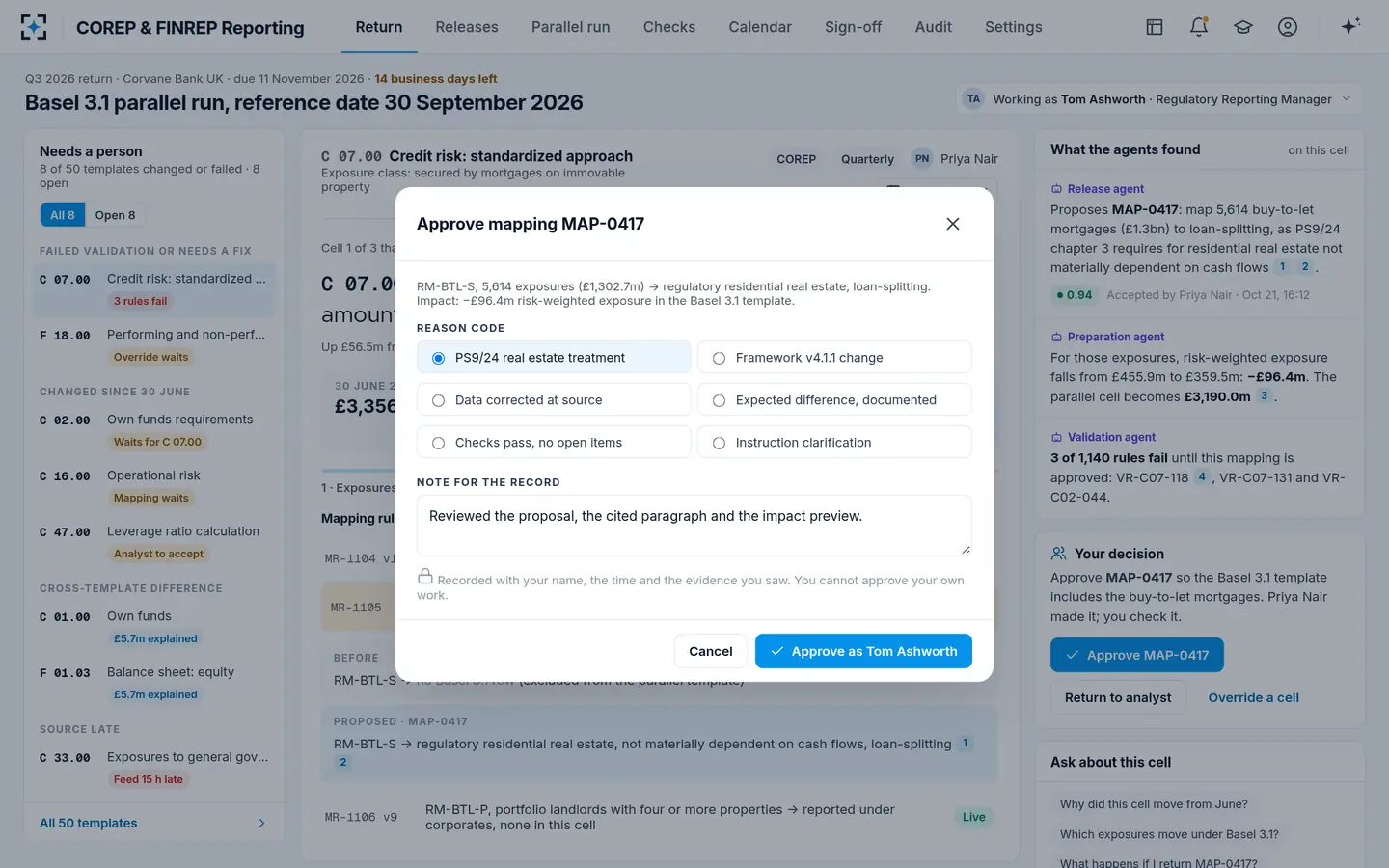
Approving a Basel 3.1 mapping with its impact in view
Questions people ask
When is the first Basel 3.1 COREP return due in the UK?
The rules apply from 1 January 2027, so the first quarterly returns under them are for the reference date 31 March 2027, due by close of business on 12 May 2027 under the PRA Rulebook's remittance dates. The return for 31 December 2026 is still made under today's rules, by 11 February 2027.
Do UK banks have to do a Basel 3.1 parallel run?
We found no PRA rule that requires one. Banks run the new templates beside the old to see and explain the capital effect before the first live return, and to prove new mappings on real quarter-end data.
What is the output floor template?
OF 02.01, a new template in the PRA's final Basel 3.1 set, reports the output floor calculation. PS1/26 also updated fields on the output floor in OF 02.00 and the Capital+ templates PRA112 and PRA113 to match the clarified calculation of the standardised total risk exposure amount.
What happens to market risk internal models reporting in 2027?
Firms with existing internal model permissions keep them during 2027 and report on C 24.00, while the new internal model templates OF 24.01 to OF 24.03 are disapplied; the internal model approach for market risk itself takes effect on 1 January 2028.
Can a regulatory reporting platform be live for 1 January 2027?
A full replacement chosen in late 2026 is unlikely to be, and does not need to be: no return under the new rules is due until 12 May 2027. The realistic aim is a Basel 3.1 layer proved in parallel on 31 December 2026 data and live for the 31 March 2027 return.