FINREP reporting requirements oblige a bank that prepares consolidated accounts under international accounting standards to send its supervisor a standard set of financial templates: the balance sheet, income statement and their breakdowns every quarter, other information every six months or every year, and extra templates when thresholds are crossed. In the EU the templates and frequencies are set by Implementing Regulation (EU) 2024/3117 (EUR-Lex); in the UK by the PRA Rulebook's Reporting (CRR) part. The cost is not trivial: the EBA's 2021 study found supervisory reporting averaged a third of banks' compliance costs, and 38% at small and non-complex institutions. Botminds' COREP & FINREP Reporting prepares FINREP alongside COREP from the same general ledger and risk data, so a bank produces the two from one source and checks one against the other.
This guide sets out who must report FINREP, which templates at which frequency, what the EBA found it costs by bank size, and what the 2025 and 2026 reforms in the EU and the UK change.
Supervisory reporting is a larger share of compliance cost at smaller banks
Small and non-complex (91 banks)
- EBA supervisory reporting · 38.38%
- Other compliance · 61.62%
Medium (28 banks)
- EBA supervisory reporting · 25.53%
- Other compliance · 74.47%
Large (26 banks)
- EBA supervisory reporting · 23.72%
- Other compliance · 76.28%
All 145 banks
- EBA supervisory reporting · 33.48%
- Other compliance · 66.52%
What are FINREP reporting requirements?
FINREP is the supervisory financial reporting framework that sits beside COREP: COREP covers capital, risk and liquidity, FINREP covers financial statements and their breakdowns. The legal hook is Article 430 of the Capital Requirements Regulation; the detail is in Article 11 of Implementing Regulation 2024/3117, which tells institutions that report "financial information on a consolidated basis in accordance with Article 430(3) or (4)" to submit the templates of Annex I, Section 2, at set frequencies (EUR-Lex). Article 12 applies the same structure, Section 3, to institutions using national accounting frameworks where the competent authority has extended FINREP to them.
The templates fall into blocks. The quarterly core is F 01.01 to F 19.00: balance sheet, income statement and the breakdowns of loans, debt securities, impairment, forbearance and non-performing exposures. Others depend on the bank's business. The table sets out the EU rule.
FINREP templates, how often, and what triggers each block (EU)
| Templates | Frequency | Who reports |
|---|---|---|
| F 01.01 to F 19.00 | Quarterly | Every institution in scope of Article 11 |
| F 20.01 to F 20.07.1 (geographical breakdown) | Quarterly | Where the institution exceeds the threshold in Article 5(2) |
| F 21.00 (assets under operating leases) | Quarterly | Where such assets are 10% or more of total tangible assets |
| F 22.01 and F 22.02 (fee and commission) | Quarterly | Where net fee and commission income is 10% or more of it plus net interest income |
| F 23.01 to F 26.00 (non-performing detail) | Quarterly | Not small and non-complex, with a non-performing loan ratio of 5% or more |
| F 30.01 to F 31.02 | Semi-annual | Every institution in scope |
| F 40.01 to F 46.00 | Annual | Every institution in scope |
| F 47.00 | Annual | Same conditions as F 23 to F 26 |
Who has to report FINREP?
In the EU, institutions that prepare consolidated accounts under IFRS as adopted in the Union, and institutions using national GAAP where their competent authority has extended FINREP to them. In the UK, the rule is narrower and now explicit. Article 430(3) of the PRA's Reporting (CRR) part requires financial information from "an institution that is subject to section 403(1) Companies Act 2006" or "a credit institution that prepares its consolidated accounts in conformity with UK-adopted international accounting standards" (PRA Rulebook). Every other firm is defined as a "reduced FINREP firm" and reports a shorter set of data items under Chapter 5A of the same part.
The two regimes have drifted apart. With effect from 31 December 2025, the PRA deleted 34 whole FINREP templates, along with two COREP templates and one PRA template, 37 in all (PRA PS27/25). One respondent warned that "firms with EU subsidiaries may still be required to report these templates under EU law, resulting in duplication and increased operational costs". A UK group with an EU bank now prepares two versions of FINREP from the same books.
FINREP in the EU and the UK, autumn 2026
EU: Implementing Regulation (EU) 2024/3117, Articles 11 and 12, under CRR Article 430.
UK: PRA Rulebook, Reporting (CRR) part, Article 430 and Chapter 4; Chapter 5A for reduced FINREP firms.
EU: IFRS consolidated reporters; national GAAP reporters where the competent authority extends it.
UK: Firms under section 403(1) Companies Act 2006, or credit institutions with consolidated accounts under UK-adopted IAS.
EU: The full Annex I, Section 2 set; IFRS 18 module from phase 1 of EBA release 4.4.
UK: 34 FINREP templates deleted from 31 December 2025; three conditional blocks in Article 11(2) now read "[deleted]".
EU: Close of business on 12 May, 11 August, 11 November and 11 February.
UK: Within 30 business days of the period end, for full and reduced FINREP alike, since 31 December 2025.
EU: The revised ITS for the 30 September 2027 reference date.
UK: The PRA's Future Banking Data review of a wider range of collections.
How often is FINREP reported, and when is it due?
Quarterly for the core, half-yearly and yearly for the rest. In the EU the remittance dates are fixed: quarterly information "by close of business" on 12 May, 11 August, 11 November and 11 February; semi-annual on 11 August and 11 February; annual on 11 February; a date on a weekend or public holiday moves to the next working day (Implementing Regulation (EU) 2024/3117, Article 3). Information is reported cumulatively from the first day of the accounting year, and audited figures that differ from the unaudited ones submitted must follow "without undue delay".
The UK changed this for FINREP at the end of 2025. COREP keeps the four calendar dates, but since 31 December 2025 a firm must submit each FINREP data item "within 30 business days of the end of the relevant reporting period", whether it reports full FINREP under Article 430(3) and Article 11(2) or the reduced set under Chapters 5A to 5F (PRA Rulebook, Reporting (CRR) Article 3(1A)). The PRA proposed it to "align all FINREP remittance dates to business days", ending a split in which some firms worked to business days and others to calendar days (PRA CP21/25). In a quarter without bank holidays the two calendars land close together: 30 business days after 30 September 2026 is 11 November 2026 in England.
How much does supervisory reporting cost a bank?
The EBA's answer, from a 2021 survey of banks' own estimates, is hundreds of thousands of euros a year for a small bank and several million for a large one, before the cost of each change. Its study extrapolated from 251 responding credit institutions to the 4,687 in its dataset. On median values, small and non-complex institutions "incurred annual ongoing costs of EUR 0.9 billion from EBA supervisory reporting requirements ... which translates to an annual cost of EUR 304.7 thousand per institution"; using averages instead, EUR 1.5 million per institution (EBA/REP/2021/15). For all EEA banks, solo and consolidated, the median-based total was EUR 5.5 billion, "approximately 1.4% of the total operating costs of all the consolidated banks".
Annual cost of EBA supervisory reporting per institution, by size
Two things stand out. Implementation cost, the money spent absorbing changes, is between a third and three-fifths of the ongoing cost in every size class, which is why release cadence matters as much as template count. And the smallest banks pay the highest share of their compliance budget for it. The EBA's own diagnosis of cost drivers included both "the magnitude of changes" and the "frequency of changes to the (EBA) reporting framework".
Do small banks report FINREP?
In the EU, yes if they are in scope of Article 11 or 12, but less of it. A small and non-complex institution, defined in the CRR as one that is not large and whose total assets average "equal to or less than the threshold of EUR 5 billion over the four-year period immediately preceding the current annual reporting period", among other conditions (CRR Article 4(1)(145)), is spared the detailed non-performing exposure templates, for example. The EBA says such institutions "are subject to reporting of only 45,000 data points (49% of total requirements)" and, in actual volumes, "report only 30% of data points compared to large institutions" (EBA, 2026).
Proportionality already does a lot for the smallest banks
49%
of total reporting requirements apply to small and non-complex institutions
45,000 of about 92,000 data points
30%
of the data points a large institution reports, on actual volumes
Small and non-complex institutions
18%
further cut proposed for them in the 2026 package
Plus lower frequencies
Proportionality has a limit as a cost lever, though. A small bank still runs the same calendar, the same release cycle and the same validation rules as a large one, and the EBA found reporting a higher share of its compliance budget, not a lower one.
What did the EBA cost of compliance study find, and what changed since?
The 2021 study recommended changes it estimated "could reduce the reporting costs faced by up to 15-24%", savings "in the range of EUR 188-288 million" for small and non-complex institutions (EBA, 2021). Five years on, the EBA reports that most of those recommendations "have been largely completed ... leading to up to 25% reduction in estimated reporting costs primarily for small and non-complex institutions" (EBA, 2026).
The 2026 package goes further. It would cut about a sixth of the data points in the EU harmonised framework and move the first reporting under the revised standards to the 30 September 2027 reference date. For FINREP it proposes a core-plus-supplement approach for smaller institutions and the review of least-used templates. The consultation closed in July 2026, and on 27 October 2026 the EBA's page still showed the package as "under consultation" (EBA). What sits outside those numbers is in EBA reporting simplification: the 980,000 national data points.
What is IFRS 18 in FINREP?
IFRS 18 is the new accounting standard for presenting financial statements, and FINREP's income and expense templates have to follow it. The EBA moved that part ahead of the rest of the simplification: phase 1 of reporting framework 4.4, final on 12 October 2026, contains "a new FINREP module reflecting IFRS 18 requirements", with "Amendments to the ITS on Supervisory Reporting linked to implementation of IFRS 18 in FINREP" listed for a first reference date in March 2027 (EBA, reporting framework 4.4). An EBA Opinion covers how to report profit or loss in the interim between a bank's first application of IFRS 18 and the amended standards.
Where the cost goes, and what COREP & FINREP Reporting takes out
The EBA's survey counts the cost; it does not split it by task. Inside a reporting team, our estimate for a mid-size UK bank is that one quarterly return and the release before it take about 33 working days by hand, and that the largest blocks are reading the release (15 days), reviewing templates against last quarter (6) and decoding validation failures draft after draft (5); reconciling COREP with FINREP takes about 2. With agents doing the reading, populating and checking, our estimate falls to 10.5 days. Those are estimates for planning, not measured results.
In COREP & FINREP Reporting, FINREP and COREP are populated by the same Preparation agent from the general ledger, the credit risk data mart, core banking, treasury and the data warehouse, and every cell is written as a sentence with its lineage. The Cross-template agent then checks the relationships between the two returns and explains each legitimate difference. In the solution's sample, a fictional UK lender, retained earnings are £612.4 million in COREP C 01.00 and £618.1 million in FINREP F 01.03: the £5.7 million is third-quarter profit not yet verified by the external auditor, which cannot count as capital until it is, and a manager accepts that explanation.
FINREP and COREP from the same data, checked against each other
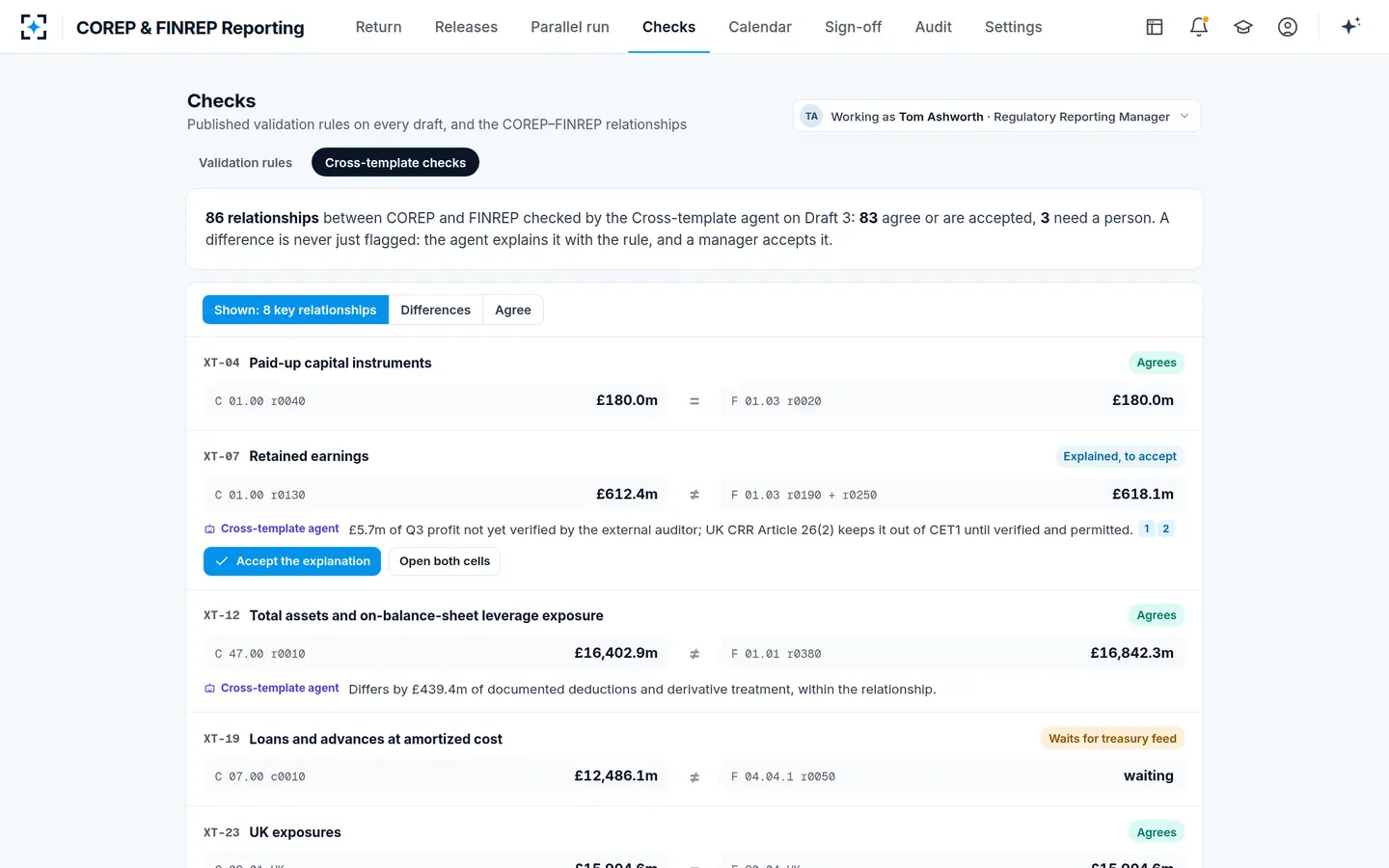
That explanation is the part the EBA's rules leave to the bank: its published validation rules file contains no rule linking a COREP table to a FINREP table. Why the two returns differ, and where they must agree, is the subject of COREP vs FINREP: two returns, one balance sheet.
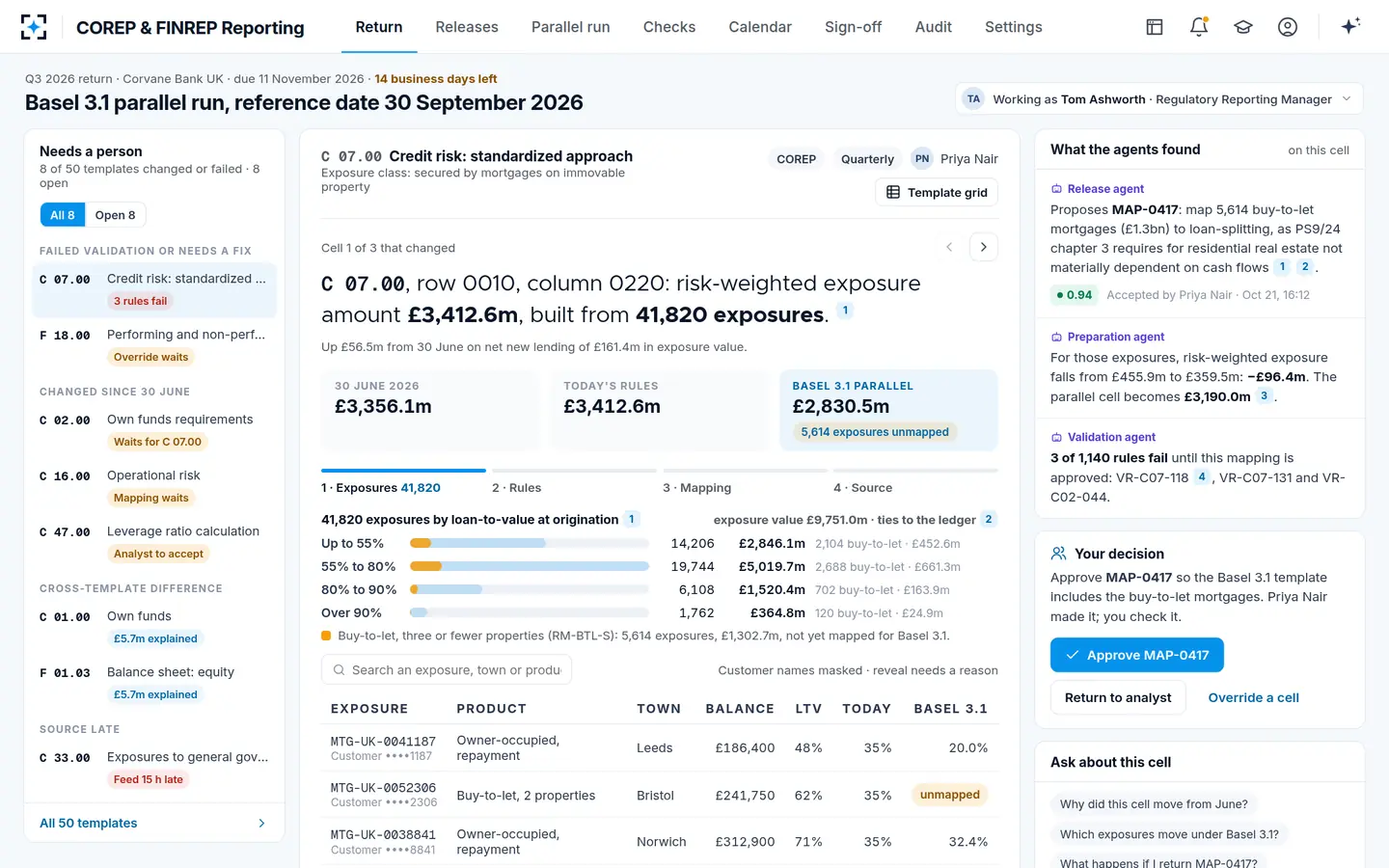
Any FINREP or COREP cell, read as a sentence and traced to its exposures
Questions people ask
What is the difference between FINREP and statutory financial statements?
FINREP uses the same accounting framework as the bank's consolidated accounts but reports it on the supervisor's templates, at a prudential scope of consolidation and with breakdowns the published accounts do not show, such as forbearance and non-performing exposures. It is also reported quarterly, cumulatively from the start of the accounting year.
Is FINREP mandatory for banks using national GAAP?
Only if their competent authority extends it to them under CRR Article 430(4); Article 12 of the EU regulation then sets the templates, from Section 3 of Annex I. In the UK, a firm outside the Article 430(3) scope is a reduced FINREP firm and reports a shorter set of data items.
How much does FINREP reporting cost a small bank?
The EBA estimated the ongoing cost of all EBA supervisory reporting, COREP and FINREP together, at a median of about €305,000 a year for a small and non-complex institution, plus about €100,700 a year to implement changes. It did not publish a separate figure for FINREP.
When will the EBA's FINREP changes apply?
The IFRS 18 FINREP module in release 4.4 has an expected first reference date of March 2027. The broader FINREP changes in the 2026 simplification package are planned for the 30 September 2027 reference date, once the revised standards are final and adopted.
Did the UK delete FINREP templates?
Yes. The PRA's PS27/25 deleted 34 whole FINREP templates, plus two COREP templates and PRA109, with effect from 31 December 2025, so firms did not have to submit them for the 2025 fourth quarter. UK groups with EU subsidiaries may still report them under EU law.