COREP vs FINREP is the difference between a bank's prudential return and its financial return. COREP, the common reporting framework, covers own funds, own funds requirements for credit, market and operational risk, large exposures, leverage and liquidity. FINREP, the financial reporting framework, covers the balance sheet, profit or loss and their breakdowns, including non-performing and forborne exposures. Both are set by the same EU regulation, Implementing Regulation (EU) 2024/3117, and in the UK by the PRA Rulebook, and both come from the same general ledger. Because one measures on prudential rules and the other on accounting rules, they rarely show the same number for the same thing, and the bank must be able to explain every gap. Botminds' COREP & FINREP Reporting prepares the two together and checks the relationships between them.
This guide sets out what each return contains, who files it, the templates people ask about most, and where the two meet.
How many templates each family has in the EU reporting regulation
What is the difference between COREP and FINREP?
COREP shows whether the bank holds enough capital and liquidity for its risks; FINREP shows its financial position and performance in supervisory detail. COREP values exposures on prudential rules, with conversion factors, risk weights and deductions from capital; FINREP values assets and liabilities as the accounts do, at amortised cost or fair value, with impairment. One regulation sets both: it "lays down uniform reporting formats, the frequency and dates of reporting" under Articles 415 and 430 of the CRR (Implementing Regulation (EU) 2024/3117, Article 1), and its Annex I lists the COREP own funds templates beside FINREP templates for IFRS and for national GAAP reporters, followed by large exposures, leverage, liquidity, asset encumbrance and interest rate risk in the banking book.
COREP and FINREP, side by side
COREP: Is capital and liquidity adequate for the risks taken?
FINREP: What does the balance sheet and income statement look like, in detail?
COREP: Prudential: exposure values, risk weights, deductions, ratios.
FINREP: Accounting: carrying amounts under IFRS or national GAAP.
COREP: C 01.00 own funds, C 02.00 own funds requirements, C 03.00 ratios, C 07.00 standardised credit risk, C 47.00 leverage.
FINREP: F 01.01 to F 01.03 balance sheet, F 02.00 profit or loss, F 04 financial assets, F 18.00 non-performing, F 19.00 forborne.
COREP: Every institution, individually and consolidated, quarterly for own funds.
FINREP: Consolidated IFRS reporters, and national GAAP reporters where the supervisor extends it.
COREP: Quarterly by 12 May, 11 August, 11 November and 11 February.
FINREP: Within 30 business days of the period end, since 31 December 2025.
COREP: About 2,070 EBA rule codes active for 30 September 2026.
FINREP: About 2,390 EBA rule codes active for 30 September 2026.
What is COREP reporting?
COREP reporting is the quarterly and other periodic reporting of a bank's own funds, capital requirements and related prudential data on the EBA's common templates. Article 5 of the EU regulation requires institutions reporting under Article 430(1)(a) of the CRR "on an individual basis" to submit the own funds section "with a quarterly frequency", and Article 7 does the same on a consolidated basis (EUR-Lex). The capital adequacy core is C 01.00 own funds, C 02.00 own funds requirements and C 03.00 capital ratios; the risk templates behind C 02.00 cover credit risk under the standardised and IRB approaches, counterparty credit risk, operational risk, market risk and credit valuation adjustment risk.
Other COREP families have their own articles and thresholds: large exposures, leverage, the liquidity coverage ratio, net stable funding and additional liquidity monitoring. In the UK, Basel 3.1 renames the own funds templates with an OF prefix from 1 January 2027, so C 02.00 becomes OF 02.00 and C 07.00 becomes OF 07.00 (PRA PS1/26 Appendix 18), while EU banks keep the C codes.
What is FINREP reporting?
FINREP reporting is the supervisory version of the financial statements, with breakdowns the published accounts do not carry. Article 11 of the EU regulation requires templates F 01.01 to F 19.00 quarterly, F 30.01 to F 31.02 semi-annually and F 40.01 to F 46.00 annually, with further blocks where thresholds are crossed. Among them is one template built for the comparison with COREP: F 17.01 to F 17.03, the "Reconciliation between accounting and CRR scope of consolidation" for assets, off-balance sheet exposures and liabilities (2024/3117, Annex I). It exists because the group the accounts consolidate and the group the CRR consolidates are not always the same. What FINREP requires of whom, and what it costs, is in FINREP reporting requirements, and what they cost by bank size.
Who has to report COREP, and who has to report FINREP?
Every credit institution under the CRR reports COREP; FINREP depends on the accounting framework. In the EU, FINREP applies to institutions reporting consolidated financial information under IFRS, and to national GAAP reporters where the competent authority has extended it under Article 430(4). In the UK, Article 430(3) of the PRA's Reporting (CRR) part requires financial information from an institution "subject to section 403(1) Companies Act 2006" or a credit institution preparing "consolidated accounts in conformity with UK-adopted international accounting standards"; every other firm is a "reduced FINREP firm" with a shorter set (PRA Rulebook).
The UK has also cut FINREP harder than COREP. Its December 2025 policy statement deleted 34 whole FINREP templates but only two COREP templates (PRA PS27/25), and the PRA's wider review notes that capital alone appears in about 120 of the more than 400 templates it collects (PRA DP1/26).
What is COREP C 02.00, and what is FINREP F 18.00?
C 02.00 is the own funds requirements template: its first row is the "TOTAL RISK EXPOSURE AMOUNT", and the rows beneath build that total up risk by risk, starting with credit risk under the standardised approach (2024/3117, Annex I). It is the denominator of every capital ratio, which is why the EBA rule v0218_m requires CET1 capital in C 01.00 to equal the total risk exposure amount in C 02.00 multiplied by the CET1 ratio in C 03.00 (EBA validation rules). If a risk weight is wrong in a template feeding C 02.00, every ratio built on it is wrong together. Metro Bank's misapplied risk weights on commercial loans led to an adjustment of about £900 million to its December 2018 risk-weighted assets (PRA, 2021).
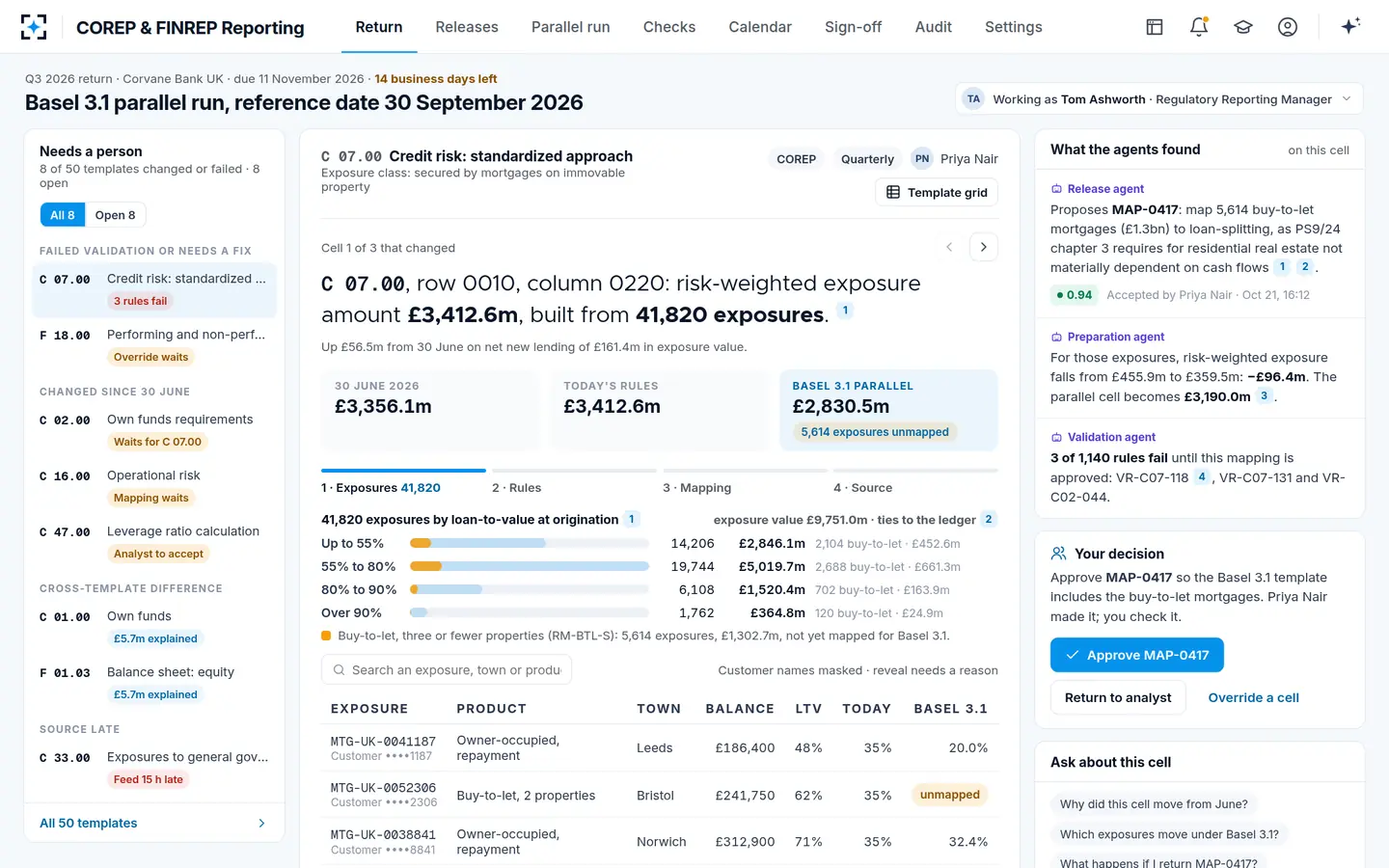
F 18.00 is "Information on performing and non-performing exposures", the FINREP template supervisors read for asset quality, with its companions F 18.01 on inflows and outflows and F 19.00 on forborne exposures. Its non-performing exposures and COREP's exposures in default are separate concepts defined in separate rules, so the two need a written bridge. In the solution's sample bank, a fictional UK lender, F 18.00 was one of eight templates needing a person on the review day, because an override was waiting for its checker.
The two returns are checked separately, never against each other
2,073
active EBA validation rule codes for COREP, 30 September 2026
Our count
2,393
active EBA validation rule codes for FINREP, same date
Our count
0
rules in the file that read both a COREP table and a FINREP table
Of 14,164 rows
How do COREP and FINREP reconcile?
Through a set of relationships the bank defines and checks itself, each either agreeing or explained. The EBA's published rules check COREP against COREP and FINREP against FINREP; in the October 2026 file, not one rule reads tables from both. The PRA expects "a formal and comprehensive process reconciling regulatory flows to appropriate records, including the general ledger, for every submission cycle", after its skilled persons found reconciliation gaps at several firms (PRA, 2021). The COREP–FINREP tie is one of those reconciliations, and with no published rule behind it, it is only as good as the bank's own list of relationships.
Where COREP and FINREP meet, and why they can legitimately differ
| Item | COREP | FINREP | Common legitimate difference |
|---|---|---|---|
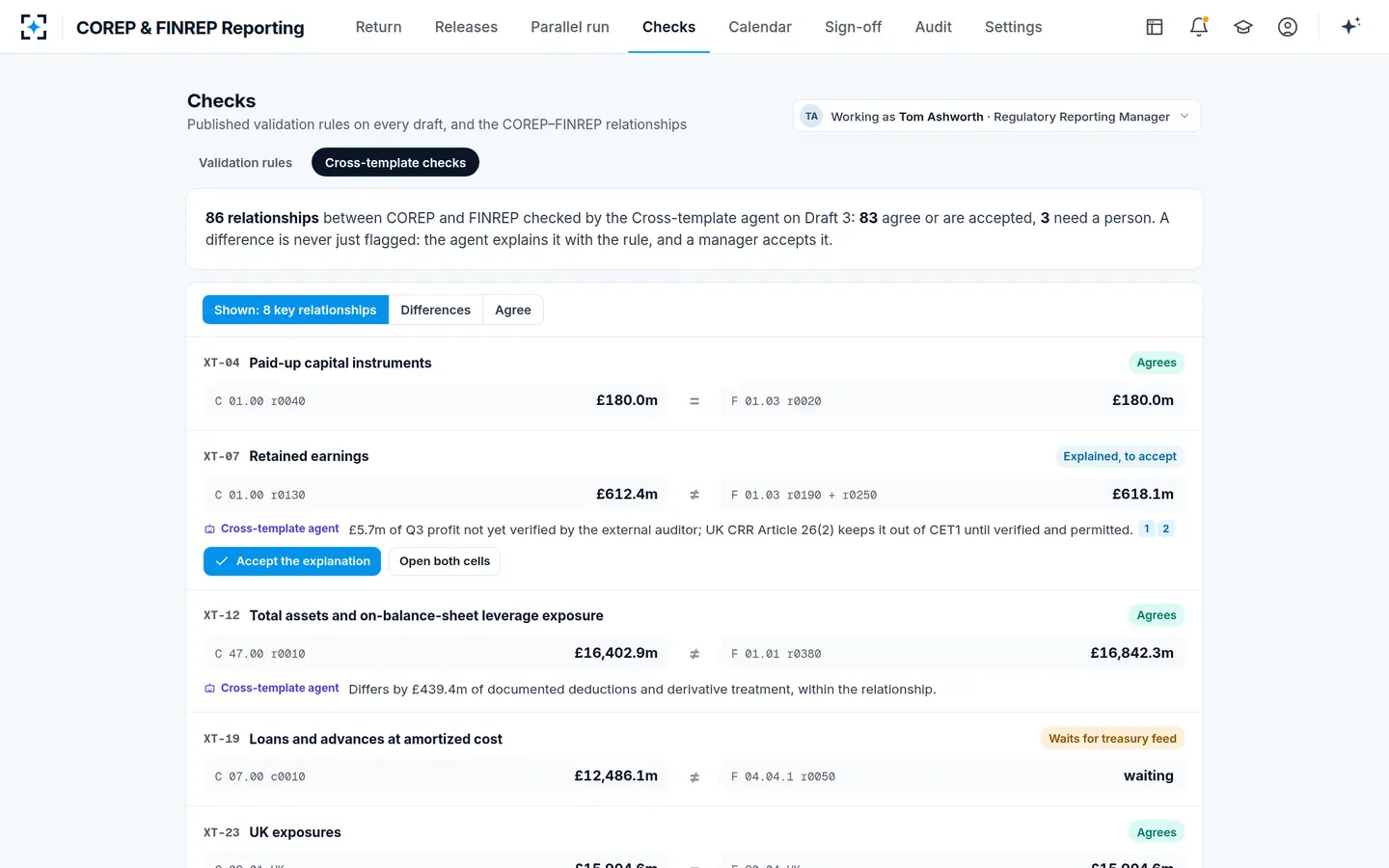
| Paid-up capital | C 01.00, fully paid up capital instruments | F 01.03, equity | Usually none: they should agree |
| Retained earnings | C 01.00, retained earnings and eligible profit | F 01.03, equity | Interim profit not yet verified and permitted for CET1 |
| Total assets and leverage exposure | C 47.00, leverage ratio calculation | F 01.01, total assets | Regulatory deductions, derivative and securities financing treatment |
| Loans and advances | C 07.00 and C 08 exposure values | F 04 and F 05, carrying amounts | Credit conversion factors, impairment, scope of consolidation |
| Defaulted and non-performing | Exposures in default in C 07.00 and C 08 | F 18.00 non-performing exposures | Separate definitions in separate rules |
| Scope of consolidation | CRR prudential group | F 17.01 to F 17.03 reconcile accounting and CRR scope | Entities consolidated in the accounts but not prudentially |
Retained earnings show how a legitimate difference works. FINREP's equity includes the year's interim profit; COREP can count it as CET1 only on conditions. The CRR lets institutions include "interim or year-end profits in Common Equity Tier 1 capital before the institution has taken a formal decision confirming the final profit or loss ... only with the prior permission of the competent authority", which is granted only where "those profits have been verified by persons independent of the institution that are responsible for the auditing of the accounts" (CRR Article 26(2)). In the solution's sample, retained earnings are £612.4 million in COREP and £618.1 million in FINREP; the £5.7 million is third-quarter profit the external auditor has not yet verified.
Two returns, two calendars in the UK
In the EU, COREP and FINREP share remittance dates: quarterly information by close of business on 12 May, 11 August, 11 November and 11 February (2024/3117, Article 3). In the UK they no longer do. Since 31 December 2025, UK FINREP data items are due within 30 business days of the end of the reporting period, while COREP keeps the calendar dates (PRA Rulebook, Reporting (CRR) Article 3). In most quarters the two land within a few days of each other, but a reconciliation that runs only when both are final may now run late for one of them.
The templates are diverging too. From 1 January 2027 UK COREP uses Basel 3.1 OF codes; EU COREP keeps C codes and changes again with the EBA's simplification for September 2027, described in EBA reporting simplification: the 980,000 national data points.
How the Cross-template agent checks COREP against FINREP
In COREP & FINREP Reporting, the Cross-template agent checks the relationships between the two returns on every draft, from own funds against equity to exposures in default. Where they agree, it says so. Where they differ, it writes the explanation with the rule behind it and a manager accepts or rejects it; the agent never accepts its own explanation. Because both returns are populated from the same general ledger and risk data by the same Preparation agent, a difference points to a rule, a scope or a data problem, not to two teams with two extracts.
86 relationships between COREP and FINREP, each agreed or explained
The same drill that explains a difference also catches an error both returns share. A misclassified loan is consistent across COREP and FINREP, passes every published rule and every tie, and is found only by opening the cell down to its exposures, which is the argument of COREP validation rules pass; the return can still be wrong.
A COREP cell written as a sentence, with its exposures
Questions people ask
Is FINREP part of COREP?
No. They are separate frameworks set out in the same EU regulation, 2024/3117, and filed to the same supervisor. COREP covers prudential data such as own funds and capital requirements; FINREP covers financial information under IFRS or national GAAP.
What does COREP stand for?
Common Reporting: the harmonised reporting of own funds, own funds requirements and related prudential data introduced for EU banks. FINREP stands for Financial Reporting, the harmonised supervisory reporting of financial statements.
Do COREP and FINREP use the same scope of consolidation?
Not always. COREP follows the prudential scope under the CRR; FINREP is reported on the CRR scope too, but starts from accounts drawn up on the accounting scope, which is why FINREP includes templates F 17.01 to F 17.03 reconciling the two.
Are COREP and FINREP due on the same day?
In the EU, yes: quarterly returns by 12 May, 11 August, 11 November and 11 February. In the UK, COREP keeps those dates while FINREP has been due within 30 business days of the period end since 31 December 2025.
Which COREP templates does a small bank file?
Fewer than a large one: templates for approaches it does not use, such as IRB credit risk or internal market risk models, do not apply, and several templates depend on thresholds, such as the geographical breakdown in C 09.01 and C 09.02, required where non-domestic exposures reach 10% of total exposures.