EBA reporting simplification is the European Banking Authority's 2026 package to shrink and steady EU supervisory reporting. Its centre is a revision of the implementing technical standards on supervisory reporting that "delivers a 16% reduction in data points in the EU harmonised reporting framework", with lower frequencies and more proportionality; counting the slimmer stress test collection, the EBA puts the "overall net reduction of around 50%" (EBA, Efficient reporting: simpler, smarter, proportionate). It was consulted on from April to July 2026 and is planned for the 30 September 2027 reference date. The same review found what sits underneath: a stocktake of 2025 national supervisory data requests "revealed the existence of 671 such requests totalling almost 980 thousand data points". Botminds' COREP & FINREP Reporting is built for teams living through this: its agents read each release down to the bank's own templates, so a smaller framework that still changes every year costs days, not weeks.
This guide sets out what the package removes, when, what it does not touch, and what the UK is doing on its own track.
National requests add ten times the data points the EBA templates define
What is the EBA reporting simplification?
It is the EBA's "most wide‑ranging review of the reporting framework in over a decade", built on its 2025 report on the efficiency of the regulatory and supervisory framework and its 2021 cost of compliance study (EBA). It has five parts: a revised set of supervisory reporting standards (consultation paper EBA/CP/2026/07, 10 April 2026); slimmer EU-wide stress test and supervisory benchmarking collections; a public repository of national data requests with guidelines on how supervisors make them; work towards integrated reporting with the ECB through the Joint Bank Reporting Committee; and better change management, including a "move towards one or two annual releases for reporting changes only".
The revised standards rebalance the framework "towards 'need‑to‑have' information", fold ad hoc collections into regular reporting, and add what new rules require: IFRS 18 in FINREP, ESG reporting, and changes for the Fundamental Review of the Trading Book. For smaller institutions the consultation proposes reduced frequencies or exemptions in liquidity and a "'core + supplement' approach in FINREP" (EBA/CP/2026/07).
How many data points will the EBA remove?
About 16% of the data points defined in the supervisory reporting standards, and more once stress testing and benchmarking are counted. The EBA says the stress testing collections fall by "around 55% data points" and supervisory benchmarking reporting by "up to 65%", giving the overall net reduction of around 50% "covering both the regular reporting and EU-wide stress test data collection, even after accounting for necessary additions" (EBA). Small and non-complex institutions, which already report about 45,000 of the roughly 92,000 modelled data points, would see "a further 18% reduction in reported data points".
What the 2026 package removes, by the EBA's count
16%
of data points in the harmonised supervisory reporting framework
Plus lower frequencies
~55%
of data points in the EU-wide stress test collection
~50%
net, across regular reporting and stress testing together
18%
further cut for small and non-complex institutions
The framework is large to begin with. The EBA describes "around 220 reporting templates of which 33% are always expected to be reported while the remaining templates are subject to different criteria", such as approaches, size or thresholds (EBA). A bank therefore feels the cut only in the templates it actually files.
When will the EBA reporting changes apply?
From the 30 September 2027 reference date, if the timetable holds. The consultation paper says "first reporting under the revised framework is expected for the reference date of 30 September 2027", and that the EBA "plans to finalise the revised ITS following the public consultation and submit the final report to the European Commission for adoption by the end of 2026" (EBA/CP/2026/07). Responses were due by 10 July 2026. On 27 October 2026 the EBA's page for the package still showed its status as "Under consultation" (EBA).
The technical side moves in two steps. Release 4.4, phase 1, final on 12 October 2026, carries the parts that cannot wait, such as IFRS 18 in FINREP; a second phase "expected early 2027" will implement the simplification package "consulted between April and July 2026, which is currently being finalized" (EBA, 12 October 2026). The release page lists September 2027 for most of phase 2 and December 2027 for DORA amendments (EBA). How a team reads those releases is in EBA reporting framework 4.4: inside the agent that reads a release.
The simplification calendar, as published by October 2026
| Date | Step | Status on 27 October 2026 |
|---|---|---|
| 10 April 2026 | Consultation paper EBA/CP/2026/07 on the revised standards published | Done |
| 10 July 2026 | Consultation responses due | Closed |
| 12 October 2026 | Release 4.4 phase 1: IFRS 18 FINREP, Pillar 3 changes | Final |
| End of 2026 | Final draft standards submitted to the Commission | Planned; page shows "Under consultation" |
| Early 2027 | Release 4.4 phase 2 (4.4.1): technical package for the simplification | Expected |
| Early 2027 | EU-wide repository of supervisory data requests fully working | Expected |
| 30 September 2027 | First reporting under the revised standards | Planned |
What are national supervisory data requests?
They are the data collections a national competent authority, or the ECB for significant banks, asks of banks on top of the EU's harmonised templates. The EBA's stocktake found that in 2025 "competent authorities across the EEA conducted a substantial number of structured microprudential supervisory data requests (671 requests totalling 978,109 requested data points)", and that they "were predominantly of a regular and recurring nature, with quarterly, annual and monthly reporting frequencies prevailing" (EBA). In other words, they are not one-off questions; they are a second reporting framework.
Supervisors have started to cut them. The EBA reports that competent authorities "have however already implemented or planned simplifications reducing national reporting data points by 17.4% for the data request by the EEA national competent authorities and 18.5% for SSM data requests". It is also building "an EU‑wide public repository of supervisory data requests", which it expects "to be fully functional in early 2027", with guidelines that would oblige authorities to record their requests in it.
"There is a shared commitment by the EU competent authorities not only to simplify the EBA reporting framework, but also all additional national supervisory reporting and data requests that come on top of the EU reporting requirements."
EBA, Efficient reporting: simpler, smarter, proportionate, 2026
Why the national layer decides how much simplification a bank feels
Because it is larger, less standard and less visible. The harmonised framework is one specification with one data point model, published validation rules and a release calendar; a national request may come as a spreadsheet with its own definitions. A 16% cut in the first layer and a 17.4% cut in the second sound alike, but the second applies to a pool counted in hundreds of thousands of requested data points, with no common dictionary to map against.
For a reporting team the practical effect is that the work of reading definitions and mapping data does not shrink in proportion to the data points removed. Every removed template is a mapping retired, every new national request a mapping written, and every release a set of changes to check against the bank's own templates. The EBA's own 2021 study counted change as a cost in its own right: annual implementation costs of about €100,700 for a small and non-complex institution and €2.7 million for a large one, on top of ongoing reporting costs (EBA/REP/2021/15), set out by size in FINREP reporting requirements, and what they cost by bank size.
What is integrated reporting in the EU?
It is the long-term plan to collect supervisory, resolution and statistical data from banks through one set of definitions, so the same fact is reported once and used many times. The EBA calls it "the ultimate objective for the EBA for the long-term" and "the flagship action to improve efficiency of reporting system", and warns that it "can lead to more granular reporting, hence volume of reported data is expected to grow but design should be simpler, closer to institutions' internal reporting systems" (EBA).
The technical base is the data point model. After the move to DPM 2.0 in release 4.2, the EBA, EIOPA and the ECB set up a DPM Alliance in March 2024, and the next version, DPM 2.1, is being built to bring the ECB's statistical data and its planned Integrated Reporting Framework into the same dictionary as prudential and resolution reporting (EBA, DPM data dictionary).
What is the Joint Bank Reporting Committee?
The JBRC is "an EU‑level advisory committee created to simplify, harmonise, and improve bank reporting across Europe", set up by the EBA with the ECB, which "helps to develop common definitions and standards for the data that banks are required to report for statistical, supervisory and resolution purposes" (EBA). One of its main priorities is semantic integration: a common data dictionary and an integrated glossary. Banks take part through a Reporting Contact Group. It issued advice on ESG definitions in January 2026, which the EBA built into its ESG reporting proposals, and the concepts in the 2026 consultation are on its 2026 work plan.
What is the PRA doing to reduce banking reporting?
The UK is cutting on its own track, and faster in places. The PRA deleted 37 templates with effect from 31 December 2025, 34 of them whole FINREP templates, and aligned FINREP remittance to business days (PRA PS27/25). Its Future Banking Data discussion paper of February 2026, which closed on 5 May 2026, looks at the rest of its banking collections and at how they are collected (PRA DP1/26).
The discussion paper is candid about the calendar problem. "Looking only at the templates currently submitted monthly, some firms would have deadlines on 15 different dates measured in business days (from 7 days to 35 days), another at 20 calendar days, and one more expressed as '1 month'." It also notes that collections arrive through the Bank's BEEDS portal, the FCA's RegData platform and email, in XBRL, XML and Excel.
Two simplifications, two timetables
EU: the EBA package: Consultation on revised standards, April to July 2026.
UK: the PRA: 37 templates deleted from 31 December 2025, 34 of them FINREP.
EU: the EBA package: 30 September 2027 reference date, if adopted.
UK: the PRA: No single date; a discussion paper on wider collections closed in May 2026.
EU: the EBA package: 671 national requests found; a public repository from early 2027.
UK: the PRA: The PRA is itself the national supervisor; DP1/26 reviews its own collections.
EU: the EBA package: Aims for one or two releases a year.
UK: the PRA: Bank of England taxonomies: 3.7.0, 4.0.0 and 4.1.1 between September 2025 and August 2026.
EU: the EBA package: CRR3 in COREP since 2025; market risk rules from 2027 with temporary adjustments.
UK: the PRA: New OF templates from 1 January 2027.
How much will EBA reporting simplification save?
The EBA has not published a new cost figure for the 2026 package and says the savings it expects "need to be confirmed through the industry response to the consultation" (EBA). The last measured baseline is the 2021 study, which estimated that its recommendations could cut reporting costs by up to 15 to 24%, or EUR 188 to 288 million for small and non-complex institutions (EBA, 2021); the EBA now reports those recommendations largely completed.
A bank's own saving depends on which of its templates go, which national requests its supervisor retires, and how much the change itself costs. In 2027 the change is heavy: release 4.4 in two phases, IFRS 18 in FINREP, and in the UK the Basel 3.1 templates from 1 January, described in Basel 3.1 reporting: a platform plan that is live by 12 May 2027.
What simplification means for a reporting team, and where COREP & FINREP Reporting fits
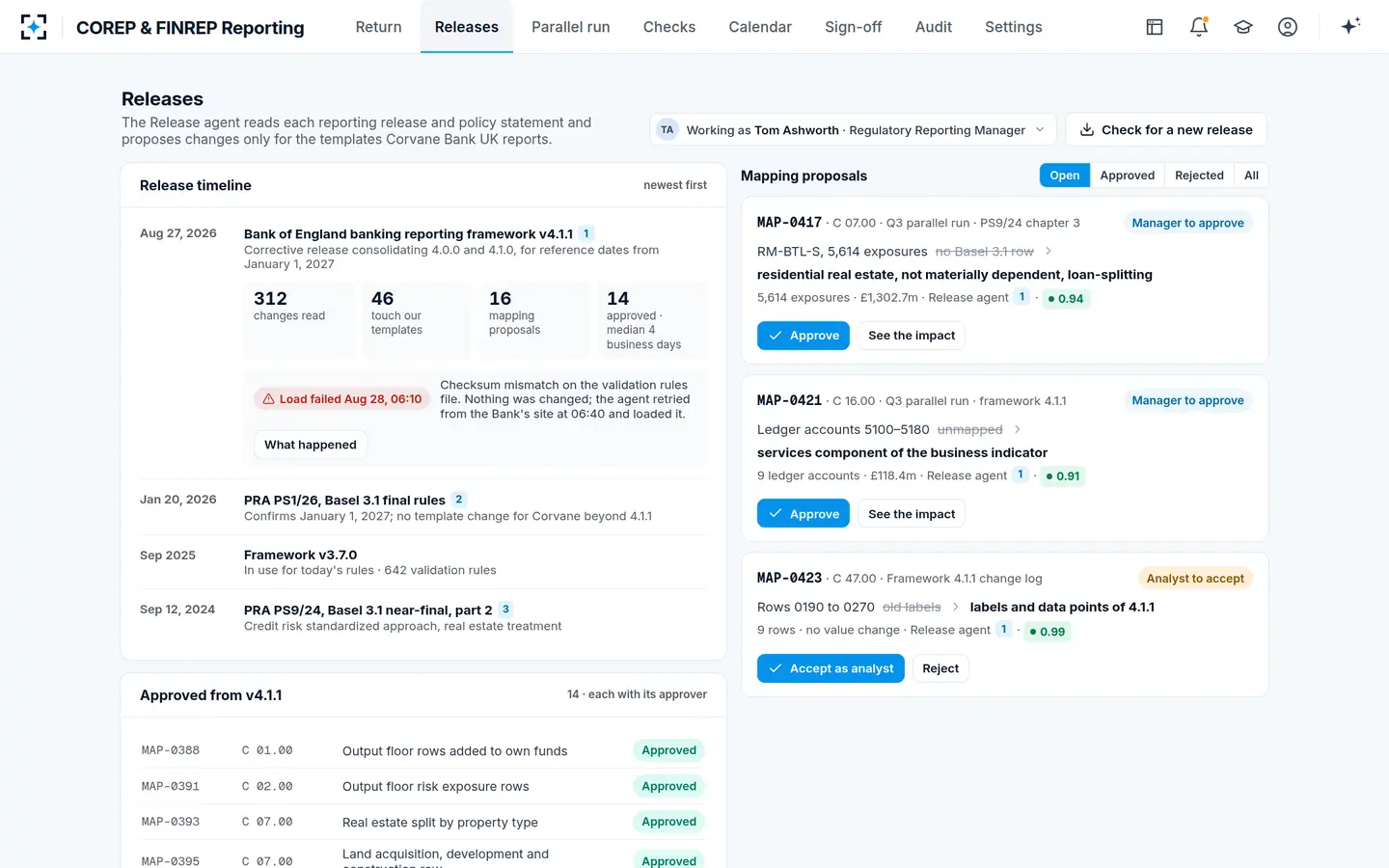
Fewer data points do not mean fewer decisions in the year they are removed. Each change in the package is a template to retire, a mapping to rewrite, a validation rule set to update and an interpretation to recheck. Take the solution's sample bank, a fictional UK lender filing 50 COREP and FINREP templates with about 12,600 populated cells: when one Bank of England taxonomy release arrived with 312 changes, its Release agent narrowed them to the 46 that touched the bank's templates and 16 that needed a mapping decision, each with its citation, for an analyst to accept and a manager to approve.
That is the job a simplification multiplies in its first year. COREP & FINREP Reporting does the reading and the checking: the Release agent proposes, the Preparation agent repopulates only what an approved mapping touches, the Validation agent reruns every rule, and the Deadline agent keeps the new dates in view. It does not decide which national requests to answer or how to interpret a new definition; people do, on the record.
A release narrowed to the templates the bank actually files
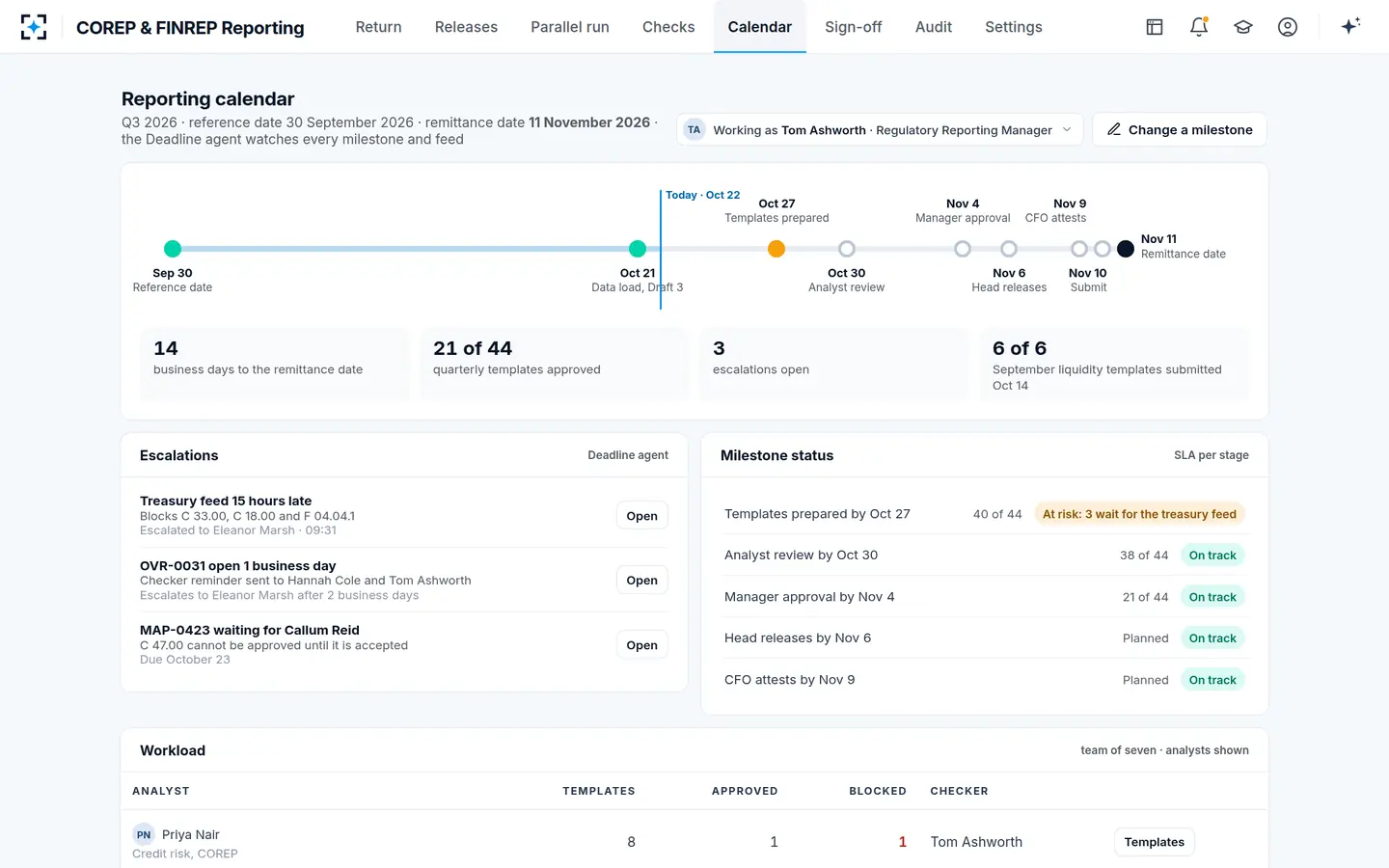
New remittance dates and milestones, tracked against the calendar
Questions people ask
Will the EBA simplification reduce COREP reporting?
Yes, in parts: phase 2 of release 4.4 lists simplification of own funds, leverage and liquidity reporting alongside FINREP, for the September 2027 reference date. The EBA counts a 16% reduction in data points across the harmonised framework, not per return.
What is the EU-wide repository of supervisory data requests?
A public database the EBA is building of the structured and ad hoc data requests competent authorities make of banks, expected to be fully working in early 2027. Authorities will be able to search existing requests before making new ones, and guidelines would oblige them to record their requests there.
Does the EBA simplification apply in the UK?
No. UK banks report under the PRA Rulebook and the Bank of England taxonomy, and the PRA runs its own review, which deleted 37 templates from 31 December 2025. UK groups with EU subsidiaries will see the EBA changes through those subsidiaries.
Why do national supervisors ask for extra data?
Because harmonised templates do not cover every supervisory question; the EBA found the 2025 requests mostly regular and recurring, quarterly, annual and monthly. The repository and the planned guidelines aim to make each request visible, avoid duplicates and encourage data sharing between authorities instead of new collections.
Will integrated reporting mean less data?
Not necessarily. The EBA expects integrated reporting to make reporting more granular, so the volume of data may grow, while the design becomes simpler and closer to banks' internal systems, with each data point defined once and used for several purposes.