A head of regulatory reporting owns a bank's prudential returns from the source data to the remittance date: the COREP templates on capital, risk and liquidity, the FINREP templates on the balance sheet and income, and in the UK the PRA's own data items. The role answers upward to a named senior manager, because the PRA makes "the production and integrity of the firm's financial information and its regulatory reporting" a prescribed responsibility (PRA Rulebook, Allocation of Responsibilities 4.1(9)). What has changed is the volume of change. Between December 2024 and October 2026 the EBA issued framework releases 4.0 to 4.4, and the Bank of England published three banking taxonomies for UK Basel 3.1, which applies from 1 January 2027. Botminds' COREP & FINREP Reporting was built for that shape of work: agents read each release, populate and check the templates, and trace every cell to its source, while analysts, managers, the head and the CFO keep every decision.
This guide sets out what the head of regulatory reporting is accountable for, what the PRA found when it looked inside reporting teams, and how a team of analysts and managers can be organised so that most of its hours go to judgement rather than to reading change logs and decoding failed rules.
The same team, organised for volume or for change
Organised for volume: A template family per preparer, filled each quarter from spreadsheets and general ledger extracts.
Organised for change: A decision per person: a mapping accepted, an interpretation approved, a difference explained, a return released.
Organised for volume: A senior analyst reads the whole change log by hand to find what touches the bank.
Organised for change: The release is narrowed to the bank's own templates first; analysts judge the proposals that remain.
Organised for volume: Held in people's heads and buried in system code, where nobody reviews them.
Organised for change: A register of key interpretations, each with an owner, a citation, a review date and sign-off.
Organised for volume: Decoded rule by rule, draft after draft, close to the remittance date.
Organised for change: Explained in words with the cause, so the fix goes to the mapping, not the cell.
Organised for volume: Assembled at quarter end from emails, screenshots and sign-off sheets.
Organised for change: Produced as the work happens: who approved what, on what evidence, cell by cell.
What does a head of regulatory reporting do?
The head of regulatory reporting runs the production of every return the bank owes its prudential supervisor and signs off that each one is complete, on time and right. In practice that is four jobs. The first is the calendar: quarterly COREP returns are due by close of business on 12 May, 11 August, 11 November and 11 February, monthly returns on the 15th calendar day after the reference date, and in the UK FINREP within 30 business days of the period end (PRA Rulebook, Reporting (CRR) Article 3). The second is change: reading each new framework release, taxonomy and policy statement and deciding what it means for the bank's templates and mappings.
The third job is judgement. A return rests on dozens of interpretations, such as which exposure class a product falls into or which general ledger accounts make up a business indicator component, and since 2019 the PRA has expected a firm to be able to list its key interpretations on request and show how they were validated (PRA Dear CEO letter, 2019). The fourth is evidence: showing the senior manager, internal audit and the supervisor how the return was produced and who approved each departure from the norm.
Titles vary. Larger groups split the role between a head of regulatory reporting for the UK and one for EU entities, with a separate head of reporting change; smaller banks fold it into the financial controller's job. The accountability does not vary, and that is where the role starts.
Who is accountable for regulatory reporting under the Senior Managers Regime?
A named senior manager is. Rule 4.1 of the Allocation of Responsibilities part of the PRA Rulebook lists the prescribed responsibilities a bank must give to its senior managers, and point (9) is "responsibility for the production and integrity of the firm's financial information and its regulatory reporting under the regulatory system" (PRA Rulebook). The PRA does not say which senior manager must hold it. A natural home is the Chief Finance function, SMF2, defined as "having responsibility for management of the financial resources of a firm and reporting directly to the governing body of the firm in relation to its financial affairs" (PRA Rulebook, Senior Management Functions 3.3).
The PRA has made the link explicit. Its 2019 letter on the reliability of returns was copied "to the relevant senior manager at your firm", and its 2021 follow-up said that senior manager needs the authority to oversee the whole process, from trade capture to the filed return, across functions (PRA, 2021). The head of regulatory reporting is therefore the person who makes that oversight possible: the senior manager signs for a process the head designs and runs.
The responsibility is stable. The PRA's October 2026 consultation on the second phase of its Senior Managers and Certification Regime review proposes to remove several prescribed responsibilities, among them those for the Certification Regime, for training and induction and for management responsibilities maps; regulatory reporting is not on its list (PRA CP14/26, 22 October 2026). Responses are due by 22 January 2027.
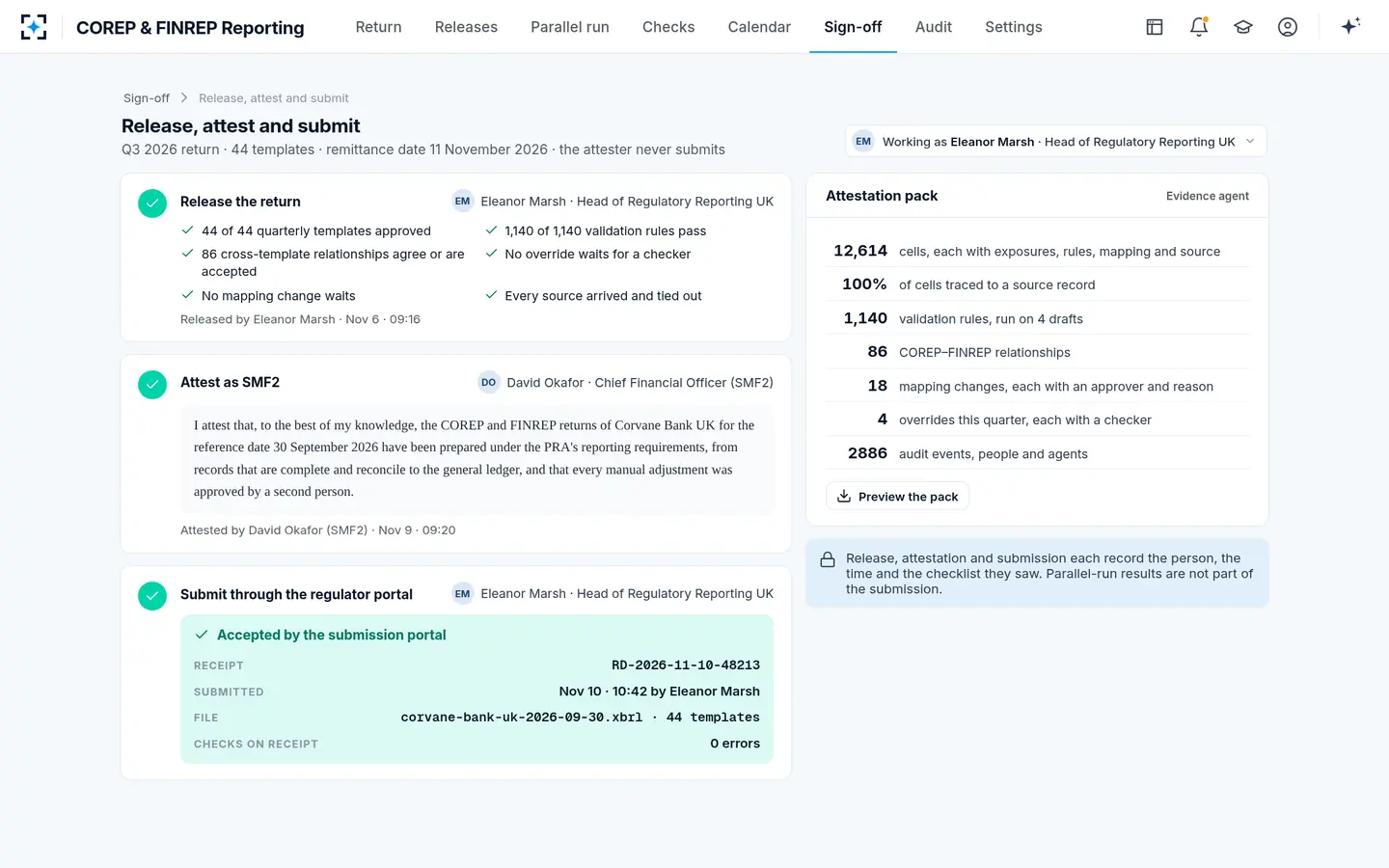
The release, the attestation and the submission, by three different people
Five EBA releases and three UK taxonomies in two years
The team's calendar is now set by releases as much as by quarter ends. The EBA's own table lists framework 4.0 from December 2024, bringing the CRR3 changes into COREP; 4.1 in the second quarter of 2025; 4.2 in the fourth quarter of 2025, which finished the move to the DPM 2.0 data dictionary; 4.3 in July 2026; and 4.4, whose first phase was released on 12 October 2026 (EBA reporting frameworks). Each brings a data point model, an XBRL taxonomy and validation rules, and the rules move between releases too: the EBA publishes a small validation rules package every quarter, shortly before each quarter end (EBA validation rules packages).
The releases a UK and EU reporting team absorbed, December 2024 to October 2026
| Release | Published | What it changed | Applies from |
|---|---|---|---|
| EBA 4.0 | December 2024 | CRR3 and CRD6 in COREP; DORA and MiCAR reporting | March 2025, module by module |
| EBA 4.1 | Q2 2025 | MiCAR guidelines; full Pillar 3 templates | June 2025 |
| EBA 4.2 | 25 November 2025 | All modules moved to DPM 2.0 and a new glossary; operational risk | December 2025 |
| Bank of England 3.7.0 | 8 September 2025 | Step-in risk reporting | 1 January 2026 |
| Bank of England 4.0.0 | 27 February 2026 | UK Basel 3.1, simpler regime for small domestic deposit takers | 1 January 2027 |
| EBA 4.3 | 9 July 2026 | Third-country branch reporting; AMLA risk assessment | December 2026 / March 2027 |
| Bank of England 4.1.1 | 27 August 2026 | Corrective release consolidating 4.0.0 and 4.1.0 | 1 January 2027 |
| EBA 4.4, phase 1 | 12 October 2026 | IFRS 18 FINREP module; Pillar 3 ESG and FRTB disclosures | December 2026 / March 2027 |
Not every release touches every bank. Release 4.3 adds reporting for third-country branches and for the Anti-Money Laundering Authority's risk assessment, which a domestic UK lender never files. That is the point: the hours go into finding out, for each release, which items touch the bank's own templates. The solution's sample puts a number on it. Of 312 changes in one Bank of England taxonomy release, 46 touched the sample bank's templates and 16 needed a mapping change. The detail of how an agent does that reading is in EBA reporting framework 4.4: inside the agent that reads a release.
How is a regulatory reporting team structured?
Most teams are built around template families: an analyst owns credit risk (C 07.00, the C 08 templates and the counterparty templates), another owns own funds and capital ratios, another liquidity, another FINREP. Managers review, the head releases. That structure follows the forms, and it worked while the forms changed rarely. It struggles when a single release changes the same concept across families, as DPM 2.0 did when the EBA updated "all modules version due to the finalisation of the data dictionary transition to DPM 2.0 and new glossary" (EBA).
A team organised for change keeps the template owners but adds three responsibilities that cut across them: a change lead who reads every release and policy statement and routes what matters; an interpretations owner who keeps the register the PRA asks for; and a controls and data owner who runs reconciliations to the general ledger and the tie-outs between COREP and FINREP. In a small bank one person may wear two of those hats. The People figure shows how each seat changes when agents take the reading, populating and checking.
Each seat keeps its judgement; agents take the reading and the checking
Today
Reads every release by hand to find what touches her templates, edits mappings in spreadsheets, decodes failed rules.
With agents
Receives proposals for her own templates only, each with the cited paragraph and the exposures it moves; accepts or rejects with a reason.
Still theirs: Accepting or rejecting each mapping proposal
Today
Reviews grids against last quarter and approves mapping changes by email.
With agents
Sees what a mapping does to each cell before approving it, with a reason code; cannot approve his own work.
Still theirs: Approval of mappings, overrides and explanations
Today
Chases late feeds and slipped milestones against the remittance date; answers the supervisor.
With agents
Gets escalations as they happen and releases the return only when every check has passed.
Still theirs: Release of the return
Today
Signs off on evidence assembled from emails and screenshots.
With agents
Reads the trail on one page: who approved what, on what evidence, for every cell.
Still theirs: The attestation
Today
Tests controls quarterly and finds overrides whose reasons are lost.
With agents
Filters every action by person, agent, mapping and override, and exports it.
Still theirs: Independent assurance
What the PRA found inside reporting teams
The PRA has looked. After its 2019 letter it commissioned skilled person reviews "covering credit and market risk returns at larger firms", and in September 2021 it wrote to every bank with the results (PRA thematic findings, 2021). Its first finding was about structure: "responsibilities were dispersed across multiple individuals and teams, and delegated too far down the organisation", which was worse where firms had "complex and fragmented end to end processes (eg from trade capture to regulatory reporting)".
"It was clear that multiple firms did not treat the preparation of their regulatory returns with the same care and diligence that they apply to financial reporting shared with the market and counterparties."
PRA, Thematic findings on the reliability of regulatory reporting, 10 September 2021
The other findings read like a job description for the head of the function. Controls: gaps around models, end-user computing and reconciliations, with the PRA expecting regulatory flows to be reconciled to the general ledger every cycle. Investment: "many firms have not prioritised investment in regulatory reporting, leading to reduced capacity and capability compared with financial reporting". The fines show what happens when those gaps meet a real error: Metro Bank paid £5,376,000 in 2021 after applying the wrong risk weight to commercial loans, an error that led it to adjust its December 2018 risk-weighted assets by about £900 million (PRA, 2021). The full set of letters and fines is in the PRA's Dear CEO letter on regulatory reporting, and three fines.
How big is a regulatory reporting team?
There is no published benchmark for headcount, and size follows scope more than balance sheet. The scope can be large: the PRA counts "over 400 templates of varying sizes and complexity" in its data collection from banks, with capital covered "in one form or another in around 120 of these templates" (PRA DP1/26, February 2026). A bank files the subset its size, approaches and activities trigger. The solution's sample bank, a fictional UK lender, files 50 COREP and FINREP templates, about 12,600 populated cells, with a team of seven.
The better question is where the team's days go. The split below is our estimate for one quarterly return and the release that lands before it, by hand. Reading the release is the largest single block, and it is the block a bigger team does not shrink, because the reading has to be done by someone who knows the bank's templates.
Where a quarter's reporting days go before agents take the reading
By hand: 33 working days
- Reading the release · 45%
- Reviewing against last quarter · 18%
- Decoding failed rules · 15%
- Mappings · 9%
- COREP vs FINREP and evidence · 12%
With agents: 10.5 working days
- Reading the release · 38%
- Reviewing against last quarter · 29%
- Decoding failed rules · 14%
- Mappings · 10%
- COREP vs FINREP and evidence · 10%
How will Basel 3.1 change regulatory reporting teams?
It changes the forms, and for one year it may double the work. The PRA's final rules and the Basel 3.1 reporting requirements both take effect on 1 January 2027, and the internal model approach for market risk follows on 1 January 2028 (PRA PS1/26, 20 January 2026). The templates are renamed as well as redrawn: the PRA's mapping shows own funds requirements as OF 02.00, a new output floor template OF 02.01, standardised credit risk as OF 07.00, and the old operational risk templates C 16.00, C 17.01 and C 17.02 deleted in favour of a new OF 16.00 (PS1/26 Appendix 18).
Teams that run the new templates in parallel before the switch carry two versions of the same return for each quarter of the run, with a difference to explain between them. No PRA rule we found requires a parallel run; banks choose it because the CFO wants to know the capital effect before the first live return. Planning that run back from the first remittance date is the subject of a platform plan for Basel 3.1 reporting.
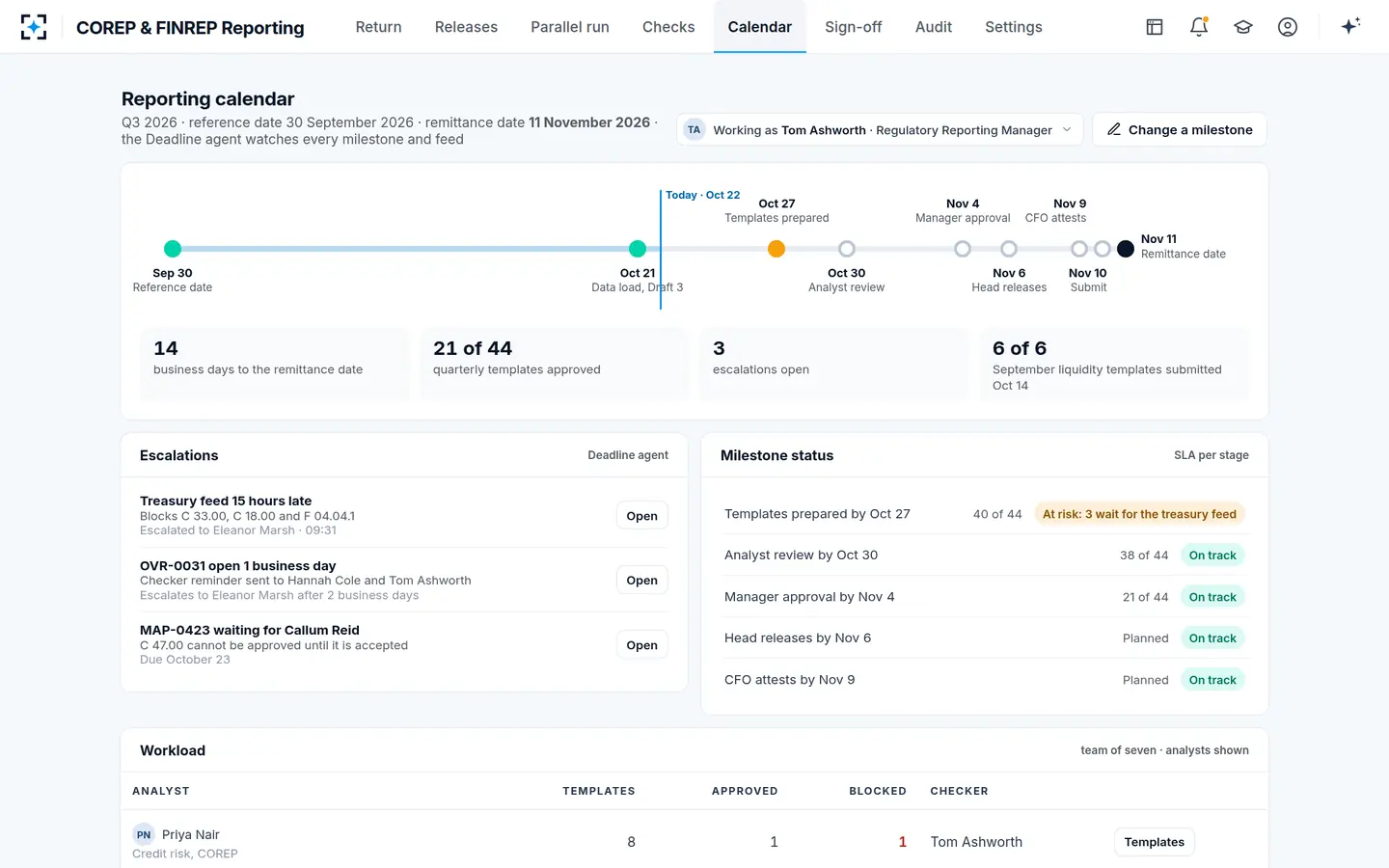
Milestones to the remittance date, with escalations as they happen
What skills does a regulatory reporting manager need?
The manager needs to read rules and data with equal ease. The work used to reward knowing the templates cell by cell; it now rewards knowing why a cell holds what it holds, and being able to show it. The checklist below is the set we would hire for, drawn from what the PRA's letters ask firms to demonstrate.
Eight skills a COREP and FINREP manager needs now
- Reads a regulation down to the cell
From a CRR article or PRA rule to the template row and column it fills, and back.
- Reads a data point model
DPM 2.0 is how the EBA now defines every data point; a manager should be able to look a cell up in it.
- Writes an interpretation others can audit
The question, the answer, the citation, the owner and the date it is next reviewed.
- Reads a validation rule as a formula
And knows which failures are arithmetic and which point to a mapping problem.
- Reconciles to the general ledger
Every cycle, with each break explained, not when time allows.
- Explains a COREP and FINREP difference
Most differences are legitimate; each needs its rule written down.
- Judges an agent's proposal
Checks the cited paragraph and the exposures it moves before accepting; never approves own work.
- Escalates early
The PRA fined Standard Chartered in 2021 partly for a four-month delay in telling it about an error.
Where COREP & FINREP Reporting fits in the team
Botminds' COREP & FINREP Reporting gives the team seven agents and keeps every decision with a person. The Release agent reads each framework release and policy statement and proposes mapping changes only for the templates the bank reports. The Preparation agent populates COREP and FINREP from the general ledger, the credit risk data mart, core banking, treasury and the data warehouse, and writes each cell as a sentence with its lineage. The Validation agent runs the published rules on every draft and explains each failure. The Cross-template agent checks COREP against FINREP. The Parallel-run agent explains the Basel 3.1 difference by driver. The Deadline agent watches the calendar and the Evidence agent builds the attestation pack.
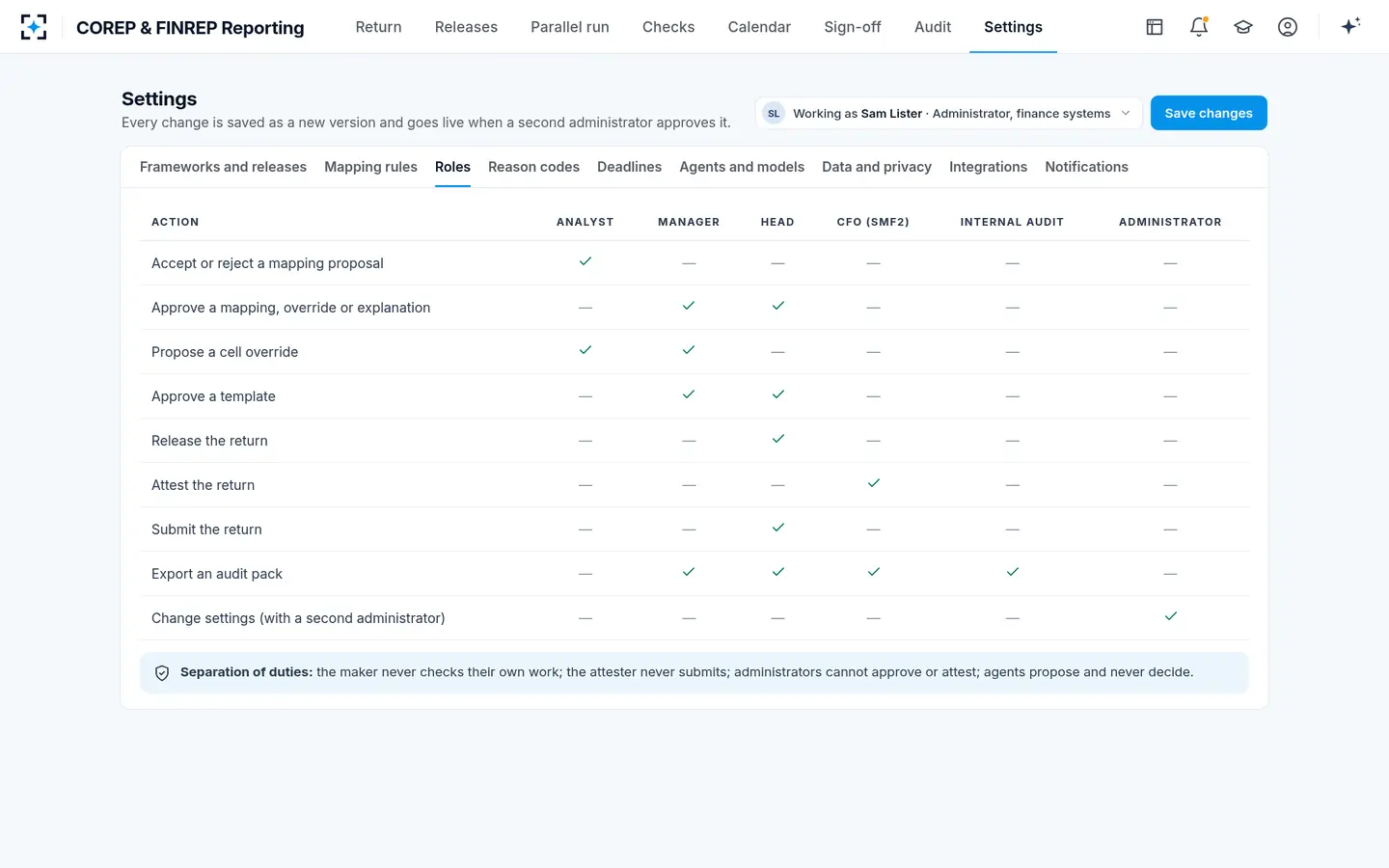
Separation of duties is enforced, not advised: an analyst accepts a mapping, a manager who did not make it approves, the head releases, the CFO attests, and the person who attests never submits. What the solution does not do is decide an interpretation, move a regulatory date or send parallel-run results to the regulator. The question of what those rules ask of a return prepared this way is taken up in FINREP AI: what the rules ask of an AI-prepared return.
Who may accept, approve, release, attest and submit
Questions people ask
What is the difference between a regulatory reporting manager and a head of regulatory reporting?
The manager reviews and approves the work on a set of templates; the head owns the whole return, its calendar and its release, and answers to the senior manager who holds the PRA's prescribed responsibility for regulatory reporting. In smaller banks one person may hold both roles; what the PRA's 2021 letter warns against is accountability pushed so far down that nobody senior oversees the whole process.
Is the head of regulatory reporting a Senior Manager Function?
Not as such. The PRA's senior management functions include the Chief Finance function (SMF2), and the prescribed responsibility for regulatory reporting must be allocated to a senior manager. A head of regulatory reporting usually reports into that person rather than holding the function, unless the bank has made them an approved senior manager.
What does a regulatory reporting analyst do?
An analyst prepares a set of templates each period, maps general ledger accounts and product codes to template rows, investigates validation failures and explains movements against the previous period. In the solution's sample, an analyst owning the credit risk templates accepts or rejects each mapping proposal with a reason, and can drill any cell to the exposures behind it.
How many templates does a UK bank report?
It depends on size, approaches and activities. The PRA counts over 400 templates across its banking data collection, and a bank files the subset that applies to it; the solution's fictional sample bank files 50 COREP and FINREP templates, 44 quarterly and 6 monthly.
What qualifications does a head of regulatory reporting need?
No qualification is prescribed by the PRA for the role. Most come from a finance background with an accounting qualification and years of COREP and FINREP preparation; what the role now adds is change management and the ability to defend interpretations to the supervisor, the skills the PRA's skilled person reviews tested.