EBA reporting framework 4.4 is the European Banking Authority's release of the data point model, XBRL taxonomy and validation rules that turn its reporting standards into something a bank's systems can file. Its first phase was published on 12 October 2026, "covering IFRS 18 reporting, Pillar 3 ESG disclosures and other technical amendments"; a second phase, numbered 4.4.1 and expected early 2027, will implement the large simplification of supervisory reporting consulted on between April and July 2026 (EBA, 12 October 2026). Each release lists hundreds of changes, and only some touch a given bank's templates. Botminds' COREP & FINREP Reporting puts an agent on that reading: it narrows a release to the templates the bank reports and proposes mapping changes with the cited paragraph, and an analyst and a manager decide each one.
This guide covers what 4.4 and its predecessor 4.3 contain, when they apply, why UK banks follow a different line, and then follows one release through the agent, step by step, to the approved mapping.
How a release reaches a mapping: the agent reads, two people decide
Agent
Load the releaseFetches the taxonomy, data point model and validation rules; checks the file checksum before using anything.
Never: use a release that fails its checksum
Agent
Narrow to our templatesCompares the new release with the one in force and keeps only the changes to modules and templates the bank reports.
Never: propose outside the templates the bank reports
Agent
Propose a mappingWrites each needed mapping change with the cited paragraph, the exposures or accounts it moves and a confidence score.
A person decides
Analyst acceptsChecks the citation and the exposures; accepts or rejects with a reason. Below 0.90 confidence a second analyst reviews.
Agent
Preview the impactShows what the pending mapping does to each cell and to the return before anyone approves it.
A person decides
Manager approvesA manager who did not make the proposal approves with a reason code; the rules rerun on the next draft.
What is EBA reporting framework 4.4?
It is the release that starts implementing the EBA's simplification of reporting, split into two phases because IFRS 18 arrives first. The EBA's page describes it as including "new and amended reporting requirements, as well as review and simplification of the supervisory and resolution reporting framework (incl. FINREP, own funds requirements, liquidity and new reporting on ESG and regular stress testing data)", and says "the technical package will be split into two phase to accommodate for the IFRS18 earlier application" (EBA, reporting framework 4.4).
Phase 1, final since 12 October 2026, contains a new FINREP module of IFRS 18-aligned templates on income and expenses; updated Pillar 3 disclosures on ESG risks, equity and shadow banking exposures with some market risk disclosure templates; technical corrections to resolution planning and MREL decisions; a correction to the third-country branch liquidity template E 09.02; and templates for the Anti-Money Laundering Authority (EBA). Phase 2 carries the substance most COREP filers care about: amendments to own funds (operational losses, transitional arrangements, a module split by financial year end, market risk), large exposures to shadow banking, FINREP, liquidity and asset encumbrance, leverage, and new ESG reporting, all for the September 2027 reference date.
When does EBA reporting framework 4.4 apply?
Module by module, from the end of 2026 to the end of 2027. The framework table gives "Module specific from 12/2026 (phase 1) or 09/2027 (phase 2)" (EBA reporting frameworks), and the release page sets a first reference date for each change. The FINREP IFRS 18 module is listed for March 2027, after the overview's December 2026; when the two disagree, the date on the module's own row is the one to plan against, and the EBA's Reporting Time Traveller shows the framework in force on any date.
EBA reporting framework 4.4: first reference date by change
| Change | Phase | Expected first reference date |
|---|---|---|
| Resolution planning and MREL decisions: technical amendments | 1 | December 2026 |
| AMLA eligibility templates and revised risk-assessment templates | 1 | December 2026 |
| Pillar 3: ESG, equity, shadow banking (SNCIs a year later) | 1 | December 2026 (December 2027 for SNCIs) |
| FINREP aligned with IFRS 18 | 1 | March 2027 |
| FRTB-related disclosure templates in the data point model | — | March 2027 |
| Supervisory benchmarking for market risk: new columns in C 106.00 | 2 | End of June 2027 |
| ITS on supervisory reporting: own funds, large exposures, FINREP, liquidity, leverage, ESG, FRTB, benchmarking | 2 | September 2027 |
| Initial margin model monitoring (new) | 2 | September 2027 |
| DORA reporting: technical amendments | 2 | December 2027 |
What is in EBA reporting framework 4.3?
Release 4.3 is narrow: it adds reporting by third-country branches under the Capital Requirements Directive and the data the Anti-Money Laundering Authority needs to choose the institutions it will supervise directly. The final package came on 9 July 2026, with a first reference date of 31 March 2027 for branch reporting and 31 December 2026 for the AMLA exercise (EBA, 9 July 2026). The EBA's own page says it "includes new reporting requirements applicable to entities which are usually outside of the scope of the EBA reporting framework", and that its AMLA components "must not be used for data submissions to NCAs, nor to EBA/AMLA", since 4.4 replaces them (EBA, reporting framework 4.3).
For a domestic bank, then, 4.3 may touch nothing at all, and proving that quickly is itself a result. It also shows why a release is not one thing: the EBA re-uploaded the 4.4 taxonomy package on 23 October 2026 to amend entries "in the JSON files of the TCB modules produced in release 4.3" (EBA). A team that filed against 4.3 needed to know that within days.
What is DPM 2.0, and what did release 4.2 change?
DPM 2.0 is the second version of the EBA's Data Point Model, the dictionary that defines every reportable data point by its business concepts. Release 4.2, final on 25 November 2025 and applicable from December 2025, made it universal: "all modules have been updated to reflect the new semantic structure ... except for DORA" (EBA, 25 November 2025). The data point model is the specification a reporting system is built from: the concepts, their relations and the validation rules, in one place (EBA).
For a reporting team the effect was a remodelling, not a new set of rules: concepts were renamed and regrouped, and the EBA published a conversion file between the DPM 1.0 and DPM 2.0 glossaries, updated again in 4.4. Mappings written against the old codes had to be checked against the new ones. Next comes DPM 2.1, being developed with the ECB through the DPM Alliance "to support the integration of ECB statistical data, including the future Integrated Reporting Framework (IReF)" (EBA, DPM data dictionary).
How often does the EBA release a reporting framework, and what is a hotfix?
Lately, two or three times a year, with corrections in between. Releases 4.0 to 4.4 span December 2024 to October 2026. Validation rules change between releases too, in a small package each quarter (EBA validation rules packages). And each final package now comes with a warning that a hotfix may follow: for 4.2, "during the week of 5 January 2026"; for 4.3, "at the end of September"; for 4.4, "in January 2027 to address critical implementation issues identified through early user feedback" (EBA).
The EBA knows the cost of this cadence. Its 2026 reporting review plans fewer, more predictable releases a year, and a pause in major changes before the September 2027 implementation of its simplification package (EBA, 2026). What the package removes, and what it leaves in national requests, is the subject of EBA reporting simplification: the 980,000 national data points.
UK banks follow the Bank of England's taxonomy, not EBA 4.4
A UK bank does not adopt an EBA release because the EBA published it. The Bank of England's banking reporting page says the PRA implemented EBA taxonomy 3.0 for use from 1 January 2022 and that "subsequent EBA taxonomies should only be implemented by firms if indicated during the PRA public consultation process for future reporting changes" (Bank of England). UK change arrives instead in the Bank of England Banking XBRL taxonomy: version 4.0.0 on 27 February 2026 implemented UK Basel 3.1 and the small domestic deposit taker regime, and version 4.1.1 on 27 August 2026 corrected it, both for 1 January 2027.
"Subsequent EBA taxonomies should only be implemented by firms if indicated during the PRA public consultation process for future reporting changes."
Bank of England, banking sector regulatory reporting page
A group with a UK bank and EU subsidiaries therefore reads two release streams with different numbering, codes and dates, and a change in one rarely means the same change in the other. The solution's sample bank is a UK lender: its settings show the Bank of England taxonomy 3.7.0 live and 4.1.1 used for the Basel 3.1 parallel run, with the EBA's 4.0 framework listed but switched off.
How do you assess the impact of a new reporting release?
Start from the bank's own footprint, not from the release notes. List the modules, templates and cells the bank actually reports, and the mapping rules that fill each; then compare the new release with the one in force at the level of data points and rules, keep only what intersects that footprint, and for each surviving change write down what mapping, source or interpretation it needs. The checklist below is the reading discipline the agent follows, and a person can follow it too.
Seven checks before a release changes a single mapping
- Is the package intact?
Check the checksum and the version; the EBA and the Bank of England both re-issue packages after defects.
- Does it apply to us?
Third-country branch or AMLA modules, for example, touch most banks not at all.
- From which reference date?
Read the module's own row; overview tables and module rows can differ.
- Which of our cells change?
Compare at data point level, not by template name, because DPM 2.0 renamed concepts.
- Which rules changed with them?
New, amended and deactivated validation rules for the same cells.
- What does each change need from us?
A new mapping, a new source field, or an interpretation with its owner.
- Who signs it?
An analyst accepts, a different manager approves, each with a reason.
Inside the Release agent: one Bank of England taxonomy release, read
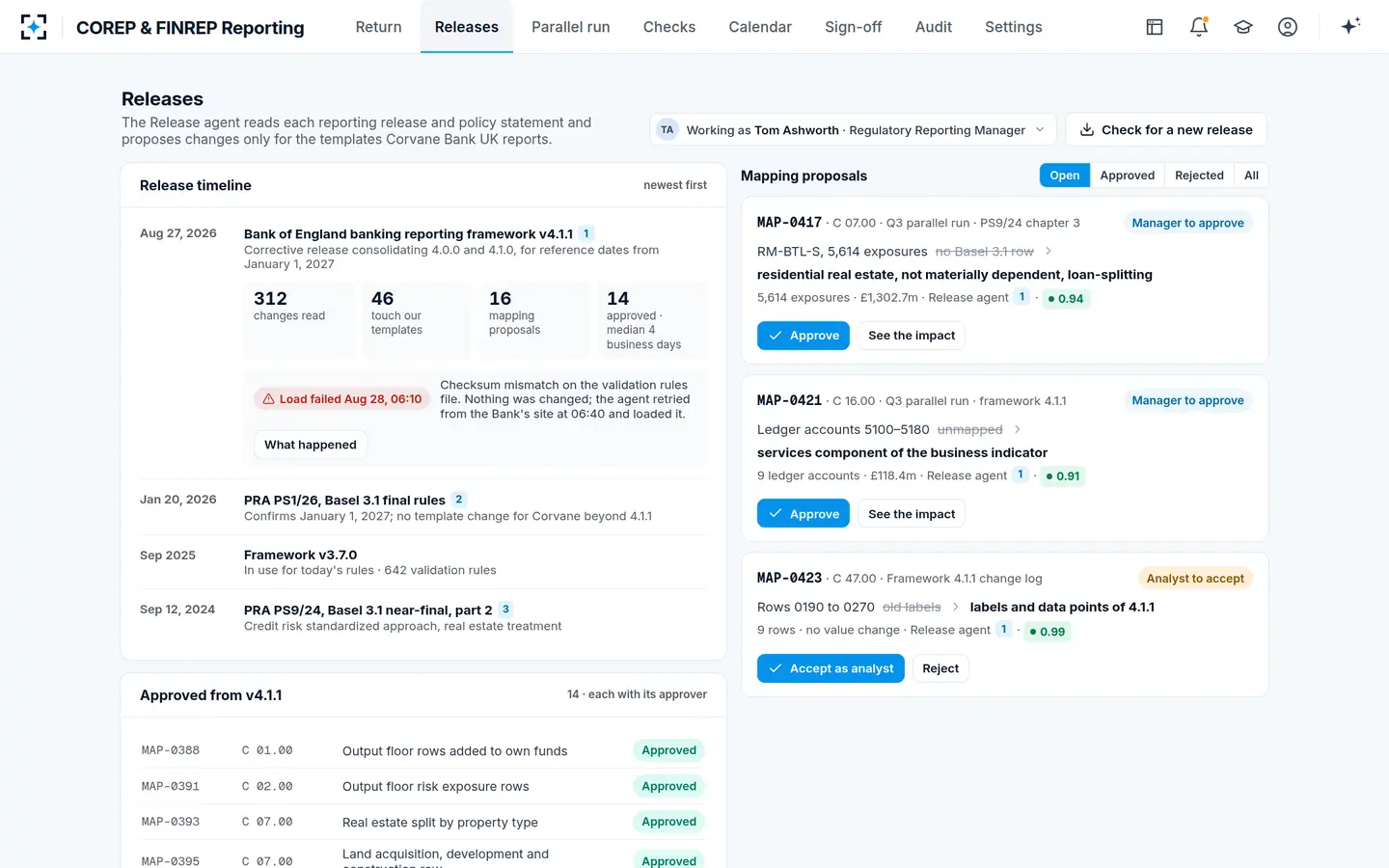
Take the solution's sample bank, a fictional UK lender, as it reads the Bank of England's 4.1.1 taxonomy for its Basel 3.1 parallel run. The Release agent loaded the release on 28 August 2026, found a checksum mismatch on the validation rules file, changed nothing, retried from the Bank's site half an hour later and loaded it. It then read 312 changes. Forty-six touched templates the bank reports; 16 of those needed a change to a mapping. By the time the sample quarter closed, 14 had been approved, in a median of 4 business days from the release, against the 2 to 4 weeks the team estimates for reading a major release by hand. The 4 days is the solution's design target.
Of 312 changes in one release, 16 needed a mapping
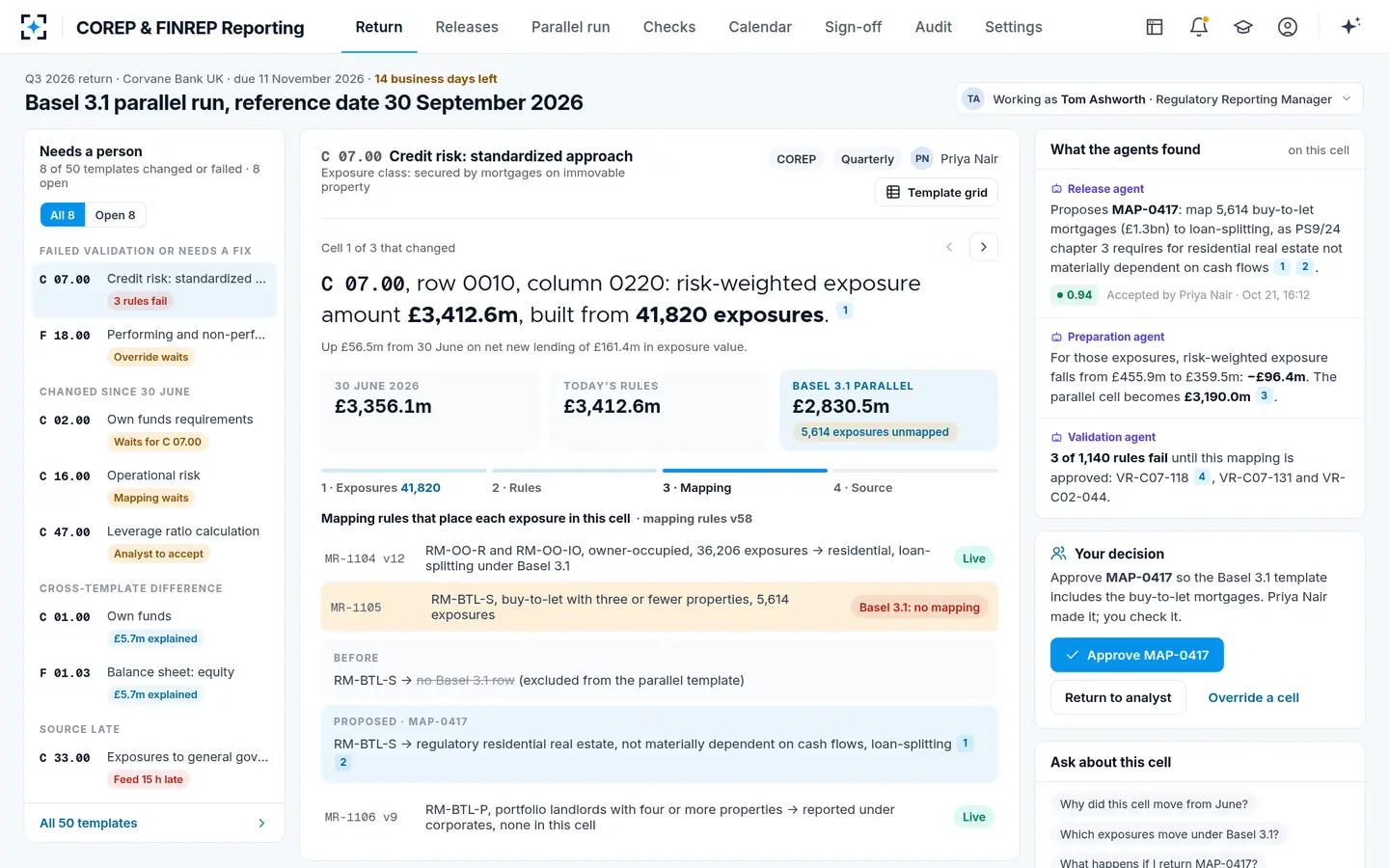
One proposal shows the shape of all of them. MAP-0417 maps a buy-to-let product family, 5,614 exposures worth £1,302.7 million, to regulatory residential real estate not materially dependent on cash flows, with the paragraph cited and a confidence of 0.94. The analyst who owns the credit risk templates accepted it on 21 October. Before the manager decided, the Preparation agent showed the impact: risk-weighted exposure for those loans falls from £455.9 million to £359.5 million in the Basel 3.1 template. He approved with a reason code, and the next draft passed every rule.
Each release narrowed to the bank's own templates, with proposals to decide
What the agent can get wrong, and the limits that catch it
Mapping a requirement to the right concept is the hard part, for people and for language models. Researchers who built a benchmark for tagging financial statements against more than 10,000 US GAAP concepts found models much better at pulling numbers out of a filing than at linking each one to the right concept (FinTagging, arXiv preprint, not peer reviewed, 2025). A regulatory taxonomy is the same problem with higher stakes, which is why the agent's output is a proposal with its evidence, never a change.
Four limits hold the line. The agent never changes a mapping. It never proposes outside the templates the bank reports. Below a confidence of 0.90, set by an administrator, a second analyst reviews the proposal. And the manager who approves cannot be the person who made or accepted it. When a proposal is wrong, the rules usually say so on the next draft; when it is wrong and the rules pass, only the drill from cell to exposure finds it, which is the argument of COREP validation rules pass; the return can still be wrong.
The mapping behind a cell, before and after a proposal
Questions people ask
What is the difference between EBA reporting frameworks 4.3 and 4.4?
Release 4.3, final on 9 July 2026, adds third-country branch reporting and AMLA risk-assessment data, so it matters mainly to branches of non-EU banks. Release 4.4, whose first phase was final on 12 October 2026, changes FINREP for IFRS 18 and Pillar 3 disclosures, and its second phase in early 2027 carries the simplification of COREP, FINREP and liquidity reporting for September 2027.
Do UK banks have to implement EBA reporting framework 4.4?
No. UK banks report on the Bank of England Banking XBRL taxonomy, currently 3.7.0 with 4.1.1 for rules taking effect on 1 January 2027, and the Bank says later EBA taxonomies apply only if the PRA says so in a consultation. UK banks with EU subsidiaries will see 4.4 through those subsidiaries.
What is the EBA Reporting Time Traveller?
It is a feature on the EBA's reporting frameworks page that shows "the entire reporting framework as it will be on a specific date", past or future. It is the quickest way to see which modules, templates and rules apply to a given reference date when releases overlap.
What is an EBA hotfix release?
A targeted update issued after a final package, without waiting for the next full release, when early users find critical defects. The EBA flagged possible hotfixes for 4.2 in the week of 5 January 2026, for 4.3 at the end of September 2026 and for 4.4 in January 2027.
Can AI read a regulatory reporting release?
It can read and narrow one, and propose the mapping changes with citations, as the Release agent does. Research on financial taxonomies finds language models weaker at linking data to the exact concept than at extracting it, so every proposal needs a person who checks the cited paragraph and the exposures before accepting it.