AI clinical trial site selection works best when it is not one model producing one score. In Clinical Trial Feasibility — Botminds' agentic solution for choosing a study's countries and sites — the work is split across six agents, each reading one kind of evidence and each carrying an explicit limit it may not cross. The protocol reader copies entry criteria and never paraphrases them. The patient-pool estimator sees counts and never patient records. The competing-trial scanner never counts a study in a different population against a site. The site history analyst never treats a missing record as a zero. The questionnaire reader drafts follow-up questions but never sends one. The ranker scores, cites and proposes — and proposes is the whole of its authority, because the tier of every site and the signature on the final list belong to named people. That division is the design, not a disclaimer: it is what makes each step checkable by the person who has to defend it.
The examples are a fictional sample study in the solution — VLT-401, a Phase 3 trial of veltrimab in moderate-to-severe Crohn's disease with 480 participants across 14 countries. Study, sites, investigators and competing trials are invented. Research and regulatory sources are linked where they appear.
What the six agents do in one round, and what they hand over
90sites
scored on six weighted factors, each with a cited reason
0
sentences in a rationale without a source behind them
3:12
minutes to re-read criteria, recount pools and re-score all 90 sites after an amendment
5managers
country managers who review their own sites before the study lead approves and the list is signed
Six agents, and the five kinds of reading a feasibility round needs
Feasibility is not one task. It is five separate acts of reading that happen to end in one table, and they fail in different ways. A misread entry criterion poisons every country's patient pool at once. A registry search that matches on disease name alone counts a paediatric study against an adult site. A management-system query that returns nothing is ambiguous between "this site has never run one of our studies" and "this site ran one and enrolled nobody". Giving each of those to a separate agent with its own evidence and its own limit means a failure stays where it happened instead of arriving as a number in column F.
It also means each agent can be asked a question in the terms of its own source. When the medical lead wants to know why one country's pool changed, the answer is a criterion, a protocol section and a data cut — not a model explanation. That is the practical difference between an agent that reads one thing well and a system that produces a score.
The six agents, and the limit each one carries
Agent
Protocol readerExtracts the population, every inclusion and exclusion criterion as a structured rule, the procedures that need site equipment, the visit burden and the target size — citing the protocol section for each.
Never: paraphrases a threshold; it is copied exactly, with its section, or flagged as unstructurable
Agent
Patient-pool estimatorApplies those criteria, in protocol order, to licensed real-world counts per country and region, keeping the funnel from diagnosed to eligible.
Never: touches patient-level data; counts only, minimum cell size 11
Agent
Competing-trial scannerReads public registries for recruiting studies and matches them on condition, phase, line of therapy and age — per country and within the radius the study sets.
Never: counts a different-population study against a site
Agent
Site history analystReads the management system: enrolled against planned, months recruiting, screen failure, activation weeks split into contract, ethics and start-up, data quality and inspections.
Never: infers what the record does not hold; no history is neutral, not zero
Agent
Questionnaire readerReads every returned questionnaire with its question numbers, checks completeness, and compares each eligible-patient claim with what the site actually screened.
Never: sends a follow-up question; it drafts and a person sends
Agent
Ranker and rationale writerScores the six factors, combines them with the study’s weights, forecasts last patient in from 2,000 simulations, and proposes primary, back-up or not selected inside each country’s allocation.
Never: writes an uncited sentence, or decides a tier
The protocol reader: copies a threshold, never paraphrases one
Everything numeric downstream is a function of one reading. On the sample study the population is adults with moderate-to-severe Crohn's disease who have failed at least one advanced therapy, with an endoscopic severity score above a stated threshold; an amendment later lowers that threshold and allows up to four prior advanced therapies. Those are not descriptions, they are filters, and a filter transcribed loosely produces a pool estimate that is wrong by a fixed factor in every country at once — the most expensive kind of error, because it looks consistent.
So the protocol reader's rule is transcription, not summary: each criterion is copied with the section it came from, turned into a rule that can be applied to a count, and shown beside its source text for the medical lead to confirm. Where a criterion cannot be made into a rule — a clinician's judgement, an unstated local standard of care — it is flagged rather than approximated, and the funnel says so. A pool that honestly says "two criteria could not be applied to this count" is more useful than one that silently assumes they do not bind.
The patient-pool estimator: counts only, never patient records
Eligible-patient estimates are the part of feasibility most often done by multiplying a prevalence figure by a guess. The estimator instead runs the protocol's criteria, in order, against licensed real-world counts, and keeps the whole funnel visible: on the sample study one country narrows from 98,900 people living with the disease to 11,500 who meet the endoscopic score, step by step, with the data cut shown at every stage.
The limit here is a privacy design rather than a quality one. The estimator sees aggregate counts, never patient-level data, and a cell with fewer than 11 patients is not reported at all. That constraint costs something real — a pool for a rare subgroup in a small country may simply be unavailable — and it is better to lose that estimate than to let site selection become a reason to move patient-level records between systems. Every number carries its data cut, so a figure quoted in March can be told apart from the same figure refreshed in September.
The competing-trial scanner: a different population never counts against a site
Competition is the factor most often measured badly, because the easy version of the search — the disease name, within a radius — is wrong in both directions. On the sample study, six Crohn's disease studies are recruiting in one country, and only one of them is competing for the same patients: the others recruit a different population. A desk that counted all six would down-rank good sites; a desk that counted none would walk a site into a trial it cannot win.
The scanner therefore matches on condition, phase, line of therapy and age, cites the registry entry for every match, and marks each as same or different population with the reason. The reason matters more than the count: a country manager who disagrees with a classification can point at it, and a classification that is argued about and corrected is worth more than a number nobody inspects. The radius is a setting — 15, 25 or 50 km — because what counts as the same catchment is a local judgement, not a universal one.
The site history analyst: no history means neutral, never zero
The most consequential rule in the whole design is the one about absence. A site with no record in the sponsor's management system is not a bad site; it is an unmeasured one. Scoring it as zero would quietly reserve every study for the hospitals that already run studies, which is both unfair and, over a programme, self-defeating — it is the mechanism by which site networks calcify.
So the analyst scores an unknown site neutral and counts its questionnaire claim at 60% rather than at zero or at face value, and the rationale says that is what happened. Where a history does exist, it is read in detail: enrolled against planned, months recruiting, screen-failure rate, and activation split into contract, ethics and start-up weeks — because a site that is fast at recruiting and slow at contracting is a different problem from one that is slow at both. The analyst has read-only access to the management system, which is a boring constraint that matters: feasibility reads the operational record, it does not write to it.
One site, with the evidence behind each sentence
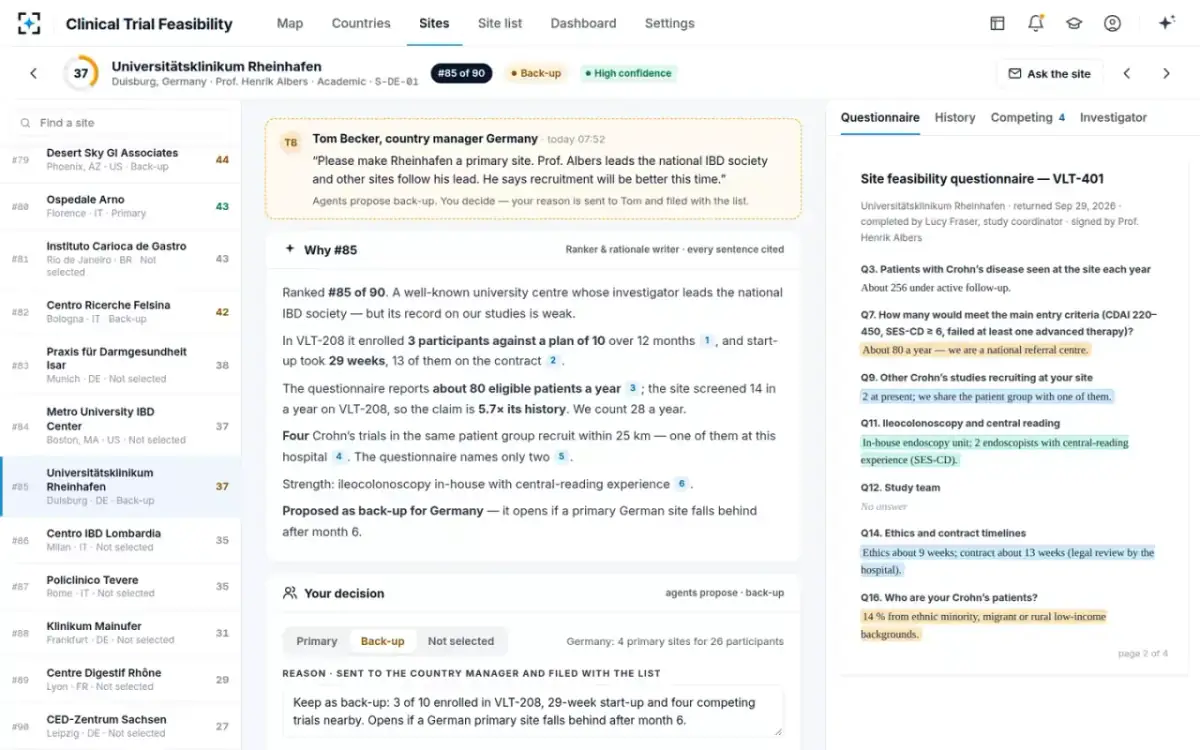
The questionnaire reader: drafts the follow-up, never sends it
A feasibility questionnaire is a mixture of fact, estimate and hope, and the reader's job is to tell them apart without insulting the site. It reads whatever arrives — portal submission, PDF, an email with the answers in the body — keeps the question numbers so an answer can be quoted back accurately, checks completeness against the threshold the study sets, and compares each eligible-patient claim with what that site actually screened on previous studies.
On the sample study 23 of the 90 scored sites claim more than three times the patients they screened. That is a finding, not an accusation: most of those claims are two-minute estimates made under no obligation to be checkable. The rule the solution applies is to count a claim at most at twice the site's screening history until the site confirms it, and to draft a specific follow-up question quoting the site's own words. The drafting limit is deliberate and worth keeping even when it is inconvenient — an automated message to 23 investigators asking them to justify their numbers is a relationship problem a sponsor cannot undo, and it should cost a person thirty seconds of judgement before it goes.
The ranker: every sentence cites what it rests on
The ranker combines the six factor scores with the study's weights — past enrollment 30%, patient pool 20%, start-up speed 15%, competition 15%, questionnaire quality 10%, representation 10% on the sample study — proposes primary, back-up or not selected within each country's allocation, and forecasts last patient in from 2,000 simulations in which each site opens when its approval path allows and recruits at its own past rate.
Two rules govern what it may write. The first is that no sentence appears without a source; a claim it cannot cite is not written at all, which converts a model's silence into a visible gap rather than a confident guess. The second is that any site moving more than five places between runs must be explained. Both exist because the output is prose, and prose is the format in which an unsupported assertion is hardest to notice.
What is AI 'confabulation', and why is a ranked list exposed to it?
Confabulation is the production of confidently stated but erroneous content — NIST's Generative AI Profile defines the term, notes that it is what people colloquially call hallucination or fabrication, and warns that it can mislead the people who rely on it (NIST AI 600-1). A ranked site list is unusually exposed to it for a specific reason, and NIST names that reason too: a generative system can produce invented reasoning, or invented citations, offered as the justification for its answer — and that justification can lead people to trust the output more than they should.
That is precisely the shape of a site rationale. A paragraph explaining why a hospital ranks 85th, complete with figures and a reference, is the most persuasive and the least verifiable artefact a feasibility desk can be handed. The defence is not a better model; it is making each citation resolve. In the solution a citation is a link into the questionnaire answer, the management-system record or the registry entry it came from, and the rule that no uncited sentence is written is what turns "check the reasoning" from an aspiration into an action a reviewer can actually take in ten seconds.
What does the FDA's draft AI guidance actually ask a sponsor to show?
The FDA's January 2025 draft guidance on artificial intelligence in regulatory decision-making for drugs and biologics is about evidence submitted to the agency, and site selection is not usually that. Its framework is still the most useful thing a sponsor can borrow, because it ties how much proof a model owes to how much damage being wrong would do. The guidance treats model risk as a combination of two factors: model influence, meaning how much the AI model's evidence contributes to answering the question compared with everything else that informs it, and decision consequence, meaning how serious the harm would be if that question were answered wrongly (FDA draft guidance, section IV.A.3).
Apply that honestly to a ranked site list and the answer is reassuring in one direction and demanding in the other. Model influence is low by construction: the ranking is one input among a questionnaire round, a country manager's local knowledge and a feasibility lead's decision, and the guidance is explicit that the risk it means is the chance that the model's output leads to a wrong decision with an adverse outcome, not some risk inherent in the model itself. Decision consequence, though, is not trivial — a poorly chosen site network is a trial that enrolls late or stops short. That combination argues for exactly the design on this page: many small, inspectable steps with human decision points, rather than one high-influence model. Turning that into measures you can run is the next question.
What an agent proposes, and what the person decides
The agents propose: Ranked 85th of 90, with the reason: 3 participants enrolled against a plan of 10 in twelve months, 29-week activation, a claim of about 80 eligible a year where 14 were screened, four same-population studies within 25 km.
A named person decides: The feasibility lead keeps it as back-up, to open if a German primary site falls behind after month six, and sends the country manager the reason in writing.
The agents propose: Ranked 13th of 14, with strong sites and a large pool, held back by about 150 days of regulatory and ethics review; moving it to core would open three sites and bring last patient in forward by two months.
A named person decides: The study lead approves or declines the allocation change, with the forecast and the evidence in front of him.
The agents propose: Flagged, counted at twice the site’s screening history rather than at face value, with a follow-up question drafted in the site’s own words.
A named person decides: The feasibility lead edits and sends the question — or decides the claim is explained and accepts it.
The agents propose: Re-proposes the ranking and recalculates the forecast as soon as a weight moves, inside each country’s allocation.
A named person decides: Decisions people have already made stay made; the study owns its weights, and every change is on the audit trail.
Where the person decides, every time
There are four decision points in a round and a person sits at each. A country manager reviews the sites in their region and may request a swap or an addition with a written reason. The study lead approves the country allocation and every tier change. The feasibility lead decides primary, back-up or not selected for each site. And the final list is signed electronically, with the signer choosing what the signature means — approving the list and the rationale behind each site, or recording that they have reviewed it. That last distinction is small and worth keeping: a reviewer and an approver are not the same claim, and a file that conflates them is harder to defend than one that does not.
This is also where the guideline sits. ICH E6(R3) keeps investigator selection with the sponsor and treats oversight as a graded obligation: "The range and extent of oversight measures should be fit for purpose and tailored to the complexity of and risks associated with the trial. The selection and oversight of investigators and service providers are fundamental features of the oversight process" (ICH E6(R3) §3.9.5). Software that proposed and then selected would be asking a sponsor to delegate a duty E6(R3) does not let it delegate. Software that proposes, cites and waits leaves the duty where the guideline puts it. What E6(R3) requires for site selection works through the clauses in full.
The same guideline sets the bar for the system itself. Principle 9.3 asks that computerised systems used in trials be fit for purpose — through risk-based validation where appropriate — with the factors critical to their quality addressed when they are designed or adapted for trial use, so that the integrity of trial data is protected (ICH E6(R3), Principle 9.3). Designed-in limits — counts only, no uncited sentence, drafts not sends — are how that principle is met in a feasibility tool, and they are inspectable in a way that a model's general good behaviour is not.
The limits matrix: six agents, and what each may never do
| Agent | Reads | Never | Why the limit is there |
|---|---|---|---|
| Protocol reader | Protocol synopsis and amendments | Paraphrases a threshold, or quietly skips a criterion it cannot structure | A misread filter makes every country’s pool wrong in the same direction, invisibly |
| Patient-pool estimator | Licensed real-world counts, by country and region | Sees patient-level data; reports a cell below 11 patients | Site selection must not become a reason to move patient records between systems |
| Competing-trial scanner | Public trial registries | Counts a different-population study against a site, or matches without citing the entry | Disease-name matching mis-ranks sites in both directions |
| Site history analyst | The clinical trial management system, read-only | Treats a missing history as zero, or writes to the management system | Scoring absence as failure reserves studies for hospitals that already run them |
| Questionnaire reader | Returned questionnaires: portal, PDF, email | Sends a follow-up question, or restates a site’s answer in its own words | A sponsor cannot undo an automated challenge sent to 23 investigators |
| Ranker and rationale writer | The five agents’ cited outputs and the study’s weights | Writes a sentence without a source, or sets a tier | Prose is where an unsupported claim hides best; the tier is the sponsor’s duty |
The decision, with the reason that goes back to the country manager
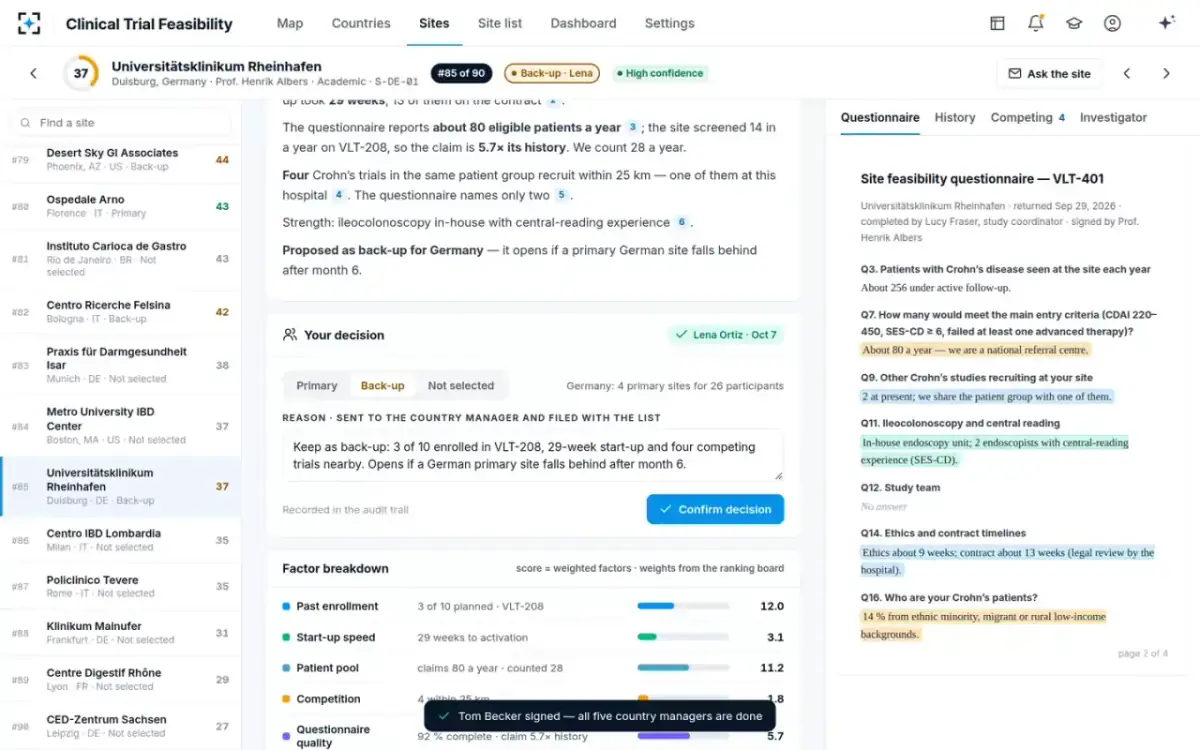
To see the ranking board, the citations and the decision screen in one pass, start from Clinical Trial Feasibility; for the seats around the desk, read who picks a trial's countries and sites.
Questions people ask
Can AI invent citations for a site ranking?
Yes, unless the design prevents it. Confabulation is a generative system stating something false with confidence. NIST's Generative AI Profile describes it as the production of confidently stated but erroneous or false content, known colloquially as hallucinations or fabrications, and notes that outputs can include confabulated logic or citations that appear to justify an answer. For feasibility that last part is the risk worth designing against, because a rationale with figures and a reference is the hardest thing on the page to doubt.
Can AI decide which sites run a clinical trial?
No, and under ICH E6(R3) a sponsor cannot arrange for it to. Selecting investigators and institutions is the sponsor's responsibility, and each investigator has to be shown qualified and resourced for that trial. Software can read the evidence, score it, cite it and propose a tier; a named person sets the tier, approves the allocation and signs the list. In Clinical Trial Feasibility the proposals and the people's changes both stay on the record, so what the agents suggested and what the desk decided can be told apart afterwards.
How does AI rank clinical trial sites?
In this solution, by scoring six factors from separate sources and combining them with weights the study sets: past enrollment against plan, eligible patients a year, start-up speed, same-population competition, questionnaire quality and representation. Each factor is a cited reading rather than an opinion — enrollment comes from the management system, competition from public registries, the pool from licensed counts — and moving a weight re-proposes the ranking and recalculates the enrollment forecast inside each country's allocation.
What does FDA guidance say about AI in clinical trials?
FDA's January 2025 draft guidance covers AI used to produce information supporting regulatory decisions about drugs and biologics, and offers a seven-step, risk-based credibility framework. Its most portable idea is model risk as a combination of model influence and decision consequence: the more the model's output drives the decision, and the worse a wrong decision would be, the more evidence it owes. Site selection usually sits outside the guidance's scope, but the framework is a reasonable template for an internal validation plan.
What are AI agent guardrails, and what do they look like in life sciences?
A guardrail is a limit the system enforces, not a behaviour it is asked for. The useful ones are specific and testable: counts only with a minimum cell size, read-only access to the operational record, no output sentence without a resolvable citation, a drafted message that a person must send, a neutral score where evidence is absent. Each can be checked by trying to break it — which is what separates a guardrail from a promise in a product description.
Is agentic AI site feasibility different from a scoring model?
Yes, in two ways that matter at review time. A scoring model produces a number whose inputs are a feature vector; an agentic design produces a chain of readings, each attributable to a source a human can open. And a scoring model has one failure mode for every error, while six narrow agents fail separately and visibly — a registry mis-match is a mis-match, not a slightly wrong score. The cost is more moving parts; the benefit is that each part can be audited on its own evidence.