Clinical trial feasibility software only earns its place against a spreadsheet where the spreadsheet cannot be checked: in the evidence behind each site's score, in the enrollment forecast, and in the re-run after a protocol amendment. Choosing countries and sites is the decision that sets a study's enrollment timeline — which countries recruit, which investigators are asked, how many participants each one is given — and it is hard because the evidence arrives in four incompatible shapes: a protocol, a clinical trial management system's history, a hundred returned questionnaires and a public trial registry. Botminds' Clinical Trial Feasibility puts six specialist agents on that evidence, ranks every country and site with a cited reason, and forecasts last patient in from P10 to P90. This page runs one 480-participant decision four ways and says what each way catches and what it leaves to somebody's memory.
The study on this page is a fictional sample used throughout the solution: VLT-401, a Phase 3 trial of veltrimab in moderate-to-severe Crohn's disease, 480 participants, target last patient in June 2028. Questionnaires went to 186 sites in 14 countries; 131 came back and 90 were usable. The sponsor, the investigators and the competing trials are invented. The research figures come from a professional body, a regulator's auditor and the international guideline, each linked where it appears.
One decision, four ways to make it
90sites
usable questionnaires to rank across 14 countries
30days
of working time by spreadsheet, on our estimate of the split
11days
from questionnaires back to an approved list, the design target
3:12
to re-score all 90 sites after an amendment, on the sample study
Four ways to run clinical trial feasibility, one site list
Almost nobody starts from nothing. The four ways below are the four that actually exist in clinical operations today, and most teams use two or three of them at once. That is worth saying because it is the real comparison: not software against no software, but a hand-assembled bundle of practices against one that holds its own evidence.
The pattern is familiar from elsewhere in the field. When the US Government Accountability Office asked 17 cancer centres with a history of enrolling diverse populations how they did it, the answer was never one system. The centres' practices fell into four areas — organization, community, workforce and patients — and "Fifteen of the centers implemented practices in at least three of these four areas". Several things running side by side, each owned by someone, is the baseline any tool has to beat.
What each of the four ways actually does with the evidence
| Spreadsheet | CTMS export | Feasibility-module platform | Six agents | |
|---|---|---|---|---|
| Reads the protocol | A person types the criteria into a column header | Not at all | A person tags the study with a therapy area | Criteria extracted as rules, each with its protocol section |
| Reads 131 returned questionnaires | Whoever has time, in whatever order | Only the fields the portal maps | Portal answers only; PDFs and email replies stay unread | All of them — portal, PDF and email — with question numbers kept |
| Checks a site’s claim against its history | By memory, if the reader knows the site | Possible, rarely done for all 90 | A flag if both numbers happen to be in the same table | Every site: the ratio is computed and the claim capped at 2× history |
| Competing trials near each site | A registry search for the countries someone worries about | Not held | A count, usually by country | Per country and within 25 km, each match marked same or different population |
| Why this site, in writing | A free-text column, filled in for the contested sites | None | A score, and sometimes a factor bar | A rationale in which every sentence names the source it came from |
| Enrollment forecast | A date someone defends in the meeting | None | Often a single date | P10, P50 and P90 last patient in, from 2,000 simulations |
| Re-run after an amendment | Start again | Re-export, start again | Re-score on the new tags; the pool is not recounted | Criteria re-read, pool recounted, 90 sites re-scored, nothing applied until a person applies it |
By spreadsheet: fast to start, impossible to re-check
A spreadsheet is the only one of the four that is ready before the protocol is. That is why it wins the first week, and why it keeps winning on small studies: twelve sites in three countries fit in a spreadsheet and in one person's head at the same time, and nothing is lost.
At 90 sites the arithmetic turns. On our estimate of the working-day split for one Phase 3 study with about 130 returned questionnaires, reading the questionnaires and chasing missing answers takes eight working days, pulling each site's history from the clinical trial management system and checking what it claims takes five, the registry search takes four, estimating eligible patients by country takes four, and scoring the sites and writing the reasons takes six. Thirty working days, of which twenty-one are reading and transcription.
Where feasibility's working days go, questionnaires back to an approved list
By spreadsheet · 30 working days
- Reading questionnaires, chasing answers (8) · 26.7%
- Site history (5) · 16.7%
- Registries (4) · 13.3%
- Patient pool (4) · 13.3%
- Scoring, reasons (6) · 20%
- Forecast, approval (3) · 10%
With agents · 6.5 working days
- Questionnaires (2) · 30.8%
- History (0.5) · 7.7%
- Registries (0.5) · 7.7%
- Pool (0.5) · 7.7%
- Scoring, reasons (1) · 15.4%
- Forecast, approval, filing (2) · 30.8%
The deeper cost is not the days. It is that a spreadsheet cannot answer the question a medical lead asks three weeks later: why is this site ranked above that one? The columns hold the result of a judgement, never the judgement. When a country manager pushes for a site — and one always does — the desk either re-does the work or defers to whoever remembers it best.
The same loss happens between studies. The sponsor's next Crohn's study asks 186 sites many of the same questions, and the answers that came back for this one are in a file nobody will open. Nancy Sacco of SiteBridge Research put the site's side of it to the Association of Clinical Research Professionals: "In an ideal world, the information sites provide for feasibility should stay in databases for future sponsor reference" — "Sadly, this does not happen, resulting in duplication of effort by sites and sponsors alike."
By CTMS export: the history is there, but nobody reads all of it
The clinical trial management system is the one place that holds the fact that matters most: what each site did last time. Enrolled against planned, months recruiting, screen failure, start-up weeks split into contract, ethics and activation. A desk that exports it has the best single predictor of enrollment in its hands.
Two things then go wrong. First, the export is a snapshot of whatever the exporter asked for, so the fields nobody thought to request — screen-failure rate, the inspection finding, the reason a past study closed at that site — are simply absent from the decision. Second, 90 sites times four or five historical studies is more reading than anyone does under deadline, so in practice the history is consulted for the twenty sites someone is arguing about and taken on faith for the other seventy.
That asymmetry is where the Rheinhafen cases hide. On the sample study, Universitätsklinikum Rheinhafen in Duisburg ranks 85th of 90, and the reason is entirely in the history: in the sponsor's earlier VLT-208 study it enrolled 3 participants against a plan of 10 in 12 months, and its start-up took 29 weeks against a German median of 24. A country manager asked for it as a primary site because its principal investigator leads the national society. Both facts are true. Only one of them is in the system, and only if someone reads that site's row.
Is there a CTMS feasibility module that does this?
Many clinical trial management systems offer a feasibility or site-selection module, and a module that lives next to the history has a real advantage: the past enrollment is one join away rather than one export away. What such modules typically do not do, in our experience, is read. The protocol stays a PDF attachment, the returned questionnaire stays a PDF attachment, and the registry is a count somebody refreshes.
The practical test is to ask the module to produce the sentence "we are not selecting this site because …" for all 90 sites and see what comes out. Where a module writes that sentence from its own fields, it is doing the work. Where it produces a number between 0 and 100, the sentence is still yours to write, and the module has moved the arithmetic rather than the judgement.
By a feasibility-module platform: a score, rarely a written reason
Dedicated feasibility platforms and site databases are the third way, and they are genuinely good at the thing a single sponsor cannot do: aggregate. A platform that has seen thousands of studies knows which sites in Poland enrol inflammatory-bowel-disease patients quickly, and it knows it from more studies than any one sponsor has run.
That strength has a known edge, and the field names it honestly. Reporting Sacco's view, the professional body notes that such platforms and databases "focus on historical data, leaving sites with both interested physicians and patients behind" — a new site with a motivated investigator and the right patients has no history to be found in, so it is invisible to the aggregate exactly when it would be most useful.
A sponsor's own answer to that is a scoring rule, not more data: a site with no history should be scored neutral rather than zero, and its own claim counted at a discount rather than ignored. In the solution a site with no history is scored neutral and its claim counted at 60%, which is a deliberate, settable choice rather than an artefact of what the database happens to hold.
By agents: a cited reason, a forecast, and a re-run on amendment
The fourth way puts six specialist agents on the same evidence a person would read. A protocol reader extracts every inclusion and exclusion criterion as a rule, with its protocol section, and never paraphrases a threshold. A patient-pool estimator applies those criteria in protocol order to licensed counts per country, keeping the funnel from diagnosed to the endoscopic score. A competing-trial scanner reads public registries and marks each recruiting study as the same or a different population. A site history analyst reads the clinical trial management system. A questionnaire reader reads all 131 returned questionnaires, portal, PDF or email, and compares each eligible-patient claim with what the site actually screened. A ranker scores six factors, writes the reason and simulates last patient in.
What changes is not the ranking. A good analyst with 30 days would rank these 90 sites much as the agents do. What changes is that every sentence of every reason names the questionnaire answer, the historical study, the registry entry or the data cut it came from, for all 90 sites and not only the contested twenty — and that the ranking is reproducible next month, by someone else.
The same Brazil decision, by spreadsheet and with agents
By spreadsheet: Brazil is "a back-up" — a judgement held by the country manager who knows it
With agents: 13th of 14, score 60, with the five factors that produced it and the value of each
By spreadsheet: "Approvals are slow there." Nobody disputes it; nobody can check it either
With agents: About 150 days for ANVISA and national ethics, so its sites open in April 2027 — after first patient in elsewhere
By spreadsheet: The country manager says the sites are the fastest she has, in the meeting
With agents: Past enrollment 1.70 participants a site a month, from site history on 4 of 4 sites; 11,500 eligible patients a year; one same-population competitor of 6 recruiting
By spreadsheet: An answer next week, after a re-build of the model
With agents: Last patient in moves from May 2028 to March 2028; three sites open as primary and take 36 participants from the US, Canada and Italy
By spreadsheet: Whoever is most senior in the room
With agents: The study lead approves the allocation change, with the forecast and the evidence in front of him
Ninety sites, ranked on what they did rather than what they claim
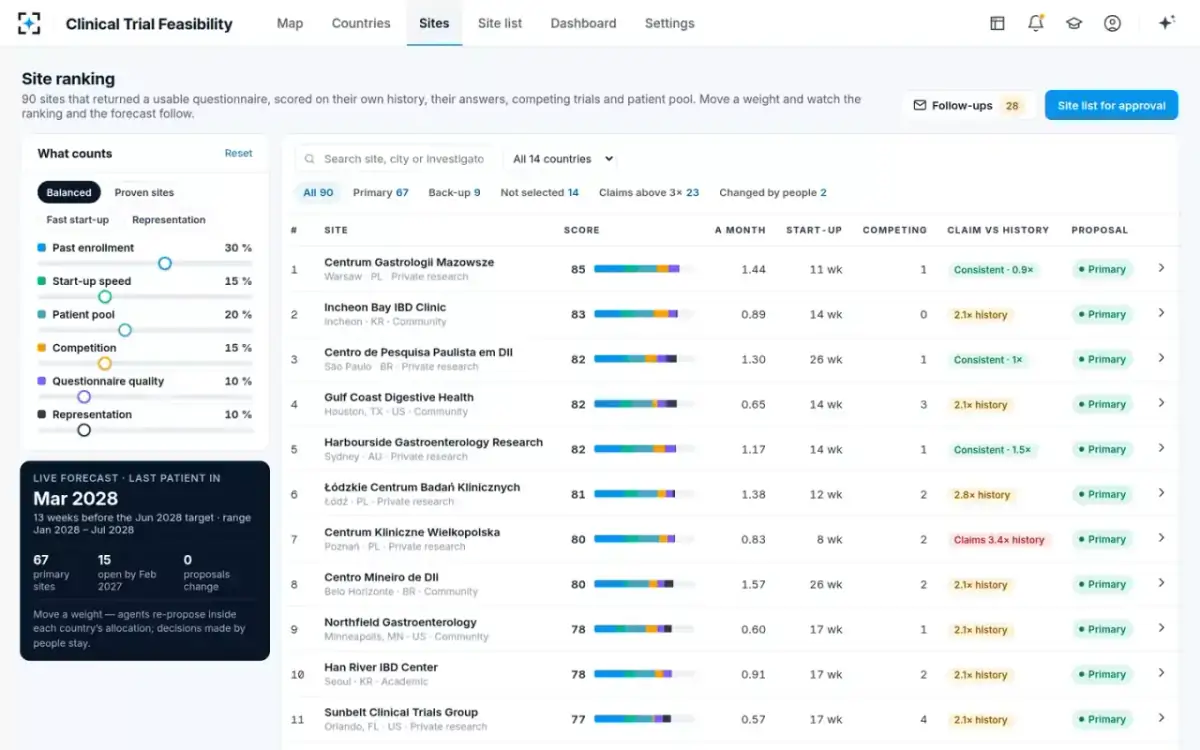
How to automate clinical trial site selection without losing the decision
Automating site selection means automating the reading, not the choosing, and the order matters. Take the four inputs in the order a person would: the protocol first, because every other number depends on the criteria; then the site history, because it is the strongest predictor and it is already yours; then the questionnaires, because they are the only source of what a site says it can do now; then the registries, which change weekly and are worthless unless refreshed.
Three rules keep the decision where it belongs. A claim is never taken at face value: on the sample study 23 of 90 sites claimed more than three times the patients they had screened, and each is counted at most twice its own history until the site confirms it. A site that moves more than five places between weekly re-scores has to be explained. And nothing proposed reaches the plan until a named person applies it — country managers review their own sites, the study lead approves the country allocation, and the feasibility lead signs the final list.
What clinical trial feasibility software requirements should you write down?
Write requirements about evidence and re-runs, not about features. Six of them separate the four ways above, and each can be tested in a demonstration on your own last study rather than taken on description.
Six requirements to write down, and how to test each in a demonstration
- Every sentence of a site’s reason names its source
Ask for one site’s reason and click each statement through to the questionnaire answer, the historical study or the registry entry. A score with a factor bar is not a reason.
- Thresholds are copied from the protocol, never paraphrased
Give it a protocol with an awkward entry criterion and check the extracted rule against the section it came from, word for word.
- Every claim is compared with that site’s own screening history
Ask for the list of sites claiming more than twice what they screened, and what the tool did about each one.
- The forecast is a range, with its assumptions visible
Ask what each site contributes, when it opens and at what rate — a single date hides the assumption that every site opens on time.
- An amendment is a re-run, not a re-build
Hand over a real amendment from your last study and time the re-count and the re-score. Ask what is held for a decision rather than applied.
- A site with no history is scored neutral, not zero
Ask what happens to a first-time site with a credible investigator. A tool that scores it zero will never find you a new site.
What does each approach do when the protocol changes?
This is the question that separates the four, because an amendment invalidates the inputs rather than the arithmetic. When an entry criterion moves, the patient pool per country changes, the eligible fraction at each site changes, and some sites that qualified no longer do. A tool that re-scores on the old pool produces a confident wrong answer.
It is also common. On the sample study, Amendment 1 lowers the endoscopic entry score and allows up to four prior advanced therapies; the pool rises 14% overall, all 90 sites are re-scored in 3 min 12 s, three proposals change, and nothing reaches the plan until the feasibility lead applies or discards it. The timings below are ours for the other three ways, from the same working-day split: a spreadsheet re-run repeats the reading, a CTMS re-export repeats it with better history, a platform re-scores quickly on a pool it never recounted.
One amendment, four ways to a usable answer
- Re-read criteria, re-estimate the pool5 d
- Re-check the affected sites5 d
- Re-score, rewrite the reasons2 d
- Re-export the site history1 d
- Re-estimate the pool by hand4 d
- Re-score, rewrite the reasons4 d
- Re-score on the existing tags1 d
- Pool still re-estimated by hand3 d
- Re-read, re-count, re-score 90 sites3:12
What an amendment changes, before anything is applied
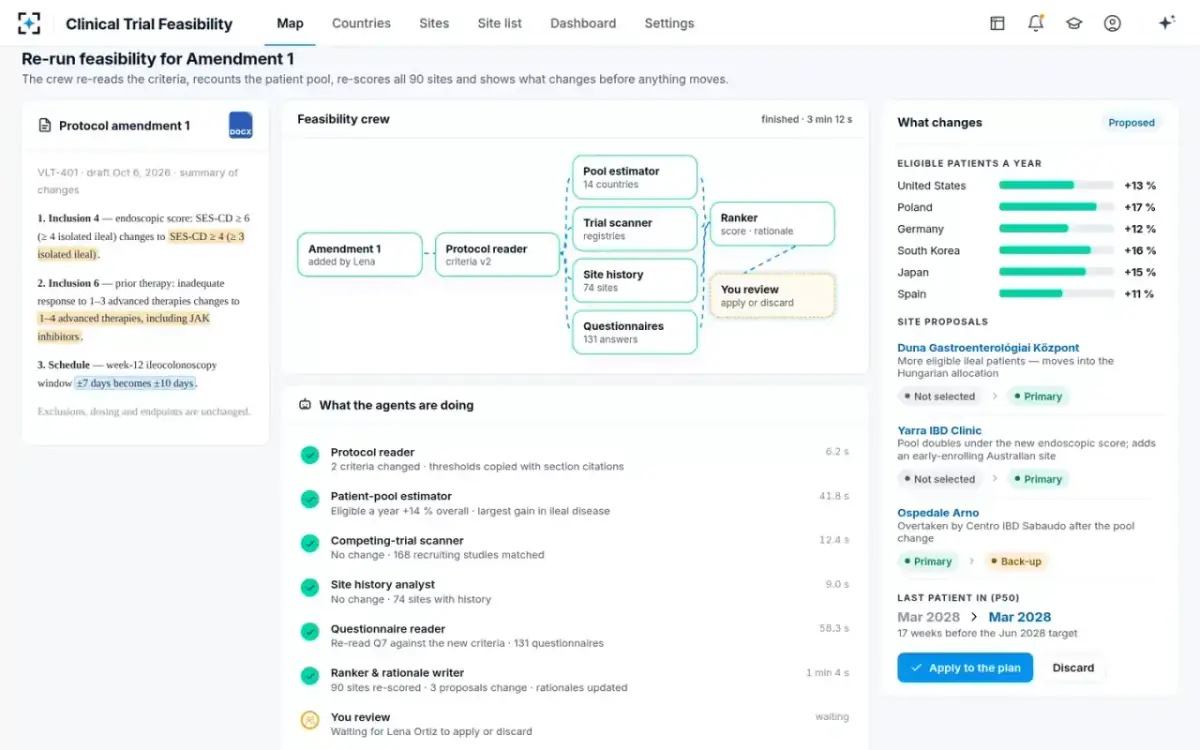
Amendments also point upstream rather than at the tool. A questionnaire round opened before the protocol is final is answered against criteria that may still change, and every answer a site gave can be invalidated by the amendment that follows; ICH E6(R3) asks that potential investigators get the protocol and "sufficient time for the review of the protocol and the information provided" (§3.7.2). A cheap re-run makes an early round survivable. It does not make it free. The full sequence is in what happens to site selection when a protocol is amended.
What a buyer should ask every vendor about citations
There is one question that sorts the market, and it is not about accuracy. Ask: show me a site's reason, and let me click each sentence through to the thing it came from. A tool that can do that for all 90 sites is holding the evidence. A tool that can do it for the demonstration site is holding a slide.
The reason this is the buying question and not a nice-to-have is that the international guideline makes the sponsor answer it. ICH E6(R3) makes essential records the ones that can be evaluated afterwards, and its own criteria for an essential record include one that "Documents sponsor oversight of investigator site selection" (Appendix C.3.1). The output of feasibility is not a score for internal use; it is part of what the sponsor is expected to be able to produce. A page on what ICH E6(R3) requires for site selection works through the clauses.
Development of a standard set of feasibility criteria would be a great help in avoiding duplication of effort. An inventory of information relating to these criteria could then be made available to sponsors and CROs.
Victor Chen, Managing Director, Clinical Trials Program, Kaiser Permanente, to the Association of Clinical Research Professionals
Chen's point cuts against the whole market, including this one: much of the cost of feasibility is that every sponsor asks the same site the same questions in a different form. No software fixes that alone. What a sponsor can do is stop throwing away the answers it already has, which is the low bar none of the four ways clears by default.
Where do spreadsheets still win?
Three cases, and they are not edge cases. A study with fewer than about fifteen sites in one or two countries: the whole decision fits in one person's working memory, and the overhead of any tool is real while the benefit is small. A first-in-human study where there is no site history to read and the investigators are chosen for their science: the strongest factor in any ranking is missing, so the ranking is mostly the questionnaire. And the week before a protocol is final, when feasibility is an exploration rather than a decision — a spreadsheet is the right instrument for a question you are still forming.
What does not hold is the fourth case people claim: that a spreadsheet is fine because an experienced feasibility lead knows the sites. That is true and it is the problem. The knowledge is real, it is in one person, and the study will be inspected, amended and staffed by others for the next four years.
Questions people ask
Is clinical trial feasibility software worth it over a spreadsheet?
It depends on the number of sites and whether the reasons have to survive. Below about fifteen sites a spreadsheet is usually the better instrument. Above about fifty, the reading alone is weeks — on our estimated split, 21 of 30 working days are reading and transcription — and no spreadsheet holds why a site was ranked where it was. The honest test is whether you could reproduce last year's site list from what you kept.
What is the best clinical trial feasibility software?
There is no single best; there are three different products sold under one name. Aggregate site databases are strongest where you have no history of your own. Modules inside a clinical trial management system are strongest where your own history is the deciding factor. Agent-based tools are strongest where the reasons have to be written, cited and re-run. Decide which of those three problems is yours before you compare features.
Can AI pick clinical trial sites on its own?
It should not, and in Clinical Trial Feasibility it does not. The agents propose; country managers review their own sites and can swap or add one with a written reason, the study lead approves the country allocation, and the feasibility lead decides each site and signs the list. A proposal that moves a site more than five places has to be explained. The value is that the reading is complete and cited, not that the choosing is delegated.
Does a CTMS feasibility module replace a feasibility platform?
Only if your own history covers the sites you are considering. A module next to the clinical trial management system has your enrolled-against-planned figures one join away, which is the strongest single predictor you own. It has nothing to say about a site you have never used, where an aggregate database or the site's own questionnaire is all you have.
How long does it take to automate site selection on a running programme?
The work is in the connections, not the ranking: the clinical trial management system as read-only, the questionnaire portal, a registry feed and a licensed patient-count source. The design target in Clinical Trial Feasibility is 11 calendar days from questionnaires back to an approved site list, including the time spent waiting for sites and approvers, against about six weeks by spreadsheet.
What should never be automated in feasibility?
The decision, the written reason sent to a country manager, and the signature. Everything that is reading — 131 questionnaires, four or five historical studies for each of 90 sites, a registry refresh, a patient-pool funnel — is mechanical and benefits from being done completely. Everything that is a judgement about a relationship, a region or a risk stays with a named person, and the signature on the final list records who made it.