A clinical trial feasibility software implementation should be measured in weeks, not quarters, and the reason is that the inputs are already on your network. Clinical Trial Feasibility — Botminds' agentic solution for ranking a study's countries and sites with a cited reason for each — is built and deployed from your own requirements and documents: your feasibility questionnaire, your clinical trial management system history and a past study's protocol. What stands between signing and a live ranking is not data engineering; it is the replay on a study you have already finished, the settings only your desk can decide, and a set of quality checks that can actually fail. This guide sets out all three, week by week, and says plainly which results should stop a go-live.
The worked example is a fictional sample study in the solution — VLT-401, a Phase 3 Crohn's disease trial of 480 participants across 14 countries. The weeks below are a plan, not a measured delivery record; the design target for a live round is 11 days from questionnaires back to an approved site list, against about six weeks by spreadsheet.
What go-live is aiming at
4inputs
you already hold: a past protocol, management-system history, one questionnaire round, your weighting rules
11days
design target from questionnaires back to an approved site list, calendar time
2-3
finished studies replayed before a live one is scored
1
named signer on the first live site list, with the meaning of the signature recorded
What data does feasibility software need from you? Four inputs you already have
Four, and none of them is a new dataset. The first is a past study's protocol synopsis with its inclusion and exclusion criteria — not the study you are about to run, but one you have finished, so the result can be checked against what happened. The second is your clinical trial management system history: enrolled against planned, months recruiting, screen-failure rates and activation weeks, read-only. The third is one completed questionnaire round, exactly as it came back — portal submissions, PDFs and the emails where somebody answered in the body of the message, because that mixture is the real input and a cleaned sample will flatter the result. The fourth is not a file at all: your weighting rules, the policy your desk already applies when it argues about which sites to open.
Two further sources are connected rather than supplied. Public trial registries are read directly for recruiting studies by country and near each site. Licensed real-world patient counts come from a data partner as counts, never patient-level records, with a minimum cell size of 11 — a constraint worth confirming with your own privacy function before the first run rather than after it.
The four inputs, and what each one has to be
- A past study’s protocol synopsis
With the inclusion and exclusion criteria as written, the procedures that need site equipment, the visit schedule and the target size. A finished study, so its result is knowable.
- Management-system site history
Enrolled against planned, months recruiting, screen failure, activation split into contract, ethics and start-up. Read-only access is enough, and is the access to ask for.
- One completed questionnaire round
As it arrived, mixed formats and all, with question numbers intact so a site’s own words can be quoted back accurately.
- Your weighting rules
How your desk already trades past enrollment against pool size, start-up speed, competition, questionnaire quality and representation — plus your claim-inflation ceiling and competing-trial radius.
- Registry access
Public trial registries, read for recruiting studies per country and within your chosen radius of each site. Connected, not supplied.
- A patient-count source
Licensed real-world counts from a data partner, counts only with a minimum cell size of 11. Confirm the terms with your privacy function before the first run.
Week by week, from your last study's files to a live ranking
The shape of the weeks matters more than their number, because the order protects you: nothing is configured before a replay has shown what the current settings produce, and no live study is scored before a finished one has been. A plan that puts configuration first produces a tool tuned to opinions; a plan that puts the replay first produces one tuned to outcomes.
From kickoff to a live ranking, and what each stretch produces
- Your questionnaire, protocol and history read inWeek 1
- Management system and registries connected, read-onlyWeek 2
- Replay of a finished study; disagreements reviewedWeek 3
- Weights, radius and claim ceiling set; second replayWeek 4
- Quality checks run and documented, with their failuresWeek 5
- First live round beside the team; signature and filing testedWeek 6
The replay: how to pilot AI clinical trial software on a finished study
Piloting on a live study is the mistake to avoid, and the alternative is better than a pilot anyway. Take a study you finished two or three years ago. Give the system the protocol, the questionnaires as returned, and the site history frozen at the decision date — frozen matters, because a replay that can see enrollment from after the list was signed is grading its own work. Then compare its proposed primary set with the one your feasibility lead actually signed, and compare both with what each site went on to enroll.
Read the disagreements, not the percentage. Sites the system down-ranked that your desk opened and that then enrolled two participants in a year are a point in its favour; sites it proposed that you declined and that a competitor filled are another. Sites where it is simply wrong are the most valuable finding of the whole go-live, because they tell you whether the error is in a weight you can set, in a data source that is thin for your therapeutic area, or in judgement the tool cannot have. Do this twice, on two different studies, before any setting is tuned — one replay tunes to an anecdote.
The replay and the first live run are different exercises
Replay, weeks 3-4: Finding out where the ranking and your desk disagree, and who was right
First live run, week 6: Proving the round works end to end with real people and real deadlines
Replay, weeks 3-4: A finished study, frozen at its decision date, with the outcome known
First live run, week 6: A live questionnaire round, with answers still arriving
Replay, weeks 3-4: Feasibility lead and validation; the medical lead on the criteria
First live run, week 6: The whole desk: country managers, study lead, medical lead, feasibility lead
Replay, weeks 3-4: Tune a weight, fix a source, or narrow what the tool is used for
First live run, week 6: Stop. The round runs the old way and go-live moves
Replay, weeks 3-4: A list of disagreements and their outcomes, kept as the regression set
First live run, week 6: A signed site list, its rationales filed, and a set of settings nobody is arguing about
Which quality checks must pass before the first live run?
A check that cannot fail is not a check, so the list below is written as results that stop a go-live rather than boxes to tick. Each is run on the replay material, each has a number attached, and each has a named owner who is allowed to say no.
The checks, what each must show, and what stops a go-live
| Check | What it must show | What stops the launch | Owner |
|---|---|---|---|
| Criteria transcription | Every inclusion and exclusion criterion copied exactly, with its protocol section, and anything unstructurable flagged rather than approximated | A paraphrased threshold, or a criterion silently dropped | Medical lead |
| Citations resolve | A sample of 20 citations opened by hand, each landing on the questionnaire answer, management-system row or registry entry it claims | One citation that does not resolve | Validation |
| Uncited sentences | Zero sentences asserting a fact about a site without a resolvable source, across 40-60 rationales | Any uncited assertion | Validation |
| Seeded errors | A planted inflated claim, a different-population competing study and a deleted site history each caught, classified and explained | A planted fault absorbed without comment | Feasibility lead |
| Counts only | No patient-level data anywhere in the pipeline; cells below 11 patients not reported; every count showing its data cut | Any patient-level record, or an unlabelled count | Privacy function |
| Access and audit | Read-only access to the management system; every agent step, decision and setting change on the audit trail with a name and a time | Write access, or a settings change with no trail | Clinical operations IT |
| Replay disagreements reviewed | Every disagreement between the ranking and the signed list read, with its outcome recorded | Disagreements nobody has looked at | Feasibility lead |
| Signature and filing | A test list signed with name, time and meaning, and filed to the trial master file under site selection with its rationales and forecast | A signature with no recorded meaning, or a filing that loses the rationales | Quality assurance |
Setting your own weights, radius and claim-inflation cap
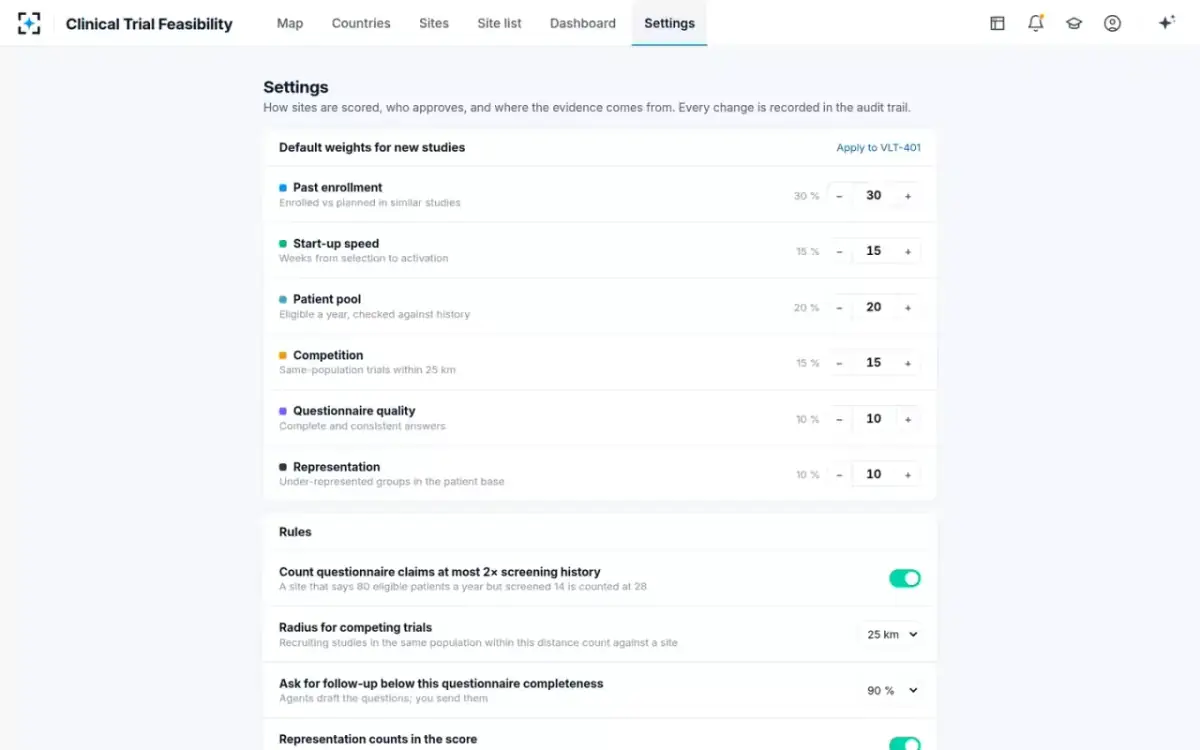
Four settings do most of the work, and all four are policy rather than configuration. The factor weights decide what your desk means by a good site: the sample study runs past enrollment at 30%, patient pool 20%, start-up speed 15%, competition 15%, questionnaire quality 10% and representation 10%, with presets for a balanced study, proven sites, fast start-up or representation. The claim-inflation ceiling decides how much benefit of the doubt a questionnaire gets — on the sample study a claim is counted at no more than twice the site's screening history until the site confirms it. The competing-trial radius decides what counts as the same catchment: 15, 25 or 50 km. And the questionnaire-completeness threshold decides when a follow-up is drafted at all.
Set them in week 4, after the first replay, and then re-run. Two habits are worth building in from the start. Change one setting at a time, so a change in the ranking has one explanation. And write down why — the reason for a 50 km radius in a country with few specialist centres is a judgement someone will have to defend in two years, and it costs nothing to record it now. Every change is on the audit trail with a name and a time, which makes the record possible but not automatic.
The settings screen: your rules, not the software's defaults
What clinical trial feasibility software validation actually covers
Validation here means two different things and it is worth separating them. The first is the computerised-system question every sponsor's quality system already knows how to ask. ICH E6(R3) is specific about the approach. Whoever is responsible for the system owns its validation status for its whole life, and the validation is scoped by a risk assessment of three things: what the system is for, how much the records it creates and keeps matter, and how far it could affect participants' safety, rights and well-being or the reliability of trial results (ICH E6(R3) §4.3.4). The validation then has to show that the system meets its requirements for completeness, accuracy and reliability, and performs as its intended purpose demands.
The second is the model question, and it is the one a go-live plan usually forgets to end. FDA's January 2025 draft guidance on artificial intelligence closes its framework with a decision rather than a document: based on the results, a model may or may not be appropriate for its context of use, and if credibility is not sufficiently established the options include reducing the model's influence by adding other evidence, raising the rigour of the assessment, adding controls, changing the approach — or treating the output as inadequate, so that "the model's COU would be rejected or revised in an iterative fashion" (FDA draft guidance, section IV.A.7). Write that last option into the go-live plan explicitly. A plan whose only possible outcome is go-live has not validated anything.
ICH E6(R3) also asks that subsequent changes to a system be validated on a risk basis, considering both previously collected and new data — which is the clause that makes a regression set out of your replay material rather than a one-off exercise. The five measures to run on a ranked site list are the detail behind every row of the check table above.
Who signs the first live site list, and what their signature means
The signature is the part of go-live that is easiest to leave at a default and hardest to correct afterwards. On the sample study two approvers are named in the settings: the study lead approves the country allocation and every tier change, and the feasibility lead decides each site and signs the final list. The list is signed electronically with name, time and the meaning of the signature chosen explicitly — approving the list and the rationale behind each site, or recording that it has been reviewed.
That distinction is not pedantry. A reviewer and an approver are making different claims, and a file that records only "signed" cannot tell an inspector which was meant. The second thing to settle before the first live round is what the signature is attached to: on the sample study the signed list, the country allocation, the forecast range and the approval record are filed together to the trial master file under site selection, with a cited rationale for each primary and back-up site. Test that filing on a throwaway list in week 5. It is a boring failure to discover in week 6 with a real study waiting.
Underneath all of this, the duty does not move. ICH E6(R3) keeps the selection of investigators and institutions with the sponsor, and asks that each investigator be qualified by education, training and experience with adequate resources and facilities, and have sufficient time, staff and facilities for the trial's duration (ICH E6(R3) §3.7.1 and §2.2.2). Software that proposes and cites leaves that duty exactly where the guideline puts it; the clauses in full are worth reading before the first signature rather than after it.
Representation: the diversity action plan that is coming
One setting deserves its own decision, because the ground under it is moving. Representation counts in the sample study's score at a weight of 10%, and can be turned off, which sets its weight to zero. The reason to leave it on is a requirement already in statute and not yet in effect: FDA's guidance on these plans was still a draft in late 2026. The Food and Drug Omnibus Reform Act amended the Federal Food, Drug, and Cosmetic Act to require a Diversity Action Plan for certain studies, including Phase 3 drug trials, and FDA's report to Congress sets out its contents: "A Diversity Action Plan must include: The sponsor's goals for enrollment in the clinical study. The sponsor's rationale for such goals. An explanation of how the sponsor intends to meet such goals" (FDA, Diversity Action Plans Summary FY 2023 and FY 2024).
The timing is the part to get right. The same report states that "the Diversity Action Plan submission requirement has not yet come into effect" and that it "will apply to certain studies for which enrollment commences after 180 days from the publication of the final guidance". Meanwhile sponsors have been filing voluntarily, and the volume is rising: FDA's drug centre received 124 voluntary diversity plans in fiscal 2023 and 161 in fiscal 2024, with its biologics and device centres also increasing. Check FDA's current position before relying on any of this, and in the meantime treat the practical question as settled: an explanation of how you intend to meet enrollment goals is a statement about which sites you opened, which is written at feasibility or not at all.
What happens on day one of your next study
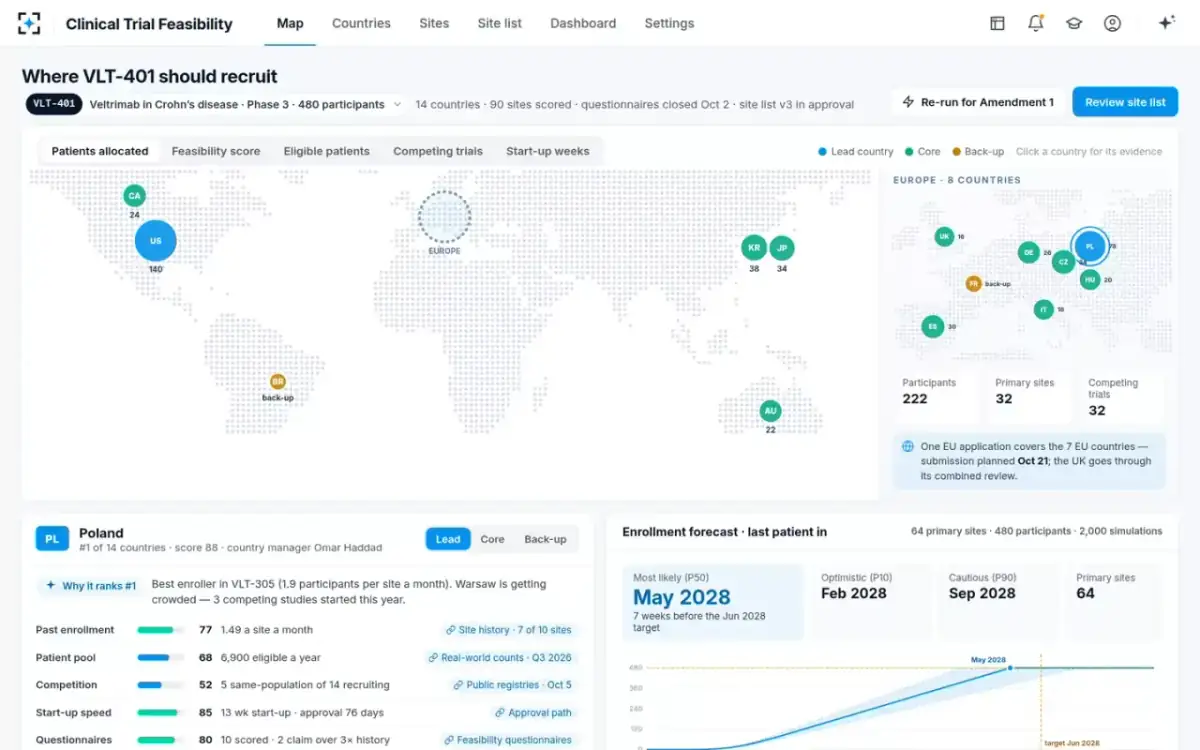
The first real round looks like the rounds the desk already runs, with the retrieval already done. The protocol synopsis goes in and its criteria come back structured, each with its section, for the medical lead to confirm. The questionnaire round closes and every returned form is read with its question numbers, completeness checked, claims compared with screening history and follow-ups drafted for the feasibility lead to send. The country map opens with each country's evidence and the enrollment forecast under it, and the ranking board arrives scored on your weights with a cited reason per site.
What the desk does on day one is the part that was always theirs: read the sites where claim and history disagree, decide the tiers, argue about the countries, and sign. A week later, when registries refresh and any site that moves more than five places is explained, the round is still live rather than finished — which is the real difference between a ranking and a spreadsheet.
Day one: the plan as a map, with the forecast underneath
If the case still has to be made internally, what a late trial costs per day prices the weeks; if the question is who does what afterwards, the desk seat by seat sets it out. To see the whole round, start from Clinical Trial Feasibility.
Questions people ask
How long does it take to implement clinical trial software?
The plan this guide sets out for this solution is about six weeks — a plan, not a measured delivery record: two to read in your questionnaire, a past protocol and your site history and connect the management system and registries read-only; two to replay finished studies and settle the weights; two to run the quality checks and go live beside the team on a real round. The variable that moves the plan most is access — a management-system connection and a privacy review for the patient-count source are the two things worth starting on day one.
How do you set up clinical trial feasibility software for a first live round?
Prove on your own finished study that it can do each of these before a live round: read whatever questionnaires actually arrive, read site history from your management system without writing to it, search public registries with a radius you set, estimate patient pools from counts rather than records, score on weights you own, cite every sentence it writes, and file a signed list with its rationales. Then set up the procedural side: an audit trail with names and times, a validation approach proportionate to the risk, and an electronic signature that records what it means.
What do I need to start using feasibility software?
Four things you already hold: a finished study's protocol synopsis with its criteria, your management-system site history, one completed questionnaire round in whatever formats it arrived in, and your weighting rules. Two things to connect: public trial registries, and a licensed source of real-world patient counts. Nothing on that list is a new dataset, which is why the plan is weeks rather than quarters.
Does clinical trial feasibility software need to be validated?
If it holds or generates records your trial relies on, yes, and ICH E6(R3) describes the approach: a risk-based assessment that considers the system's intended use, the importance of the records involved and the potential effect on participants and on the reliability of results. Validation has to demonstrate conformance to requirements for completeness, accuracy and reliability. Treat the model's own credibility as a second, separate question with its own plan and its own possible failure.
Can we run it alongside our existing feasibility process?
For the first live round, that is the recommended arrangement: the desk runs its normal process and the solution runs beside it, and the two lists are compared before either is signed. It costs one round of duplicated effort and it buys the only comparison that matters to the people who will use it. After that, whether to keep running both is a decision for the feasibility lead, made on what the comparison showed.
What happens when we change a weight after go-live?
The agents re-propose inside each country's existing allocation and the forecast is recalculated on the spot, but decisions people have already made stay made — a site a feasibility lead has placed does not move because a weight moved. Any site shifting more than five places is explained, and the change itself is recorded with a name and a time. Change one setting at a time, so the shift in the ranking has one explanation.