The clinical trial protocol amendment impact on site selection is larger than most plans allow for, because an amendment invalidates the inputs rather than the arithmetic: change an entry criterion and the eligible population changes, every country's patient pool changes with it, the share of each site's patients who still qualify changes, and the enrollment forecast built on all three is out of date. Site selection is the decision that sets where a study recruits, and it is the part of the plan most often left as it was when the protocol moves. Botminds' Clinical Trial Feasibility treats an amendment as a re-run: six agents re-read the changed criteria with their protocol sections, recount the patient pool country by country, re-score every site and show exactly what would change — and hold all of it until a named person applies or discards it.
The worked example is a fictional sample study used throughout the solution: VLT-401, a Phase 3 trial of veltrimab in moderate-to-severe Crohn's disease, 480 participants, 90 scored sites across 14 countries. Amendment 1 lowers the endoscopic entry score and widens the permitted treatment history. The sponsor, sites and investigators are invented; the research and the guideline quoted are linked where they appear.
Amendment 1, on the sample study
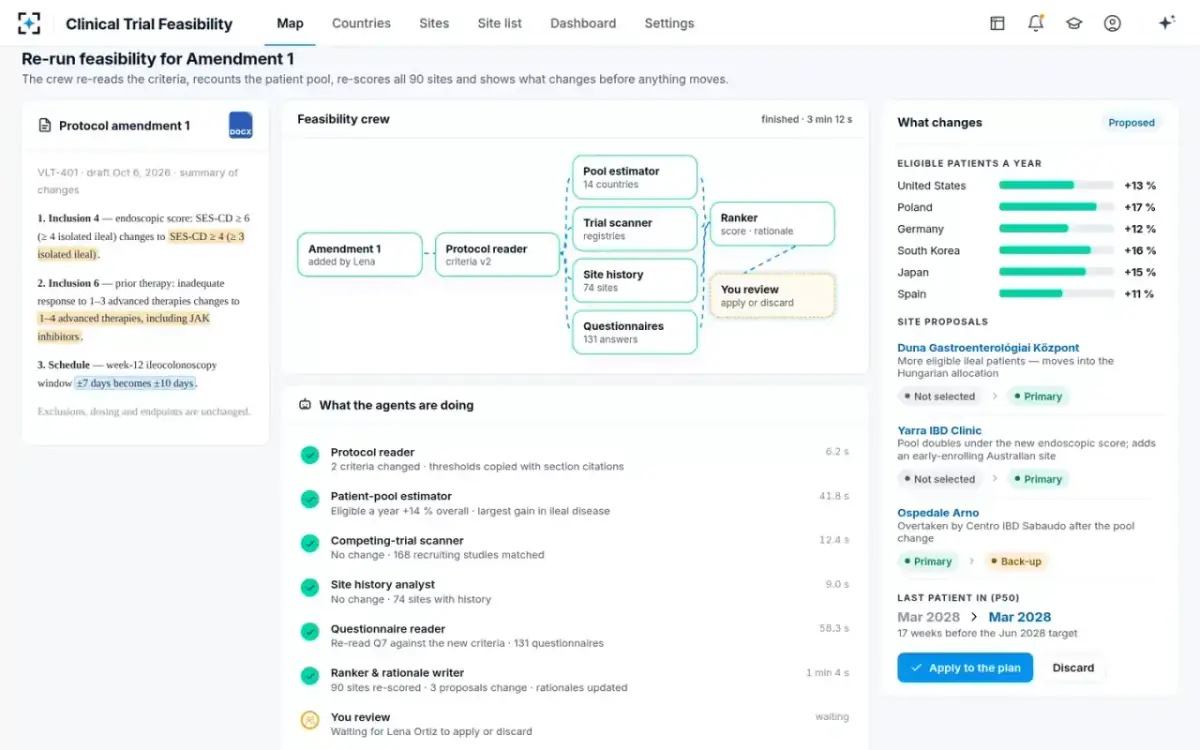
2criteria
changed, each threshold copied with its protocol section
14%
more eligible patients overall, recounted country by country
90sites
re-scored in 3 min 12 s, where a re-check by hand takes days
3
site proposals change — and none of them moves until a person applies it
One amendment, ninety sites to re-check
The guideline's definition is almost comically short. ICH E6(R3) glosses a protocol amendment as "A documented description of a change(s) to a protocol", and that brevity is the problem: one documented change can invalidate a thousand derived numbers without saying so.
On the sample study the two changed criteria touch almost everything. Lowering the endoscopic entry score admits patients with less severe disease at colonoscopy; allowing up to four prior advanced therapies admits patients who were previously excluded as too heavily treated. Both widen the pool, but not necessarily evenly: countries where patients reach specialist care at different stages of disease can gain by different amounts, and so can sites that recruit from referral centres rather than community clinics. A uniform 14% applied to every country would be wrong in both directions at once.
The clinical trial protocol amendment impact nobody plans for
Teams plan for the regulatory impact — submissions, approvals, consent — and for the operational one: re-training, re-supply, revised schedules. What is rarely planned for is that the site list itself was an answer to a question that has now changed.
The chain runs in one direction and every link carries the error forward. The criteria decide who is eligible. Eligibility decides each country's pool. The pool, with each site's history and competition, decides each site's score. The scores and the country allocation decide which sites open and how many participants each is given. The sites and their opening dates decide the forecast. Change the first link and leave the rest, and the plan is internally consistent and externally wrong.
What a re-run does, and where it stops
Agent
Protocol readerReads the amendment, identifies every changed inclusion and exclusion criterion and copies the new threshold with its section
Never: Never paraphrases a threshold; flags any criterion it cannot structure
Agent
Patient-pool estimatorRe-applies the criteria in protocol order to licensed counts per country and rebuilds the funnel to the new endoscopic threshold
Never: Counts only, minimum cell size 11; shows the data cut and any criterion it could not apply
Agent
Competing-trial scannerRe-matches recruiting studies against the amended population — a competitor may now share patients it did not share before
Never: A different-population study never counts against a site
Agent
Questionnaire readerRe-reads each site’s answers against the new criteria and flags where an answer no longer applies
Never: Follow-up questions stay drafts until a person sends them
Agent
Ranker and rationale writerRe-scores all 90 sites, rewrites the affected reasons and recalculates last patient in
Never: No uncited sentence; explains every move of more than five places
A person decides
Feasibility leadReads what would change, then applies or discards it — nothing reaches the plan before this step
How often are clinical trial protocols amended, and at what cost?
More than half the time, and the cost is measured in hundreds of thousands of dollars per amendment. A Tufts Center for the Study of Drug Development study with fifteen pharmaceutical companies and contract research organisations analysed 836 protocols and found that 57% had at least one substantial amendment — and that 45% of those amendments were judged avoidable (Getz et al., 2016).
Protocol amendments, measured
| What was measured | Finding | What it rests on |
|---|---|---|
| Share of protocols with at least one substantial amendment | 57% | Data from 836 phase I–IIB/IV protocols |
| Share of those amendments judged avoidable | 45% | Impact assessment of 136 randomly selected amendments |
| Mean substantial amendments per protocol, phase II and phase III | 2.2 and 2.3 | The same 836-protocol set |
| Median direct cost to implement one substantial amendment, phase II | US$141,000 | Direct-cost analysis of 52 protocols |
| Median direct cost to implement one substantial amendment, phase III | US$535,000 | Direct-cost analysis of 52 protocols |
| Effect on recruitment | Protocols with at least one substantial amendment had fewer actual screened and enrolled patients than planned, compared with protocols without one | The same study |
The last row is the one feasibility should sit up for. Amended protocols recruited worse than unamended ones against their own baseline plan — which is consistent with the mechanism on this page, where the plan keeps running on a population that has changed underneath it.
The guideline makes the same point from the design end. Its protocol appendix asks that trials be described in a "clear, concise and operationally feasible protocol", and suggests that writing acceptable ranges into specific provisions — building adaptability into the protocol — can cut deviations and sometimes remove the need for an amendment at all (ICH E6(R3), Appendix B). Forty-five per cent avoidable is the same observation with a number on it.
What exactly changes when the eligibility criteria change
Three quantities move, and they move at different speeds. The pool moves immediately and arithmetically. Each site's share of the pool moves with its own case mix, which the sponsor often cannot see directly and has to infer from screening history. The competition moves last and least predictably: a study that was recruiting a different population may now be recruiting yours.
One criterion, before and after, with what each number does
The criterion
Endoscopic entry score at or above the original threshold, assessed at screening colonoscopy
SES-CD ≥ 4 (≥ 3 for isolated ileal disease), copied with its section citation
Prior therapy
Limited number of prior advanced therapies permitted
Up to four prior advanced therapies permitted
Eligible patients, all countries
The pool the original site list was built on
Up 14% overall — and not by 14% in any one country
Site proposals
76 primary and back-up sites on the signed list
Three proposals change, each with the reason it changed
Last participant enrolled
Most likely May 2028, range February to September
Recalculated from the new pool and the same site histories
The widening direction is the comfortable one. An amendment that narrows a criterion is the dangerous case: the pool shrinks, sites that were marginal become unviable, and a forecast that is not recalculated understates how late the study will now finish. The research suggests criteria tend to grow over time — median eligibility criteria content in National Cancer Institute-affiliated trials "increased over time, from 214 (IQR [23, 282]) unique content words in 2008 to 417 (IQR [289, 514]) in 2018" — and that longer criteria predict accrual failure. The accrual evidence is in why most trials miss enrollment, by the numbers.
Why a criterion must be copied, never paraphrased
Because the paraphrase is where the pool silently changes without anyone deciding to change it. "Moderate to severe disease at endoscopy" and "SES-CD ≥ 4, or ≥ 3 for isolated ileal disease" are not the same instruction, and only the second can be applied to a count. A patient-pool estimate built on the first is an estimate of something nobody specified.
It matters more on a re-run than on a first pass, because the comparison is the output. If the original criterion was captured as a paraphrase and the amended one is captured as a threshold, the difference between them includes the difference in how they were written down — and a change of 14% could be 9% of amendment and 5% of transcription. In the solution the protocol reader copies each threshold exactly, with its section, and flags any criterion it cannot structure rather than approximating it.
The same discipline protects the other direction. A medical lead reviewing the re-run is checking a copied threshold against the amendment in front of her, which takes a minute. Checking a paraphrase against an amendment is an interpretation, and interpretations do not compare cleanly between two versions of a protocol.
Re-counting the patient pool after a criterion change
Recounting is not re-filtering a list; it is rebuilding a funnel in the protocol's own order. On the sample study the funnel for one country runs from people living with the condition, to those with moderate-to-severe disease, to those who have failed advanced therapy, to those who meet the endoscopic threshold — 98,900 to 11,500 in Brazil before the amendment. Change the endoscopic step and only the last stage moves; change the prior-therapy step and a middle stage widens, which changes what the last stage is applied to.
Two constraints sit on the count and should survive any re-run. It is counts only, never patient-level data, with a minimum cell size of 11 — a stage that would return fewer than 11 people is not reported as a number. And every figure shows its data cut and any criterion that could not be applied to the available counts, so the medical lead can see which parts of the amendment the estimate actually reflects.
How to re-run site feasibility after an amendment, step by step
The order is the same as a first pass, and skipping a step is what produces a confident wrong answer rather than a slow one.
Seven steps, in the order that keeps the re-run honest
- Capture the change as text, with its section
Copy the new threshold from the amendment, not from the summary of changes. Note any criterion that cannot be expressed as a rule.
- Recount the pool country by country, in protocol order
Rebuild the funnel rather than scaling the old number. A widened middle stage changes what later stages apply to.
- Re-match the competing studies against the new population
A study that recruited a different population may now share yours — and one that shared yours may no longer.
- Re-read the questionnaire answers that the change touches
A site’s estimate of eligible patients was an answer to the old criteria. Where it no longer applies, ask rather than scale it.
- Re-score every site, not only the ones you expect to move
The point of re-scoring all 90 is to find the site you were not watching. Any move of more than five places should come with its reason.
- Recalculate the forecast as a range from the new inputs
The sites open when their approval paths allow and enrol at their own past rates. A single new date tells the steering group nothing about the tail.
- Show the differences and stop
Everything above is a proposal. The plan changes when a named person applies it, and the discarded options stay visible.
The re-run, finished, with nothing applied
What ICH E6(R3) requires before an amendment takes effect
no deviations from or changes to the protocol should be initiated without prior documented IRB/IEC approval/favourable opinion of an appropriate protocol amendment except when necessary to eliminate immediate hazards to the participants
ICH E6(R3) Guideline for Good Clinical Practice, section 1.4.7, Step 4 final guideline, 6 January 2025
The clause sits in the ethics committee's written procedures and governs conduct at sites, and it sets the tempo everything else has to respect. A sponsor may plan against an amended protocol, model it, recount the pool and re-rank the sites; what it may not do is let any of that reach a site before the ethics committee's documented opinion exists, except to remove an immediate hazard to participants.
That distinction is a useful design rule for any re-run, and it is why the re-run on this page ends in a held state rather than an applied one. Modelling the change early is good practice — it is how a sponsor knows whether an amendment is worth making. Acting on it early is a protocol deviation. A tool that applies its own conclusions automatically has collapsed the two, and the sponsor only finds out at the inspection. The clauses that govern the selection itself are in what ICH E6(R3) requires for clinical trial site selection.
What should reach the plan automatically, and what needs a decision?
Draw the line at the point where a number becomes a commitment. Recounting a pool is reading. Re-scoring a site is arithmetic over readings. Opening a site, moving a country between tiers, reallocating participants and telling a steering group a new date are commitments, and each has an owner.
The same amendment, re-checked by hand and re-run
A manual re-check: The sites someone is already worried about — in practice the top and bottom of the list
An automatic re-run, held for a decision: All 90, because the cost of re-scoring the eighty you were not worried about is zero
A manual re-check: Scaled, or left as it was, because recounting 14 funnels is days of work
An automatic re-run, held for a decision: Rebuilt country by country in protocol order, each figure showing its data cut
A manual re-check: Summarised into a working note; the threshold is read once and retyped
An automatic re-run, held for a decision: Copied with its protocol section, so the before and after compare cleanly
A manual re-check: Days of recounting and re-reading, most of a first pass
An automatic re-run, held for a decision: 3 min 12 s on the sample study, then the time a person needs to read it
A manual re-check: Whatever the person doing it changed as they went
An automatic re-run, held for a decision: Nothing. The differences are shown and wait to be applied or discarded
A manual re-check: The new list, and whatever was in the email thread
An automatic re-run, held for a decision: The changed reasons, the proposals that were discarded, and who applied what
Why nothing should move until a person applies it
Three reasons, and only the first is about compliance. The guideline requires documented approval before a change is initiated at a site, so automatic application is a deviation waiting to be found. The second is that a re-run proposes against one dimension — the amended criteria — while the person holds the ones the model cannot see: a country manager's conversation with a principal investigator, a contract in negotiation, a site that has just lost its coordinator.
The third is the one teams feel later. A decision that was applied automatically has no author, and a year after the study closes nobody can say whether a site was dropped because the criteria changed or because somebody wanted it dropped. On the sample study the people's own moves stay on the record beside the agents' proposals, with the reason each person gave — which is what makes the list readable to someone who was never in the room. The four ways teams run this decision today, and what each can support, are set out in spreadsheets, a CTMS module or agents.
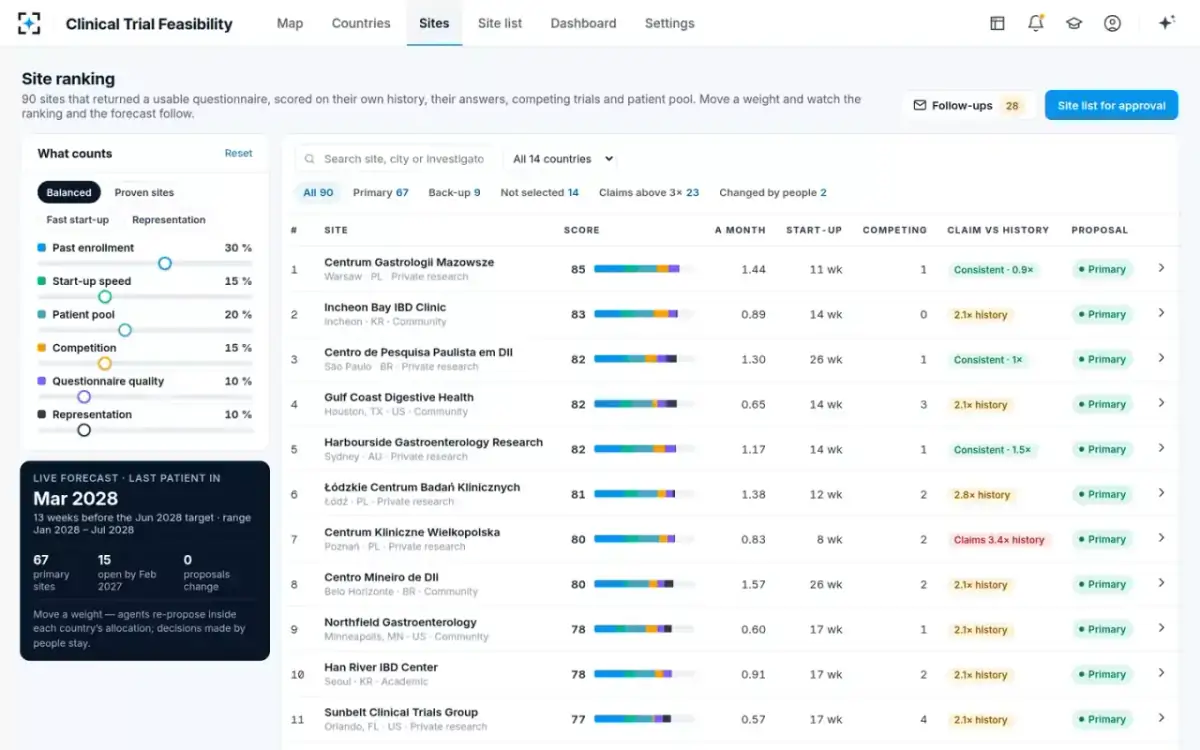
The board the re-run proposes against
Questions people ask
How often are clinical trial protocols amended?
Often enough to plan for. A Tufts Center for the Study of Drug Development analysis of 836 protocols found 57% had at least one substantial amendment, with phase II and phase III protocols averaging 2.2 and 2.3 substantial global amendments each. Nearly half of those amendments were judged avoidable.
Why are protocol amendments so expensive?
Because a substantial amendment has to be implemented across a study already running, not just written. The same study puts the median direct cost of implementing one substantial amendment at US$141,000 for a phase II protocol and US$535,000 for a phase III. The indirect cost is the recruitment effect: amended protocols enrolled fewer patients relative to their baseline plan than unamended ones.
Does a protocol amendment mean site selection has to be redone?
Not redone, but re-checked — and the re-check has to start from the patient pool rather than from the scores. If the amendment changes an inclusion or exclusion criterion, every country's eligible population changes, so every site's share of it changes and the forecast built on both is stale. If the amendment touches only visit logistics or safety reporting, the pool is unaffected and the site list usually stands.
How long does it take to re-run site feasibility after an amendment?
By hand, days rather than hours for a study of this size, because recounting the patient pool country by country and re-reading the affected questionnaires is most of a first pass. On the fictional sample study, the agents re-read the criteria, recount the pool and re-score all 90 sites in 3 min 12 s, and then wait: the time that matters after that is the time a person needs to read what changed.
Can the re-run update the plan automatically?
It should not. ICH E6(R3) asks that no change to the protocol be initiated without prior documented ethics-committee approval, except to eliminate an immediate hazard to participants, so acting on an amendment before that approval exists is a deviation. Modelling the change early is sound practice and is how a sponsor decides whether the amendment is worth making; applying it to the plan is a decision with an owner.
What should be kept from an amendment re-run for the trial file?
The changed criteria as copied text with their protocol sections, the recounted pool with its data cut, the rewritten reasons for any site whose proposal changed, the proposals that were discarded, and who applied what and when. The discarded options matter as much as the applied ones: they are what shows the decision was made rather than defaulted into.