Who decides which sites a clinical trial uses? Formally the sponsor does, and nobody else can: ICH E6(R3) puts investigator selection on the sponsor and asks that each investigator be qualified by education, training and experience and show adequate resources and facilities for the trial (ICH E6(R3) §3.7.1). In practice that duty is carried by five seats on one desk — a feasibility lead, a study lead, one country manager for each region, and a medical lead — working from a questionnaire round, an export from the clinical trial management system and a spreadsheet. The work is hard because the evidence arrives in different shapes from a hundred-odd sources at once, and the reasoning that reconciles it rarely survives the meeting it was made in. Botminds' Clinical Trial Feasibility puts six agents under that desk: they read the protocol, the site history, the returned questionnaires, the public registries and licensed patient counts, rank every country and site with a cited reason, and forecast when the last patient will be enrolled — and every one of the five seats still decides what it decided before.
The desk on this page is a fictional sample study in the solution: VLT-401, a 480-participant Phase 3 trial of veltrimab in moderate-to-severe Crohn's disease, with a target last patient in of June 2028. The people, the sponsor and the sites are invented; the shape of the week is not. Figures about the study are sample data; figures from research are linked where they appear.
One questionnaire round, and what the desk has to read
186sites
sent a feasibility questionnaire, across 14 countries
131
questionnaires came back
90
came back usable enough to score
5seats
share the one decision the sponsor owes a regulator
Who decides which sites a clinical trial uses? Five seats, one list
The list is one document and five judgements. The feasibility lead owns the document: which sites are primary, which are back-up, which are not selected, and the reason attached to each. The study lead owns the consequence: how many participants each country is allocated and what that does to the enrollment date the programme has promised. Each country manager owns the local truth — which of their sites is actually ready this year, which investigator has moved, which hospital is mid-merger. The medical lead owns the question of whether the entry criteria were read correctly at all, because a patient-pool estimate built on a misread threshold is confidently wrong rather than roughly right.
None of those four can be collapsed into the others, which is why the decision takes five seats rather than one. The feasibility lead cannot know that a German investigator took a chair in Vienna in March. The country manager cannot see what their advocacy costs the date in another region. And the study lead, who signs for the date, has no way to audit a patient-pool funnel without the medical lead reading the criteria beside it.
Five seats on one feasibility desk, and what each keeps
Today
Runs feasibility for three studies at once from questionnaires, a management-system export and a spreadsheet. Needs the reason, not the score — and the reason is usually in somebody’s head.
With agents
Opens every country and site with a cited reason beside it, decides on the evidence and signs a list whose rationale is filed with it.
Still theirs: the decision on every site, and the signature on the final list
Today
Owns the timeline and the country allocation, and asks what moving a country does to last patient in — an answer that takes until the next meeting.
With agents
Receives each tier change with the forecast it produces, and approves or declines it with the evidence in front of him.
Still theirs: approval of the country allocation and every tier change
Today
Knows her sites and argues for them in meetings. Her best argument — the sites are fast, the approval is slow — is hard to show in a spreadsheet.
With agents
Points at the country page: site history, the patient funnel, competing studies and the approval path, each with its source.
Still theirs: the request to add, swap or hold a site in her countries
Today
Pushes for the investigators he trusts, on reputation and relationship, with no counter-evidence in the room.
With agents
Gets a written reason for every decision on his sites, drawn from each site’s own enrollment history, before he signs his countries.
Still theirs: the same request, and the right to an answer he can read
Today
Checks that entry criteria were transcribed correctly, late, by eye, after the pool estimates are already in the deck.
With agents
Sees each criterion with its protocol section, and an amendment re-run that shows what would change before anything is applied.
Still theirs: confirmation of the criteria and the patient-pool logic
The feasibility lead: owns the list, not the opinions behind it
The feasibility lead's job is not to have the best opinion about every site. It is to hold a list in which each row's reason can be read by somebody who was not in the room — the study lead next week, the country manager who disagreed, a sponsor's own auditor two years later. That is a different skill from site judgement, and the thing that defeats it is not difficulty but volume: 90 usable questionnaires, each with a management-system history behind it, a registry search around it and a patient-pool estimate above it.
So the seat spends its time on retrieval, not judgement. Pull the site's last three studies. Find what it enrolled against plan. Find how long activation took. Search the registry for recruiting studies near it. Compare the questionnaire's claim against what the site screened. Then write a sentence. Multiply by ninety, and the week is gone before a single ranking argument has been had.
In the solution, the retrieval is done before the seat sits down, and the ranking board arrives with six weighted factors already scored and cited: past enrollment 30%, patient pool 20%, start-up speed 15%, competition 15%, questionnaire quality 10%, representation 10%. The lead's work becomes the part that needed a person — moving a weight and watching the ranking and the forecast follow, reading the sites whose claims and history disagree, and deciding which of them is worth a follow-up question rather than a rejection.
The study plan as a world map, with the forecast under it
The study lead: approves what moving a country costs the date
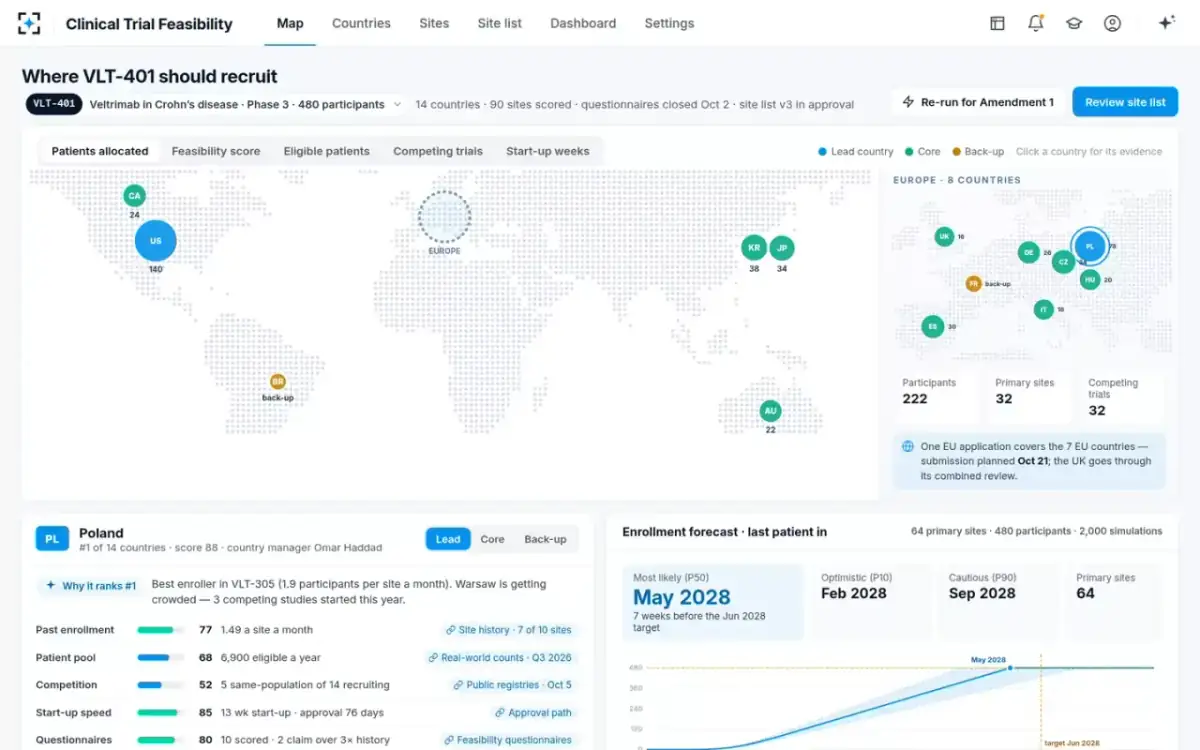
The study lead is the seat that owns the enrollment date, and the only question that seat really has is what a change costs it. On the sample study the answer is arithmetic the desk could not previously do in a meeting. Brazil ranks 13th of 14 on score, held back almost entirely by approval time — about 150 days for the national regulator and ethics review together, so its sites would open in April 2027, after the February 2027 first-patient target. Move Brazil from back-up to core and three ready sites open as primary, taking 36 participants from the United States, Canada and Italy; the most likely last patient in moves from May 2028 to March 2028.
That is a decision with two defensible answers, which is exactly why it belongs to a named person rather than a score. A study lead may prefer May 2028 on 64 sites to March 2028 on 67, because three more sites starting up in a country whose approvals take about 150 days are three more places for something to go wrong. What the seat cannot do is make the trade without seeing both numbers. In the solution the tier change arrives as a proposal with the forecast it produces and the evidence behind it, and nothing moves until the study lead approves it.
The forecast moves when a country moves
The country manager: argues for sites with a name attached
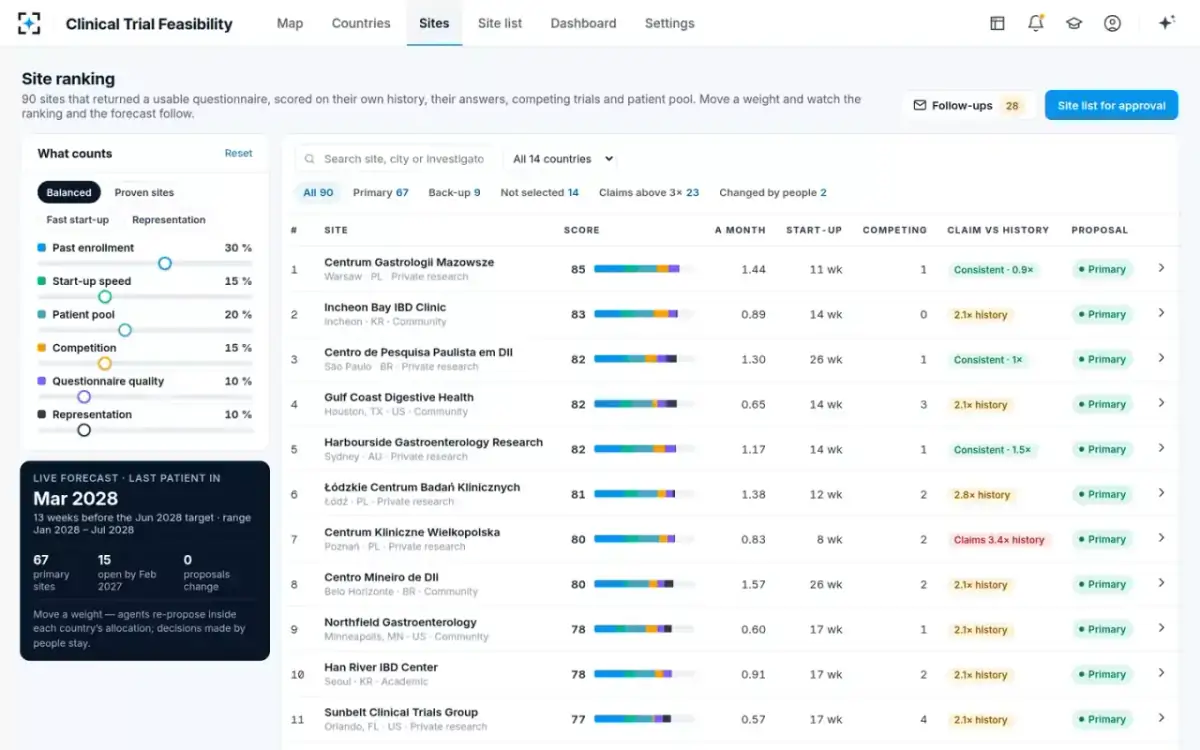
Country managers are the seat most often described as a problem and most often right. Their argument is local and unquantified — this investigator leads the national society, that hospital has a referral network nobody can see in a registry — and it arrives as advocacy because there is no other channel for it. On the sample study a country manager asks for a German university hospital as a primary site because its principal investigator leads the national society for the disease and other sites follow his lead.
The site ranks 85th of 90. On the sponsor's previous study it enrolled 3 participants against a plan of 10 in twelve months; activation took 29 weeks against a German median of 24; its questionnaire claims about 80 eligible patients a year where it screened 14, so the claim is counted at twice its history rather than at face value; and four studies in the same patient group are recruiting within 25 km, one of them in the same hospital. The feasibility lead keeps it as back-up, to open if a German primary site falls behind after month six, and the reason goes back to the country manager in writing.
Nothing about that exchange requires software. What the software changes is that the country manager gets an answer rather than a silence, and that the answer is specific enough to argue with — which is the only form of disagreement that improves a site list. If the manager knows the 3-of-10 study closed early for a safety hold rather than for recruitment, that is new evidence, and it goes on the record beside the decision.
The medical lead: keeps the criteria copied exactly, never paraphrased
The medical lead's seat exists because every number downstream depends on one piece of reading. A patient-pool estimate is the entry criteria applied, in order, to a population count; get the endoscopic threshold or the prior-therapy limit slightly wrong and every country's pool is wrong in the same direction, invisibly. ICH E6(R3) states the principle plainly: "Factors critical to the quality of the trial should be identified prospectively" (ICH E6(R3), Principle 6.2). On a feasibility desk, the faithful transcription of the eligibility criteria is one of those factors, and it is almost never written down as one.
So the medical lead reads the criteria against the pool funnel: 98,900 people living with the disease in one country, narrowing to 11,500 who meet the endoscopic score. In the solution the protocol reader copies each threshold exactly with its section citation and flags any criterion it cannot turn into a rule, and the funnel shows which criteria could not be applied to the count at all — which is the number the medical lead most needs and most rarely gets.
What does ICH E6(R3) actually ask the sponsor to prove?
Three things, and only the first is usually documented. The sponsor must select the investigators and institutions, and each must be qualified and resourced for this trial — which means the file has to show what "qualified and resourced" meant for this protocol, not in general. The investigator, in turn, has to be able to demonstrate a potential for recruiting the proposed number of eligible participants within the agreed recruitment period, from retrospective or currently available data (ICH E6(R3) §2.2.1) — a demonstration, not an assertion, which is why a questionnaire claim far above a site's screening history is a finding rather than a number.
The third is the one that moves the date: the sponsor must give the potential investigators "the protocol and an up-to-date Investigator's Brochure as well as sufficient time for the review of the protocol and the information provided" (ICH E6(R3) §3.7.2). Feasibility rounds that compress that review are buying a faster questionnaire at the cost of a worse answer. Where a coordinating committee or coordinating investigator is used in a multicentre trial, E6(R3) adds that "their organisation and/or selection are the sponsor's responsibility, and their roles and responsibilities should be documented prior to their involvement in the trial" — so the committee that advises on sites is itself part of what the file has to explain.
What the sponsor owes, and which seat proves it
| What E6(R3) asks | What that means on a site list | The seat that proves it |
|---|---|---|
| The sponsor selects the investigators and institutions, each qualified and resourced for this trial (§3.7.1) | A reason per site that names the evidence: enrollment history, staff, facilities, the equipment the protocol needs | Feasibility lead, in the signed list |
| The investigator demonstrates a potential to recruit the agreed number in the agreed period, from available data (§2.2.1) | A claim checked against what the site screened, not accepted at face value | Feasibility lead, on the evidence the questionnaire reader assembled |
| Potential investigators get the protocol, a current brochure and sufficient time to review them (§3.7.2) | A questionnaire window long enough to be answered honestly, and a record of when it opened and closed | Country manager, who runs the round locally |
| Factors critical to trial quality are identified prospectively (Principle 6.2) | The entry criteria transcribed exactly, with the sections they came from, before any pool is counted | Medical lead |
| Trial processes stay proportionate and avoid unnecessary burden on investigators (Principles 7.1 and 7.4) | A shorter questionnaire, and no question whose answer the sponsor already holds | Study lead, who owns the process the desk runs |
| A coordinating committee’s organisation and selection are the sponsor’s responsibility, documented first (§3.7.1) | The advisory route into the site list is itself on the record | Study lead |
Where the week goes: chasing questionnaires versus judging evidence
Split a Phase 3 feasibility round into working days and the shape of the problem shows up immediately. Reading questionnaires and chasing the missing answers is the largest block; pulling site history, checking registries and estimating pools together take more again; scoring and writing the rationale takes more than a working week on its own. Deciding — the part the five seats are actually paid for — is the smallest block in the round.
Working days in one feasibility round, by spreadsheet and with agents
| The work | By spreadsheet | With agents | Who still does it |
|---|---|---|---|
| Reading questionnaires and chasing missing answers | 8 days | 2 days | Feasibility lead sends every follow-up |
| Pulling site history and checking claims against it | 5 days | half a day | Feasibility lead reads the disagreements |
| Checking registries for competing studies | 4 days | half a day | Country manager confirms what is local |
| Estimating eligible patients by country | 4 days | half a day | Medical lead confirms the criteria and the funnel |
| Scoring sites and writing the rationale | 6 days | 1 day | Feasibility lead decides each site |
| Forecast, country review, approval and filing | 3 days | 2 days | Study lead approves; feasibility lead signs |
The ratio is the argument for the desk, not the saving. A round in which seven days in ten are retrieval produces a list whose reasons were written last, quickly, by a tired person. A round in which the retrieval is already done and cited produces a list whose reasons were the work. The total time matters less than which part of it the five seats spend their judgement on; what the weeks themselves cost is a separate calculation.
Who answers the site's questionnaire, and who reads it
There is a sixth seat in this story that no sponsor employs: the research coordinator at each of the 186 sites, filling in a form. It is worth knowing what that seat experiences, because it determines the quality of everything the desk then reads. Feasibility questionnaires "can be anywhere from 10 to 40 pages", a site leader told the Association of Clinical Research Professionals in 2024, and general-capability questionnaires in particular "present a resource and time burden for site staff with often no response or follow-up from the requestors" (ACRP, "Fixing Feasibility", 2024).
That is the likeliest explanation for a 131-from-186 return rate and a 90-from-131 usable rate, ahead of any theory about site motivation. A 30-page form from a sponsor that may never reply is answered quickly, optimistically, by whoever has an hour. The claim of 80 eligible patients a year against 14 screened is not usually a lie; it is an estimate made in two minutes under no obligation to be checkable. ICH E6(R3)'s principle 7.4 asks that trial processes be workable in practice and free of needless complexity, procedures and data collection, and that sponsors not put unnecessary burden on investigators — a sentence written about trial conduct that reads just as well as a rule for the questionnaire that precedes it. The practical consequence for the desk: treat every claim as an estimate, count it against history, and send a specific follow-up rather than a reminder. Which questions earn their place on the form, and which answers predict enrolment, is the subject of designing the site feasibility questionnaire.
One questionnaire, from the site's desk to a signed list
Agent
Questionnaire readerReads every returned questionnaire with its question numbers — portal, PDF or email — checks completeness, and compares the eligible-patient claim with what the site screened.
Never: sends a follow-up question; it drafts, a person sends
Agent
Site history analystReads the management system for enrolled against planned, months recruiting, screen failure and activation weeks split into contract, ethics and start-up.
Never: treats a missing history as zero; no history is scored neutral
Agent
Competing-trial scannerReads public registries for recruiting studies and marks each same or different population, per country and within the radius the study sets.
Never: counts a different-population study against a site
Agent
Ranker and rationale writerScores six factors, combines them with the study’s weights, and writes a rationale in which every sentence cites the evidence behind it.
Never: writes an uncited sentence, or decides a tier
A person decides
Country managerReviews the sites in their countries, asks for a swap or an addition with a written reason, and signs their countries.
A person decides
Feasibility leadDecides primary, back-up or not selected for each site, and signs the list with the meaning of her signature; the rationales are filed to the trial master file.
What changes on each seat when the reason is already written?
Less than the software's own marketing would suggest, and more than the people expect. Nobody loses a decision. The feasibility lead still decides every site and signs; the study lead still approves every allocation change; the country managers still argue for their sites, and the medical lead still confirms the criteria. What moves is the input each seat argues from. The country manager arrives with the site's own enrollment history instead of a reputation; the study lead arrives with a forecast instead of an estimate; the feasibility lead arrives with 90 rationales to read instead of 90 rationales to write.
The second change is slower and matters more. Once the reason behind each site is written at the time of the decision, a desk can go back a year later and check itself: did the sites ranked in the top band actually enroll faster than the ones in the bottom band? That question is unanswerable on a desk whose reasons lived in a meeting, and it is the only way a feasibility function gets better rather than just quicker. The five measures worth running on your own finished studies make it concrete.
The third is about representation. The GAO's review of cancer centres with a record of enrolling diverse populations found the practice starts above the study: "Fourteen of the 17 selected cancer centers noted adopting an institutional commitment to diversity and serving diverse communities in their service area, including through cancer clinical trials" (GAO-23-105245). A feasibility desk cannot create that commitment, but it decides whether a site that has it gets picked — which is why representation sits in the sample study's scoring weights as a factor of its own rather than as an afterthought at the end of the round.
Signed, with every rationale filed beside it
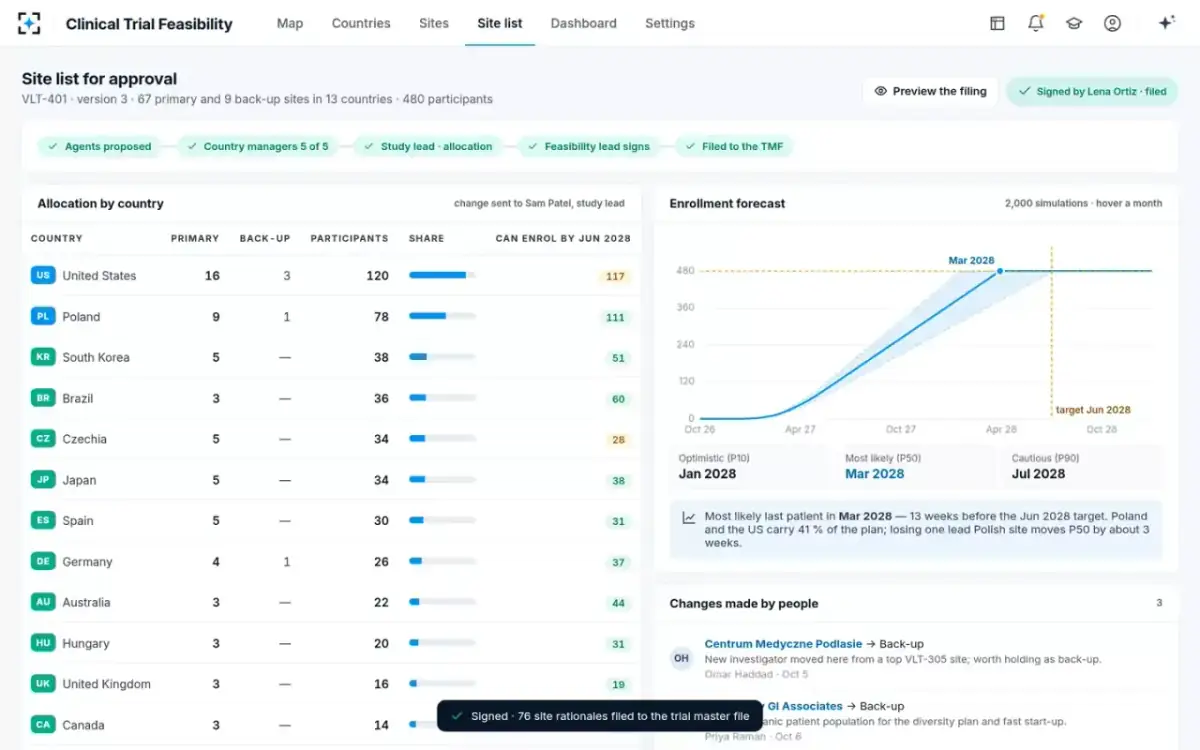
That is the whole desk: five seats, one list, and a file that explains itself. To see the map, the ranking board and the signature in one pass, start from Clinical Trial Feasibility.
Questions people ask
What does a clinical trial feasibility lead do?
A feasibility lead decides which countries and which sites will recruit a study's patients, and owns the reason attached to each choice. The work is a questionnaire round to candidate sites, a reading of each site's enrollment history, a search for competing studies, an estimate of eligible patients per country, a ranking, and an enrollment forecast — ending in a site list the lead signs and files. On a Phase 3 study with about 130 returned questionnaires, most of the round is retrieval rather than judgement.
What is a clinical trial feasibility specialist?
The same work, usually one level below the lead and across more studies: sending and chasing questionnaires, assembling site history, checking registries and preparing the comparison the lead decides on. Titles vary by sponsor and contract research organisation — feasibility specialist, feasibility manager, study start-up specialist, site identification lead — and the boundary with country management differs between a sponsor that runs its own trials and one that outsources them.
Who selects investigators for a clinical trial?
The sponsor. ICH E6(R3) §3.7.1 makes investigator and institution selection the sponsor's responsibility, and asks that each investigator be qualified by education, training and experience and show adequate resources and facilities for the trial. A contract research organisation can run the round and recommend, but delegating the activity does not move the duty, so the sponsor's file still has to show what qualified and resourced meant for that protocol.
What does a study lead do in clinical operations?
A study lead owns the timeline, the budget and the country allocation — how many participants each country is asked to recruit — and approves changes to it. On a feasibility desk the study lead is the seat that trades a date against a risk: on our sample study, accepting three extra Brazilian sites' start-up work to move the most likely last patient in from May 2028 to March 2028, or declining it and keeping the plan on 64 sites.
What does a country manager do in a clinical trial?
A country manager owns the sites in their region: the local approval path and its timing, the relationships with investigators, and the case for which sites should recruit. In feasibility their job is to supply the local truth no central dataset holds — an investigator who has moved, a hospital mid-merger, a referral network — and to sign their own countries' portion of the list. They request, with a reason; they do not decide the tier.
How do you become a clinical research feasibility specialist?
Most people arrive from one of three directions: site-side research coordination, which teaches what a questionnaire answer is worth; clinical data or management-system work, which teaches where site history lives; or country and start-up roles, which teach what an approval path really costs. The specific skill the seat rewards is being able to write a defensible reason quickly — a sentence that names the evidence it rests on and would still read as fair to the site it rejected.