A site feasibility questionnaire is the form a sponsor or contract research organisation sends to candidate sites to establish whether each can recruit the study's participants on time: whether eligible patients exist near the site, whether it has shown it can find them, how fast it can start, and what else is recruiting the same population. For the sponsor it is less predictive than its length suggests. Self-reported patient estimates are routinely several times what the site has actually screened, an oncology task force called current feasibility methods "costly, inefficient, unnecessarily burdensome, and resource intensive", and the strongest predictor of enrolment, the site's own history, is usually already in the sponsor's systems. Botminds' Clinical Trial Feasibility reads every returned questionnaire, compares each claim with the site's history, checks registries for competing trials and ranks the sites with a cited reason, for the feasibility lead to decide.
This guide is for feasibility leads, site selection managers and clinical operations heads at sponsors and CROs. The worked example is a fictional sample study, VLT-401, a Phase 3 trial in moderate-to-severe Crohn's disease with 480 participants across 14 countries; its figures are sample data.
One questionnaire round, from the sponsor's side
186sites
asked to complete the questionnaire, in 14 countries
131
returned it at all
90
returned something usable enough to score
23of 90
claimed more than three times the patients they had screened in a year
What is a site feasibility questionnaire for?
It exists to answer four questions about each site against one specific protocol: are there enough eligible patients near it, has it shown it can find and enrol them, can it start on time, and are other studies already recruiting the same patients. Everything else in a 30-page form (equipment, storage, staffing, ethics calendars) is detail in service of those four.
The questionnaire is also the sponsor's evidence that it selected sites deliberately. ICH E6(R3) makes selection the sponsor's responsibility: "The sponsor is responsible for selecting the investigator(s)/institution(s). Each investigator should be qualified by education, training and experience and should demonstrate they have adequate resources and facilities to properly conduct the trial" (ICH E6(R3), 3.7.1). A returned questionnaire, scored and filed with the reason for each decision, is a large part of how that is shown.
What ICH E6(R3) asks the sponsor to establish about each site
The guideline's investigator sections set the content of a defensible questionnaire: recruitment potential based on data, enough time, staff and facilities, and qualification. Each requirement maps to a question and, better, to evidence the sponsor can check. How the clause works in a selection decision is set out in what ICH E6(R3) requires for site selection.
Each E6(R3) requirement, the question it implies, and the evidence that answers it
| E6(R3) requirement | The questionnaire asks | Evidence the sponsor can check |
|---|---|---|
| 2.2.1 Recruitment potential “based on retrospective or currently available data” | Patients screened and enrolled on similar studies; patients on the register meeting key criteria now | Enrolled against planned on the sponsor’s own past studies; a dated register count |
| 2.2.2 Sufficient time, qualified staff and adequate facilities | Coordinator time free from the start date; the investigator’s other studies; equipment and procedures | Named staff and their allocation; the procedures the protocol needs, such as a specific endoscopic score |
| 3.7.1 Investigator qualified by education, training and experience | Investigator CV, GCP training, experience in the indication | Current CV and training dates; past inspection history where available |
| 3.7.2 Sufficient time to review the protocol | Confirmation the site has read the synopsis or protocol | The date the protocol was sent and the time allowed for the return |
The phrase "retrospective or currently available data" matters for design. It means the guideline expects recruitment potential to be shown from what a site has done or can count now, not from what it hopes. A questionnaire that asks only "how many patients could you enrol?" invites the hope and leaves the sponsor to discount it privately.
Which questionnaire answers predict enrolment, and which do not?
The answers with the most signal are the ones already tested against reality: past enrolled-against-planned on comparable studies, actual screening counts with a date, and start-up times by stage. The weakest is the site's own forecast of how many patients it will enrol, because it is consistently optimistic. On the sample study, the historical factors carry 45% of the score between them; the questionnaire's own completeness and consistency carry 10%.
How the six factors are weighted on one Phase 3 study
The protocol itself is the other predictor a questionnaire should surface. In a study of 1,197 trials affiliated with the US National Cancer Institute, 19.3% failed for low accrual, and the accrual failure rate rose from 11.8% in the decile with the shortest eligibility criteria to 29.4% in the decile with the longest; "Eighteen exclusion criteria categories were significantly associated with accrual failure, including renal, pulmonary, and diabetic, among others" (PubMed 36398619). A questionnaire that asks each site which exclusions will cut its population, and by roughly how much, collects evidence for an amendment before the first patient is missed. The wider enrolment picture is set out in why most clinical trials miss enrollment.
The burden problem: why shorter, standard questionnaires return better data
Questionnaires that are long, generic and delivered as forms to download get fewer and worse answers. On the sample study 55 of 186 sites never returned the form, and 41 of the 131 that did returned something too incomplete to score; a sponsor that loses half its candidate sites to the instrument has a measurement problem before it has a site problem.
The sites' professional body has recorded the complaint. A site director told the Association of Clinical Research Professionals that "feasibility questionnaires can be anywhere from 10 to 40 pages", and described the mechanics: "we typically receive a pdf attachment, which must be downloaded, converted to enable it to be filled out, then re-saved and e-mailed back" (ACRP, 2024). An ASCO task force, working from surveys of sites, sponsors and CROs, reached a consensus that applies beyond oncology.
“Three key recommendations were identified for application across all biotech-pharma sponsored trials: (1) implement a streamlined and uniform FA process across trials and sponsors; (2) minimize and standardize questions; and (3) leverage technology to centralize FAs, facilitate communications, and reduce redundancies.”
ASCO task force on feasibility assessments, JCO Oncology Practice (PubMed 33405975)
The same task force described the current process as "of uncertain effectiveness". For a sponsor the practical reading is that every question has a cost in returns and in answer quality, so each one should earn its place by feeding a score or a decision. Questions the sponsor can answer from its own systems, such as the site's past performance on its studies and its start-up history, should be pre-filled for the site to confirm, not asked again.
Designing questions a desk can score
A question is scoreable when it fixes the unit, the period and the source of the answer. "How many eligible patients do you see?" produces adjectives; "how many patients meeting criteria 3, 5 and 7 did you screen in the 12 months to September, from which system?" produces a number that can be compared across 90 sites and checked against history.
The same question, asked so it can and cannot be scored
Hard to score: “How many eligible patients could you enrol per year?”
Built to be scored: “Patients screened for IBD studies in the last 12 months; of those, how many met an SES-CD at or above this protocol’s threshold? Date of the count and system used.”
Hard to score: “Describe your experience in Crohn’s disease.”
Built to be scored: “Enrolled and planned on your last two Crohn’s studies, with dates; reason for any shortfall.”
Hard to score: “Estimated time to activation?”
Built to be scored: “Weeks for contract, ethics and activation on your last two studies, separately.”
Hard to score: “Are there competing trials?”
Built to be scored: “Recruiting studies at your site in this indication, with registry number and population.”
Hard to score: “Is staffing adequate?”
Built to be scored: “Coordinator full-time equivalents free from the planned start date; the investigator’s other active studies.”
Verifying the answers: claim against history
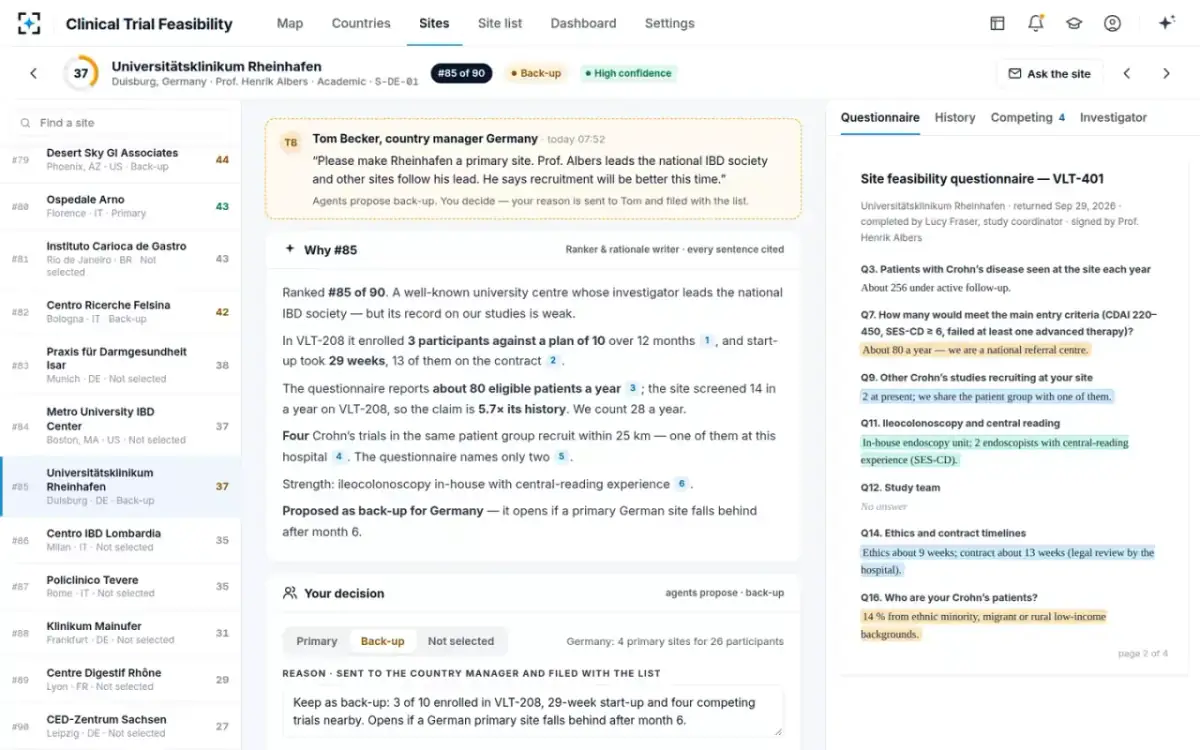
A careful desk caps self-reported patient claims at a multiple of the site's own screening history until the site confirms them, rather than believing or discarding them. On the sample study, 23 of 90 sites claimed more than three times what they had screened in a year. That is rarely dishonesty; it is the gap between the patients a clinic sees with the condition and those who pass fourteen inclusion and eleven exclusion criteria.
One sample site's claim, its history, and what was counted
The cap is only fair if the site is asked. In the solution, follow-up questions are drafted for sites with missing answers or claims far above their history (below 90% completeness by default), and a person on the sponsor's team sends them. A confirmed and explained claim can then be counted in full. The rule should be written down and applied to every site the same way; a discount applied privately by one reviewer is neither consistent nor defensible.
Competing studies need the same discipline. What matters is not how many trials recruit near a site but how many recruit its patients: the same condition, phase of disease, line of therapy and age range. The sample study reads recruiting studies from public registries such as ClinicalTrials.gov, marks each as the same or a different population with the registry entry cited, and counts only the same-population studies within a 25 km radius, which is a setting.
One site's questionnaire beside its history, its competitors and the reason
From scores to decisions, with a written reason for each site
A ranked list is not a selection. The feasibility lead decides which sites are primary, which are back-ups and which are not selected, and the reason for each should be written, cited and sent to the country manager who proposed the site. On the sample study, Rheinhafen was kept as a back-up for Germany with a written trigger: it opens if a German primary site falls behind after month six.
What a defensible site selection file holds for each site
- The returned questionnaire, with question numbers.
Or the date it was requested and not returned.
- The site’s history on comparable studies.
Enrolled against planned, screen-failure rate and start-up weeks by stage, from the sponsor’s own systems.
- Every claim beside the history it was tested against.
The cap applied, the follow-up sent and the answer received.
- Competing same-population studies, each with its registry entry.
And the different-population studies that were excluded from the count.
- The investigator’s qualifications and resources.
The evidence for E6(R3) sections 2.2 and 3.7.1.
- The decision, who made it, and the written reason.
Primary, back-up with its trigger, or not selected.
The same file is what lets the desk re-run selection when the protocol changes. An amendment that narrows an inclusion criterion changes every site's eligible pool, and the questionnaire answers collected against the old criteria go stale the day it is approved; what happens to the ranking then is worked through in site selection after a protocol amendment.
Where Clinical Trial Feasibility fits in the questionnaire round
Clinical Trial Feasibility reads each returned questionnaire whatever its shape, pulls the site's history from the sponsor's clinical trial management system, sizes the patient pool from licensed real-world counts with a minimum cell size and no patient-level records, scans public registries for same-population studies, and ranks the usable sites on weighted factors the sponsor sets. It drafts follow-up questions for incomplete or out-of-range answers and writes a cited rationale for every site.
Ninety sites scored, with claim-against-history on each row
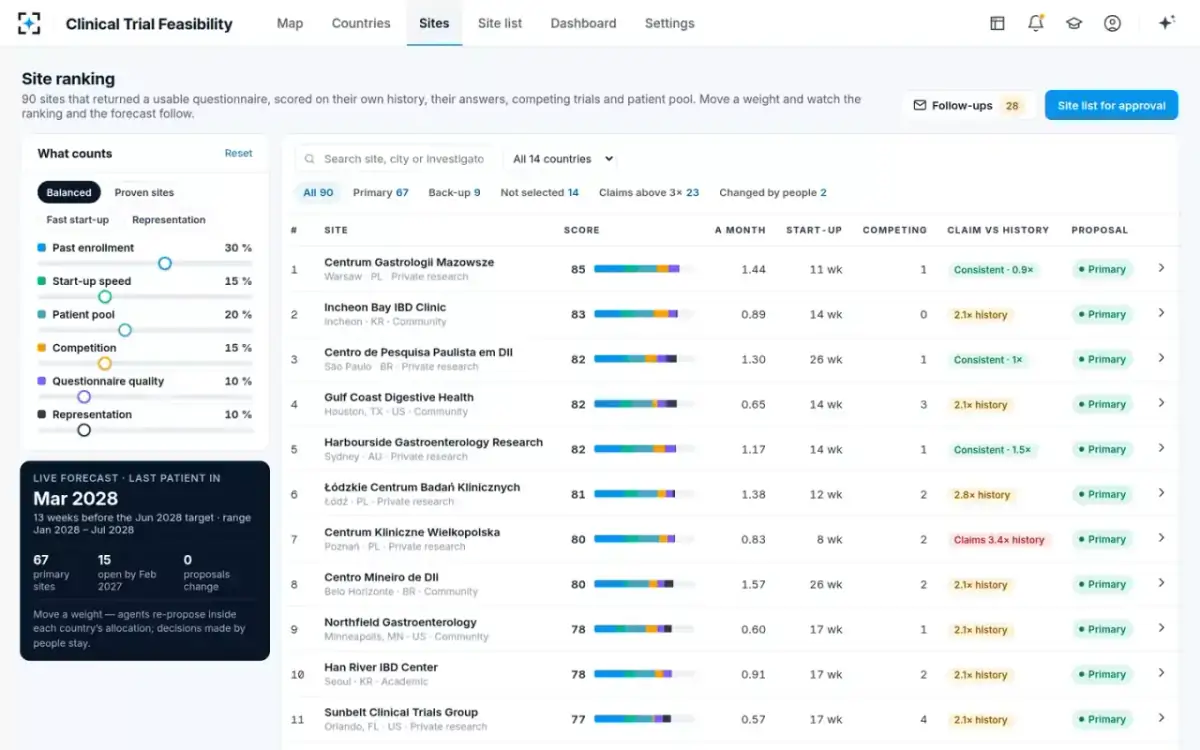
It does not decide. The agents propose a ranking; the feasibility lead chooses primary and back-up sites, a person sends every follow-up question, and country managers can request a change with their reason recorded. It also does not shorten the questionnaire for the sponsor: what to ask remains the sponsor's design choice, though the history it already holds can be pre-filled rather than asked again. How it compares with running the round on spreadsheets is covered in spreadsheets, a CTMS module or agents.
Questions people ask
What should a site feasibility questionnaire include?
Questions that establish recruitment potential from data, resources and qualifications, and competing studies, each with a fixed unit, period and source. ICH E6(R3) section 2.2.1 expects recruitment potential to be shown "based on retrospective or currently available data", so screening counts and past enrolment are more useful than a site's forecast.
How long should a clinical trial feasibility questionnaire be?
As short as the scoring needs. Sites report forms of 10 to 40 pages, and an ASCO task force recommended that sponsors "minimize and standardize questions". Pre-filling what the sponsor already knows, such as past performance on its own studies and start-up history, cuts length without cutting evidence.
How accurate are site feasibility estimates?
Self-reported patient estimates are commonly optimistic. On the fictional sample study, 23 of 90 scored sites claimed more than three times what they had screened in a year. Capping a claim at a multiple of history until the site confirms it keeps the estimate usable without ignoring sites that can genuinely do more.
What is the best predictor of site enrolment performance?
A site's own enrolled-against-planned record on comparable studies, followed by dated screening counts for the protocol's key criteria. The protocol's eligibility criteria also matter: in a study of 1,197 NCI-affiliated trials, accrual failure rose from 11.8% to 29.4% between the shortest and longest decile of criteria.
Should sponsors use a standard feasibility questionnaire?
A standard core for site capabilities, with a short protocol-specific supplement, answers most of the burden complaint. The ASCO task force recommended a streamlined, uniform process across sponsors. The limit is that the most predictive questions are protocol-specific (which exclusions cut this site's population), and a generic form cannot ask them.
What should a sponsor do when a site does not return the questionnaire?
Record the request and the non-return, and decide whether the site's history justifies a follow-up call. On the sample study 55 of 186 sites never returned the form. Non-return is evidence about responsiveness, but a high-performing site on past studies may be worth a direct conversation.