ICH E6(R3) sets out investigator selection requirements in three short clauses and one principle, and none of them mentions a score. Section 3.7.1 makes the sponsor, not the site and not the contract research organisation, responsible for choosing investigators, and asks that each one be qualified and demonstrate adequate resources. Section 2.2.1 asks the investigator to demonstrate a potential for recruiting the agreed number of participants, with a parenthesis that quietly decides most feasibility arguments. Section 2.2.2 defines resources as time, staff and facilities. Principle 9.4 then asks that what you relied on remain traceable. Botminds' Clinical Trial Feasibility is built around those four sentences: six agents read the protocol, the site history, the returned questionnaires and public registries, and write a reason for every country and site in which each statement names the source it came from.
The guideline is quoted here from its Step 4 final text, endorsed by the regulatory members of the ICH Assembly on 6 January 2025, which sets out the principles and Annex 1. The worked examples are from a fictional sample study used throughout the solution: VLT-401, a Phase 3 trial in moderate-to-severe Crohn's disease, 480 participants, 90 usable questionnaires across 14 countries. The sponsor, the investigators and the sites are invented.
The four sentences that govern site selection, and what satisfies each
| Where | What it asks for | What satisfies it | What does not |
|---|---|---|---|
| Section 3.7.1 | The sponsor selects the investigators; each is qualified by education, training and experience and demonstrates adequate resources and facilities | A named decision-maker, a written reason per site, and the qualification evidence behind it | A ranked list with no author and no reason |
| Section 2.2.1 | The investigator demonstrates a potential for recruiting the agreed number of eligible participants in the agreed period | The site’s own past screening and enrollment, or current data, compared with what it claims | A number typed into a questionnaire and accepted as given |
| Section 2.2.2 | Sufficient time, an adequate number of available and qualified staff, and adequate facilities for the trial’s foreseen duration | Staffing and equipment answers checked against the protocol’s procedures and the site’s other commitments | A tick box labelled "adequate" |
| Principle 9.4 | Processes for managing records so that integrity and traceability are maintained, allowing accurate reporting, interpretation and verification | Each statement in the reason linked to the questionnaire answer, study or registry entry it came from | A score whose inputs have since been overwritten |
What ICH E6(R3) requires of investigator selection
Read the four together and a shape appears. The guideline is not interested in how you weigh past enrollment against patient pool; it is interested in whether a specific claim about a specific site was true, who decided on it, and whether anyone can see that afterwards. A sponsor that can produce, for each of 90 sites, the sentence it relied on and the document that sentence came from has met the requirement whatever its scoring method. A sponsor with a beautifully weighted model and no retained evidence has not.
That is why the obligation lands hardest on the fast, messy part of a study: the three weeks between questionnaires coming back and a site list being approved. The decision is made under time pressure, on evidence from four systems, by people who will have moved on to the next study before anyone asks about it.
Clause 3.7.1: the sponsor's responsibility, not the site's
The sponsor is responsible for selecting the investigator(s)/institution(s). Each investigator should be qualified by education, training and experience and should demonstrate they have adequate resources and facilities to properly conduct the trial.
ICH E6(R3) Guideline for Good Clinical Practice, section 3.7.1, Step 4 final guideline, 6 January 2025
Two words carry the clause. "Responsible" settles who answers for the choice when the trial is inspected: the sponsor, even where a contract research organisation ran the questionnaire round, built the model and recommended the list. Delegation moves the work, not the answer. "Demonstrate" settles the standard of proof: the investigator has to show the resources, which means somebody at the sponsor has to have looked at what was shown.
The clause's neighbour is easy to miss and useful in an argument about timelines. Section 3.7.2 asks that the sponsor give the potential investigator the protocol and a current Investigator's Brochure, "as well as sufficient time for the review of the protocol and the information provided". A questionnaire round that opens before the protocol is settled, and closes in ten days, is already in tension with that sentence, and the site's answers are the evidence the sponsor will later rely on.
Clause 2.2.1: what counts as proof of "a potential for recruiting"?
The investigator should be able to demonstrate (e.g., based on retrospective or currently available data) a potential for recruiting the proposed number of eligible participants within the recruitment period as agreed with the sponsor.
ICH E6(R3) Guideline for Good Clinical Practice, section 2.2.1
The parenthesis is the whole clause. "Retrospective or currently available data" is not a projection, an estimate or an intention; it is what the site has already done or can show it has now. A site that enrolled three participants against a plan of ten in the sponsor's last study has retrospective data, and it says what it says. A site that reports 240 patients on its register who meet the entry criteria today has currently available data. A site that writes "approximately 80 eligible patients per year" in a questionnaire box has supplied neither.
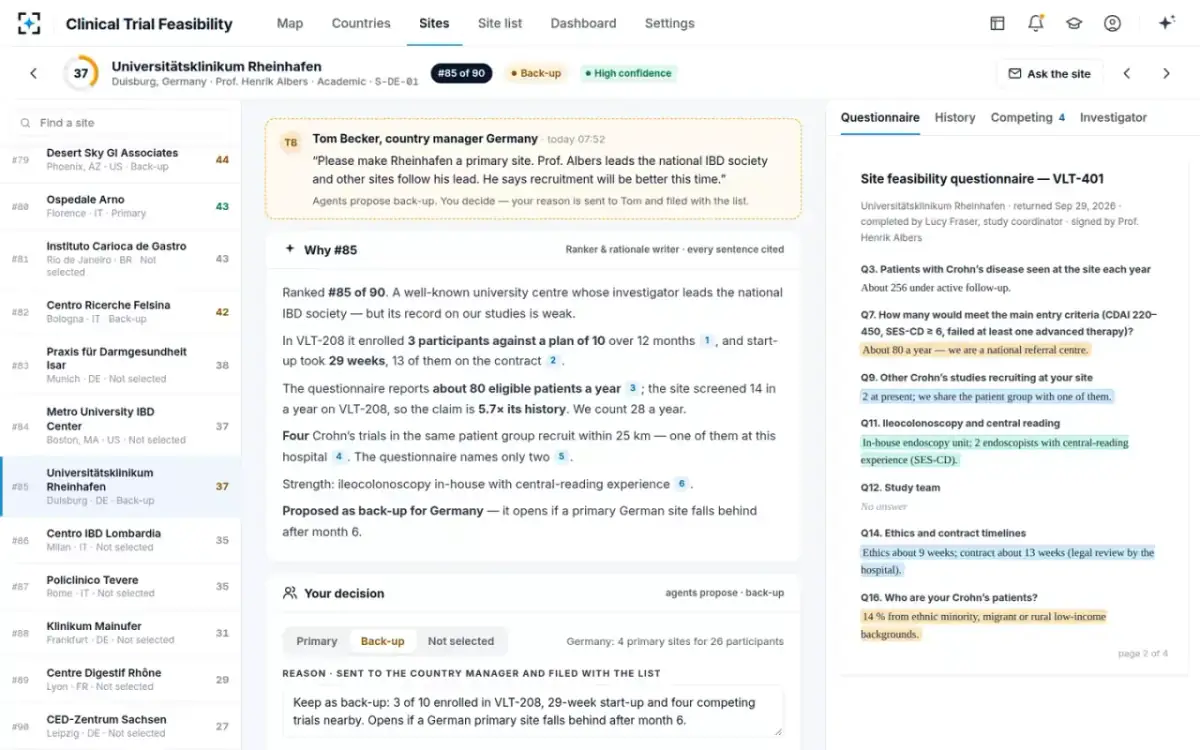
This is the clause that makes claim-checking a compliance activity rather than a nicety. On the sample study, 23 of 90 sites claimed more than three times the patients they had screened on their last study with this sponsor. The solution counts such a claim at no more than twice the site's own history until the site confirms it, and drafts a follow-up question for a person to send. Universitätsklinikum Rheinhafen claimed about 80 eligible a year where it had screened 14 (5.7 times its history) and was counted at 28.
Note what the clause does not say. It does not say a site with no history fails. A first-time site can demonstrate potential from currently available data: a register, a referral network, a clinic's throughput. What it cannot do is substitute confidence for either. In the solution a site with no history is scored neutral rather than zero, with its own claim counted at 60%: a stated rule rather than a silent one. How to design the site feasibility questionnaire turns the same clause into the questions a sponsor asks.
Clause 2.2.2: adequate staff, facilities and time, defined
The investigator should have sufficient time, an adequate number of available and qualified staff, and adequate facilities for the foreseen duration of the trial to conduct the trial properly and safely.
ICH E6(R3) Guideline for Good Clinical Practice, section 2.2.2
"Adequate" is relative to the protocol, which is why this clause cannot be answered by a standing site profile. A study whose entry criterion depends on an endoscopic score needs a site that performs ileocolonoscopy and reads it to the protocol's scale; a study with a two-weekly visit schedule for 18 months needs coordinator hours nobody has yet committed. The protocol decides what adequate means, and the protocol changes.
"For the foreseen duration" adds the dimension questionnaires rarely capture: the site's other commitments. Four competing studies recruiting the same patient group within 25 km of a site is a fact about the patients; two other studies starting at the same site in the same quarter is a fact about the staff. Both are "adequate resources" questions, and only one of them is usually asked.
One site, one clause at a time
3.7.1 · Qualified by education, training and experience
Principal investigator leads the national inflammatory-bowel-disease society; qualification evidence on file from the earlier VLT-208 study.
Satisfied
2.2.1 · Demonstrated potential for recruiting
Enrolled 3 participants against a plan of 10 in 12 months on VLT-208. Questionnaire claims about 80 eligible a year; screened 14. Counted at 28.
Demonstrated: at 28, not 80
2.2.2 · Sufficient time, staff and facilities
Start-up took 29 weeks against a German median of 24. Four Crohn's studies in the same patient group recruiting within 25 km, one at this hospital.
Open question for the country manager
9.4 · Traceable afterwards
Each sentence above links to the VLT-208 study record, the returned questionnaire with its question numbers, or the registry entry for each competing study.
Satisfied
The decision that followed is the point of the clause: Rheinhafen was kept as a back-up site for Germany, opening if a German primary site falls behind after month 6, and the written reason went to the country manager who had asked for it. The guideline does not require that the site be rejected. It requires that the resources be demonstrated and that the choice be the sponsor's, made on what was shown.
Principle 9.4: why record integrity and traceability stand on their own
Principle 9.4 asks for efficient and robust processes for managing records, data included, so that their integrity and traceability hold and personal information stays protected, and gives the reason: so that what the trial reports can be accurately reported, interpreted and verified (ICH E6(R3), principle 9.4).
Three words in that sentence decide what a feasibility output has to look like two years later: reporting, interpretation and verification. Reporting is easy: the site list exists. Interpretation asks whether a reader can tell what the sponsor believed at the time. Verification asks whether the thing it believed can still be checked against what it was taken from.
A spreadsheet usually fails the third. Its cells hold the figures as they were at the moment someone typed them, and the registry, the questionnaire portal and the clinical trial management system have all moved on. The sponsor can show what it concluded and cannot show what it concluded from. Principle 9.5 then raises the stakes, asking that essential records "be available to regulatory authorities, monitors, auditors and IRBs/IECs (as appropriate) upon request".
A score column and a cited reason, against the same clause
A spreadsheet's score column: Site 85 of 90, score 41
A reason in which every sentence names its source: Three sentences, each ending in the study, questionnaire answer or registry entry it came from
A spreadsheet's score column: The claim was entered; whether it was checked is not visible
A reason in which every sentence names its source: The claim, the screening history it was compared with, and the ratio between them
A spreadsheet's score column: Staffing and facilities were somewhere in the questionnaire
A reason in which every sentence names its source: Start-up weeks against the country median, and competing studies with their registry entries
A spreadsheet's score column: The inputs have been overwritten by the next refresh
A reason in which every sentence names its source: Each statement still resolves to the version of the source it was written from
A spreadsheet's score column: The analyst who built it has left
A reason in which every sentence names its source: The reason reads the same to a person who was never in the room
What changed in the R3 update, and why it matters now
The previous revision, E6(R2), was adopted on 9 November 2016 as an addendum folded into the 1996 text. E6(R3) is a rewrite: a set of principles followed by annexes, rather than a list of duties, and it says so in its own introduction: the principles are "intended to apply across clinical trial types and settings and to remain relevant as technological" change continues. For feasibility, three consequences follow.
First, the recruiting-potential clause widened its evidence. R2 asked the investigator to demonstrate potential "e.g., based on retrospective data"; R3 reads "retrospective or currently available data", which is what lets a first-time site make its case from a register or a clinic's throughput. Second, the records language became media-neutral and process-based: principle 9.4 asks for processes that maintain integrity and traceability, which is a different instruction from keeping a folder. Third, the guideline became insistent on proportionality (effort matched to risk), which cuts both ways in feasibility. A twelve-site study does not need what a 90-site study needs; a 90-site study cannot claim a twelve-site study's standard of evidence.
How to document investigator qualification, line by line
The guideline's essential records table names the documents, and they are undramatic: "Relevant documents evidencing qualifications of investigator(s) and sub-investigator(s) (e.g., curriculum vitae) involved in conducting the trial", marked with an asterisk as a record that should generally be in place before the trial starts, alongside "Site monitoring reports (including site selection …)", also asterisked. The guideline also lists the investigator's current curriculum vitae among what goes to the IRB/IEC for review.
What the table does not do is describe the reasoning. That is covered by the test in Appendix C.3.1, where an essential record is one that, among other things, "Documents sponsor oversight of investigator site selection and monitoring". The qualification file proves the investigator could run the trial. The selection record proves the sponsor chose on that basis rather than on habit, and it is the half most often missing.
Where the guideline puts a person, and what the agents may not decide
Agent
Protocol readerExtracts every inclusion and exclusion criterion as a rule, with the protocol section it came from
Never: Never paraphrases a threshold, and flags any criterion it cannot structure
Agent
Site history analystReads the clinical trial management system: enrolled against planned, months recruiting, screen failure, start-up weeks
Never: Read-only; no history means neutral, never zero
Agent
Questionnaire readerReads all returned questionnaires with their question numbers and compares each claim with what the site screened
Never: Quotes the site’s own words; follow-up questions stay drafts until a person sends them
Agent
Ranker and rationale writerScores six factors, writes a reason in which every sentence cites its source, and proposes primary, back-up or not selected
Never: No uncited sentence; proposes only, and explains every move of more than five places
A person decides
Country managerReviews the sites in their own countries and may swap or add one, with a written reason
A person decides
Study leadApproves the country allocation and every tier change, with the forecast the change produces
A person decides
Feasibility leadDecides each site, signs the list with the meaning of the signature, and files it with every rationale
One site's reason, with the evidence it was written from
Clinical trial site selection criteria the guideline does not give you
Read E6(R3) looking for a list of site selection criteria and you will not find one. There is no required weighting, no minimum enrollment rate, no maximum number of competing studies, no threshold for start-up weeks. The guideline fixes the questions and leaves the sponsor to answer them, which is the right division (a rare-disease study and a primary-care study cannot share a scoring rule), and it leaves the sponsor with the obligation to write down what it did choose.
That gap is also a real cost to the sites, who answer a differently shaped version of the same questions for every sponsor. Victor Chen of Kaiser Permanente put it to the Association of Clinical Research Professionals: "Development of a standard set of feasibility criteria would be a great help in avoiding duplication of effort." Until there is one, the sponsor's own weights are the standard, which is why they belong in a setting with a recorded history rather than in a formula in a spreadsheet. In the solution the default weights (past enrollment 30%, patient pool 20%, start-up 15%, competition 15%, questionnaire quality 10%, representation 10%) are a setting, and every change to them is on the audit trail.
What does an inspector actually ask to see?
In our experience the questions are narrow and concrete, and they are answerable in minutes or not at all. They follow the clauses in order: who chose, on what, was the claim checked, and can you still show it.
Five things to be able to produce for any selected or rejected site
- The written reason for this site, as it stood on the date of the decision
Not the current one. Clause 3.7.1 asks who selected and on what basis; the basis has a date.
- The evidence behind each statement in that reason
The questionnaire answer with its question number, the earlier study, the registry entry, the data cut of the patient count.
- What the site claimed, and what it had actually screened
Clause 2.2.1 asks for demonstrated potential. The comparison is the demonstration; the claim alone is not.
- The qualification file for the investigator and sub-investigators
Curriculum vitae or equivalent, in place before the trial starts, as the essential records table marks it.
- Who decided, when, and what their signature meant
A site list signed with name, time and meaning, filed with every rationale and the approval record.
The signed list, filed with every rationale
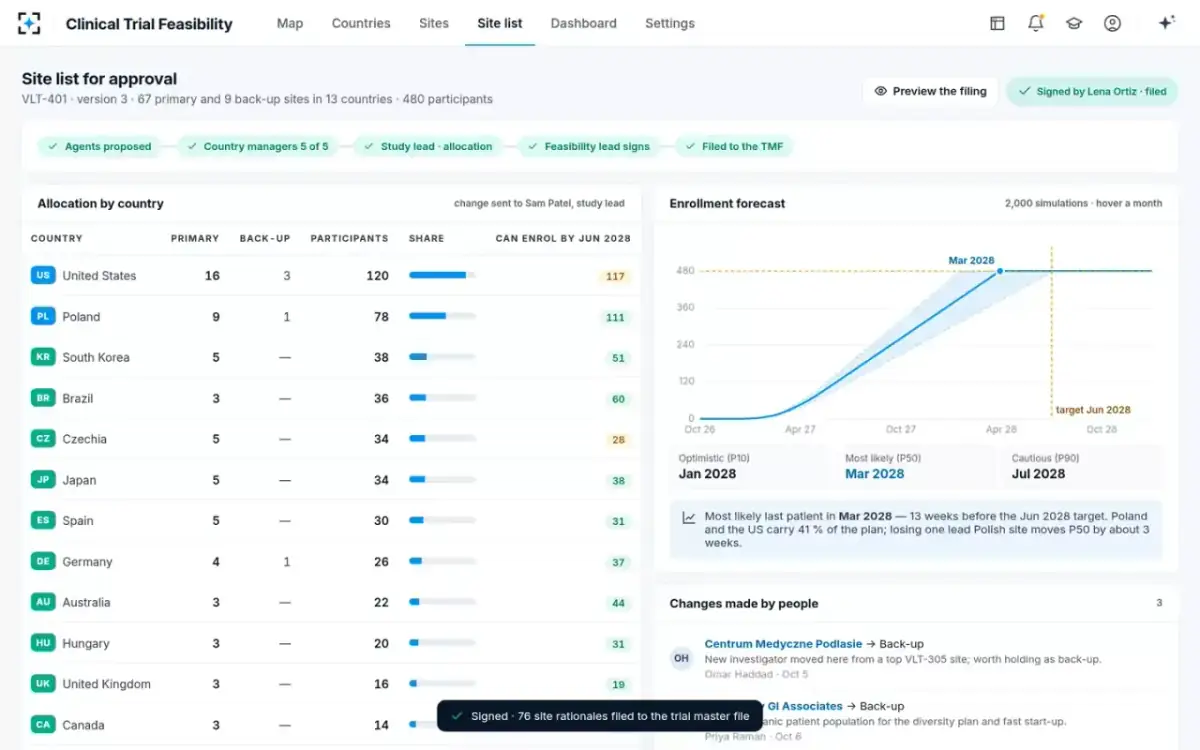
The last of those is the one teams underestimate. A list is filed; a decision is defensible only with the reason beside it. A comparison of the four ways feasibility actually gets done turns on exactly this, and so does what happens when the protocol is amended, because an amendment changes what "eligible" meant.
Questions people ask
Does ICH E6(R3) require a site selection score?
No. The guideline requires that the sponsor select the investigators, that each be qualified and demonstrate adequate resources, and that the investigator demonstrate a potential for recruiting the agreed number of participants. No weighting, threshold or scoring method is named. A score is one way to organise the evidence; the obligation is to have the evidence and to have chosen on it.
What is the difference between E6(R2) and E6(R3) for site selection?
R2 was an addendum folded into the 1996 text and adopted in November 2016. R3, endorsed at Step 4 on 6 January 2025, restructures the guideline into principles with annexes. For site selection the substantive changes are that recruiting potential may now be shown from "retrospective or currently available data" rather than retrospective data alone, and that the records requirement is written as a process that maintains integrity and traceability rather than as a set of documents to keep.
Who is responsible for site selection under GCP, the sponsor or the CRO?
The sponsor. Section 3.7.1 states it directly, and delegating the questionnaire round, the model or the recommendation to a contract research organisation does not move it. In practice that means the sponsor should be able to produce the reason for a site it never spoke to, which is why the evidence has to be held somewhere the sponsor can reach it.
How do you document that an investigator has adequate resources?
By showing what was examined, not by asserting the conclusion. Section 2.2.2 names time, an adequate number of available and qualified staff, and adequate facilities, judged against this protocol's procedures and duration. In practice that is the questionnaire's staffing and equipment answers, checked against the protocol's procedures, the site's start-up history and its other recruiting commitments, with each check resolvable to its source.
Can a site with no trial history be selected under E6(R3)?
Yes. Clause 2.2.1 allows potential to be demonstrated from "retrospective or currently available data", and currently available data (a patient register, a clinic's throughput, a referral network) is available to a first-time site. What is not allowed is treating the absence of history as proof either way. Scoring such a site zero is as unfounded as taking its estimate at face value.
How long must site selection records be kept?
The guideline asks that essential records be retained securely by sponsors and investigators for the period applicable regulatory requirements set, and be available to regulatory authorities, monitors, auditors and ethics committees on request. The period comes from the local requirement rather than from E6(R3); what the guideline adds is that the records must still be interpretable and verifiable when they are produced.