A regulatory reporting control framework is the set of roles, controls and evidence a bank uses to make sure its returns to supervisors are accurate, complete and on time. For the Call Report it has five working parts: a preparer, an independent reviewer, a person who releases the set, a chief financial officer who signs the declaration with directors who attest, and internal audit that tests whether all of it worked. The hard part is not drawing the chart; it is keeping review independent inside a 30-day window, when the explanations for failed quality edits are written in the last week and the reviewer reads them in a spreadsheet. Botminds' Call Report Analysis gives the reporting team agents that draft and challenge those explanations, while every acceptance, approval, release and signature stays with a named person.
The rules below come from the FFIEC 031 and 041 General Instructions and the OCC's Regulatory Reporting booklet, linked where they apply. The worked quarter comes from the solution's fictional sample bank, Corvane National Bank, filing for September 30, 2026; its people and figures are sample data.
The Call Report control framework runs against a fixed clock
4,238
FDIC-insured banks and savings institutions at June 30, 2026, each filing every quarter
30days
from the report date for the CDR to receive the report; no other extensions
3directors
attest beside the CFO at a national or state member bank; 2 at a state nonmember bank
3years
to keep the signed report, amendments, workpapers and support
What is a regulatory reporting control framework?
It is the bank's written answer to three questions an examiner asks: who is responsible for each report, what stops an error reaching the agencies, and what proves those controls ran. The OCC's examiner booklet lists what a bank's regulatory reporting policies generally cover, and the list reads as the table of contents of a framework: governance and controls, software selection, the preparation, review and filing of reports and amended reports, reconciliation, change management for new requirements, data quality, documentation and workpapers, "roles and responsibilities for preparing, reviewing, and filing reports," staff authorities and training (OCC, Regulatory Reporting).
The framework has to fit the bank. The OCC asks for processes "commensurate with the bank's size, complexity, and operations," automated, manual or both. A $600 million bank filing the FFIEC 051 may have one preparer, a controller who reviews and a CFO who signs; a $90 billion bank filing the FFIEC 031 has a team per schedule group, a quality control function and an internal audit program that tests a sample of the report every year. The roles are the same; what changes is how many people stand in each one.
One principle sits above the rest. The General Instructions say the bank's responsibility for accurate data "cannot be transferred or delegated to software vendors, servicers, or others outside the reporting bank" (FFIEC 031 and 041 General Instructions). A framework can use software and third parties at every step; it cannot hand any of them the accountability.
Five seats in the Call Report review and sign-off chain
The Call Report passes through five seats inside the bank before the Central Data Repository (CDR) receives it, and a sixth outside the bank reads it afterwards. Each seat exists because a rule or a supervisory expectation names it, and each owns one decision that the seat before it cannot make.
The Call Report Analysis view of five seats, and the decision each keeps
Today
Owns a set of schedules, maps the general ledger to them, runs the FFIEC edits and writes the explanation for every quality edit that still fails, usually from email replies in the last week.
With agents
Starts from a draft whose drivers already add up to the change, each figure opening to its journal entry or subledger line, and accepts, edits or rejects it with a reason.
Still theirs: the judgement that an explanation is true, under the preparer's own name
Today
Reviews explanations in a spreadsheet export while the analysts are still writing, so the review narrows to spot checks as the due date nears.
With agents
Approves from a queue showing who accepted each explanation, what was challenged and what is still open; cannot approve a correction they proposed.
Still theirs: the second-person review the OCC expects before filing
Today
Decides the set is ready in a final crunch, on the strength of a status meeting.
With agents
Releases only when every release check is met, with escalations from day 20 already visible.
Still theirs: the decision that the report is complete enough to sign
Today
Sign a report without seeing who checked each explanation or what is still unresolved.
With agents
Sign with the counts, the approvers and the open items in front of them, before submission.
Still theirs: the declaration and the attestation, which nobody else can give
Today
Tests the controls after the fact from email trails and spreadsheet versions.
With agents
Reads every draft, challenge, override and approval on one trail, and exports it for examiners.
Still theirs: the independent test of whether the controls worked
The sixth seat is the agencies' own analyst. National banks and FDIC-supervised banks work with an assigned analyst in the FDIC's Data Collection and Analysis Section; state member banks contact their Federal Reserve District Bank (FDIC, Call Report Analysts). That analyst reads the bank's edit explanations after the report is accepted and can ask for revised explanations or resubmitted data. A framework that works inside the bank but produces explanations the analyst cannot follow has failed at the last step, which is why what happens when an accepted report comes back belongs in the same conversation.
Who reviews the Call Report before it is filed?
Someone independent of the person who prepared it. The OCC puts the expectation in so many words: effective policies "designate an individual, group, or department with the responsibility of preparing regulatory reports, while another independent individual, group, or department would typically be designated responsible for reviewing regulatory reports for accuracy and compliance with requirements before filing" (OCC, Regulatory Reporting).
The same booklet names the fundamental controls: "separation of duties, dual controls, and independent reconcilements," and gives one example that every desk should test itself against: segregation of duties should apply when the general ledger is reconciled to the figures in the quarterly report. A preparer who maps an account and also signs off the reconciliation of that account has removed the control the OCC calls fundamental.
In practice the reviewer is the regulatory reporting manager, or at a small bank a controller or a second accountant who did not prepare the schedule. The OCC allows the review to be outsourced, on one condition: "the independent party performing the review should be trained and familiar with the bank's regulatory reporting process." A third-party reviewer who sees only the final figures, and not how the bank derives them, does not meet it.
Quality control before filing, quality assurance after
The OCC separates two independent checks that banks often run together. Quality control happens "concurrently with the bank activity and before filing" and is meant to catch errors in this quarter's report. Quality assurance "is conducted after the bank has filed the regulatory report" and asks a different question: whether the bank followed its own process.
Quality control and quality assurance check different things
Quality control (before filing): Is this quarter's report right?
Quality assurance (after filing): Did we follow the process we wrote down?
Quality control (before filing): During preparation, before the file reaches the CDR
Quality assurance (after filing): After submission, on a sample of reports and controls
Quality control (before filing): Secondary reviews and sign-offs; checking manual and automated data feeds before filing
Quality assurance (after filing): Whether required sign-offs took place; whether an automated feed was overridden without the required approval
Quality control (before filing): Errors corrected before the bank files
Quality assurance (after filing): Findings on policy, training needs and process weaknesses
Quality control (before filing): Independent of the preparer
Quality assurance (after filing): Independent of both the preparer and the reviewer
The distinction matters for evidence. Quality control leaves corrections; quality assurance needs proof that a control ran even when it found nothing. A sign-off that exists only as a reply-all email is easy to perform and hard to prove. The OCC's own example of a quality assurance test, whether an automated feed was overridden "without the appropriate approval," presumes the bank logs both the override and the approval in a place a reviewer can read months later. Regulatory reporting quality assurance follows that second check in more depth.
Who may not do what: the separation-of-duties matrix
The clearest way to write a Call Report control framework is as a list of things one person may not do twice. The OCC's internal control questionnaire asks examiners to test it directly: "Is the person who attests to the accuracy of the information in the regulatory report different from the person who provides the report data and the person who is the report's reviewer?" For banks that use mapping software, it asks whether the person who verifies the data is different from the person who files the report.
Separation of duties on the Call Report: the pairs a framework keeps apart
| Pair of duties | Why they are kept apart | Where the expectation comes from |
|---|---|---|
| Preparing a schedule / reviewing it | A reviewer who prepared the figures checks their own assumptions. | OCC booklet, Policies and Procedures |
| Reconciling the general ledger / reporting the figures | The reconciliation is the control on the figures; one person cannot be both. | OCC booklet, Internal Controls |
| Providing or reviewing the data / attesting to it | The signer's declaration is meant to be a third view, not a restatement of the preparer's. | OCC internal control questionnaire, question 2 |
| Verifying mapped data / filing the report | Automated mapping moves the risk into the mapping; the filer should not be its only check. | OCC internal control questionnaire, question 3 |
| Proposing a correction / approving it | A change to a reported figure needs a second, independent person. | OCC fundamental controls: dual controls |
| CFO declaration / director attestation | Directors attest "other than the officer signing the chief financial officer declaration." | FFIEC General Instructions, Director Attestation |
Most desks satisfy the first and last rows on paper. The middle rows are where findings come from: an analyst who maps a new general ledger account, reconciles it and writes the explanation for the swing it causes; a manager who spots an error late, corrects the figure and approves the correction because nobody else is in the office on day 29. A framework should say in advance who stands in for each seat when its owner is away, so the deadline never becomes the reason a pair collapses into one person.
What does the CFO declaration actually attest?
It attests to the correctness of the whole report. The General Instructions require "the chief financial officer of the bank (or the individual performing an equivalent function)" to sign a declaration on the cover page "attesting to the correctness" of the report filed. At least three directors attest at national banks, state member banks and savings associations, and at least two at state nonmember banks, in each case other than the officer who signed the declaration (FFIEC 031 and 041 General Instructions).
The signature has to come first. Electronic signatures are allowed, but the bank "must include the date of signing as part of the signature process to validate that the electronic signature occurred prior to Call Report submission." A framework that collects signatures after the file goes to the CDR, because the CFO was travelling on day 30, has a dated piece of evidence that shows the control failed.
Five tests an electronic Call Report signature must pass
- Form
An image of the signer's physical signature, or an electronic signature applied by clicking a box or entering a PIN.
- Intent
The officer or director must intend to sign as the attestation that the report is prepared under the instructions and is true and correct, using the attestation text from the signature page.
- Association
The signature is tied to a full version of the report, with the date of signing showing it came before submission.
- Authentication
A reliable sign-on ties the signature to the signer, such as requiring the officer or director to log into the bank's systems.
- Integrity
The signed report is safely stored, readily retrievable and cannot be lost or altered, for as long as a paper report would be kept.
What the signer can see is a framework decision, not a rule. The instructions require a signature; they do not say what the CFO reads first. A useful sign-off pack is short: the count of explanations filed, who accepted and who approved each, any correction to a reported figure and its approver, the open items and why they are acceptable, and the release decision. A CFO who signs from that pack is signing for a process; one who signs from the final file alone is signing for the figures and trusting everything behind them.
How does the review fit inside 30 days?
Only by planning backwards from the signature. The report is due 30 calendar days after the report date; the signature must precede submission; the release must precede the signature; and the independent review must precede the release. Every day a preparer spends chasing a reason for a swing is taken from the reviewer, because the end of the window does not move.
A sample bank's Call Report window: review keeps its days only if drafting starts early
- Close and first edit rundays 1–9
- Chase reasons and draft explanationsdays 10–23
- Reviewdays 24–27
- Release, sign, submitdays 28–30
- Close and first edit rundays 1–9
- Drafts, challenges and acceptancedays 10–20
- Escalations and approvaldays 21–24
- Release, sign, bufferdays 25–30
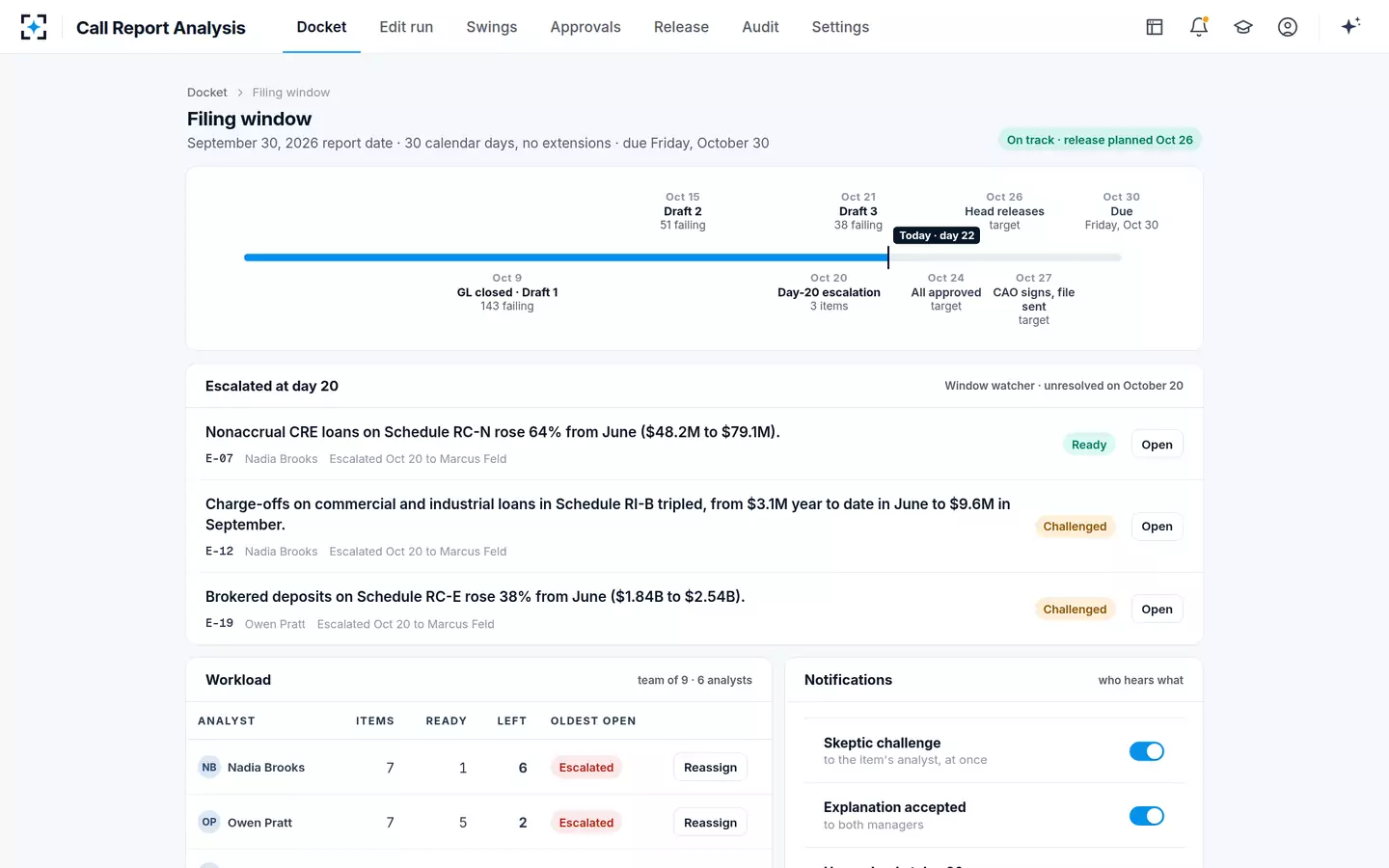
In the sample quarter the first edit run failed 143 edits; by the third draft on October 21, 38 needed a written explanation and every one was already drafted. On day 22, 29 were ready and 9 were left, three of them escalated to the manager at day 20 with a copy to the head of regulatory reporting. That escalation is a control in its own right: it makes the late items visible a week before the due date, while there is still time for an independent review rather than a rushed one.
The 30-day window with escalations and workload by analyst
The evidence that survives the exam: workpapers and the trail behind them
A control that left no evidence did not happen, as far as an examiner is concerned. The General Instructions ask the bank to keep "a signed and attested record of its completed Call Report, including any amended reports, and the related workpapers and supporting documentation" for three years after the report date, unless state law requires longer. The OCC adds that workpapers "should allow for a proper audit trail" and provide "a logical tie between report data and the bank's financial records."
For the explanations, the tie is the hard part. An explanation says nonaccrual loans secured by nonfarm nonresidential property rose $30.9 million because three office loans went on nonaccrual; the workpaper has to show those three loans, their balances, the date of the status change and any paydown that offsets them. In the sample quarter, the first draft named three loans adding to $35.2 million against a $30.9 million change, and the residual pointed to a $4.3 million paydown the draft had missed. Three years later, the evidence needed is not just the final sentence but the draft it replaced and why.
Maker, then checker: a different person approves every explanation and correction
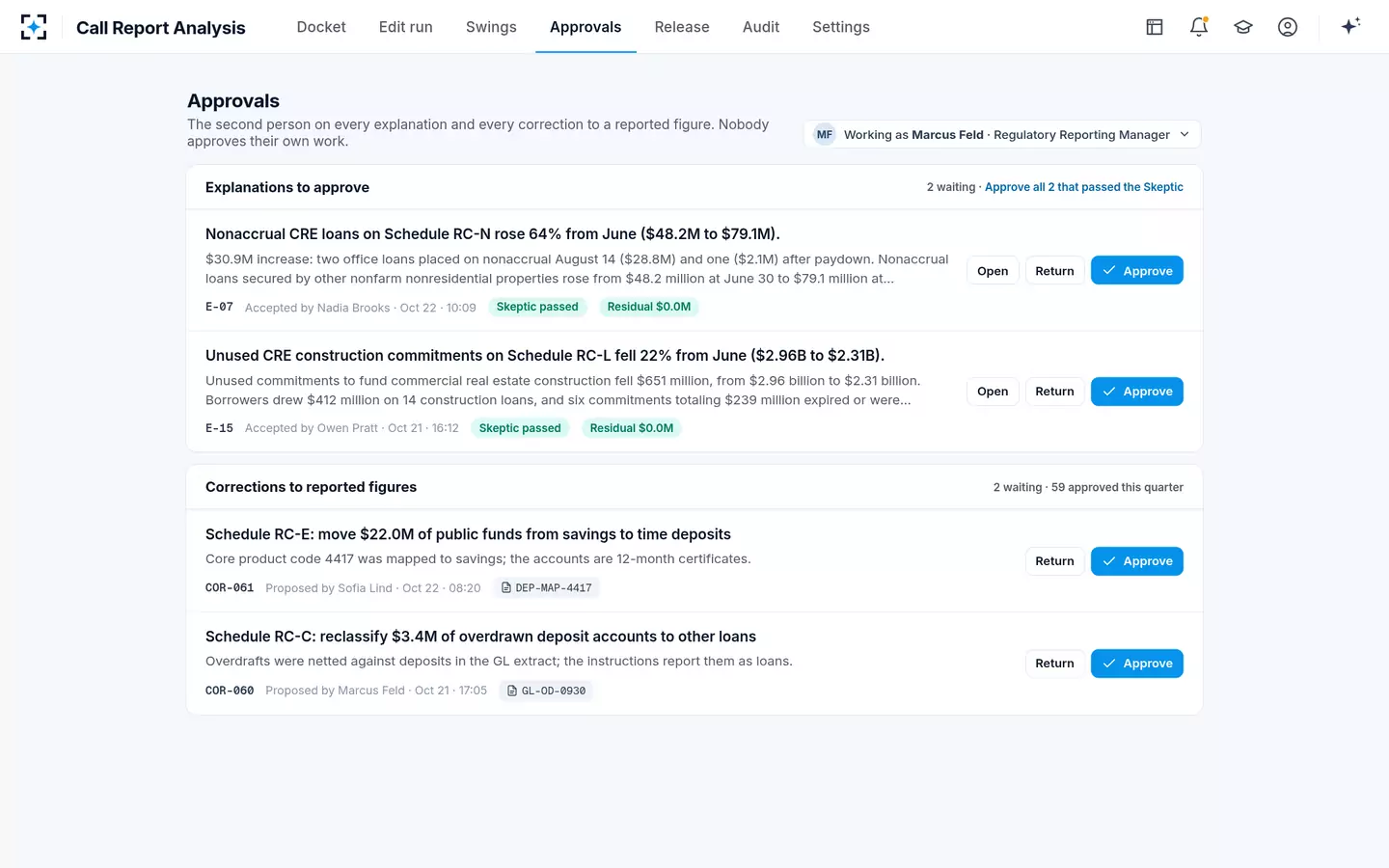
The sample bank keeps drafts, challenges, approvals and evidence links for seven years, a setting longer than the three-year minimum. Whether a bank needs that is its own decision; the point is that the retention clock in the instructions applies to the workpapers, so a trail that lives in an email archive with its own deletion policy can expire before the report it supports.
Where regulatory reporting control frameworks fail
Frameworks rarely fail because a role is missing from the chart. They fail where the chart and the calendar disagree, and the OCC booklet points at most of the places.
Six weak points examiners look for in a Call Report control framework
- Review compressed by the deadline
Independent review that happens in the last two days becomes sampling by necessity. Plan the review days first and protect them.
- One person in two seats
Absences and late corrections collapse preparer and reviewer, or proposer and approver, into one. Name a stand-in for every seat.
- Changes the framework did not see
New general ledger accounts, software updates and instruction changes. The OCC expects mapping to be updated as accounts are added and when rules change.
- Incentives
The OCC tells examiners to watch for incentive compensation that "could incentivize management to file inaccurate regulatory reports."
- No rotation
Duties should rotate "to plan for succession, increase the depth and knowledge of employees, and prevent or detect fraud."
- Third parties outside the program
A vendor that reviews or files belongs in third-party risk management, and the bank keeps the accountability.
Rotation deserves a separate word, because it is the control most desks honour least. The analyst who has owned the nonaccrual schedule for five years is the one who knows why it moves, and rotating them out feels like a risk. It is a smaller one when each explanation carries its own evidence: a new owner inherits the reasoning and the support, not just last quarter's words.
How examiners test the framework, and what a failure costs
Examiners start from the controls, then test the figures. The OCC's questionnaire asks whether the bank has "clearly defined responsibilities and lines of authority," whether preparation, review, attestation and filing sit with different people, whether quality control reviews the report before filing and whether quality assurance reviews it afterwards. Findings turn on root cause and materiality: a misstatement can lead to a violation, a matter requiring attention, or an amended report.
Besides its general civil money penalty authority under 12 USC 1818(i), the OCC has separate statutory authority to assess penalties for Call Report filing violations, and its examiners use dedicated penalty matrixes for them (OCC, Regulatory Reporting). What one Call Report error costs works through the penalty tiers, the amendments and the examination time that follow.
For a buyer, the practical test is the one the questionnaire sets. If an examiner asked tomorrow who prepared, reviewed and approved each explanation in last quarter's report, and on what evidence, how long would the bank take to answer? If the answer is "a few days, from email," the framework exists on paper and in people's memories, and the next exam will find the gap between the two.
Where Call Report Analysis fits in the control framework, and where it does not
Call Report Analysis sits inside the preparer's seat and makes the reviewer's seat easier to hold. Its agents run the edits on each draft, split each swing into drivers tied to journals and subledger lines, draft the explanation, and have a Skeptic agent try to break it: if the drivers do not add up to the change within $0.25 million or 2%, the draft cannot be accepted. The agents never change a reported figure, accept, approve, release or submit; those stay with the analyst, the manager, the head of regulatory reporting and the signer.
Where a quarter's explanation days go, by hand and with Call Report Analysis
| Kind of work | By hand | With the solution |
|---|---|---|
| Asking credit, treasury and deposits why a figure moved | 3 days | 0.5 day |
| Pulling journals and subledger detail for each swing | 3 days | 0.5 day |
| Writing the explanations and making the figures add up | 3 days | 1 day |
| Re-checking last quarter's recurring explanations | 1 day | 0.25 day |
| Manager review of every explanation | 2 days | 1 day |
| Release by the head of reporting and the signature | 1 day | 1 day |
| Total | about 13 days | about 4 days |
For the framework, three features matter more than the days. Every acceptance, approval, override and release carries a name, a time and a reason code. A manager cannot approve a correction they proposed. And each agent run records its prompt and model version, with a new version tested on last quarter's set and approved by a second administrator before it runs, which is how a bank answers the model-risk question an examiner will ask about AI in regulatory reporting. To see the chain on your own last quarter, start from Call Report Analysis.
Questions people ask
Can one person prepare and review the Call Report at a small bank?
The OCC expects preparation and review to sit with different people and calls separation of duties a fundamental control. A bank without a second qualified person can have the pre-filing review done by a third party, provided the reviewer is trained and familiar with the bank's own reporting process.
Who has to sign the Call Report?
The chief financial officer, or the person performing an equivalent function, signs a declaration attesting to the report's correctness. At least three directors attest at national banks, state member banks and savings associations, and at least two at state nonmember banks, none of them the officer who signed the declaration.
Can the Call Report be signed electronically?
Yes, if the process shows the signer's intent using the attestation text, ties the signature to the full report, authenticates the signer, keeps the signed report intact, and records the date of signing. The date is what proves the signature came before submission.
How long must Call Report workpapers be kept?
Three years after the report date, with the signed and attested report and any amendments, unless a state requires longer. The General Instructions tie the period to the FDIC's three-year window for verifying deposit insurance assessments.
Does using a vendor's software move responsibility for the Call Report?
No. The General Instructions say the responsibility for accurate data "cannot be transferred or delegated to software vendors, servicers, or others outside the reporting bank." The OCC expects vendors involved in preparing, reviewing or filing to sit inside the bank's third-party risk management.
What is the difference between quality control and quality assurance for the Call Report?
Quality control is an independent check of this quarter's report before it is filed, such as a secondary review of figures and data feeds. Quality assurance runs after filing and tests whether the bank followed its own process, such as whether required sign-offs took place.