For a pharma research team, PubMed vs Google Scholar is usually argued over size, and size is the least useful thing about either. The difference that decides which one your search should rest on is whether the search can be written down and run again tomorrow with the same result — and on that test the evidence is blunt: in a comparison of 28 academic search systems, Google Scholar was one of only two that failed to return identical results for repeated identical queries, which is why its authors class PubMed as a principal search system and Scholar as a supplementary one. Both then share a larger gap. Neither can see a line of what your own organisation has written — the internal reports and signed notebook entries that usually decide the question you are asking. Scientific Literature Search is Botminds' agentic solution for exactly that gap: published papers, patent families, internal research reports and signed lab notebooks searched in one question, with every statement opening the passage it came from.
The comparison below rests on a peer-reviewed evaluation published in 2020, so it describes the systems as they were tested; the two PubMed counts are ours, measured on 27 October 2026 and certain to have moved since. The screens are a fictional sample library.
What one study measured across 28 academic search systems
28
academic search systems compared on how well a user can actually retrieve records
2
of those 28 failed to return identical results for repeated identical queries — Google Scholar one of them
41,346,224
records in PubMed when we counted them on 27 October 2026
PubMed vs Google Scholar: which should you search?
Search PubMed when the answer has to be defensible, and use Google Scholar to find what PubMed's vocabulary would not have led you to. That is not a compromise; it is the division the evidence supports. Gusenbauer and Haddaway tested 28 systems against what a systematic search actually requires and sorted them into principal and supplementary systems: PubMed is listed among the principal ones, Google Scholar among the supplementary, and the paper is explicit that "while Google Scholar is considered unsuitable for primary review searches, it is considered a suitable supplementary source of evidence (including on grey literature)" (Gusenbauer & Haddaway, Research Synthesis Methods, 2020).
In practice that means Scholar is excellent at the thing a scientist actually does most often — find me something relevant about this — and unreliable at the thing a search has to do afterwards, which is prove what it looked at. Starting in Scholar and finishing in PubMed is a sound habit. Starting in PubMed and never opening Scholar means missing theses, reports and work published outside biomedicine's own journals.
The same question in two places
PubMed: Biomedicine and health: MEDLINE and related collections, curated with controlled vocabulary and publication types.
Google Scholar: Multidisciplinary and crawler-based, including grey literature such as theses and reports alongside journal articles.
PubMed: Full Boolean with field tags — publication type, date, subject heading — and a search history you can re-open.
Google Scholar: Keyword-led. The 2020 evaluation found it failed all or all but one of the Boolean tests, and caps a query at 256 characters.
PubMed: Yes: identical queries returned identical results throughout the evaluation.
Google Scholar: Not always. It was one of two systems out of 28 that failed to deliver replicable results for repeated identical queries.
PubMed: The full result set.
Google Scholar: The evaluation recorded a limit of 1,000 records reachable per query.
PubMed: A principal search system.
Google Scholar: A supplementary one — valuable beside a principal system, not instead of it.
What each one actually indexes
PubMed is a curated index of biomedical and health literature. Its value is not that it holds everything but that what it holds is described in a consistent way: every record carries publication types, subject headings and dates that a query can address directly. That is what makes a PubMed search a statement rather than an attempt — you can write exactly "records of this type, published in this window, about this concept", and get the same set back next week.
Google Scholar is a crawler over the scholarly web, multidisciplinary by design, and it reaches material no bibliographic database curates: theses, working papers, institutional reports. For a question that crosses a field boundary — a biomarker assay borrowed from environmental chemistry, say — Scholar will often surface the paper that a biomedical index never had.
Neither is a quality filter, and both contain material you would not want to cite unexamined. When we counted on 27 October 2026, PubMed held 70,554 records carrying the preprint publication type and 35,241 carrying the retracted-publication type. Being indexed is not a verdict, which is the real answer to the question people actually mean when they ask whether a database can be trusted.
Is Google Scholar peer reviewed?
No. Google Scholar is an index, not a selection: it finds scholarly material on the web, and a large share of that material is peer reviewed because a large share of scholarly publishing is — but nothing in Scholar asserts that any given result passed review. Its coverage of grey literature, which is one of its genuine strengths as a supplementary source, is by definition coverage of work that was not through a journal's review process.
The question matters most when the answer is assumed. A result found in Scholar can be a published trial, a preprint of that trial, a conference abstract about an earlier analysis of it, or a thesis chapter by one of its authors — four records of very different weight that look alike in a results list. The fix is not to avoid Scholar; it is to record what each kept result actually is. An evidence row that names the publication type is doing in one cell what a database's curation does across a whole index, and the columns an evidence table needs sets out where that goes.
The test that matters: can the search be run again tomorrow?
In our sample of 28 academic search systems, all but two — Google Scholar and WorldWideScience — were reproducible in terms of reporting identical results for repeated identical queries.
Gusenbauer & Haddaway, Research Synthesis Methods, 2020
This is the finding that should settle the argument, and it is the one least often quoted. The paper's authors describe Scholar's failure as intermittent rather than constant: repeated queries sometimes replicated and sometimes did not, which is in one sense worse than failing outright, because a search that usually repeats teaches you to trust it.
Their summary is unambiguous: "our findings demonstrate why Google Scholar is inappropriate as principal search system", and more broadly, "only half of the search systems analyzed and only a few Open Access databases can be recommended for evidence syntheses without adding substantial caveats". The second half of that sentence deserves as much attention as the first. The problem is not one system; it is that many systems were never built for a search anybody has to defend.
Reproducibility is also the property that decays silently. Nothing announces that a system has started personalising results or capping a result set, so the only protection is to write the strategy down as you ran it and re-run it later to see whether it still returns what it returned — the search you can repeat works through what that record has to contain.
Field tags, Boolean and why the two disagree on the same question
Give PubMed and Scholar the same question and they will hand back different sets, often with little overlap, and the reasons are mechanical rather than mysterious.
The first is Boolean. The 2020 evaluation found that Google Scholar, along with four other systems, "failed all or all but one of the Boolean tests we performed", and recorded that it "only allows searches of up to 256 characters". A search strategy with four concept blocks and their synonyms can easily exceed 256 characters, so what Scholar receives is not the strategy you wrote — it is whatever survived truncation, interpreted by a system that does not reliably honour the operators in it.
The second is vocabulary. A curated index lets you search a concept rather than a word, which catches the papers that call it something else; a keyword engine catches the papers that use your words, plus whatever its ranking thinks you meant. The two sets differ most exactly where a field is changing its terminology — which is where new results live.
The third is ranking and reach. Relevance ranking is excellent for finding something and useless for finding everything, and the evaluation recorded a ceiling of 1,000 records reachable per query in Scholar. A question whose honest answer is "4,300 records, of which 60 matter" cannot be answered by a system that will only show you the first thousand.
What a reviewer will ask you about either one
Not which system you preferred. PRISMA 2020 asks reviewers to list every source they searched or consulted — databases, registers, websites, organisations, reference lists — and to say when each was last searched (PRISMA 2020, item 6). Three things follow for anyone writing up a search.
Name Scholar if you used it, rather than quietly leaving it out because it looks less rigorous. Say what you used it for — scoping, citation chasing, grey literature — because a supplementary use is a legitimate use and an undeclared one is not. And give the date, since a crawler-based index on Tuesday is not the index it was in March.
The same three apply to your own internal sources, and they are the ones teams forget. A search that drew on a programme's own reports and does not say so leaves its reader unable to tell whether an absent result was excluded or never visible.
The gap they share: everything your own programme already knows
Four kinds of source answer most research questions. Published literature and patent families are outside your organisation; internal research reports and signed lab notebooks are inside it. PubMed covers the first well within biomedicine. Scholar reaches more widely and more loosely. Neither has ever seen the third and fourth, and no amount of argument about coverage changes that.
Four source types, and who can see them
| Source type | A curated literature index | A web-scale scholarly engine | Your own library |
|---|---|---|---|
| Peer-reviewed papers and reviews | Yes, within its subject scope, with publication types and subject headings | Yes, across every field, mixed with everything else it crawls | Yes, with target, model system and n recorded on each |
| Preprints and theses | Preprints carry a publication type of their own — 70,554 records when we counted | Yes — grey literature is where it is strongest as a supplementary source | Yes, marked for what they are |
| Patent families and their claims | Not what a literature index is for | Not a patent register | Searched beside the papers, and labelled a claim, not a result |
| Internal research reports | Never | Never | Yes, answered only to the programme that owns them |
| Signed lab-notebook entries | Never | Never | Yes, searchable once they are signed |
The cost of that gap is not abstract. A programme's own interim report is the one source that can tell you the published number does not reproduce in your hands, and it is also the one source guaranteed to be missing from every comparison of search engines ever written.
Searching published work and your own reports in one question
The useful move is not to pick a winner but to stop running four searches. In the sample library on these screens, one question reaches papers synced nightly, patent families synced weekly, internal research reports on upload and signed notebook entries on sign-off — 128,412 sources in total, searched together, with each source carrying its target, model system, n and the programme it belongs to.
Scientific Literature Search: four source types in one list
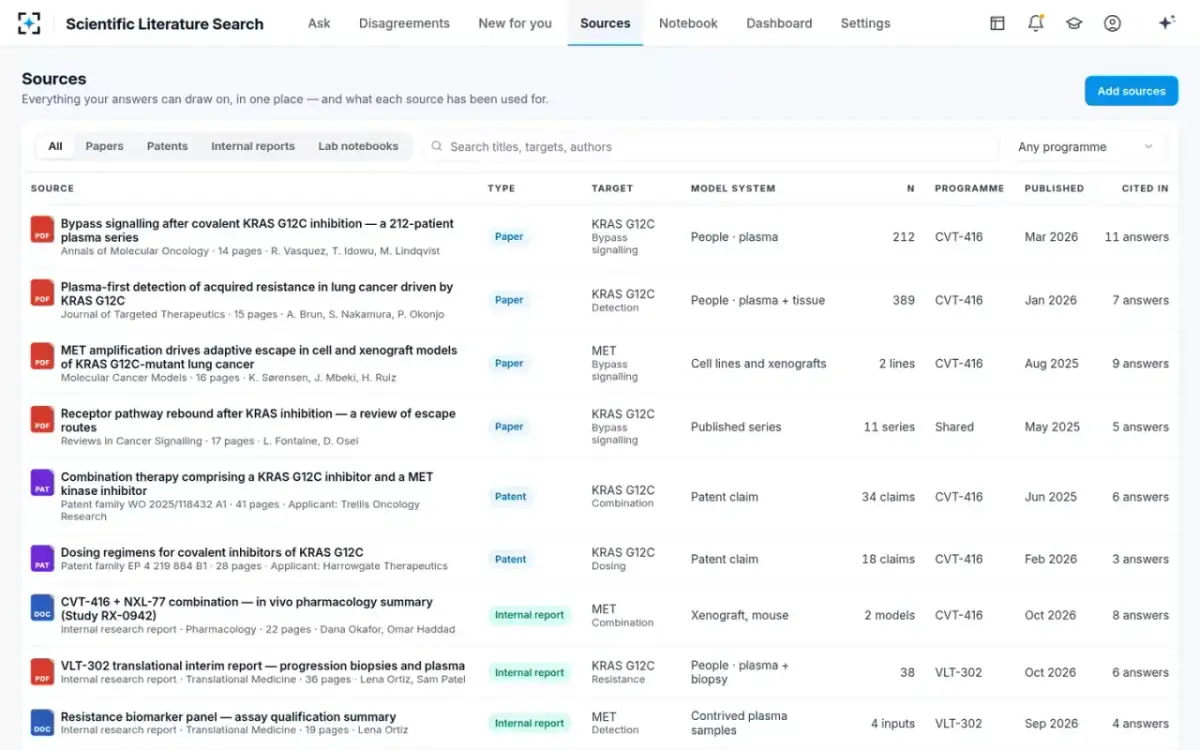
Two rules make that safe rather than merely convenient. Internal reports and notebooks are answered only to the programme that owns them, while papers and patents are open to everyone in research; and patent text is labelled a claim, not a result, and counted apart — searching papers and patents together without confusing them covers why that label matters.
One question, scoped across all four source types
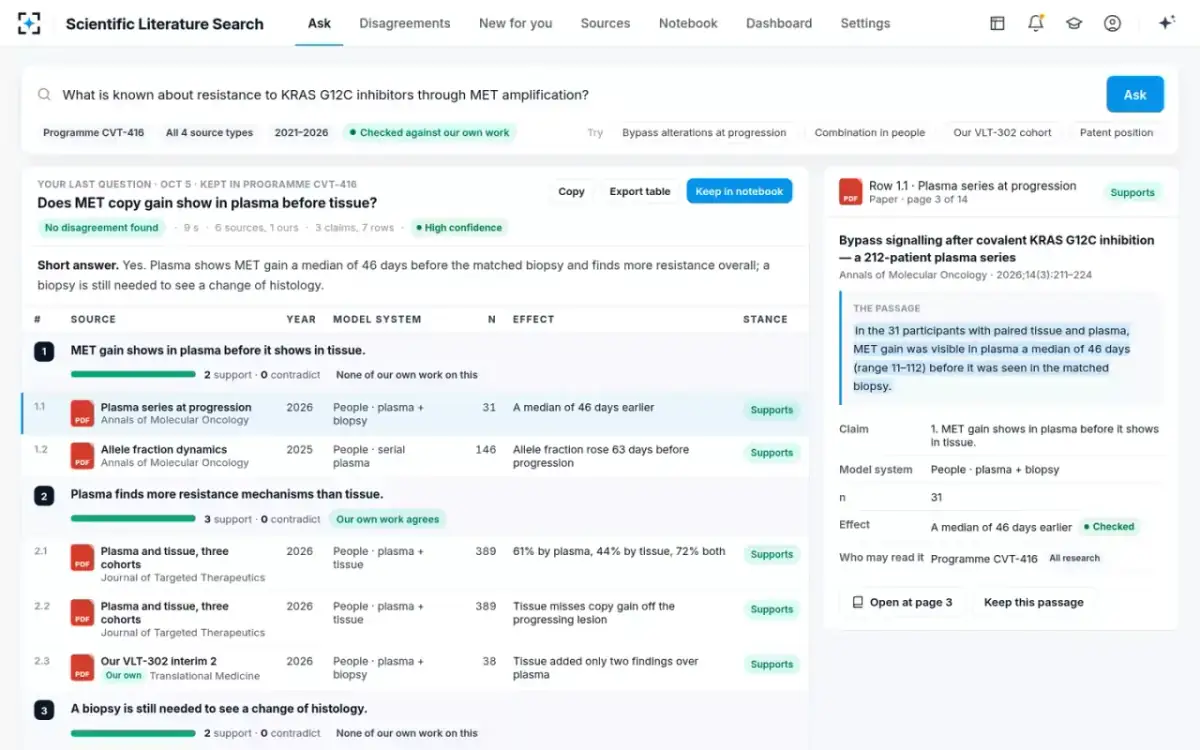
A working rule for which to open first
Scope in Scholar, search in PubMed, check in your own library, and write all three down. Scholar is where a question stops being vague; PubMed is where it becomes a strategy with a date on it; the organisation's own reports are where it either survives contact with your data or does not.
Questions to ask of any search system before you rely on it
- Does the same query return the same records tomorrow?
Run one query twice, a week apart. Two systems out of 28 failed this in the 2020 evaluation; it is cheap to test and rarely done.
- Does it honour the Boolean you wrote?
Test a three-block strategy with nested OR groups and check the count changes as the logic changes.
- How long a query will it accept?
A real strategy runs to hundreds of characters. Find the ceiling before a truncated strategy quietly becomes your search.
- How many records can you actually reach?
Relevance ranking plus a result ceiling means a large result set is not a result set you have seen.
- Can you export the whole set, with its date?
A search you cannot export is a search you cannot screen, count, or report.
- Who may see what it returns?
The moment internal reports are searchable, the answer has to respect who owns them — a question no public index has to answer.
One more reason not to treat either system as the finish line: even well-indexed published work is poorly digested. Bastian, Glasziou and Chalmers found that "only a small minority of trial reports are being analysed in up-to-date systematic reviews" (Bastian et al., PLoS Medicine, 2010). Whichever system you start in, much of what you need has not been summarised for you by anybody — which is the work the search is for. To see all four source types answered in one question, start from Scientific Literature Search.
Questions people ask
Can you use Google Scholar for a systematic review?
Not as the principal search system. The 2020 evaluation of 28 academic search systems concluded that Google Scholar is inappropriate in that role, chiefly because repeated identical queries did not reliably return identical results and Boolean operators were not dependably honoured. It is recommended as a supplementary source, particularly for grey literature, and should be named as such in the write-up with the date it was searched.
What does PubMed cover that Google Scholar does not?
Not more material — different handling of it. PubMed adds curation: publication types, subject headings and dates that a query can address directly, a full result set you can export, and a strategy that returns the same records when run again. Those are what let a search be reported and re-run, which is the part of the work Scholar was never built for.
Why do PubMed and Google Scholar give different results for the same question?
Three mechanical reasons. Scholar caps a query at 256 characters and did not reliably honour Boolean operators in the 2020 tests, so a long strategy is not the strategy it runs. A curated index searches concepts through controlled vocabulary while a keyword engine searches your words. And relevance ranking with a reachable ceiling of 1,000 records returns a different kind of answer from a complete set.
Can PubMed be trusted?
As an index, yes — it is consistent, curated and reproducible, which is what a search needs from it. As a quality filter, no index should be trusted, and PubMed does not claim to be one: when we counted on 27 October 2026 it held 70,554 records carrying the preprint publication type and 35,241 carrying the retracted-publication type. Judge the record, not the database it sits in.
How many records are in PubMed?
41,346,224 when we counted them through the National Library of Medicine's own search endpoint on 27 October 2026, of which 1,882,304 carried a 2025 publication date. The figure rises every day, so quote it with the date you measured it — and note that a record is a citation, not a full text.
What do PubMed and Google Scholar both miss?
Everything your own organisation wrote. Internal research reports and signed lab-notebook entries are not indexed by any public search system, and they are frequently the most decisive evidence on a question a programme is actually asking — including the cases where a published result does not reproduce in your own hands. Searching them alongside the literature is a separate capability, with its own access rules.