An evidence table for a literature review is the grid that sits under the prose: one row per study, one column per thing a reader needs in order to judge it. Six columns do nearly all the work — source, year, model system, n, effect and stance — and a seventh thing, the passage each row came from, decides whether the table is evidence or decoration. The hard part is not drawing the grid. It is keeping every cell faithful to a sentence somebody else can open, through months of reading, a new result that arrives late, and the moment a reviewer asks where a number came from. Scientific Literature Search is Botminds' agentic solution for that: it answers a question as numbered claims, each a block of evidence rows in exactly this shape, and every row opens the passage behind it.
The table on this page is a sample: the programmes, studies, people, journals and sources shown on the screens are fictional. The research figures come from peer-reviewed and government sources and are linked under the figure that uses them.
One claim, six columns
| Source | Year | Model system | n | Effect | Stance |
|---|---|---|---|---|---|
| Plasma series at progression · Annals of Molecular Oncology | 2026 | People · plasma | 212 | MET copy gain in 10.8% — 23 of 212 at progression | Supports |
| Review of escape routes · Reviews in Cancer Signalling | 2025 | Published series | 11 series | The most common single bypass alteration in every series | Supports |
| Our VLT-302 interim 2 · Translational Medicine, internal | 2026 | People · plasma + biopsy | 38 | 10.5% — 4 of 38 at progression | Supports |
| Colorectal and lung models · Molecular Cancer Models | 2026 | Cell lines, colorectal and lung | 19 lines | Lung only: far lower in colorectal lines | Limits it |
What is an evidence table?
An evidence table is a structured summary of the studies behind a statement, one row per study, built so that a reader can check the statement without reading the studies. It is not a reference list, which records only that a source exists, and it is not a results section, which argues. Its whole purpose is to put the things that decide an argument — how many, in what system, measured how, and which way the result cuts — where they can be compared across rows.
The discipline is older than the format. PRISMA 2020, the reporting standard for systematic reviews, puts the obligation on the data items themselves: "List and define all outcomes for which data were sought" (Page et al., BMJ, 2021, item 10a). Defining an outcome before you extract it is what stops a table drifting — one row recording a response rate, the next a progression rate, both under a column headed "effect".
Two tables are often confused. An evidence table holds one row per study with the study's own numbers. A summary-of-findings table holds one row per outcome with the pooled result across studies, the number of participants behind it and a judgement of certainty. The first is the raw material; the second is the conclusion. Writing the second without the first is where unchecked numbers enter a review.
The six columns that do the work
Source names the study and where it was published, closely enough to find again. For an internal report, name the report and the programme that owns it; an internal row that cannot be located is worse than no row.
Year is not decoration. In fast-moving work it decides what the authors could have known: a 2021 resistance paper was written before the assays the 2026 papers use, and a reader needs that in the same glance as the effect.
Model system is the column most often left out and most often decisive. A result in cell lines, a result in xenografts and a result in people are three different claims, and compressing them into one column headed "study type" loses exactly the distinction a programme decision turns on.
n is the size of what was measured, in the units the source used — 212 people, 11 series, 19 cell lines. Resist the urge to normalise it: a reader who sees "19 lines" knows how to weigh it, while "n = 19" invites a comparison with 19 patients.
Effect is what the source found, quoted rather than paraphrased, with its denominator. "10.8% — 23 of 212" is checkable. "About one in ten" is not, and neither is "a substantial minority".
Stance is what the row does to the statement above it: supports, contradicts, or limits. The third value is the one most tables lack, and it is the one that carries the most information, because most disagreement in science is not contradiction but scope.
Why the passage is the column you cannot drop
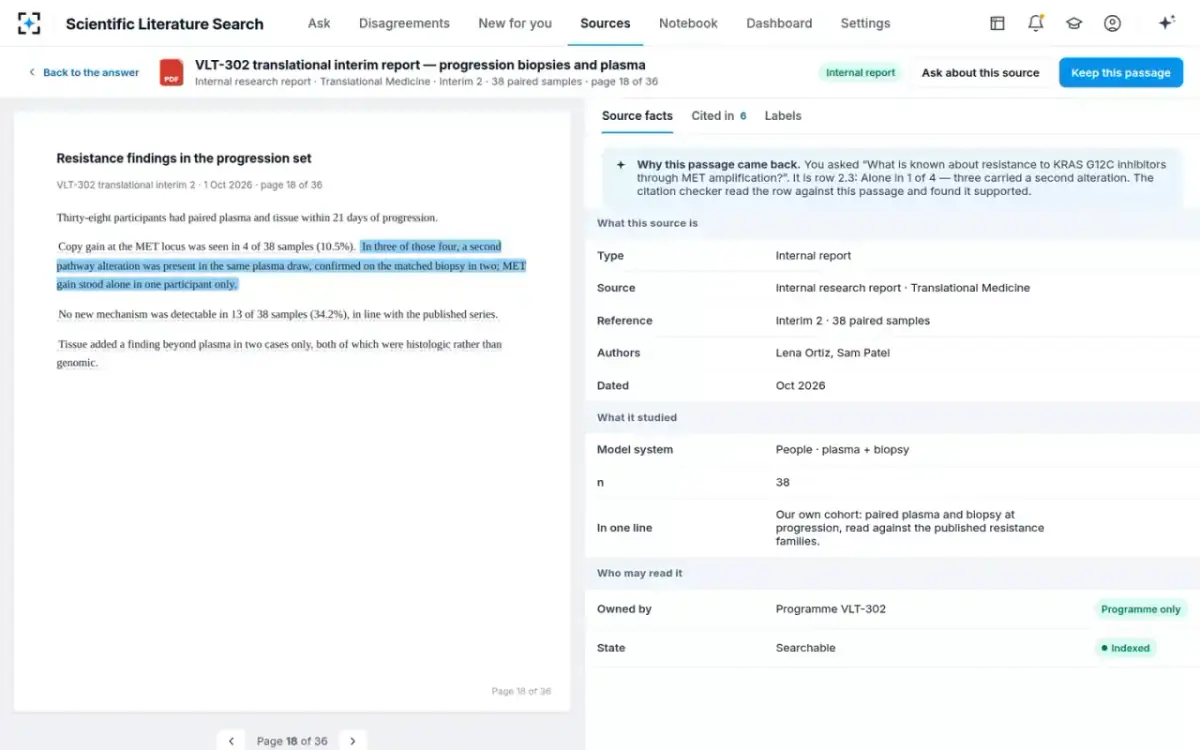
Every row should open at the sentence it came from, on the page it is on. That sounds like a nicety until the first time a number is challenged. A row with a passage behind it lets a reader disagree with the source; a row without one only lets them disagree with you, which is a slower and less productive argument.
A row, and something that only looks like one
A summary nobody can open: A phrase written by whoever built the table, at one remove from the source.
A row with its passage: The figure as the source states it, with the denominator it came with.
A summary nobody can open: Accept it, or go and find the paper and read it themselves.
A row with its passage: Open the sentence, on its page, and judge the source directly.
A summary nobody can open: The table-builder reconstructs where the number came from, sometimes successfully.
A row with its passage: The passage is already attached; the question is answered in one click.
A summary nobody can open: Nothing happens. The cell goes on saying what it always said.
A row with its passage: The row can be re-read against the source it names, and flagged if it no longer holds.
A summary nobody can open: A claim about a summary.
A row with its passage: A claim about a result.
In Scientific Literature Search this is enforced rather than encouraged. A row that carries no passage is removed before the answer is shown; the citation checker then reads each surviving row back against its passage, including the n and the model system, and anything the source does not actually say is taken out and the removal recorded. In the sample answer all 17 rows survived that check and none were removed — which is the useful thing to report, because a check that cannot remove a row is not a check.
Scientific Literature Search: five numbered claims, each a block of evidence rows
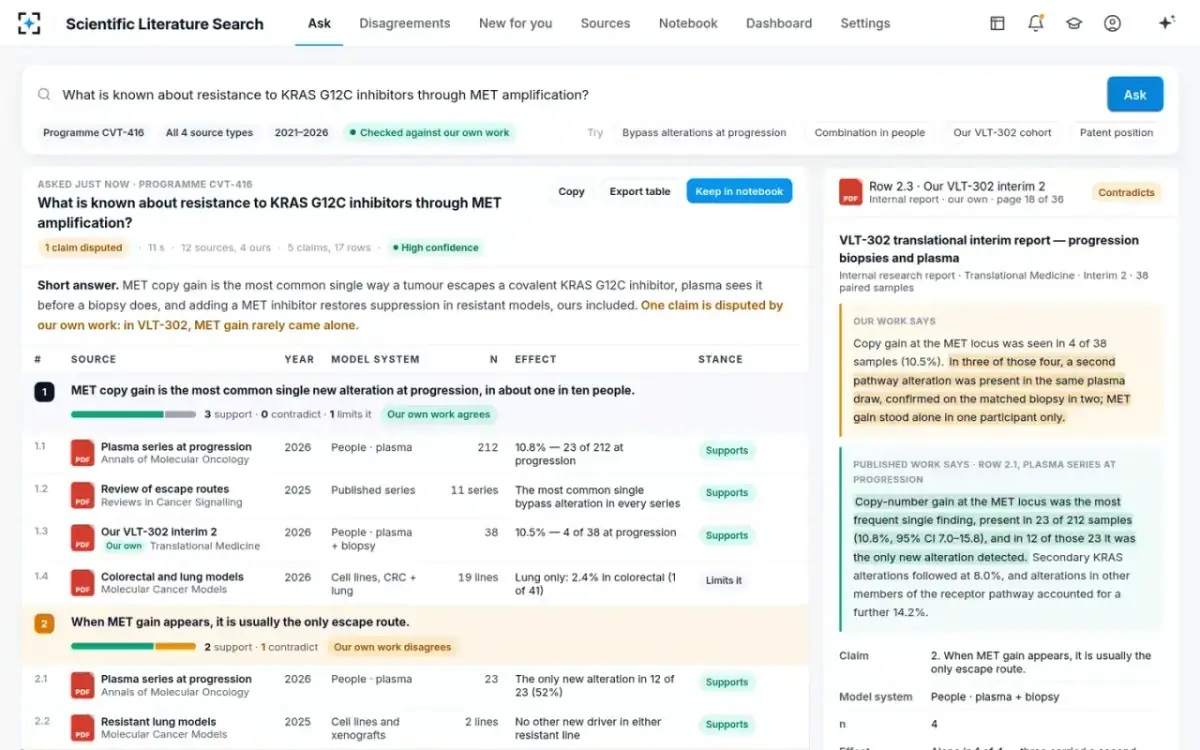
n and model system: the two cells a reader checks first
Give an experienced reader a new evidence table and watch where their eye goes. Not to the effect — to n and to the model system, because those two decide how much the effect is allowed to mean. A 2.4% difference between two cell lines and a 2.4% difference across 212 patients are different kinds of fact, and only the two cells say which you are looking at.
This is also where irreproducibility hides. Writing for the National Institutes of Health, Collins and Tabak noted that when results fail to reproduce, the explanation is often mundane — a different animal strain, a different laboratory environment, a small change in protocol (Collins & Tabak, Nature, 2014). A table whose model-system column says "mouse" for both of two disagreeing studies has thrown away the most likely reason they disagree. Record the strain, the line, the matrix — plasma, tissue, or both — and the disagreement often stops being a disagreement.
Small numbers deserve a mark of their own. Four samples can be worth writing down and can still settle nothing. The sample library on these screens calls out any n below ten on the claim itself, so a four-sample internal result is visible as a signal to check rather than a refutation; the threshold is a setting, not a fixed rule.
Stance: supports, contradicts, limits — and how to count them
A stance column turns a pile of rows into an argument. Three values are enough. Supports means the row's result points the same way as the claim. Contradicts means it points the other way on the same question. Limits means it holds, but only inside a narrower boundary than the claim states — a different tumour type, a different dose, a different population.
Counting them gives a reader something no prose summary does: the shape of the evidence at a glance. Two claims from the sample answer show both common shapes — a claim with real support and one boundary, and a claim where the organisation's own work pulls the other way.
Stance, counted: two claims from the sample answer
Two rules keep the count honest. Count a patent claim apart from a result, because a claimed dose range asserts a boundary somebody wants to defend rather than something that was measured — why a patent claim is not a result works that through. And never let the count decide. In the sample library the meter is a reading, not a verdict: the agreement agent counts and explains, and only the person who owns the contradicting report may settle it.
What columns should an evidence table have for a drug programme?
Start from the six, then add the columns your decision actually turns on. For a drug programme that usually means four more: target and mechanism, so rows about different escape routes do not sit in one block; dose or exposure, because a result at one dose rarely transfers to another; owner, which for an internal report is the programme that may answer with it; and the passage itself.
Before a row goes in the table
- The figure is quoted, with its denominator
Write 23 of 212, not 10.8% alone, and never a rounded version of either. A recalculated number cannot be checked against its source.
- The model system says which system
People, plasma, tissue, cell lines, xenografts — and the strain or line where it is known.
- n is in the source’s own units
Patients, series, lines, or samples. Converting them loses the thing a reader weighs the row by.
- The stance names what the row does to the claim
Supports, contradicts, or limits — and limits needs the boundary written next to it.
- The passage opens at the sentence
Page and position, not the document. A row that opens a 60-page report at page one has no passage.
- Patent text is labelled as a claim
Counted apart from results, so a claimed range is never read as a measured one.
- An internal row names its owner
The programme that owns the report, so the one person who can settle a disagreement about it can be found.
Conference abstracts, patent claims and internal reports as rows
Three kinds of row behave differently from a journal article, and a table that treats them identically will mislead.
A conference abstract is a result that may never be checked. In a Cochrane methodology review of 425 reports covering 307,028 abstracts, the overall proportion published in full by the time each report checked was 37.3%, and a survival analysis put it at 46.4% by ten years (Scherer et al., Cochrane Database of Systematic Reviews, 2018). On either figure, more than half of the results first shown as abstracts never acquire a full paper, a methods section, or peer review of the result you are about to put in a row. Include them — they often carry the newest number — but mark the row for what it is.
A patent claim is not a measurement at all. It states a boundary the applicant wants, and it is written broad on purpose. A row that records a claimed 200 to 400 mg window alongside rows of measured response rates invites exactly the misreading that the label exists to prevent.
An internal report or a signed notebook entry is usually the most relevant row in the table and the one most likely to be missing. It also needs a provision the published rows do not: who signed it, when, and what the signature meant. The electronic-records rule for regulated work asks for precisely that — a signed electronic record must show the signer's printed name, the date and time of signing, and what the signature meant — review, approval, responsibility or authorship (21 CFR 11.50(a)). An evidence table that draws on internal work inherits that question, and the simplest answer is the one the solution takes: index a notebook entry only after it is signed.
Keeping the table true when a new result arrives
A table is a photograph of the evidence on the day it was built, and the evidence keeps moving. The cheap failure is the one nobody sees: a row stays correct while the claim above it quietly stops being true, because a newer, larger or better-controlled result arrived and was never read against the table.
Two habits fix most of it. Keep the table rather than the prose, so a new row can be added to an existing claim instead of a document being rewritten. And run the new material against what you already kept, rather than only reading it for what is interesting. In the sample library, overnight work matches new sources to what each person asked to be told about and re-reads each new internal report against the answers the team has kept — in the sample, one interim report disagreeing with a kept claim, another still agreeing with one.
One failure mode deserves naming on its own: a source that is withdrawn after you cite it. The row stays, the number stays, the claim stays, and nothing in the table knows. Finding retracted papers before you cite one sets out the marks to look for and the standing re-check that catches what the marks miss.
One row, opened at its passage, in Scientific Literature Search
Reporting the table so another team can rebuild it
A table that cannot be rebuilt is a table that has to be trusted, and trust is exactly what the format exists to replace. Rebuilding needs three things written down beside it.
First, where the rows came from. PRISMA 2020 asks reviewers to name every database, register, website, organisation and reference list they searched or consulted (PRISMA 2020, item 6), and to say when each was last searched. The same applies to a working table: a reader who does not know that your internal reports were included cannot tell whether an absent result was excluded or never visible. The six steps of a search you can repeat covers the rest of that record.
Second, what the columns mean. Define "effect" and "stance" once, in a line, and stick to it; most tables that go wrong went wrong in a definition rather than in a cell.
Third, the yield. Among 195 systematic reviews, searches returned between 27 and 92,020 records, and the mean share of those records that ended up included was 2.94% (Borah et al., BMJ Open, 2017). Reporting how many records your search returned and how many became rows tells a reader how selective the table is, which is the first thing a sceptic wants to know.
How much reading one table stands on
92,020
records returned by the largest of the searches behind 195 systematic reviews; the smallest returned 27
2.94%
of those records became included studies, on average
37.3%
of 307,028 conference abstracts had been published in full when checked; 46.4% estimated by ten years
List and define all outcomes for which data were sought.
PRISMA 2020, item 10a
That one line is the whole discipline of an evidence table, compressed. List, so nothing is implied. Define, so two rows mean the same thing by the same word. And for which data were sought — which includes the outcomes you looked for and did not find, the rows that are empty on purpose. To see the table built from a question, with every row opening its passage, start from Scientific Literature Search.
Questions people ask
How do you build an evidence table?
Write the claim first, then collect rows against it rather than collecting studies and looking for a pattern. For each study, fill the six columns from the full text — source, year, model system, n, effect, stance — and attach the sentence each cell came from. Then read the rows back against their passages before you write a word of prose; that pass is where most errors are caught.
What is the difference between an evidence table and a summary of findings table?
An evidence table has one row per study and holds each study's own numbers. A summary-of-findings table has one row per outcome and holds the pooled result, the number of participants contributing to it and a certainty judgement. The second is built from the first, and a summary-of-findings table whose underlying evidence table was never assembled cannot be checked.
How do you record sample size in an evidence table?
In the units the source used, with the denominator kept: 212 people, 38 people, 11 series, 19 cell lines. Keep the raw counts beside any percentage — "10.8% — 23 of 212" — because a percentage without its denominator cannot be weighed or re-checked. Mark small numbers rather than hiding them; a result from four samples is worth recording and worth flagging.
Should an evidence table include unpublished studies?
Yes, with the row marked for what it is. Conference abstracts, internal research reports and signed lab-notebook entries often carry the newest and most directly relevant result — and a Cochrane methodology review estimated that only 46.4% of results first presented as abstracts are published in full within ten years, so excluding them on principle removes a large body of evidence. Mark each row's type, and for internal work record who owns it.
How do you show disagreement between studies in an evidence table?
Put it in the stance column and count it, rather than smoothing it into the prose. Distinguish a row that contradicts the claim from one that limits it to a narrower setting — most apparent disagreement is scope, not conflict. Then record the most likely reason the two differ, usually a difference in model system, n or protocol, and give the disagreement an owner who can settle it.
How many columns is too many?
When a column is empty for most rows, it is not a column; it is a note. Six columns plus the passage answer most questions, and a drug programme typically needs three or four more — target and mechanism, dose, and the owner of an internal row. Anything beyond that tends to be read by its author and nobody else.