To find retracted papers, search the mark rather than the paper. In PubMed a retracted article carries the publication type Retracted Publication and the phrase "Retraction in: [article title]" on its own citation, so you can filter a result set to it, check a single record before you cite it, or re-run the filter over a reference list you already have. That part takes minutes. The hard part is everything the mark does not cover: the years of citations made before the notice appeared, the preprints and conference abstracts nobody marks at all, and the study plan in your own files that still rests on a paper somebody withdrew last spring. Scientific Literature Search is Botminds' agentic solution for that second half — every statement it keeps carries the passage it came from, and the answers a team has already kept are re-read as new material arrives.
The counts below are ours, measured on 27 October 2026 through the National Library of Medicine's own search endpoint; they rise every week. The screens are a fictional sample library — the programmes, studies, people and sources on them are invented.
What carries a mark in PubMed, and how much of it there is
35,241
records carry the Retracted Publication type
4,063
carry an expression of concern — a question raised, not yet answered
214,740
carry a published erratum, the far larger stream of corrections
How do you find retracted papers?
Three moves cover almost everything, and all three use the same marks.
Check one paper. Open its record and look for the linked phrase. The National Library of Medicine's policy is explicit about what it puts where: the Retraction Notice type goes on the notice, the Retracted Publication type goes on the article, and "citations for retraction notices contain the phrase 'Retraction of: [article title],' and citations for retracted articles contain the phrase 'Retraction in: [article title]'" (NLM, Errata, Retractions, and Other Linked Citations in PubMed).
Filter a set. Add the publication type to a search and you get the retracted members of that set directly; invert it and you get the rest. This is the one to run over a reference list before it goes anywhere, and it is the step most often skipped because nothing prompts it.
Re-check what you kept. This is the move that actually matters and the only one with no button for it. A reference list is a photograph of what was true when it was assembled. Nothing in a document knows that one of its sources was withdrawn eighteen months later.
The Publication Type Retraction Notice [PT] is assigned to the citation for the retraction notice, and the citation is linked to the citation for the retracted article. The Publication Type Retracted Publication [PT] is assigned to the retracted article.
National Library of Medicine, Errata, Retractions, and Other Linked Citations in PubMed
What PubMed puts on a retracted article
Two records, linked. The notice is a citable item of its own, published on a numbered page by the journal that published the article, and indexed with its own publication type. The article keeps its record and gains a type and a phrase pointing at the notice. Neither record disappears, which is the right design: a withdrawn paper that vanished would leave every document citing it pointing at nothing.
Three neighbours of the retraction are worth knowing, because they carry different weight and different marks. An expression of concern is a question the editor has raised and not yet answered; the policy describes it as typically written by an editor, whose job is then "to initiate appropriate investigative procedures, discover the outcome of the investigation, and notify readers of that outcome", and the outcome "may require the publication of a retraction notice". An erratum covers corrections, corrigenda, addenda and partial retractions, which the library treats uniformly as errata — including the partial retraction of a single table or figure, which can be exactly the table you cited. And a comment is a substantive published challenge that carries no mark on the original at all beyond a link.
One thing the mark deliberately does not tell you is why. The policy states it plainly: the library "does not differentiate between articles that are retracted because of honest error and those that are retracted because of scientific misconduct or plagiarism". Reading a retraction as an accusation is a mistake; journals retract "because of pervasive error or unsubstantiated or irreproducible data" as well as for misconduct, and treating the two alike is the library's considered position, not an oversight.
What happens when a paper is retracted?
Procedurally: the journal publishes a notice that clearly states the article is being retracted or withdrawn in whole, and by whom — an author or the author's legal counsel, the head of the department, dean or laboratory director where the work was done, or the journal editor. The notice has to be citable — a numbered page in an issue, or, for online-only content, readily discernible in a later issue's table of contents and tied to identifiable pagination. The indexing service then links the two records.
Practically: almost nothing happens to the article's existing citations. The paper has already been read, downloaded, quoted in slide decks, summarised in reviews, and written into study plans. The notice reaches the record, and the record is not where most of its influence lives.
The citations made before the notice — the larger problem
The research on this is uncomfortable. Bolland, Grey and Avenell followed a research group whose work carried 113 published concerns about publication integrity, traced 376 of its source publications and the 5,577 articles citing them, and counted which references pointed at a source that had a published concern against it. Of 6,926 references, 3,925 did. Of those 3,925, the overwhelming majority — 3,688 — were in articles published before the concern about the source was published (Bolland et al., Accountability in Research, 2022).
Where the references went, in one study of a single research group
6,926 references traced
- To a source with a published concern — 3,925 · 57%
- To a source with none — 3,001 · 43%
The 3,925 references to a flagged source
- In articles published before the concern appeared — 3,688 · 94%
- Later · 6%
Their conclusion is the sentence to take away: "many articles cite retracted publications, with the majority of these references occurring before the retraction". A pre-retraction citation is not misconduct and not carelessness — when it was made, there was nothing to find. It is simply a claim whose foundation moved afterwards, and the authors note that "very few publications assess the impact of the retracted citations, even though the findings of many might be altered, at least in part, by removal of the retracted citation".
That is the actual task. Not screening tomorrow's search — re-reading yesterday's conclusions.
Preprints, conference abstracts and the sources nobody marks
The marking system works where there is an index to carry it. Outside that, warning is a matter of convention, and conventions are uneven.
Five kinds of source, and what warns you
| Source | What marks it when it is withdrawn | How you would find out | What has no mark at all |
|---|---|---|---|
| A journal article indexed in a curated database | A publication type on the article and a linked, citable notice | On the record itself, and as a filter over a whole result set | Nothing — this is the case the system was built for |
| A journal article outside that index | Whatever the journal publishes on its own page | By returning to the page and reading it again | No field to search, so no way to check a list in bulk |
| A preprint | The server’s own withdrawal convention, which varies | By revisiting the server; a PDF already downloaded says nothing | The copy in a shared drive, which is the copy people read |
| A conference abstract | Rarely anything at all | Usually only if a later full paper contradicts it | The abstract itself, which keeps circulating unchanged |
| An internal report or notebook entry | Whatever your own organisation decides | Only if somebody is told to look | Every downstream answer that quoted it |
The last row deserves attention because it is the only one inside your control. A superseded internal report is exactly as capable of invalidating a conclusion as a retracted paper, and nothing in the published world will ever mark it. Where internal reports are searched alongside the literature, a new version arriving is the signal — searching your own work alongside the published literature sets out how the two fit in one question.
Can you still cite a retracted paper?
Yes, in two situations, and the test is what the citation is doing. Citing a retracted paper as a retracted paper — in a methods discussion, a history of a question, or a piece of work about retraction itself — is normal and correct. What is not defensible is citing it for its result, as though the result still stood.
If you do cite one, say so in the citation itself rather than in a footnote nobody reads, and give the notice as well as the article. The reader's question is always the same: did the author know? A citation that names the retraction answers it in four words.
The harder case is the paper that has an expression of concern and no retraction. Nothing has been decided; the editor has said that something is being looked at. Treat it as a claim whose weight has dropped rather than disappeared, and record the mark against the row so that the next person does not have to rediscover it. That is a job for the stance column in an evidence table — the columns that make a row checkable covers where it sits.
The standing check: re-reading what you have already written
Every approach above is a point-in-time check, and the evidence says most citations to a flagged source were made before the flag existed. What catches the rest is a standing one: when new material arrives, read it against the conclusions already kept, rather than only against the question somebody is asking today.
In the sample library on these screens that runs overnight. New sources are matched to what each person asked to be told about, each with one line saying why it matched, and every new internal report is read against the answers the team has kept — in the sample, one interim report disagreeing with a kept claim while another version still agrees with one. One row on that list is a paper published in February that only reached the library this week, which is the pattern in miniature: what is new to you is rarely what is new to the world.
Scientific Literature Search: what arrived overnight, and what it does to answers already kept
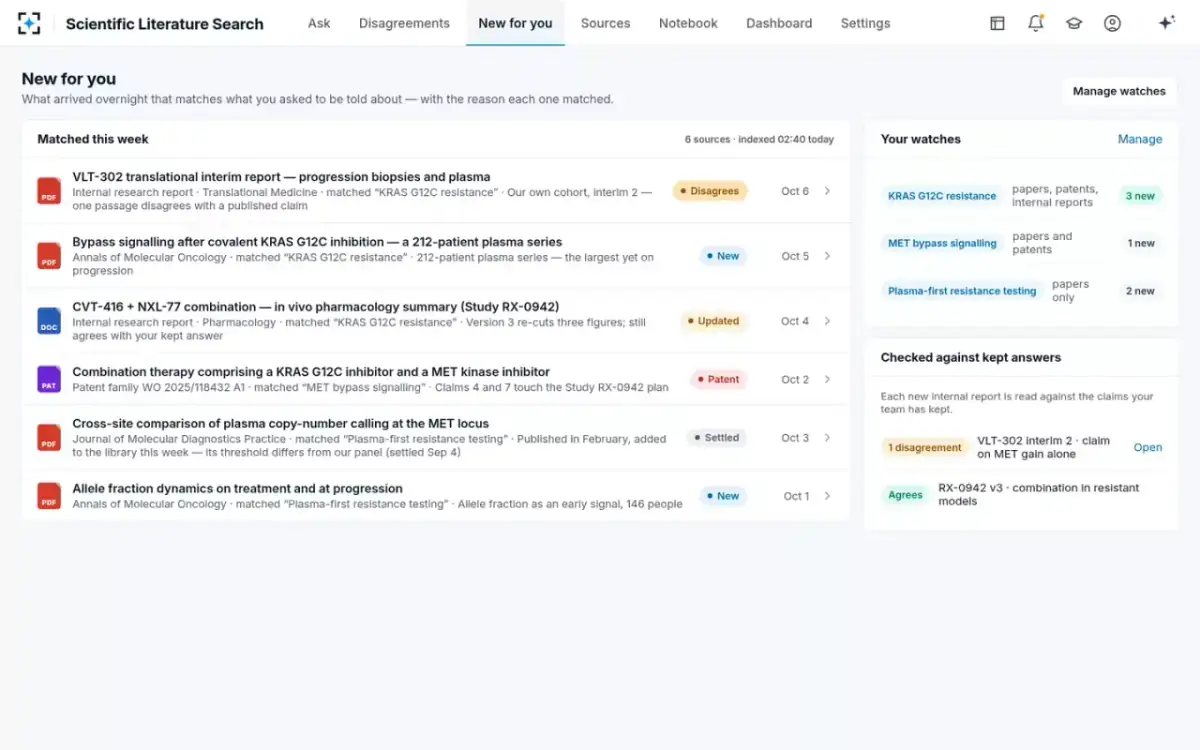
This is a re-check, not a retraction database: the solution does not subscribe to a feed of withdrawn papers. What it does is keep every kept statement attached to the passage it came from, so a claim can be re-read against its source whenever that source changes — and keep the kept answers in one place, so there is a list to re-read at all.
What to do when a claim you kept loses its source
Work from the statement, not the document. Four steps, in order.
Before a claim goes into a plan — and after one of its sources is withdrawn
- Check the mark on every source behind the claim
Retraction, expression of concern, erratum. A partial retraction of one figure can be the figure the claim rests on.
- Re-read the passage, not the abstract
If the claim was built from a sentence, the question is whether that sentence survives. Sometimes a withdrawn paper was never the source of the number anyway.
- Count what is left
A claim with four supporting rows that loses one is weaker; a claim with one row that loses it has nothing behind it and must come out.
- Find everything else in the programme that cites it
The same source is rarely used once. This is the step that needs a list of kept answers, and the step people skip because they do not have one.
- Record what you did and when
Including the decision to keep a claim that lost a source, with the reason. A reviewer will ask, and a year later you will not remember.
- Tell whoever is relying on it
A study plan already circulated is a document somebody is acting on. The correction is worth less the longer it waits.
The third step is where most of the value is and where most teams have nothing to work with. If the evidence was kept as prose, losing a source means re-reading the prose and guessing which sentences depended on it. If it was kept as statements with their rows, the affected statements are the ones whose rows name that source, and the rest are untouched.
Who decides, and what gets written down
A withdrawn source is a judgement call, not an automatic deletion, and the judgement belongs to a person. Whether a claim survives the loss of one of its rows depends on what the other rows say, how close the withdrawn result was to the claim, and what the work is for — a question that no count can answer.
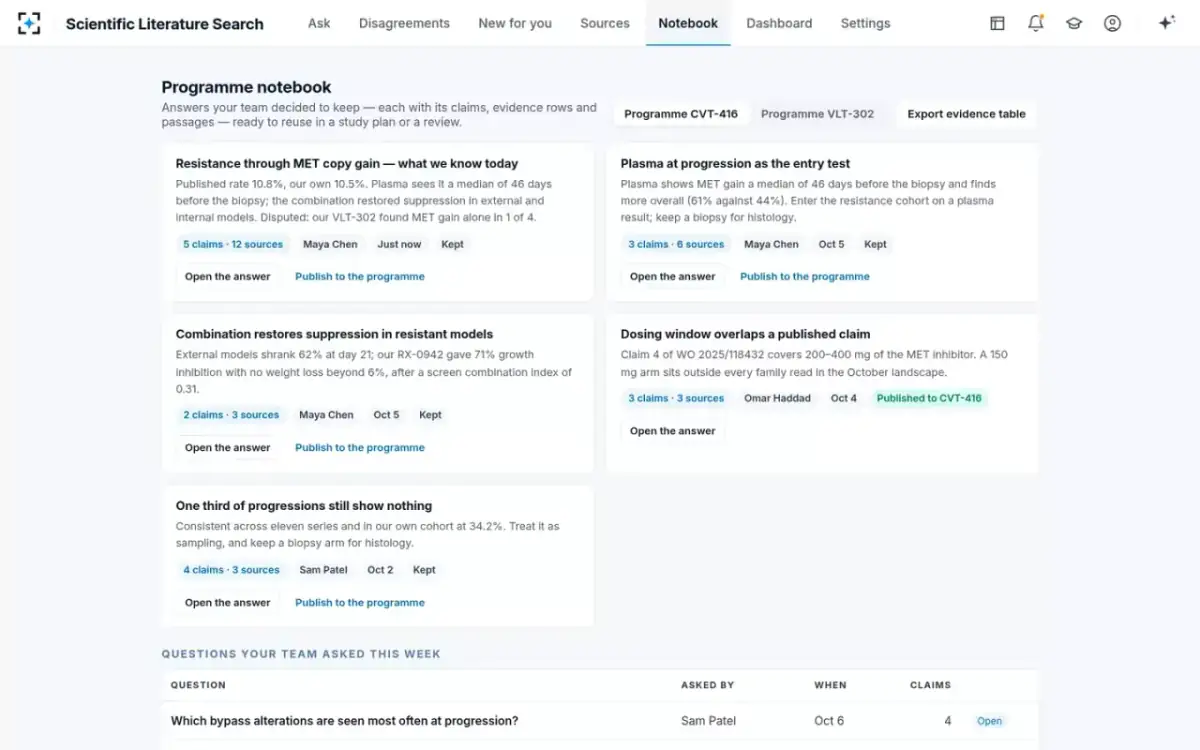
What software should do is narrower and more useful: make the dependency visible, refuse to assert anything it cannot open a passage for, and keep a record of what changed. In the sample library every kept answer sits in the programme notebook with its claims, its evidence rows and its sources, and an evidence table can be exported from it; a row the citation checker cannot support against its passage is removed and the removal recorded; and a disagreement stays on the list, in the open, until the person who owns the contradicting source settles it. An agent never closes one.
Kept answers in Scientific Literature Search, each still attached to its rows
A last note on proportion. Thirty-five thousand retracted articles is a small number against forty-one million, and the risk of citing one is correspondingly small for most questions. The two hundred thousand errata are the quieter risk, and the superseded internal report is the quietest of all. The discipline that catches all three is the same one: keep the sentence behind every statement, and re-read it when the ground moves. To see that on your own library, start from Scientific Literature Search.
Questions people ask
How do you know if a paper has been retracted?
Look at its database record rather than the PDF. In PubMed a retracted article carries the publication type Retracted Publication and the phrase "Retraction in: [article title]", linking to the notice; the notice itself carries the type Retraction Notice and the phrase "Retraction of:". Because the type is a searchable field, you can also run the check across a whole reference list at once rather than one record at a time.
What is a retraction notice?
A separate, citable item published by the journal, stating clearly that the article is retracted or withdrawn in whole. It must say who is retracting it — an author or the author's legal counsel, the head of the department, dean or laboratory director where the work was done, or the journal editor — and it must appear on a numbered page — or, for online-only content, be readily discernible in a later table of contents with identifiable pagination. The index then links the notice and the article to each other.
Why do people keep citing retracted papers?
Mostly because they cited them first. In a study of 6,926 references traced from one research group's publications, 3,925 pointed at a source with a published concern, and 3,688 of those were in articles published before the concern appeared. Nothing was there to find at the time. The citation that follows a notice is the minority case; the backlog of citations made before it is the large one, and it is invisible unless somebody goes looking.
What should you do if you cited a retracted paper?
Work from the statement it supported rather than the citation. Re-read the passage you relied on, count what other evidence remains behind the same statement, and decide whether the statement survives — a claim with four supporting sources is in a different position from one with a single source. Then find everything else in the programme that used it, record what you decided and why, and tell whoever is acting on the document.
Is a retraction always a sign of fraud?
No. The National Library of Medicine does not differentiate between articles retracted because of honest error and those retracted for misconduct or plagiarism, and journals retract for pervasive error or unsubstantiated or irreproducible data as well. An expression of concern says even less: it records that an editor has raised a question and has not yet reported an outcome, which may or may not end in a retraction.
What about preprints and conference abstracts?
They are the gap. Withdrawal on a preprint server follows the server's own convention, and a copy already downloaded carries no warning at all; a conference abstract rarely gets any notice, and goes on circulating unchanged. Neither can be checked in bulk the way an indexed article can, so the practical defence is to record what each kept statement rests on and re-read it when newer material on the same question arrives.