A non-patent literature search is a search of everything that is not a patent document — journal papers, conference proceedings, theses, registry entries, standards and technical reports — carried out to establish what was already publicly available, and when. Patent examiners run one when they examine an application; scientists run the same search for the opposite reason, to know what is already known before designing the next study. It is hard because the two bodies of material look alike in a list and mean different things: a paper reports what was measured, a patent claim states a boundary somebody wants to defend, and the moment they sit in one undifferentiated list a claimed dose window gets quoted as a finding. Scientific Literature Search is Botminds' agentic solution for searching both at once without confusing them — papers, patent families, internal research reports and signed notebooks in one question, with patent text labelled a claim, not a result, and counted apart.
The legal material below is quoted from the United States Patent and Trademark Office's own manual and from federal regulations, read on 27 October 2026. The screens are a fictional sample library, and nothing here is legal advice: a patent position is a question for counsel.
What is a non-patent literature search?
In patent work, "non-patent literature" is a category defined by exclusion: everything an examiner may cite that is not a patent or a published application. The phrase is a searching term, not a quality judgement — a non-patent literature search is simply the half of a prior-art search that goes through the scientific record rather than the patent registers.
For a research programme the same search has two jobs. The first is defensive: know what is already public, because a disclosure that was public before a filing date can be prior art against your own application. The second is practical: a patent family tells you what other groups thought was worth protecting, often years before they published anything about it, and that is information a paper search will not give you.
Both jobs need the same record keeping as any other search — the sources named, the strategy written down, the dates kept — which the six steps of a repeatable search sets out in full. What this page adds is the one discipline a literature search does not need and a prior-art search cannot do without: keeping claims and results visibly apart.
What counts as prior art, and from when
The useful mental model is that prior art is about availability, not about quality or peer review. A thesis in a library catalogue, a conference handout, a poster, a webpage, a standards draft, a registry entry and a journal article can all qualify. What they have to have in common is that somebody interested in the subject could have found them.
A reference is proven to be a "printed publication" upon a satisfactory showing that such document has been disseminated or otherwise made available to the extent that persons interested and ordinarily skilled in the subject matter or art, exercising reasonable diligence, can locate it.
United States Patent and Trademark Office, Manual of Patent Examining Procedure § 2128
Read that sentence as a searcher rather than as a lawyer and it becomes a specification for your own work. The test is whether a diligent person skilled in the field could locate the document. A result that exists only in a slide deck on a shared drive fails it. A result in a thesis catalogued by a university library may pass it. And — the part that stings — a search that could not locate something a diligent person could have located is a search with a hole in it.
'Publicly accessible' is the test, not 'published'
The manual is blunt about which word governs: in determining whether a document in an online database is a printed publication, "public accessibility is key" (MPEP § 2128.01). Not printing, not peer review, not a journal's imprimatur — accessibility.
That has three consequences for how you search. Indexing is evidence of accessibility but not a precondition for it, so material that no database indexes can still count. A document's accessibility has a date attached to it, which may be later than the date printed on the document. And "we could not find it" is not the same as "it was not available" — which is exactly why the strategy and the date have to be written down, so that the claim your search supports is the accurate one: this is what a diligent search of these sources on this date returned.
The same test, aimed the other way, is how a search engine fails you. An evaluation of 28 academic search systems concluded that only half of them, and only a few open-access databases, could be recommended for evidence synthesis without substantial caveats (Gusenbauer & Haddaway, Research Synthesis Methods, 2020). A system that cannot be queried precisely or exported completely cannot tell you what was accessible; it can only tell you what it chose to show. Which systems survive that test is worth settling before you rely on one.
What is the difference between a patent claim and a result?
A result is a report of something that was measured: this many subjects, this system, this effect. A claim is a statement of scope — the boundary within which the applicant asserts a right — and its legal job is to be clear about that boundary, not to report evidence. The manual says so directly: the purpose of the definiteness requirement "is to ensure that the scope of the claims is clear so the public is informed of the boundaries of what constitutes infringement of the patent" (MPEP § 2173).
A claim and a result, side by side
A patent claim: The boundary of a right: a range, a combination, a method, stated as widely as the applicant can support.
A reported result: What happened when something was measured, in one system, at one size.
A patent claim: The specification, where worked examples may or may not appear; the claim itself reports nothing.
A reported result: The methods, the n, the model system and the analysis, in the paper or the report.
A patent claim: A range is drawn to cover what a competitor might do, not to describe an optimum.
A reported result: A number is what was observed, with whatever variance it came with.
A patent claim: That somebody intends to defend this territory — and that your plan may sit inside it.
A reported result: That this effect was seen in this system, within the study’s own limits.
A patent claim: Apart. A claim is never a supporting source for a scientific statement.
A reported result: As evidence, with its stance: supports, contradicts, or limits.
Why claims are written broad, and what that does to a reader
Breadth in a claim is a drafting strategy, not an empirical finding. A claim to "200 to 400 mg" does not mean the applicant tested 200, 400 and the range between; it means the applicant wants the territory. Read as science, that range looks like a dosing conclusion supported by somebody's data. Read as law, it is a fence.
The practical damage is specific. A scientist designing a cohort sees a range in a document that looks authoritative, and treats it as external corroboration of a dose. The number then travels: into a slide, into a plan, into a discussion of what "the literature" says. Nothing in the original ever claimed to be a result, and nobody misrepresented anything; the category was lost in transit, which is why the label has to travel with the row rather than live in somebody's memory.
Scientific Literature Search: a gap in people, and a claim that is not a result
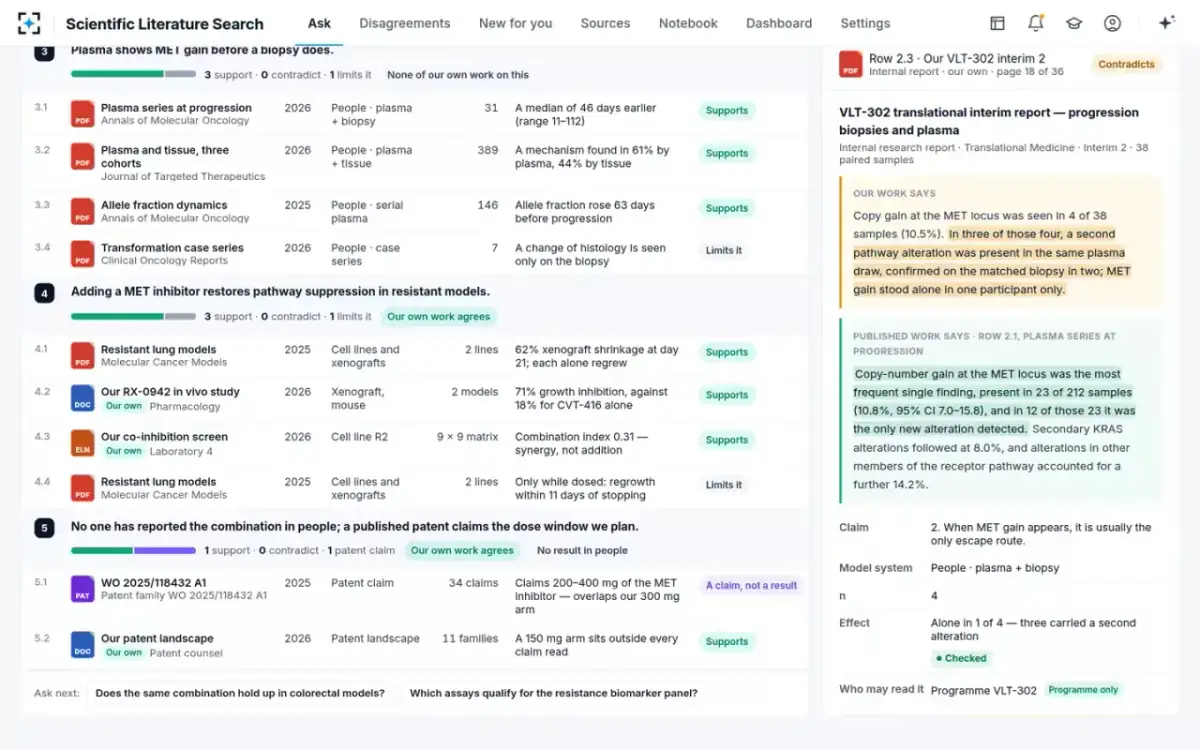
Claim 5 on that screen is the shape worth studying: the honest answer to a question can be that nobody has shown it. The meter counts one supporting source and one patent claim, and the claim says in words what is missing — no result in people. A system that could only count agreement would have had to leave that claim out, and the gap is the most decision-relevant thing on the page.
Three dates that are not the same: priority, publication, and the day you read it
Every disclosure has several dates, and conflating them produces wrong conclusions in both directions — thinking something is older than it is, or newer.
For a patent application the gap is structural. Applications are published "promptly after the expiration of a period of 18 months from the earliest filing date for which a benefit is sought" (35 U.S.C. 122(b)(1)(A), reproduced at MPEP § 1120). For up to a year and a half, therefore — unless the applicant asks for earlier publication — somebody else's filing is invisible to every search anybody can run, and some applications are never published at all before grant. A patent landscape read today describes a world as it was eighteen months ago, plus whatever has published since.
Trial results run on a different and also fixed clock. For an applicable clinical trial, results information is due no more than a year after the primary completion date (42 CFR 11.44(a)). A registry entry can therefore be the earliest findable record of an outcome, well before any paper.
One result, and the clock before anybody outside can find it
- The work, up to the priority filingvariable
- Confidential, until 18 months from the earliest filing date18 months
- Publishedfindable
- The trial, to primary completionvariable
- Up to one year to submit results information12 months
- Postedfindable
Then there is the third date, the one nobody records: the day your search could actually locate it. A paper published in February that reaches your library in October is nine months old to the world and new to you, and an evidence row that carries only the publication year hides the difference. Record both — the date on the document, and the date you searched.
Searching families, claims and papers in one question
Running two searches and merging the results by hand is where the category gets lost. In the sample library on these screens the two are searched together and kept apart on arrival: patent families and their claims are synced weekly alongside the literature, every source carries its target, model system and n, and patent text is labelled on every answer it appears in.
Where a claim can be found, and what it is worth
| Where you find it | What it asserts | What sits behind it | What a reader may take from it |
|---|---|---|---|
| A peer-reviewed paper | A measured result, within the study’s own limits | Methods, n, model system, and review by somebody outside the group | Evidence, to be weighed by its n and its system |
| A patent claim | A boundary the applicant seeks to defend | Nothing is reported in the claim itself | That somebody intends to hold this territory — never that a number was observed |
| A patent specification | Support for the claims, sometimes with worked examples | Whatever the applicant chose to include; no outside review | A result reported by an interested party, to be marked as such |
| A trial registry entry | That a trial exists, what it measures, and later its results | The protocol as registered, and results due within a year of primary completion | The earliest findable record of an outcome, often before any paper |
| An internal research report | Your own organisation’s result | The study as run in your own labs, with its own n | Usually the most directly relevant evidence you have, and unreviewed outside |
Scale is the argument for doing it in one question rather than two. PubMed alone held 41,346,224 records when we counted on 27 October 2026, and a programme's patent landscape runs to dozens of families on top of it; the sample library on these screens searches 128,412 sources of all four types together. Nobody merges that by hand twice.
Where a programme's own reports sit in this picture
Your own unpublished work occupies an awkward and important position. Scientifically it is often the most relevant evidence in existence on your question. In prior-art terms it is usually not available to anybody, which is the point — but it can become available through a conference abstract, a poster, a registry entry or a departing colleague's thesis, and the date that happens matters.
So internal material belongs in the same answer as the published work, with two things attached: who may read it, and what it is. In the sample library internal reports and signed notebook entries are answered only to the programme that owns them, a notebook entry becomes searchable only once it is signed, and patent counsel can be given papers and patents only. That last setting is the one people find surprising until they need it.
Two readers of the same patent
Today
Opens a patent family looking for numbers, finds a dose range in a claim, and has no way to mark it as a claim when it goes into a study plan.
With agents
Sees the patent row in the same answer as the papers, labelled a claim and counted apart, with the overlap against the planned arm stated in words.
Still theirs: Decides what to keep, and what the cohort does next
Today
Reads claims against a study plan held somewhere else, and hears about a dose change after it is made.
With agents
Reads the claims beside the evidence the plan rests on, and is given papers and patents only — not the programme’s internal reports.
Still theirs: Owns the reading of the claim; no agent interprets a boundary
Labelling, so a claim is never counted as evidence
A label is only as good as the place it lives. Written in a methods note, it survives one reading. Attached to the row, it travels with the number into every answer, every export and every reuse.
Three rules make that work in practice, and all three are settings rather than beliefs. Patent text is labelled a claim, not a result, and counted apart on the agreement meter — a programme that deliberately wants claims to count as support can change that, as a recorded decision rather than an accident. Figures are quoted, never rounded or recalculated, so a claimed range reaches the page as the range the applicant wrote. And a statement with nothing behind it is not written: where the library cannot answer a question with a passage, the answer says so rather than producing a plausible sentence.
The source at its page, with who may read it
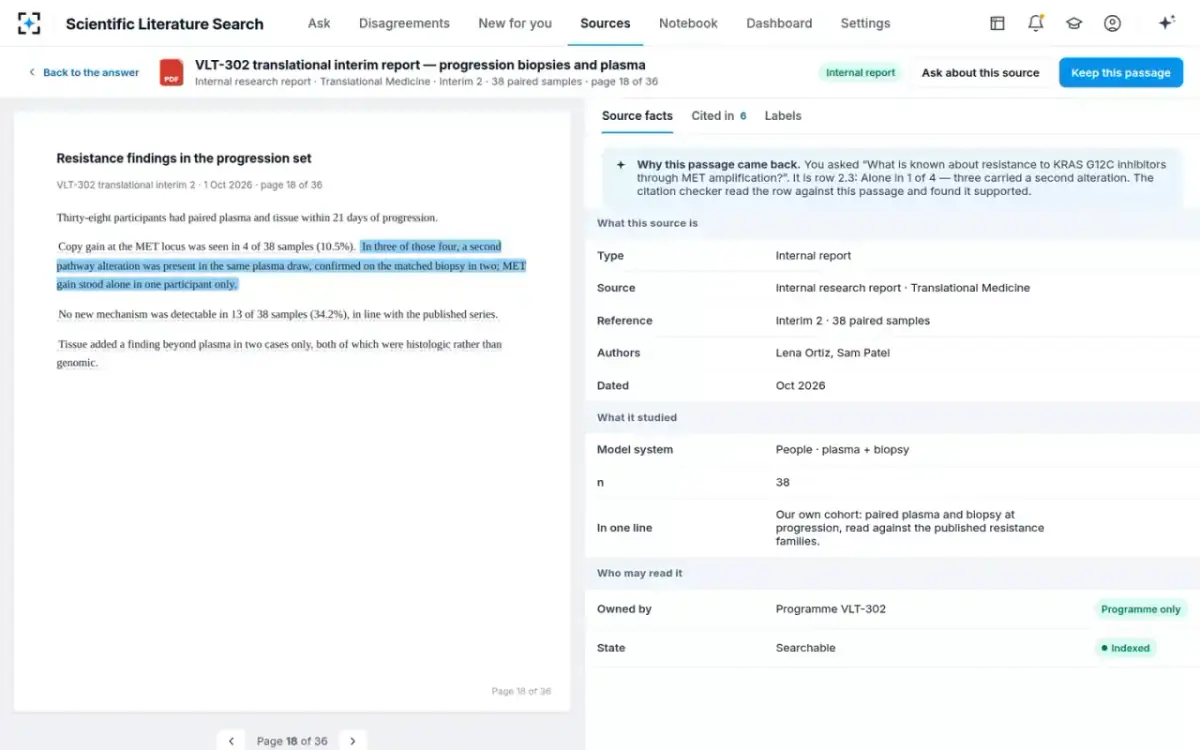
Where a patent claim and a scientific statement end up side by side, the evidence table is what keeps them legible — the columns that make a row checkable covers the stance column that does the work. To see papers, patent families and your own reports answered in one question, start from Scientific Literature Search.
Questions people ask
What is non-patent literature?
Everything citable as prior art that is not a patent document: journal articles, conference proceedings and abstracts, theses, books, standards, technical reports, registry entries and web material. The category exists because patent offices index patents and applications separately from everything else, so a complete prior-art search has to run on both sides and a "non-patent literature search" is the half that goes through the scientific record.
Is a published paper prior art?
It can be, and what decides it is accessibility rather than the journal. The patent manual's test for a printed publication is whether the document was disseminated or otherwise made available such that a person interested and ordinarily skilled in the field, exercising reasonable diligence, could locate it. A thesis in a catalogued library collection can meet that test; a result circulating only inside one group does not.
Do patents report experimental results?
Sometimes, in the specification, and never in the claim. A specification may contain worked examples, and those are results reported by an interested party without outside review — useful, and to be marked as such. The claim itself reports nothing: it states the boundary of the right being sought, which is why a range in a claim is not evidence about a dose.
When does a publication become publicly accessible?
On the date a diligent person in the field could have located it, which is often not the date printed on it. A United States patent application is generally confidential until it publishes, 18 months after the earliest filing date for which a benefit is sought, though an applicant may ask for earlier publication and some applications are not published before grant. A clinical trial's results information is due within one year of the primary completion date. And a paper is accessible to you only once it reaches whatever you search — so record both the document's date and the date you searched.
How do you search patents and papers together without confusing them?
Keep them in one search and two categories. Every row should carry what kind of source it is, and patent text should be labelled and counted separately from measured results, so a claimed range can never be totalled with experimental evidence. Doing it the other way — two searches merged by hand afterwards — is precisely where the category gets lost.
Who should read the claims?
Counsel, always, for anything that touches a position. The useful division is that a search can put the right claim in front of the right person, with the overlap against a planned study stated in plain words, and can mark the row so that nobody downstream mistakes it for a result — but the reading of a claim's boundary is a judgement, and no software should make it.