How does an R&D team run a biomedical literature search it can repeat? Write the question so that a search can answer it; name every source you will search, including the ones your own organisation owns; record the strategy exactly as you ran it; screen by reading the passage rather than the abstract; and tie every statement you keep to the sentence it came from. The work is hard not because searching is hard but because the route has to survive being walked again: by a co-author next month, by a reviewer next year, by a regulator who asks which sources were searched and on what date. Scientific Literature Search is Botminds' agentic solution for exactly that: it searches published papers, patent families, internal research reports and signed lab-notebook entries in one question, and answers as numbered claims whose every evidence row opens the passage behind it.
The screens on this page come from a sample library: the programmes, studies, people, journals and sources named in them are fictional. The research figures are from government and peer-reviewed sources, linked under the figure they support, and the two counts we measured ourselves say the day we measured them.
How much there is to search before you narrow anything
41,346,224
records in PubMed when we counted them on 27 October 2026
1,882,304
of those records carry a 2025 publication date, about 5,150 a day
2.94%
of the studies a systematic review finds in its searches are included in it, on average
How do you do a scientific literature search?
Six steps, in this order: question, sources, strategy, run, screen, keep. The order matters because each step produces something the next one needs, and because five of the six leave a record behind. A search with no record is a search that happened once.
That is not a style preference. The PRISMA-S extension, the reporting standard for the search half of a systematic review, puts it plainly: "the literature search must be designed to be both robust and reproducible to ensure the minimization of bias" (Rethlefsen et al., Systematic Reviews, 2021). Robust and reproducible are two different properties. A robust search finds what is there. A reproducible one can be run again and return the same thing, and only the second is checkable by anybody but you.
One question, from plain words to a kept answer, in Scientific Literature Search
A person decides
ScientistAsks the question in plain words and sets the scope: the programme, which source types, how far back.
Never: has to write Boolean to be understood
Agent
Library agentHas already split each source into passages and recorded target, mechanism, indication, model system and n, keeping the page and the position of every passage.
Never: indexes a notebook entry before it is signed
Agent
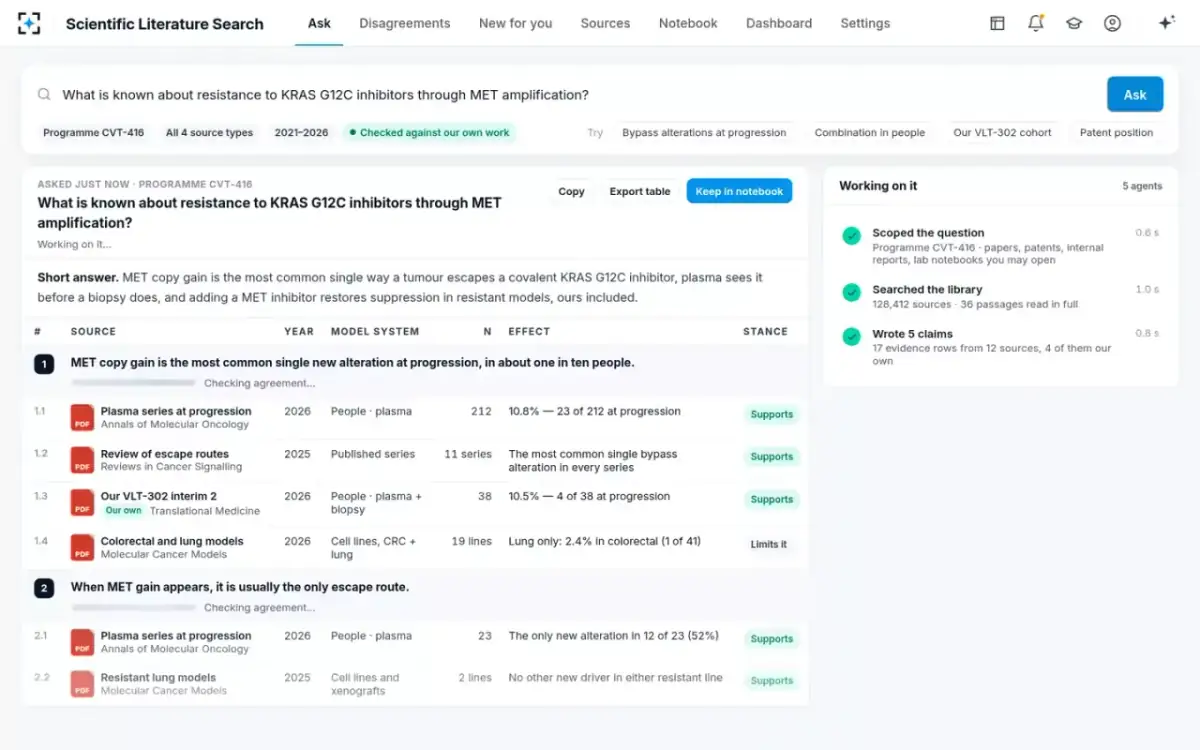
Research agentSearches every source type the asker may open, reads the candidate passages in full and writes numbered claims, each a block of evidence rows: source, year, model system, n, effect, stance.
Never: writes a claim when the library has no passage for it
Agent
Citation checkerReads each row back against its passage, including n and the model system, and removes anything the source does not say.
Never: adds a source the research agent did not use
Agent
Agreement agentCounts, per claim, what supports, contradicts or limits it, and reads the organisation’s own reports against the published ones.
Never: decides which side is right
A person decides
ScientistKeeps the answer in the programme notebook with its rows and passages, so the next person starts from the evidence rather than a search box.
Never: has to re-find a source to reuse the answer
Turn the question into something a search can answer
Many searches fail at the first step, and they fail quietly: the search runs, returns results, and answers a slightly different question. The cure is to write the question with its parts named, then write down what an answer would have to contain.
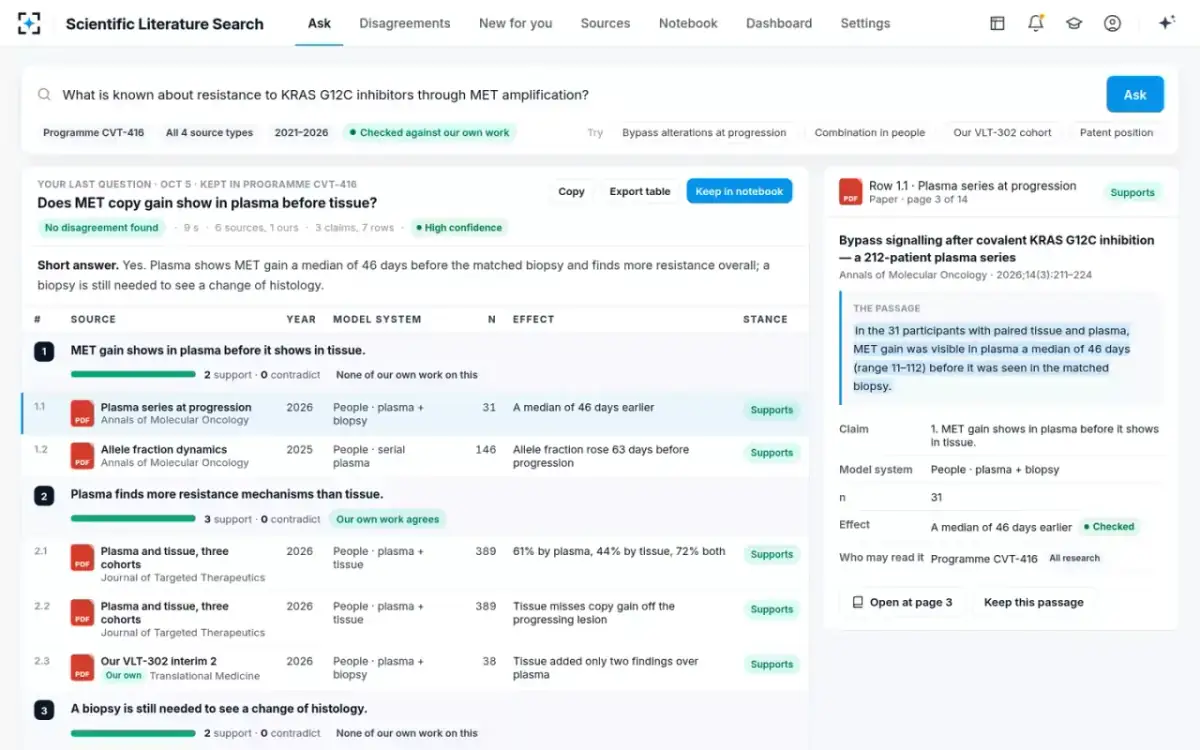
Take a real shape of question from drug discovery: what is known about resistance to a covalent KRAS G12C inhibitor through MET amplification? Four parts are doing work. The target and the drug class fix the system. The escape mechanism fixes the outcome. "What is known" is the part that needs pinning down, because it can mean three different searches (in cell lines, in animal models, or in people), and the three have different answers. Say which you mean, or ask for all three and keep them in separate claims.
Then write the units. A question about a resistance mechanism is answered by a rate, an n, a model system and the sentence that reports them. Deciding that before you search changes what you do with a hit: you stop collecting papers that are "about" the topic and start collecting passages that carry the four things. The search usually gets smaller, and the answer firmer.
Scientific Literature Search: the question bar, its scope, and the last answer still open
Which sources count, and the two kinds most teams never search
A source list is a decision, not an inventory. Four kinds of source answer scientific questions, and many teams search only two of them.
The first two are the familiar ones: the published literature, and patent families with their claims. The third is the organisation's own research reports (pharmacology, translational, discovery), which are often the most decisive evidence available and the hardest to find, because they were written for a programme meeting rather than for a reader two years later. The fourth is the signed lab notebook, where a result exists months before it becomes a report and years before it becomes a paper.
Leaving the last two out has a specific consequence: the search cannot tell you that your own data disagrees with the literature. That disagreement is the single most useful thing a search can find before a study plan is written, and it is invisible to any search engine that only sees what has been published. In Scientific Literature Search all four source types are searched in one question, with internal reports and notebooks answered only to the programme that owns them and notebook entries searchable only once they are signed.
Where papers and patents sit next to each other, label them. A patent claim is a boundary somebody wants to defend, not a measured result, and the two look identical in a list of hits; the reason papers count as prior art while claims stay claims is worth reading before any search that touches a patent position.
Write the strategy so someone else can run it again
The strategy is the part of a search that most often exists only in a browser history. PRISMA-S item 8 asks for something stricter: the strategy for every database and information source, reproduced exactly as run rather than as remembered (PRISMA-S checklist, item 8). Exactly as run is the whole instruction. A strategy retyped from memory loses the typo that changed the result, the limit somebody added at 6pm, and the bracket that made two concepts into one.
If the same query leads to the same search results, the search is considered reproducible.
Gusenbauer & Haddaway, Research Synthesis Methods, 2020
That definition is the test to hold a search to, and it is worth noticing how weak a bar it is, and how many searches still fail it. A search run on a system that personalises results, ranks by relevance with no stable ordering, or caps how many records you can export is not reproducible in this sense, whatever else it is good at. Which system you start in therefore matters more than its size, and what PubMed and Google Scholar each find, and what both miss works that comparison through on this test rather than on coverage.
Two searches, one question
A keyword list: Whatever the terms happened to catch. Synonyms and spelling variants are found by luck.
A written strategy: Each concept gets its own block of synonyms and controlled terms, so a missed term is visible as a gap, not a silence.
A keyword list: Different the second time, and nobody can prove it was different.
A written strategy: Copied as run, so the same query returns the same records: the definition of a reproducible search.
A keyword list: Applied in the interface, forgotten by the write-up.
A written strategy: Stated with a reason: why 2021, why this species, why English only, or that no limit was used.
A keyword list: The result. Nothing about how it was reached.
A written strategy: The route: which sources, which strategy, which date, how many records each returned.
A keyword list: The search is re-done from the beginning, slightly differently.
A written strategy: The search is re-run, and only what is new has to be read.
What a defensible search writes down
- The question, in one sentence, with the units an answer must carry
Written before the first search, so the scope is a decision and not a result of what turned up.
- Every source searched, and the date each one was searched
Including the sources inside the organisation. A source named with no date cannot be re-run against the same corpus.
- The strategy for each source, copied exactly as it was run
Terms, field tags, Boolean structure and the order of operations, as typed, not as intended.
- The limits, with a reason for each
Date, species, language, publication type. "No limits were used" is also an answer, and a useful one.
- Who screened, and against what criteria
One person screening is a different claim from two screening independently; say which happened.
- What was excluded and why
The reason, at the level of the reason ("no n reported", "wrong model system"), not a count of exclusions.
How many results is too many to screen?
There is no magic number, but there is a useful range. In a study of 195 systematic reviews, "the number of studies found in the literature searches ranged from 27 to 92 020; the mean yield rate of included studies was 2.94%" (Borah et al., BMJ Open, 2017). A yield of three in a hundred is normal for a systematic review, and a reviewer who screens 92,020 records to include a few dozen is doing exactly what the method asks.
For a working search (a study plan this week, not a published review) the arithmetic runs the other way. If your strategy returns 4,000 records and you have two days, you are not going to screen them; you are going to read the first eighty by relevance rank and call it a search. That is a different method with a different error rate, and the honest move is to say so rather than to claim the 4,000 as coverage. Narrow the question instead: one mechanism, one model system, one time window.
The flow of new work is what makes this permanent. In 2010 Bastian, Glasziou and Chalmers counted the literature a clinician would have to keep up with: "There are now 75 trials, and 11 systematic reviews of trials, per day and a plateau in growth has not yet been reached" (Bastian et al., PLoS Medicine, 2010). When we counted the 2025 publication year ourselves, PubMed held 36,115 records tagged as clinical trials and 43,848 tagged as systematic reviews, about 99 trials and 120 reviews a day, with the records tagged as systematic reviews now outnumbering those tagged as trials. The shape of the problem has changed as well as its size.
Two practical consequences. First, "I read everything" stopped being true some time ago, so a search's value now lies in what it can prove it looked at. Second, any answer worth keeping has to be re-checkable, because the literature under it keeps moving, which is why the overnight watch in the solution re-reads new sources against the answers a team has already kept, rather than only alerting on new titles.
Screening: reading for the passage, not the abstract
Screening is where searches go wrong in a way nobody notices for months. An abstract is written to be persuasive and short; it drops the n, the strain, the dose and the caveat. A claim built on an abstract is a claim about a summary, and the gap between the two is where most citation errors live.
The discipline is simple and slow: for every statement you intend to keep, find the sentence in the full text that says it, and read the sentence. If the sentence reports 23 of 212 samples, your row says 23 of 212, not "about 10%", and not "approximately one in ten", because the moment a figure is rounded it can no longer be checked against its source. In Scientific Literature Search this is a rule rather than a habit: doses, rates and n are quoted exactly as written, every row must carry a passage, and a row the citation checker cannot support against its passage is removed and the removal recorded.
Scientific Literature Search at work: scoped, searched, written, then checked
What is the difference between a literature search and a systematic review?
A literature search is one component of a systematic review, and a systematic review is one use of a literature search. The search answers what is out there about this question. The review adds everything that comes after: a protocol registered before the work starts, inclusion criteria fixed in advance, independent screening by two people, risk-of-bias assessment of each included study, and a synthesis that may or may not pool results.
The practical difference is how much of the method is decided before you look. A systematic review fixes its decisions in a protocol so that the result cannot be shaped by what the searching turns up; a working search makes its decisions as it goes and should say so. Both must be written down. Only one claims to be the complete body of evidence on its question.
This matters when somebody asks whether your search "was systematic". Often the answer is no, and that is fine: many decisions in research are made from a search, not a review, because a review takes months. What is not fine is a search presented as a review, because the reader will assume the protocol, the double screening and the bias assessment that were never done. If what you did was scope the evidence in two days, say that, and say which parts of the method you skipped.
The six steps and what each one leaves behind
| Step | What you decide | What you write down | What goes wrong when you skip it |
|---|---|---|---|
| 1. Write the question | What is being asked, of what, measured how, and what an answer would have to contain to be useful. | The question in one sentence, and the units an answer must come in: the rate, the n, the model system. | Every later decision becomes arguable, because nothing says what is in scope. |
| 2. Name the sources | Which sources will be searched, and which deliberately will not. | Each source, and the date it was searched. | A reviewer cannot tell whether a missing study was excluded or never looked for. |
| 3. Write the strategy | The terms, the synonyms, the field tags, the Boolean structure, the limits. | The strategy for each source, copied as it was run, not as it was planned. | Nobody can run the search again, including you in six months. |
| 4. Run it and keep the yield | Nothing: this step is mechanical, and should be. | How many records each source returned, on what date. | The numbers in the write-up stop adding up, and the first reviewer notices. |
| 5. Screen by reading the passage | What each candidate actually measured, and whether that answers the question. | What was excluded and why, at the level of the reason, not the count. | An abstract phrase gets quoted as a result it does not support. |
| 6. Keep the answer with its passages | What the body of work supports, where it disagrees, and what nobody has shown. | Each statement with the source, the page and the sentence behind it. | The next person asks the same question from an empty search box. |
Where unpublished and internal results change the answer
The sharpest finding a search can produce is a conflict between the published literature and the organisation's own data, and it is easy to miss, because the two bodies of evidence are often read by different people at different times. By the time anyone notices, the study plan is written.
In the sample answer on these screens, the published plasma series found MET copy gain alone in 12 of 23 samples; the fictional internal interim found it alone in 1 of 4, with three of the four carrying a second alteration. The second figure comes from four samples, so it settles nothing, and the solution says so, calling out small numbers below ten rather than letting four samples read like a refutation. What it does is change the next decision: a cohort entered on a panel rather than on one mechanism. That is the whole value of searching your own work, and it needs no statistical significance to be worth two minutes of a programme lead's time.
Internal evidence also arrives in the wrong order. A notebook entry is signed months before the report is written; a report circulates a year before anything is published. A search that only sees published work is therefore systematically behind on the questions where your organisation is ahead. The rule the solution applies (index a notebook entry only after it is signed, and answer it only to the programme that owns it) is what makes searching that material possible without turning a library into a leak.
Writing the search down so the next person starts where you stopped
The last step is the one that gets skipped, and it is the one that compounds. A search written up as prose with a reference list cannot be re-run, re-checked or extended; the next person who needs the same answer opens an empty search box. A search kept as statements with their passages can be re-read in ten minutes, extended in an hour, and corrected when one of its sources changes.
Three things make a kept answer reusable. Every statement carries its source, its page and its sentence, so a reader can disagree with the evidence rather than with you. The disagreements are kept visible rather than resolved into a smooth paragraph, with an owner attached to each. And the questions themselves are kept, not just the answers, because the questions a team asked this week are the best available map of what it is about to decide. The evidence table is where all three live, and which columns an evidence table actually needs is the next thing to get right.
One more habit earns its keep: re-read what you have already written down when the literature moves. A claim can lose its source without anybody touching your document: a paper is corrected, or retracted, and your statement goes on sitting in a study plan. Finding retracted papers before you cite one covers the marks to look for and the standing check that catches the rest. To see the whole route on a library of your own, start from Scientific Literature Search.
Questions people ask
What are the steps of a literature search?
Six: write the question with the units an answer must carry; name every source, including internal ones; write the strategy for each source; run it and record how many records each returned, with the date; screen by reading the passage rather than the abstract; and keep each statement with the sentence behind it. Five of the six produce a written record, which is what makes the search repeatable.
How do you write a search strategy?
One block per concept, synonyms and controlled vocabulary inside each block joined with OR, the blocks joined with AND, then limits with a reason for each. Write it per source, because field tags differ, and save it as it ran: PRISMA-S item 8 asks for strategies "copied and pasted exactly as run", which is the only version that reproduces the result.
How many databases should you search?
There is no required number, and counting databases is the wrong measure. What a reviewer asks is which sources were searched and when, and whether the mix covers the question, so a search of two well-chosen sources plus your own reports and notebooks is often stronger than four general databases. Record every source and its search date, and state the ones you decided not to search.
How do you know when to stop searching?
When new records stop changing the answer: the last fifty titles screened produce nothing you have not already seen, and the references of your included studies point back at the set you already have. For a working search, also stop when the question is answered in the units you wrote down at the start. Record where you stopped and on what date, because that is where the next search begins.
How do you record a literature search?
Keep four things per source: the strategy as run, the date searched, the number of records returned, and the limits applied. Then keep the screening decisions: who screened and why each exclusion happened. Statements kept with the passage behind them are what make the record reusable rather than merely defensible; a reference list on its own cannot be re-run.
Where do unpublished results fit in a literature search?
They belong in the source list, named and dated like any other source. Internal research reports and signed lab-notebook entries are frequently the most decisive evidence on a question your own organisation is working on, and they are the only sources that can tell you your data disagrees with the published literature. Searching them needs access rules: in Scientific Literature Search a report answers only to the programme that owns it, and a notebook entry becomes searchable only once it is signed.