Suspicious activity report software is any system that helps a bank prepare and file SARs with FinCEN: FinCEN's BSA E-Filing forms, the SAR modules inside AML case management suites, narrative drafting tools, and services that write SARs for a bank. The useful way to compare them is by what one SAR costs to produce, stage by stage, because most of the cost is not the form. FinCEN's own estimate is 1.98 hours per SAR on average across all filers; for a structuring case at a community bank, we estimate about five hours by hand, most of it gathering evidence from other systems, writing the narrative and keying the same numbers again. Botminds' SAR Narrative & Filing is built for those hours: agents draft the narrative and FinCEN fields from the case and check every number against the bank's records, and people review, sign and file.
Where this guide uses a worked example, it is a fictional sample bank, Tessaly Community Bank, filing about 260 SARs a year. Regulator figures are linked where they appear, and our own estimates are labelled as such.
Where one SAR's preparation hours go: our estimate for a structuring case
By hand: about 5.0 hours
- Gather evidence · 30%
- Write narrative · 30%
- Key fields and table · 15%
- Tie out · 10%
- QC, sign and file · 15%
With agents drafting: about 2.5 hours
- Gather · 20%
- Review and edit draft · 30%
- Fields and tie out · 20%
- QC, sign and file · 30%
What is suspicious activity report software? Four kinds
Four kinds of product are sold as SAR software, and they automate different stages. The first is FinCEN's own BSA E-Filing System: a discrete form for one report at a time and a batch channel for filers who send XML, and since 2013 the mandatory route for every SAR. It validates format and critical fields; it does not write anything. The second is the SAR module of an AML case management or transaction monitoring suite, which carries case data into the form and builds batch files. It saves keying and tracks deadlines; the narrative is still written by a person.
The third kind drafts the narrative: templates that fill sentences from case fields, single-model generators, or agents that split drafting from checking. It goes after the largest share of the hours, and carries the newest risk, an invented or miscopied fact. The fourth is a service: people outside the bank who investigate or write SARs under contract. All four can be combined, and most banks already own the first two. The question a buyer is really asking is which of the remaining hours a product removes, and what it adds in review, validation and risk.
How much does it cost to file a SAR? FinCEN's number and yours
FinCEN's published estimate is about $75 of filer time per SAR: 1.98 hours at a weighted average labour cost of $37.79 an hour. Its 2024 paperwork notice counts 4,367,197 SARs from 11,458 institutions in calendar 2022, "8,647,050 hours" a year and an annual cost of "$326,772,020" (FinCEN, 89 FR, February 12, 2024). The 1.98 hours comes from FinCEN's analysis of 2019 filings, grouped by filer type, filing method, narrative length and number of activities.
That average is pulled down by volume. The ten largest filers sent about 45% of all SARs in fiscal 2024 (FinCEN Year in Review, FY 2024), many of them in batches and many of them short continuing reports. A community bank writing a structuring narrative from six systems is not the average filer. And the notice measures the paperwork burden of the SAR; it does not count the investigation that came before it.
The SAR workload in FinCEN's own numbers
4.8M
SARs filed in fiscal 2025, up from 4.3 million in fiscal 2022
All filer types
1.98hrs
average filer burden per SAR in FinCEN's paperwork estimate
$327M
a year in filer time for SARs, at $37.79 an hour
45%
of fiscal 2024 SARs came from the ten largest filers
The other public measure is GAO's. In a 2020 study of 11 banks, direct BSA compliance costs ranged from about $14,000 to about $21 million in 2018, about 2% of operating expenses at each of the three smallest banks against less than 1% at the three largest, and suspicious activity reporting was on average 28% of compliance costs, second only to customer identity verification at 29% (GAO-20-574). GAO is clear that the 11 banks are not a representative sample. The shape still holds: SAR work is a quarter of the bill, and it weighs more on small banks.
How long does it take to write a SAR?
FinCEN's average is about two hours of filer time; for a typical structuring SAR at a community bank we estimate five hours of preparation after the decision to file. The split at the top of this guide shows where they go. Gathering the evidence from the core banking system, document imaging, the payments hub and the CTRs already filed takes an hour and a half. Writing who, what, when, where, why and how takes another hour and a half. Keying the same amounts, dates and names into the FinCEN fields and building the transaction table takes forty-five minutes, and tying it all out takes thirty.
Three of those stages are the same facts handled again. The analyst reads an amount, writes it into a sentence, keys it into Item 29 and adds it to the attachment. Each copy is a chance for the copies to disagree, and reviewers know it: the tie-out stage exists because the copying stage is error-prone. Software that removes the copying removes the tie-out with it; software that only speeds the typing does not.
Our estimate with agents drafting is about 2.5 hours, and a design target of half the preparation time. The time that does not shrink is review and signature, half an hour and a quarter of an hour, because those are the steps the rule and the bank's procedure give to people.
By hand, outsourced or drafted by agents
The three ways differ less in price than in who holds the facts while the SAR is written, and who checks them. By hand, the analyst who investigated writes the SAR, which keeps the knowledge in one head and the hours on one desk. Outsourced, a contractor writes from what the bank sends, which moves the hours but adds a hand-off and a second copy of confidential material outside the bank. With agents, the draft is written from the case documents with a citation per sentence, and the analyst who investigated reviews it.
Three ways to write a SAR, compared on what decides the cost
| By hand | Outsourced writing | Drafted by agents, checked, signed by people | |
|---|---|---|---|
| Who writes | The investigating analyst | A contractor, from what the bank sends | An agent, from the case documents |
| Who checks the numbers | The analyst, then a reviewer, by eye | The bank's reviewer, on return | A separate checking agent against the systems of record, then a reviewer |
| Where the hours go | Gathering, writing, re-keying | Preparing the package, then reviewing the return | Reviewing the draft and the disagreements |
| Confidential material | Stays in the bank | Shared with the contractor as the bank's agent | Stays in the bank's environment |
| Cost shape | Salary; scales with headcount | Per SAR or per hour; scales with volume | Subscription and integration; scales with cases |
| Main risk | Late filing when the queue grows | Hand-off delay; facts lost between investigator and writer | A wrong fact in a fluent draft, unless checked against the records |
| Responsibility | The bank | The bank | The bank |
When does outsourcing SAR writing make sense?
Outsourcing makes most sense for a surge with an end date: a backlog, a lookback ordered by a regulator, a product launch that floods the queue. It makes least sense as the steady state, because every SAR then carries a hand-off between the person who investigated and the person who writes, and the investigator still has to review the return. Whoever writes, the contractor works as the bank's agent, the bank's third-party risk management applies to the relationship, and the decision to file stays inside the bank.
Outsourcing is common for backlogs and lookbacks. Bank of America's 2026 consent order records that a lookback under revised thresholds required "800 consultants", and that the new thresholds would add 16,000 U.S. investigations a month and an "incremental 750" staff going forward (FinCEN Consent Order 2026-03). That is the scale at which the hours argument becomes a hiring plan. At a community bank the same argument is one analyst's capacity, and whether the queue can absorb a bad month.
What a late or missing SAR costs
The hours are the smaller term. A SAR filed late or not at all is a violation, and in the enforcement record it is what follows a queue that grew faster than the staff. USAA Federal Savings Bank filed 3,873 SARs late between 2017 and 2021, "with an average filing time of 226 days after the underlying suspicious activity ended", almost 10% of its SARs for the period; the penalty was $140 million (FinCEN Consent Order 2022-01). TD Bank admitted to willfully filing more than 6,000 SARs late during its backlogs (FinCEN Consent Order 2024-02).
Late and missing SARs in three recent FinCEN orders
None of these were writing failures alone; each began with monitoring and staffing. But each ended in SARs that did not reach FinCEN in time, which is the part of the chain SAR software touches. A tool that shortens preparation buys slack on the clock; a tool that shows every case's day and escalates before the deadline turns the slack into filings on time.
The return on SAR software, term by term
Hours saved
(hours by hand − hours with the tool) × SARs a year × loaded hourly cost
Use your own time study. FinCEN's 1.98 hours is an average across all filers.
BSA officer
Errors not filed
corrected or amended SARs avoided × hours each + findings avoided
Disagreements between narrative, fields and records caught before signature.
QA lead
Licence and integration
subscription + connecting case, core, imaging and payments systems
Read access to the systems the case draws on.
IT and procurement
Validation and oversight
model risk or audit review + ongoing sampling of drafts
Generative AI sits outside the 2026 model risk guidance; the bank still has to test it.
Model risk, internal audit
Put the sample bank's numbers into the first term. At about 260 SARs a year and our estimate of 2.5 hours saved on each, the bank recovers about 650 hours. At the May 2023 mean wage for compliance officers in credit intermediation, $82,310 a year or about $39.57 an hour (Bureau of Labor Statistics), that is roughly $25,700 in wages before benefits. It is a real number and a modest one. The second term, and the late filing it prevents, is usually the reason a BSA officer buys.
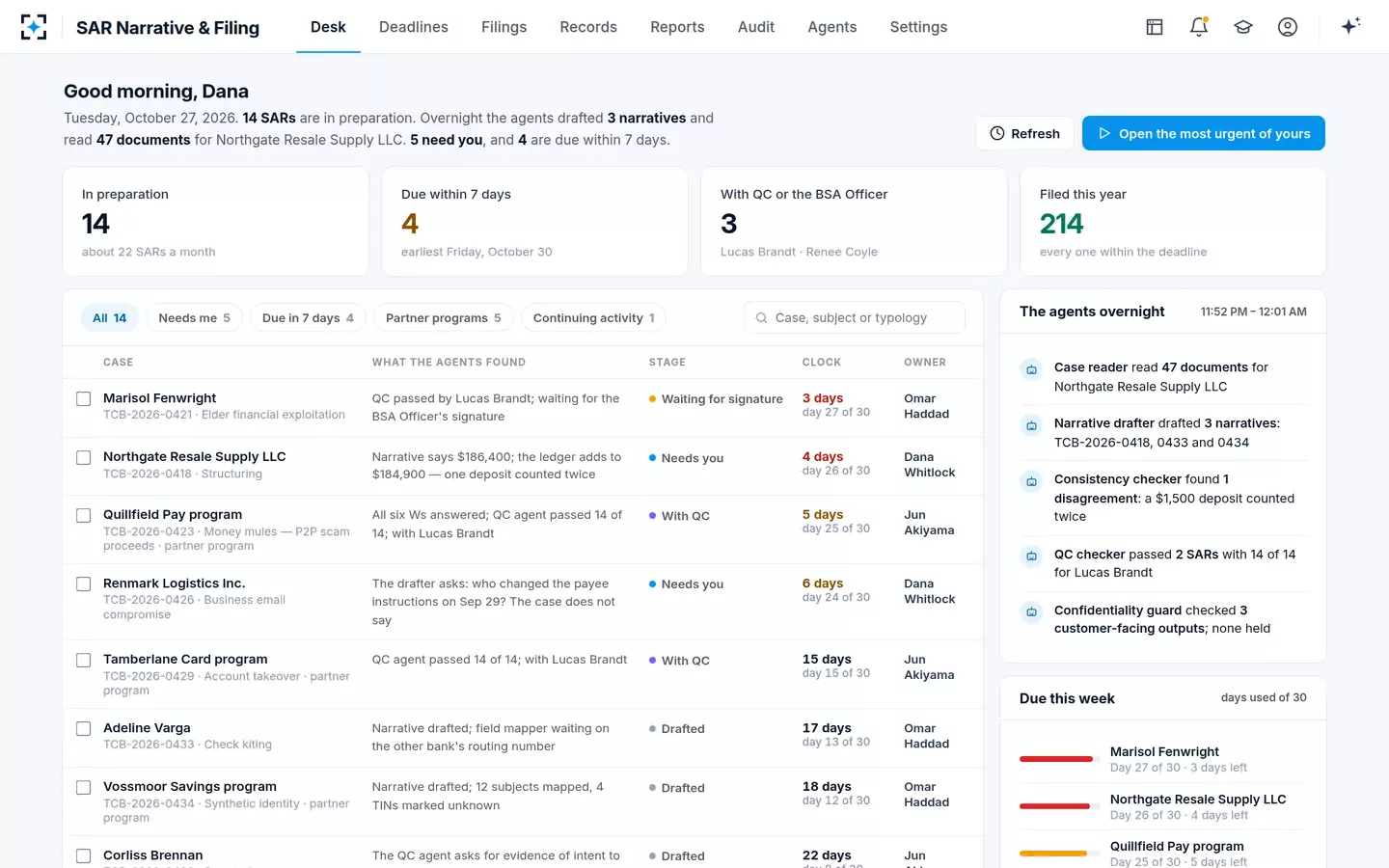
The analyst's desk: cases ranked by days left, with what the agents found
What to look for in SAR software
Look for what it does to the copies and the clock. A product that writes faster but leaves the analyst to tie out the narrative, the fields and the attachment by hand has removed the easy half of the work. A product that shows deadlines but cannot say which cases are blocked, and on whom, is a calendar. Ask to see each point below on one of your own closed cases, not on the vendor's sample.
Nine questions for suspicious activity report software
- Which systems does it read, and which does it write to?
Case management, core banking, imaging, payments, prior CTRs and SARs; BSA E-Filing for submission.
- Does every sentence and field carry its source?
One click from a number to the page it came from.
- What checks the draft, and against what?
A separate check against the systems of record, not the extracts the drafter read.
- Who decides when the draft and the records disagree?
A named person, with a reason code the signer sees.
- How does it count the clock?
From the determination, with 30 and 60 days fixed and escalation points the bank sets.
- Can one person prepare, review and sign the same SAR?
The answer should be no, enforced by the system.
- How does it keep a SAR off customer-facing screens?
Holds, notes, statuses and file names are where disclosures happen.
- What does it keep for five years?
The SAR, the supporting documents identified as such, and the trail of who did what.
- How do we test it before we rely on it?
A back-test on SARs already filed, scored by our own reviewers.
Where SAR Narrative & Filing sits among SAR software
The solution sits after monitoring and investigation and before BSA E-Filing. It reads the case and the systems the case draws on, drafts the narrative and the FinCEN SAR fields with a source for each, checks every amount, count, date and name three ways, runs the bank's QC checklist, and submits only after the BSA officer signs. It also keeps the clock: every open case shows its day and its due date, and escalates at the days the bank sets. The design target is that every SAR has every amount, date and name checked three ways before signature.
It does not monitor transactions or replace case management; it works from their output. It does not decide whether to file. And it is not a substitute for validation: banks should expect model risk or internal audit to test it, which is why we suggest starting with a pilot on fifty SARs you already filed. For how the drafting and checking are kept apart, see why a SAR narrative generator should never check its own work.
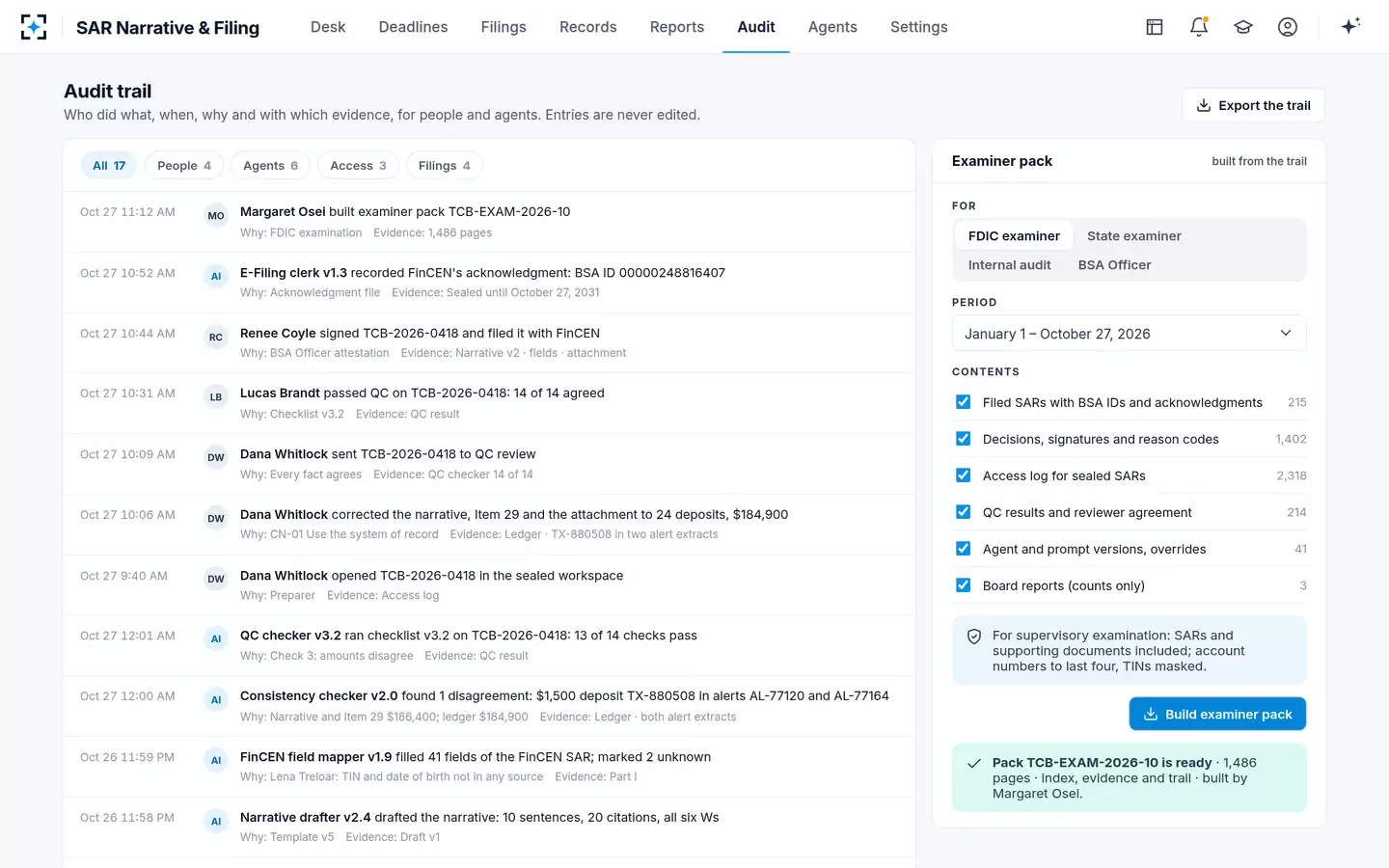
An examiner pack built from the trail, not assembled for the exam
Questions people ask
How many SARs are filed each year?
About 4.8 million in fiscal 2025, across all filer types, up from 4.3 million in fiscal 2022, according to FinCEN's Year in Review. Filing is concentrated: the ten largest filers accounted for about 45% of fiscal 2024 SARs.
Should SAR writing be outsourced?
It can be, and banks do it for backlogs and lookbacks, but the bank stays responsible for every SAR it files and the decision to file stays inside the bank. The contractor acts as the bank's agent for confidentiality purposes, and the 2023 interagency third-party guidance applies to the relationship.
Can SAR filing be automated?
Large parts can: gathering the evidence, drafting the narrative and fields, checking them against the bank's records and building the filing. The decision to file, the review and the signature should stay with people, and FinCEN's rules still require the bank to stand behind the content.
Does BSA E-Filing keep a copy of the SAR?
No. FinCEN's FAQ says BSA E-Filing does not keep records for filers, and FinCEN will not send back a copy of a filed report. The bank must save its own copy before submitting and keep it, with the supporting documents, for five years.
What share of BSA compliance cost is SAR work?
In GAO's 2020 study of 11 banks, suspicious activity reporting averaged 28% of direct BSA compliance costs, behind customer identity verification at 29%. GAO notes the sample is not generalizable, but the costs weighed more on the smallest banks.
What is a suspicious activity report system?
Usually the set of tools a bank uses to move from an alert to a filed SAR: monitoring, case management, the SAR form and BSA E-Filing. FinCEN's own system, BSA E-Filing, is the end of that chain and the only way a SAR reaches FinCEN.