A SAR narrative generator is software that drafts the narrative section of a suspicious activity report from the case: the alerts, the account activity, the investigator's notes and the customer profile. Most now use a large language model, and the prose they produce is fluent. Fluency is not the risk. The documented failure of generated narratives is a detail that is not in the case, written in the same confident voice as the details that are, and the only reliable defence is a check that the generator does not perform on itself. Botminds' SAR Narrative & Filing separates the two: one agent drafts and cites every sentence, a different agent compares every amount, date and name with the bank's systems of record and can only report a disagreement, never settle it, and people decide, review and sign.
The examples come from a fictional sample bank, Tessaly Community Bank, and its structuring case against Northgate Resale Supply LLC. Research and regulatory sources are linked where they appear.
Writer and checker: two agents, two jobs, two different sources
The drafter: The case: alerts and their extracts, deposit tickets, teller notes, wires, letters, the customer profile.
The checker: The narrative, the FinCEN SAR fields and the systems of record: core banking, payments hub, CTR filings.
The drafter: Sentences in an introduction, body and conclusion, each with the question it answers and its citations.
The checker: A table of facts across three columns, each marked agrees or disagrees, with the cause of each disagreement.
The drafter: Must not write a fact without a citation.
The checker: $0 on amounts; counts, dates, names and branches must match exactly.
The drafter: Send, file, or write "see attached".
The checker: Resolve a disagreement or choose which number is right.
The drafter: A question when no source answers who, what, when, where, why or how.
The checker: The disagreement and its cause, for the analyst to correct from the record or override with a reason.
What is a SAR narrative generator?
A SAR narrative generator turns case data into the free-text narrative of a FinCEN SAR, and three designs are sold under the name. The oldest is a template: fields from the case system dropped into fixed sentences. It cannot invent anything, and it cannot explain anything either; the "why" section reads like the alert rule that fired. The second is a single model prompted with the case: it writes well, and everything it writes, true or not, arrives in one pass. The third splits the work among agents with separate jobs, and adds checks between them.
The search term people use for what they want is telling: "SAR narrative generator with audit trail". What a BSA officer needs is not a paragraph but a paragraph that can be defended line by line to a reviewer, an examiner and, years later, an investigator. The filing instructions set the bar for that paragraph: "Filers must provide a clear, complete, and concise description of the activity, including what was unusual or irregular that caused suspicion" (FinCEN SAR Filing Instructions, April 2026). A generator is worth what it does to meet that sentence, and to prove it.
Can AI write a SAR narrative? What the research shows
It can write one; the open question is whether every fact in it is true. The most detailed public study of generated SAR narratives is a 2025 paper by researchers at a large payments company, posted on arXiv and not peer reviewed. Testing a baseline in which one model drafted the narrative from the case data, the authors found that "the LLM invented details such as fabricated interactions, spurious transaction events, and contextually unsupported notes, even when explicitly instructed not to add information" (Naik et al., arXiv:2509.08380).
The same paper names the second failure, which matters more to a manager's budget: "Although drafting appeared rapid, the required manual validation and correction nullified any time benefits, shifting the burden to investigators." A generator that writes in ten seconds and needs an hour of line-by-line checking has moved the work, not removed it. The authors' answer was to break the job into specialised agents with a validation step and keep investigators reviewing every draft.
Although drafting appeared rapid, the required manual validation and correction nullified any time benefits.
Naik et al., Co-Investigator AI, arXiv:2509.08380 (2025), on a single-model baseline
Banks are already using these tools. Treasury's December 2024 report on AI in financial services, summarising responses to its request for information, records that "Generative AI has been deployed to complement an investigation platform in collating and summarizing data and automating report creation and filing" (U.S. Treasury, Artificial Intelligence in Financial Services). That is a statement by respondents, not a Treasury finding about quality, but it settles the question of whether the practice exists.
Why the generator must not check its own work
A model asked to check its own draft reads the same inputs the same way, so it confirms its own mistakes. The failure that matters most in SAR narratives is not a misspelt name; it is a number that is internally consistent and wrong, because the inputs were wrong in a way the drafter could not see. Only a check against a different source finds it.
The sample case has exactly that error. Northgate's cash deposits were caught by two monitoring alerts whose date windows overlapped: AL-77120 ran from September 2 to September 24 and AL-77164 from September 24 to October 8. A $1,500 cash deposit at the East Fenwick branch on September 24 sat in both. The draft added the two alert extracts, 15 plus 10 deposits, $113,200 plus $73,200, and wrote that the subjects made 25 deposits totalling $186,400. The FinCEN field for the amount involved said $186,400 too. Narrative and fields agreed with each other perfectly.
A self-check would have passed it: the sentences are cited, the arithmetic is right, the field matches the prose. The core banking system's account history, which the drafter never added up, holds 24 deposits and $184,900. The consistency checker found the gap at midnight because its job is to read that system and compare, and it named the cause: one deposit, two alerts. This is the reason the generator and the checker must be separate agents with separate sources. Separation of duties is an old control. It applies to agents for the same reason it applies to people.
One cause, two disagreements: the checker reads the bank's records, not the draft's
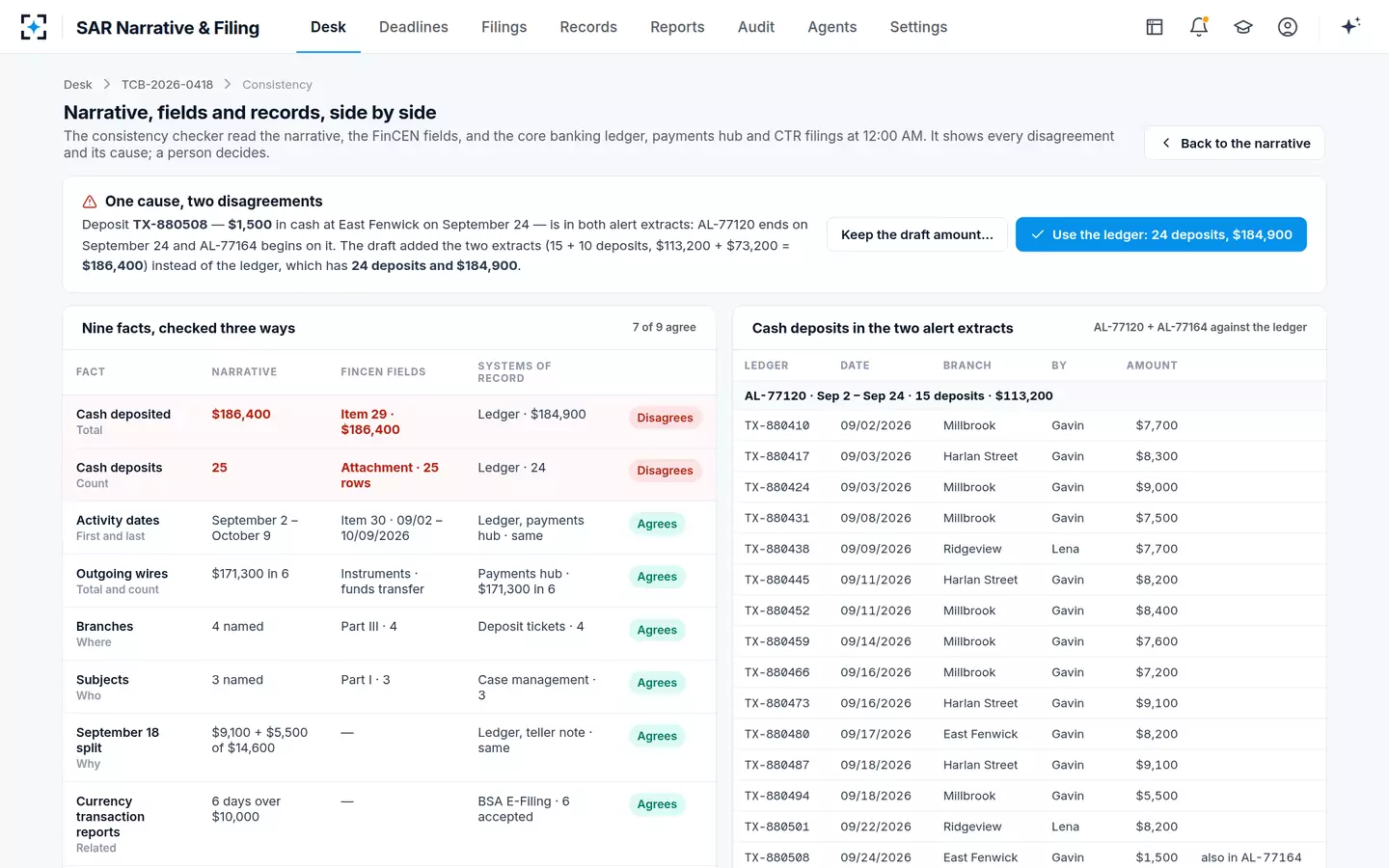
The checker's tolerance on amounts is $0, and it has no button of its own: the two choices on the banner belong to the analyst.
What an independent check compares: narrative, fields, records
An independent check compares three versions of each fact: what the narrative says, what the FinCEN SAR fields say, and what the bank's systems of record say. Each copy is a chance to drift. The analyst writes amounts in the prose, keys them again into Part II, and builds a transaction table for the attachment; the reviewer then checks all three by eye. A checker that reads all three and lines them up turns that review into a list of disagreements.
The facts worth checking are the ones an investigator will use first: total amount and count of transactions, the first and last dates (Item 30), the outgoing payments and their total, the branches where the activity happened, the subjects and their identifiers, and the single events that carry the reason for suspicion. In the sample case the checker lined up nine. A tolerance of $0 on amounts sounds strict until you remember that Item 29 goes into FinCEN's database, where investigators search it; a difference of $1,500 between narrative and field is a question someone will have to answer later.
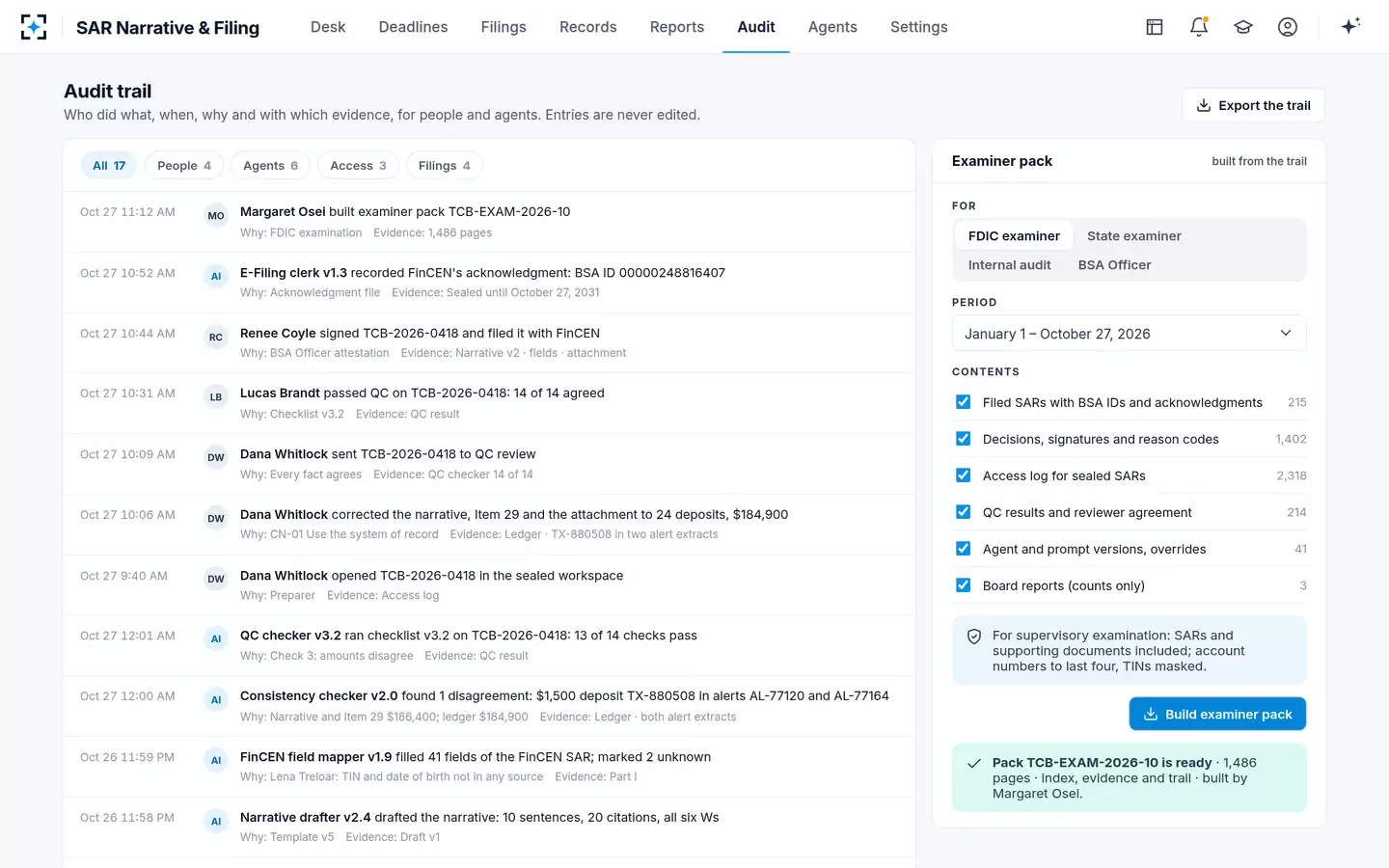
The check does not decide. When the draft and the system of record disagree, there may be a reason the draft is right: a deposit posted to the wrong account, a reversal. So the analyst chooses, either correcting from the record with a correction code or keeping the draft with an override code that the BSA officer sees at signature. In the Northgate case Dana Whitlock, the analyst, chose the record at 10:06 AM, and the narrative, the amount field and the attachment changed together.
The maker-checker chain in SAR Narrative & Filing
Agent
Case readerReads the case file and cites every value to its page; a value read below 0.90 confidence goes to the analyst.
Never: reads outside the case.
Agent
Narrative drafterWrites the introduction, body and conclusion, each sentence with its citations and the question it answers.
Never: writes a fact without a citation.
Agent
Consistency checkerCompares narrative, FinCEN fields and systems of record and names the cause of each disagreement.
Never: resolves a disagreement.
A person decides
BSA analystCorrects from the system of record or overrides with a reason code, then sends to review.
Agent
QC checkerRuns the bank's checklist and FinCEN's narrative guidance, citing evidence for each check.
Never: passes QC.
A person decides
Quality reviewer, then BSA officerThe reviewer passes or returns with a code; the officer signs and files.
Who is responsible for an AI-drafted SAR?
The bank is, exactly as it is for a SAR written by hand. Nothing in the SAR rule moves responsibility to a tool, and the examination manual's model gives the last word to a named decision maker, an individual or a committee (FFIEC manual, SAR Decision Making). The person who attests and submits through BSA E-Filing is attesting to the content, whoever drafted it.
The Wolfsberg Group's principles for AI in financial crime compliance put the same point in operating terms. Under proportionate use, they ask an institution to weigh how serious the financial crime risk is against the error rate of the AI tool, to validate how the tool is used and configured on a regular cycle, and to keep watching that it performs consistently once it is live (Wolfsberg Principles, 2022; the questions to ask a case management vendor turn the principles into a checklist). For a SAR generator, the margin for error on a filed amount is close to zero, which argues for an exact check rather than a sampled one.
In practice responsibility needs names on the screen. In the sample bank three different people prepare, review and sign every SAR, and the system will not let one person hold two of those roles on the same report. The reviewer can pass or return a SAR with one of five reason codes but cannot edit the narrative, so the preparer remains the author of record and the reviewer remains independent of it.
Every step by a person or an agent, on one trail
What do regulators say about AI drafting SARs?
No U.S. regulator has issued a rule specific to AI-drafted SARs, and the documents that touch the question are either guidance that excludes it or proposals that are not yet in force. The SAR rule and the filing instructions describe what the narrative must contain, not who or what writes it. That leaves the bank's ordinary obligations, complete and accurate reports, effective internal controls, and an independent test of the process, as the standard an AI drafter has to meet.
Two 2026 documents set the current frame. The revised interagency model risk guidance of April 17, 2026 leaves generative and agentic AI out of its scope altogether, calling both novel and still changing fast (OCC Bulletin 2026-13); the agencies say they plan a request for information on AI, which had not been published as of late October 2026. FinCEN's April 2026 proposal for AML/CFT programs would tell institutions that trying new technology responsibly will not, on that ground alone, add to their risk of enforcement (91 FR 18704; the guide to the proposal covers it in full), but it is a proposal: comments closed in June 2026 and no final rule has been published.
What the documents say about AI in SAR work, and their status in October 2026
| Document | What it says that matters here | Status |
|---|---|---|
| SAR rule, 31 CFR 1020.320, and FinCEN filing instructions (April 2026) | What a SAR must contain and when; silent on how it is drafted | In force |
| Interagency model risk guidance (OCC 2026-13, Fed SR 26-2) | Generative and agentic AI are outside its scope; an AI request for information is planned | In force; RFI not yet issued |
| FinCEN AML/CFT program proposal, 91 FR 18704 | Names generative AI as an innovative approach; no added enforcement risk from responsible use | Proposed; not final |
| Treasury, AI in Financial Services (Dec 2024) | Respondents report generative AI automating report creation and filing | Report; not guidance |
| Wolfsberg AI/ML Principles (2022) | Weigh margin for error against risk; validate and monitor regularly | Industry standard-setter; voluntary |
Where the agencies have been specific, it is about content, not authorship. FinCEN alerts ask filers to put key terms in the narrative so that reports can be found: the 2024 deepfake alert, for example, asks for "FIN-2024-DEEPFAKEFRAUD" in field 2 and the narrative (FinCEN Alert FIN-2024-Alert004). A generator that does not know which alerts a case matches will leave the term out, and a checker should test for it.
What a SAR narrative generator with an audit trail must record
An audit trail for a generated narrative has to answer, for each sentence, where it came from, which version of which agent wrote it, and which person accepted it. The examiner's question about a SAR is rarely "was this written by AI?"; it is "how do you know this number is right, and who decided?" The trail is the answer to that question, built while the work is done rather than reconstructed for the exam.
Eight things to ask a SAR narrative generator to show on one of your cases
- A source for every sentence
Click a sentence, see the page and the passage. A sentence without one should block signature.
- A check against the systems of record
Not the case extracts the drafter read: the core system, the payments hub, the CTRs already filed.
- Disagreements shown, not fixed
The checker names the cause; a person chooses, with a reason code.
- "Unknown" instead of a guess
Missing identifiers marked unknown in the critical fields, never filled with a plausible value.
- Separate preparer, reviewer and signer
Enforced by the system, not by a policy line.
- Agent and prompt versions on every action
So a change in the drafter can be tied to a change in output, and model risk can review it.
- Advisory key terms tested
When a case matches a FinCEN alert or advisory, the narrative carries its key term.
- An examiner pack from the trail
Who did what, when, why and with which evidence, without re-opening the case file.
Where SAR Narrative & Filing fits, and where it does not
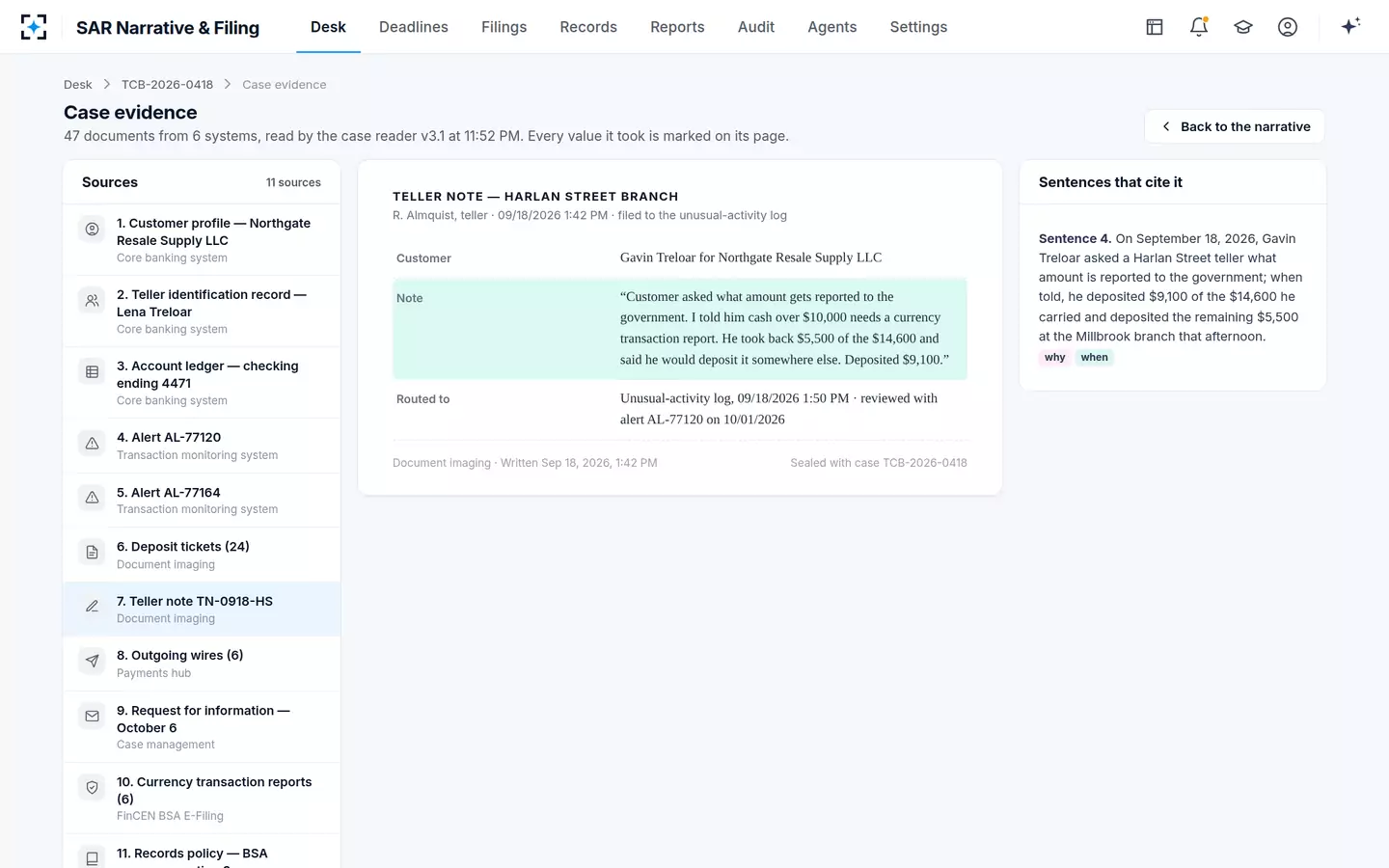
The solution fits the part of the SAR process that starts after a person has decided the activity is suspicious: the case is in, the narrative and fields have to be written, checked, reviewed, signed and filed inside the 30-day clock. Its agents read the documents the case already holds, 47 from six systems in the Northgate example, and write the five Ws paragraph by paragraph, with the coverage of each question counted.
It does not decide whether to file; that stays with the bank's decision maker, and the BSA officer can record a decision not to file with a reason code. It does not replace transaction monitoring or case management; it reads their output. It reads only inside the case, so a narrative can be no better than the evidence gathered, and when a question has no answer in the case the drafter asks the analyst rather than filling the gap. And it is not a way to skip the bank's own validation: the sensible first step is to run it on SARs already filed and let your reviewers score the drafts, as described in a pilot on fifty SARs you already filed.
Eleven sources from six systems, each cited line marked
Questions people ask
Is it allowed to use AI to write SARs?
No rule prohibits it. The SAR rule and FinCEN's filing instructions set what a SAR must contain and when it is due, not how it is drafted, and the bank remains responsible for the content of every report it files under its own attestation.
Does FinCEN accept AI-generated SARs?
FinCEN accepts SARs that pass BSA E-Filing's checks and is not told how the narrative was written. What it expects of the narrative is a "clear, complete, and concise" description, in English, of what was unusual and why, and the filer's attestation covers it.
How do you check an AI-written SAR?
Compare every amount, count, date and name in the narrative with the FinCEN fields and with the bank's systems of record, not with the case extracts the drafter read. Then review it against the bank's checklist as you would any SAR, and keep the reviewer separate from the preparer.
Can a SAR narrative generator invent facts?
Yes. The 2025 arXiv study of a single-model baseline found invented interactions and transaction events even when the model was told not to add information. Citation per sentence makes an invented fact visible; a check against the systems of record catches a wrong fact that is cited.
Is generative AI covered by model risk guidance?
Not by the current interagency guidance: OCC Bulletin 2026-13 and Fed SR 26-2, issued April 17, 2026, place generative and agentic AI outside their scope. The agencies have said they plan a request for information on AI, so banks govern these tools under their own controls for now.
Who signs an AI-drafted SAR?
The same person who signs any SAR at the bank, usually the BSA officer. In SAR Narrative & Filing the officer signs only after a different person has reviewed it, and the filing agent cannot submit without that signature.