The FFIEC SAR quality guidance is the "SAR Quality" passage of the FFIEC BSA/AML Examination Manual and its Appendix L, "SAR Quality Guidance", which the manual says exists "to assist banks in writing, and assist examiners in evaluating, SAR narratives". Its standard is short: banks "are required to file SARs that are complete, thorough, and timely", with all known subject information and a narrative that describes the activity and the reason it is suspicious. The detail sits in FinCEN's 2003 narrative guidance and the April 2026 filing instructions. Turned into a scoring sheet, those documents give a QA team a measure of quality that does not depend on how many SARs the bank files. Botminds' SAR Narrative & Filing runs a version of that sheet on every draft before review, and a person passes or returns each SAR.
The examples come from a fictional sample bank, Tessaly Community Bank, and its checklist of 14 checks; the scoring sheet below is our synthesis of the public guidance, with each element's source named.
A SAR quality scoring sheet: fifteen elements from the FFIEC and FinCEN guidance
NarrativeWho
Every subject named, with role, occupation or business, identifiers and relationships to each other.
FinCEN 2003, "Who"
Weight 2
NarrativeWhat
The instruments and mechanisms, and the flow of funds from source to application.
FinCEN 2003, "What"
Weight 2
NarrativeWhen
When the activity was first noticed and how long it ran; individual dates and amounts, not only a total.
FinCEN 2003, "When"
Weight 2
NarrativeWhere
Each branch or location involved, and any foreign jurisdiction or other institution.
FinCEN 2003, "Where"
Weight 1
NarrativeWhy
Why the activity is unusual for this customer, against expected activity and similar customers.
FinCEN 2003, "Why"
Must pass
NarrativeHow
The method, end to end: structured deposits and the wires that followed them, for example.
FinCEN 2003, "How"
Weight 2
NarrativeOutcome
Whether each transaction was completed or only attempted, and who benefited and how.
Filing instructions 2026, Part V
Weight 1
NarrativeShape
Introduction (purpose, case number, red flags), chronological body, conclusion (actions taken, where records are).
FinCEN 2003, organizing
Weight 1
AccuracyAmounts and dates tie out
Narrative, Item 29, Item 30 and the attachment agree with each other and with the bank's records.
FFIEC, SAR Quality; FAQ 23
Must pass
AccuracyCritical fields
Each critical field completed, or its "Unknown" box checked; no guessed identifiers.
FinCEN SAR FAQ 1
Must pass
AccuracyActivity categories
The Part II boxes match the narrative; "Other" only where no category applies.
FFIEC, Identifying Underlying Crime
Weight 1
FormSelf-contained
No "see attached", no tables in the text; any CSV attachment is described in the narrative.
FFIEC; filing instructions 6.1.6
Must pass
FormKey terms
The advisory or alert key term, where the case matches one.
FFIEC, SAR Quality
Weight 1
FormNothing that must stay out
No legal disclaimers; no mention of a grand jury subpoena or national security letter.
Filing instructions; FFIEC
Must pass
TimelinessOn the clock
Filed within 30 days of the determination, or 60 when no suspect was identified.
31 CFR 1020.320(b)(3)
Must pass
What is the FFIEC SAR quality guidance?
It is a short passage in the manual's Suspicious Activity Reporting section, backed by an appendix and by FinCEN's own guidance, and its message is that the narrative carries the SAR. "Because the SAR narrative section is the only area summarizing suspicious activity, the section, as stated on the SAR, is 'critical.' Thus, a failure to adequately describe the factors making a transaction or activity suspicious undermines the purpose of the SAR" (FFIEC manual, SAR Quality). The same passage warns that "inaccurate information on the SAR, or an incomplete or disorganized narrative, may make further analysis difficult, if not impossible."
The manual then sends readers to two places. Appendix L, the "SAR Quality Guidance", is written for both the writer and the examiner. And a footnote lists FinCEN's own filing guidance, the electronic filing requirements and a 2007 paper on common errors. The working detail most banks use comes from FinCEN's November 2003 "Guidance on Preparing a Complete & Sufficient Suspicious Activity Report Narrative" and the Part V checklist in the current filing instructions, released in April 2026.
The guidance is a standard, not a template. It does not prescribe a length, a set of headings or a form of words. That is why a bank needs its own sheet: the guidance says what a complete SAR contains, and the sheet turns that into checks a reviewer can apply the same way on every report.
What makes a good SAR? Complete, accurate, timely, and inside the SAR
A good SAR lets an investigator who has never seen the case understand who did what, with which money, and why the bank thinks it is suspicious, from the report alone. The manual's four tests are in its own words: complete, thorough, timely, and "included within the SAR". The last one is easy to miss. A CSV attachment of transactions is allowed, up to one megabyte, and "will be considered a part of the narrative and is not considered to be a substitute for the narrative. For example, narratives should not simply state 'see attachment'" (FFIEC manual).
Accuracy covers the form as well as the prose. For each field marked critical, FinCEN's FAQ says institutions "must either provide the requested information or affirmatively check the 'Unknown' (Unk.) box" (FinCEN SAR FAQs, item 1), and on the amount involved it is categorical: "Never enter '0' in the Item 29 amount field under any circumstance" (item 23). A narrative that says one total while Item 29 says another fails the accuracy test even if both are close.
The scoring sheet: fifteen elements in four groups
The sheet at the top of this guide groups the guidance into narrative completeness, accuracy, form and timeliness. Eight narrative elements come from the 2003 guidance's five Ws, its "how", and its suggested introduction, body and conclusion, plus two items the 2026 instructions add to their Part V checklist: whether each transaction was completed or only attempted, and who benefited and how (Filing instructions, Part V).
Six elements are marked "must pass" because no total can make up for them: a SAR whose "why" is missing has no reason to exist, one whose amounts disagree with the bank's records will mislead, one that leans on an attachment or a guessed identifier is incomplete by FinCEN's own terms, one that mentions a subpoena can compromise an investigation, and a late one is a violation. The others carry weights, so a narrative thin on "where" loses points without being returned. The weights are a suggestion. Set them in the procedure and keep them stable, so a score this quarter means the same as a score last quarter.
The sheet scores a SAR, not an analyst, and it scores what is on the page. FinCEN's 2003 commentary on one weak narrative makes the point: the bank "responds to the checklist found in the SAR instructions", but "fails to provide a chronological and complete account of the violation of law in order to explain the nature of the suspicious activity" (FinCEN, 2003, insufficient example 2). Ticking every element in a list is not the same as telling the story the list describes, and a scorer should mark it down.
What are common SAR narrative errors?
The same three gaps recur: no dates and amounts for individual transactions, no account of where the money went, and no description of the customer or why the activity is unusual for them. FinCEN's 2003 guidance printed three insufficient depository-institution narratives with a commentary on each, and every one of the three commentaries names all three gaps. The figure counts them.
Three weak narratives, the same three gaps
Accuracy errors get less space in the guidance, and they have a different source: copying. The analyst reads a total from one place, keys it into Item 29, types it into the narrative, and builds the attachment from a third extract. When the extracts overlap or one has been refreshed, the copies drift. The sample case had that error: one $1,500 deposit was in two alert extracts, so the draft said 25 deposits and $186,400 while the bank's records held 24 and $184,900. Element 9 exists for exactly this, and it is the one a reviewer reading prose is least likely to catch.
How do examiners review SAR quality?
Examiners review the process first and sample individual SARs to test it. The manual tells them to "focus on evaluating a bank's policies, procedures, and processes to identify, evaluate, and report suspicious activity", and also that "examiners should review individual SAR filing decisions to determine the effectiveness" of the process. On narratives specifically: "By their nature, SAR narratives are subjective, and examiners generally should not criticize the bank's interpretation of the facts. Nevertheless, banks should ensure that SAR narratives are complete, thoroughly describe the extent and nature of the suspicious activity, and are included within the SAR" (FFIEC manual).
The OCC's community bank procedures, in force for examinations beginning February 1, 2026, list among their example tests "Determining whether reports, such as SARs and CTRs, are complete and accurate", alongside sampling alerts and reviewing the SAR decision process, with sample sizes set by the bank's risk profile (OCC Bulletin 2025-37, attachment). An examiner who pulls ten SARs is applying a version of this sheet by hand. A bank that has scored every SAR before filing knows what the examiner will find.
The same guidance, read at two different moments
Quality reviewer, before filing: Every SAR, before the BSA officer signs.
Examiner, after filing: A sample sized to the bank's risk profile.
Quality reviewer, before filing: Is this SAR complete, accurate and ready to sign?
Examiner, after filing: Does the bank's process produce complete, accurate SARs?
Quality reviewer, before filing: May challenge it and return the SAR.
Examiner, after filing: Generally should not criticize it.
Quality reviewer, before filing: A return with a reason code, fixed before filing.
Examiner, after filing: A finding on the program, and possibly a corrected or amended SAR.
Quality reviewer, before filing: The case file and the bank's systems of record.
Examiner, after filing: The filed SAR, the case file, the bank's procedures and QC results.
How do you QA a SAR without rewriting it?
Score it, return it with a reason, and let the preparer fix it. A reviewer who edits the narrative becomes its co-author, and the bank loses both the independent check and the record of what the preparer got wrong. A return code per failed element keeps the reviewer independent and turns every return into data: five returns for a missing "why" in a month is a training need; five for disagreeing amounts is a process problem upstream.
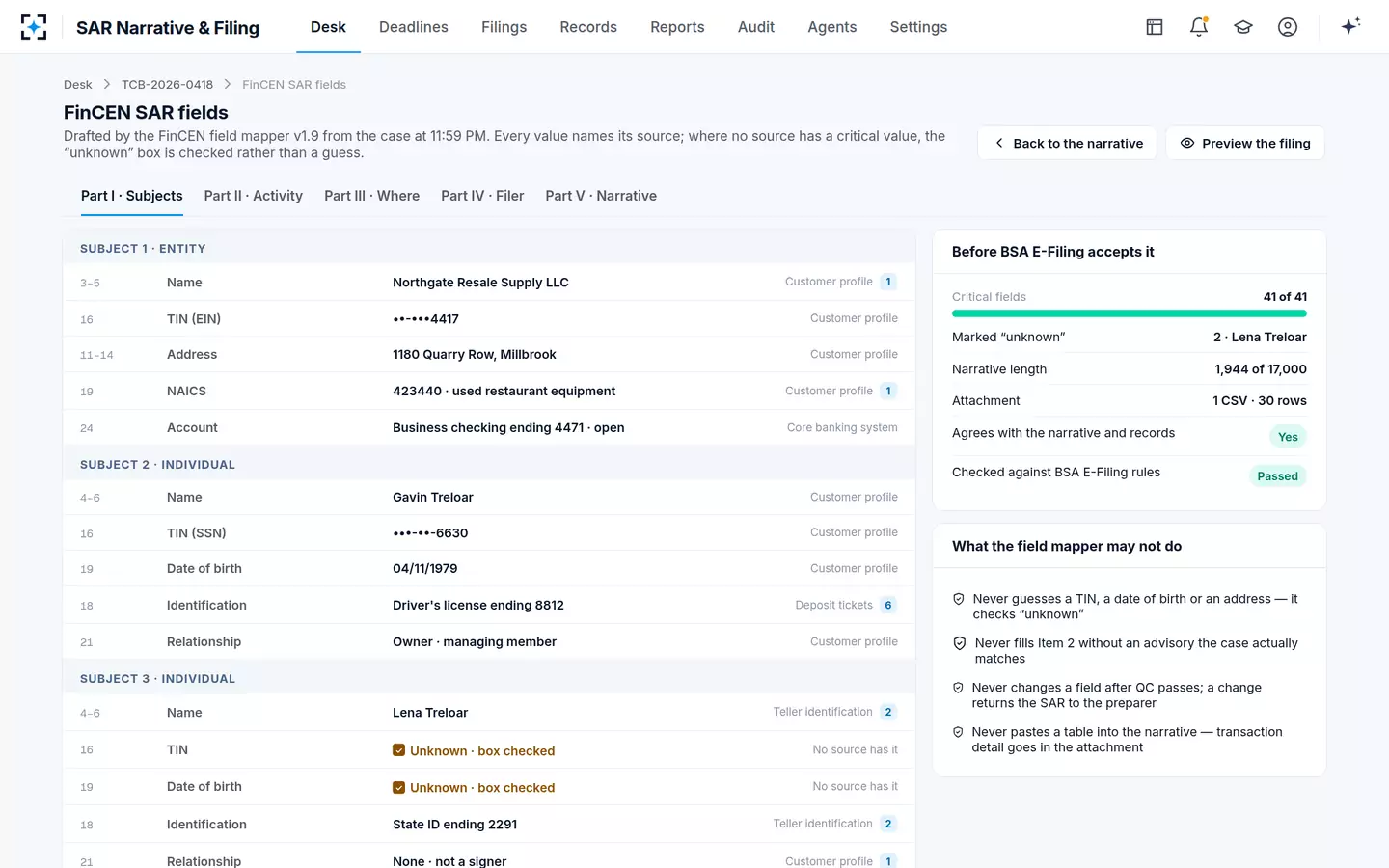
The sample bank uses five return codes: a W missing or thin, fields and narrative disagree, basis for suspicion not shown, activity category does not match, and wording that could reveal the report. Each maps to elements on the sheet. Its reviewer can agree or disagree with each automated check, and can pass or return, but cannot type in the narrative.
The checker finds the disagreement; a person decides
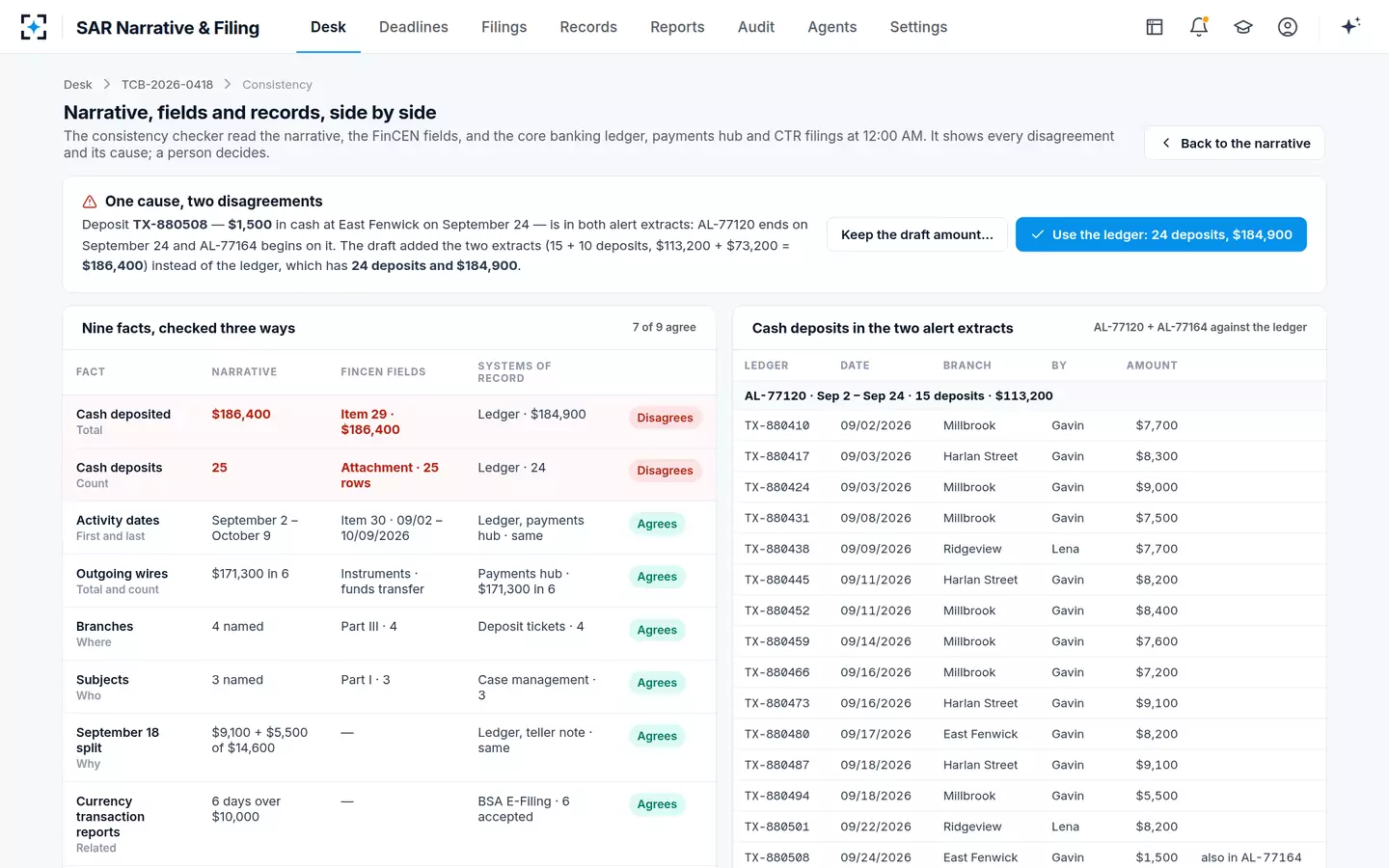
The check that changed most in 2025 is structuring. Since the October 9, 2025 interagency FAQs, cash near $10,000 alone does not require a SAR; the bank must know, suspect or have reason to suspect the transactions were designed to evade reporting. A quality sheet should therefore ask for the evidence of intent, not the amounts. The October 2025 SAR FAQs sets out the four changes.
What SAR quality markers can a bank track?
Track what the sheet finds, not how many SARs are filed. Volume says how busy the program is; it says nothing about whether an investigator could use the reports. The Wolfsberg Group, a standard-setter of global banks, says the best indicator of quality is direct feedback from government authorities, and where that is limited, institutions "should consider factors like the complexity of the investigation, the identification of network activity, or reporting in identified priority areas, as indicators of quality" (Wolfsberg Group, Statement on Effective Monitoring, 2024).
Feedback is scarce, and filers say so. In GAO's interviews for a 2024 report, representatives "in all seven interviews" suggested FinCEN find ways for law enforcement to give feedback "on a broader scale and in a timelier way", saying "feedback on whether their SARs were helpful or not would help them improve" (GAO-24-106301). Until that arrives, the markers below are what a bank can measure for itself.
Eight SAR quality markers that do not count SARs
- Must-pass failures found before filing
By element. The aim is that none survive to the signature.
- Return rate by reason code
Which elements fail, for whom, and whether the rate falls after training.
- Disagreements between narrative, fields and records
Found by a check before review; each one is an error that did not reach FinCEN.
- Corrected and amended SARs filed
Per hundred SARs; a falling rate means fewer errors were filed.
- Days from determination to filing
The distribution, not the average, and the share filed in the last three days.
- Key terms on advisory-matched cases
Share of SARs matching a FinCEN alert or advisory that carry its term.
- Network and priority-area reporting
Share of SARs naming related subjects or touching a national AML/CFT priority.
- Requests for supporting documentation
Law enforcement follow-ups, the nearest thing most banks get to feedback.
How SAR Narrative & Filing runs the sheet before signature
The solution runs the bank's own checklist on every draft, with FinCEN's narrative guidance and the October 2025 FAQ checks, and cites the evidence for each result; in the sample bank, the Northgate SAR showed 14 of 14 checks passing after the analyst's correction, 13 of 14 before it. The QC checker agent never passes a SAR. Lucas Brandt, the sample bank's reviewer, agreed check by check and passed it at 10:31 AM; he could have returned it with a code.
Two elements on the sheet are hard to test by reading and easy to test by comparing, and the solution does them before QC. A consistency checker compares the narrative, the FinCEN fields and the bank's systems of record for every amount, count, date and name. And a field mapper checks each critical field and marks "unknown" where no source holds the value, instead of guessing. How to write a SAR narrative walks the narrative elements through one case, paragraph by paragraph.
Critical fields: completed from a source, or marked unknown
Questions people ask
What is Appendix L of the FFIEC BSA/AML manual?
Appendix L is the manual's "SAR Quality Guidance". The SAR section says it is there "to assist banks in writing, and assist examiners in evaluating, SAR narratives", and it builds on FinCEN's 2003 guidance on complete and sufficient narratives.
What does FinCEN consider a complete SAR narrative?
One that answers who, what, when, where and why, describes how the activity was carried out, and is organised as an introduction, a chronological body and a conclusion. The April 2026 instructions add whether transactions were completed or attempted and who benefited, and ask for a description of the supporting documentation the bank keeps.
Do examiners criticize how a bank interprets the facts in a SAR?
Generally not: the manual says narratives are subjective and examiners "generally should not criticize the bank's interpretation of the facts". They do expect the narrative to be complete and within the SAR, and they test samples for completeness and accuracy.
Can a SAR narrative refer to an attachment?
It can describe one but not lean on one. A single CSV file of up to one megabyte may be attached for transaction detail; its contents must be described in the narrative, and the manual says narratives "should not simply state 'see attachment'".
What should a SAR QC checklist include?
The five Ws and how, completed or attempted, who benefited, amounts and dates that agree with Items 29 and 30 and the bank's records, critical fields completed or marked unknown, matching activity categories, advisory key terms, and filing within 30 or 60 days of the determination. Mark the items no total can rescue as must-pass.
How often should SAR quality be reviewed?
Every SAR before filing, by someone other than the preparer, and a sample after filing through independent testing. The FFIEC manual sets no fixed frequency for independent testing; the OCC's community bank procedures ask examiners to consider whether it covers SAR decision making and SAR completion and filing.