The FinCEN SAR FAQ of October 2025, issued on October 9, 2025 by FinCEN with the Federal Reserve, the FDIC, the NCUA and the OCC, answers four questions, and on each the answer is no. A transaction near the $10,000 currency reporting threshold does not by itself require a SAR. A bank is not required to run a separate review after filing a SAR to see whether the activity continued. The Day 0, 30, 120 and 150 schedule for continuing-activity SARs is optional. And there is no requirement to document a decision not to file. The FAQs say they "do not alter existing BSA legal or regulatory requirements or establish new supervisory expectations", and they do not: what they remove are expectations that had grown up around the rules. Botminds' SAR Narrative & Filing builds the four answers into its checks and settings, so a bank can apply them case by case.
The examples come from a fictional sample bank, Tessaly Community Bank. Quotations are from the FAQs and the other documents linked where they appear.
Four habits, four answers: SAR practice before and after October 9, 2025
What many banks did: File a SAR on repeated cash deposits just under the threshold, whatever else is known.
What the October 2025 FAQs say: No SAR is required absent knowledge, suspicion or reason to suspect the transactions were designed to evade reporting (Question 1).
What many banks did: Run a separate review of the customer or account to see whether the activity continued.
What the October 2025 FAQs say: Not required; risk-based monitoring that is reasonably designed to catch it is enough (Question 2).
What many banks did: Treat the 90-day review and 120-day deadline as mandatory.
What the October 2025 FAQs say: An optional schedule for institutions that elect it; otherwise file as the ordinary deadlines require (Question 3).
What many banks did: Write up every no-file decision, often at length.
What the October 2025 FAQs say: No requirement or expectation to document it; a short statement will usually suffice where a bank chooses to (Question 4).
What did the October 2025 SAR FAQs change?
They changed expectations, not rules. The five agencies say the answers "clarify regulatory requirements related to SARs to assist financial institutions with their compliance obligations while enabling institutions to focus resources on activities that produce the greatest value to law enforcement agencies and other authorized government users of Bank Secrecy Act (BSA) reporting" (SAR FAQs, October 9, 2025). The SAR rule itself, 31 CFR 1020.320, did not change; neither did the $5,000 threshold or the 30- and 60-day deadlines.
What changed is the burden a bank can drop without being told otherwise. Each answer takes a practice that started as advice, sometimes a single line in a 2000 or 2006 FinCEN publication, and says it was never required. That matters because the AML Act of 2020 told Treasury to review whether the processes for "a continuing suspicious activity report" should be "streamlined or otherwise adjusted" (AML Act §6204). The FAQs answer part of that question in practice, and FinCEN wrote the first three into its April 2026 filing instructions.
The answers to these FAQs do not alter existing BSA legal or regulatory requirements or establish new supervisory expectations.
FinCEN, Federal Reserve, FDIC, NCUA and OCC, SAR FAQs, October 9, 2025
Do you need to file a SAR for cash just under $10,000?
Not for the amount alone. Question 1 answers: "No. The mere presence of a transaction or series of transactions by or on behalf of the same person at or near the $10,000 CTR threshold is not information sufficient to require the filing of a SAR. Financial institutions are only required to file a SAR if the institution knows, suspects, or has reason to suspect that the transaction or series of transactions are designed to evade CTR reporting requirements."
Structuring has not become legal or harder to report. The FAQ restates FinCEN's definition: structuring can happen "in any amount, at one or more financial institutions, on one or more days, in any manner", and a series of transactions "need not exceed the $10,000 reporting threshold at any single financial institution on any single day" to qualify. It also says a bank's program "should be designed to detect and report structuring", and a footnote preserves "a financial institution's ability to use appropriately tailored automated monitoring systems". What changes is the narrative: a structuring SAR now has to show the reason for suspicion beyond the amounts, such as a customer asking about reporting, deposits split across branches on one day, or cash far beyond the account's expected activity.
FinCEN's April 2026 filing instructions repeat the Question 1 language in their section on additional reporting and add a sentence: "Appropriate records must be maintained in each case" (FinCEN SAR Filing Instructions, April 2026, 5.7). The CTR obligation is untouched: cash over $10,000 in a business day is still reported on a CTR, and a SAR follows only where there is reason to suspect.
Is a continuing activity review required?
No. Question 2 says "a financial institution is not required to conduct a separate review—manual or otherwise—of a customer or account following the filing of a SAR to determine whether suspicious activity has continued. Financial institutions instead may rely on risk-based internal policies, procedures, and controls to monitor and report suspicious activity as appropriate, provided those internal policies, procedures, and controls are reasonably designed to identify and report such activity."
The FAQ explains how the review came to look mandatory. In October 2000 FinCEN suggested a "general rule of thumb" that "organizations should report continuing suspicious activity with a report being filed at least every 90 days", and "over time, this suggestion has become interpreted as a requirement or expectation" of a separate review. A bank that drops the scheduled review still has to catch continuing activity; it does so through the same monitoring that caught it the first time.
What is the SAR 90-day review, and when should a continuing activity SAR be filed?
The 90-day review is the optional schedule in Question 3, for banks that elect FinCEN's continuing-activity guidance: file the initial SAR by day 30, review the next 90 days, and file a continuing SAR by day 150. With no subject identified, every date moves 30 days later: initial SAR by day 60, the 90-day period ending on day 150, the continuing SAR by day 180. The FAQ is explicit that institutions "are not required to do so and may instead file SARs as appropriate in line with applicable timelines". A bank that does not elect the schedule files a new SAR within 30 days of determining that new activity is suspicious, like any other SAR.
The continuing-activity schedule, for banks that elect it
- Initial SAR dueDay 0–30
- 90-day periodDay 30–120
- Continuing SAR dueDay 120–150
- Initial SAR dueDay 0–60
- 90-day periodDay 60–150
- Continuing SAR dueDay 150–180
Two filing details follow the schedule. Item 30 of a continuing SAR "should include the entire 90-day period starting on the date immediately following the filing of the initial SAR or the date following the end of the previous 90-day period". And the April 2026 instructions say a continuing report puts the 90-day amount in Item 29 and the cumulative amount in Item 31, and should not reproduce earlier narratives. FinCEN updated item 16 of its online SAR FAQ to the same timeline on October 9, 2025 (FinCEN SAR FAQs).
Do you have to document a decision not to file a SAR?
No. Question 4: "There is no requirement or expectation under the BSA or its implementing regulations for a financial institution to document its decision not to file a SAR. FinCEN has previously encouraged, but not required, financial institutions to document the decision not to file a SAR." Where a bank chooses to, "in most cases, a short, concise statement documenting a financial institution's SAR decision will likely suffice", with more for complex investigations.
Three cautions keep this answer from being read too broadly. First, a bank's own policy may still require documentation, and examiners test whether a bank follows its own procedures. Second, an enforcement order can require it: the OCC's January 2024 consent order against Blue Ridge Bank required "procedures for an effective Suspicious Activity Report ('SAR') decision-making process that require documenting individual decisions on whether to file SARs and key facts supporting each decision to not file a SAR" (OCC AA-ENF-2023-68); that order was terminated in November 2025 (AA-ENF-2025-58). Third, a short note is cheap and useful. The manual already expects investigators to write down their conclusions and whether they recommend filing; a sentence of reason on a closed case is what the next analyst reads when the customer comes back.
Does the FFIEC manual reflect the 2025 SAR FAQs?
Not yet in its text, and it says so. The manual's SAR section now opens with a banner saying the section will be updated for the interagency FAQs, and naming the January 2021 and October 2025 FAQs as the most current guidance on continuing-activity SARs, documenting a decision not to file, and keeping a customer after a SAR (FFIEC manual, Suspicious Activity Reporting; the guide to FFIEC manual updates tracks the banner).
Below the banner the older text is unchanged. It still tells banks to document each SAR decision with the specific reason for filing or not, and says that "FinCEN's guidelines have suggested that banks should report continuing suspicious activity by filing a report at least every 90 calendar days." Where the two conflict, the banner settles it: lead with the FAQs. The OCC's community bank examination procedures, in force for exams from February 1, 2026, already point examiners reviewing SAR decisions to Question 4 (OCC Bulletin 2025-37, attachment).
Where each document stands on the four questions, October 2026
| Document | Status | Reflects the FAQs? |
|---|---|---|
| Interagency SAR FAQs, October 9, 2025 | Current guidance from all five agencies | They are the source |
| FinCEN SAR Filing Instructions, April 2026 | Current filing instructions | Yes: Questions 1, 2 and 3 written in |
| FinCEN online SAR FAQ, item 16 | Updated October 9, 2025 | Yes: the optional timeline |
| FFIEC BSA/AML Manual, SAR section | Banner: "to be updated" | Banner only; body text predates the FAQs |
| OCC community bank procedures (Bulletin 2025-37) | Effective for exams from February 1, 2026 | Yes: cites Question 4 |
| A bank's own SAR policy | Whatever the board approved | Only if the bank has updated it |
| Enforcement orders | Binding on the bank named | Not necessarily: an order can require more |
What to change in your SAR procedures, and what to keep
Change the procedure where it requires what the FAQs say is not required, and keep what the bank still needs for its own reasons. Removing a required step is a policy change: it goes through whoever approves the BSA program, and the reason should be written down, citing the FAQ. The checklist below is a starting point for that review.
Updating a SAR procedure for the October 2025 FAQs
- Structuring: require evidence of intent
Remove any rule that files on amounts near $10,000 alone; require the narrative to show why the bank suspects evasion.
- Keep the monitoring
Near-threshold scenarios still feed review; Question 1 changes what triggers a SAR, not what triggers a look.
- Retire the scheduled post-SAR review
Or keep it by choice for higher-risk relationships, and say so.
- Decide whether to elect the continuing schedule
Bank-wide, or case by case by the BSA officer, and record the election.
- Right-size no-file documentation
A short statement of reason is enough in most cases; more for complex ones.
- Check orders and commitments
An open consent order or a written commitment to a regulator overrides the FAQs for that bank.
- Update QC and training
The quality checklist should test structuring narratives for intent, not amounts.
- Tell the board what changed
Fewer near-threshold and continuing SARs will change the counts the board sees.
Expect the counts to move. A bank that filed on near-threshold cash by default, or filed continuing SARs every 90 days on every subject, will file fewer SARs, and that is the agencies' stated intent. Whether those were defensive SARs, filed to protect the bank rather than to inform law enforcement, is a question each bank can answer from its own files.
How SAR Narrative & Filing applies the October 2025 FAQs
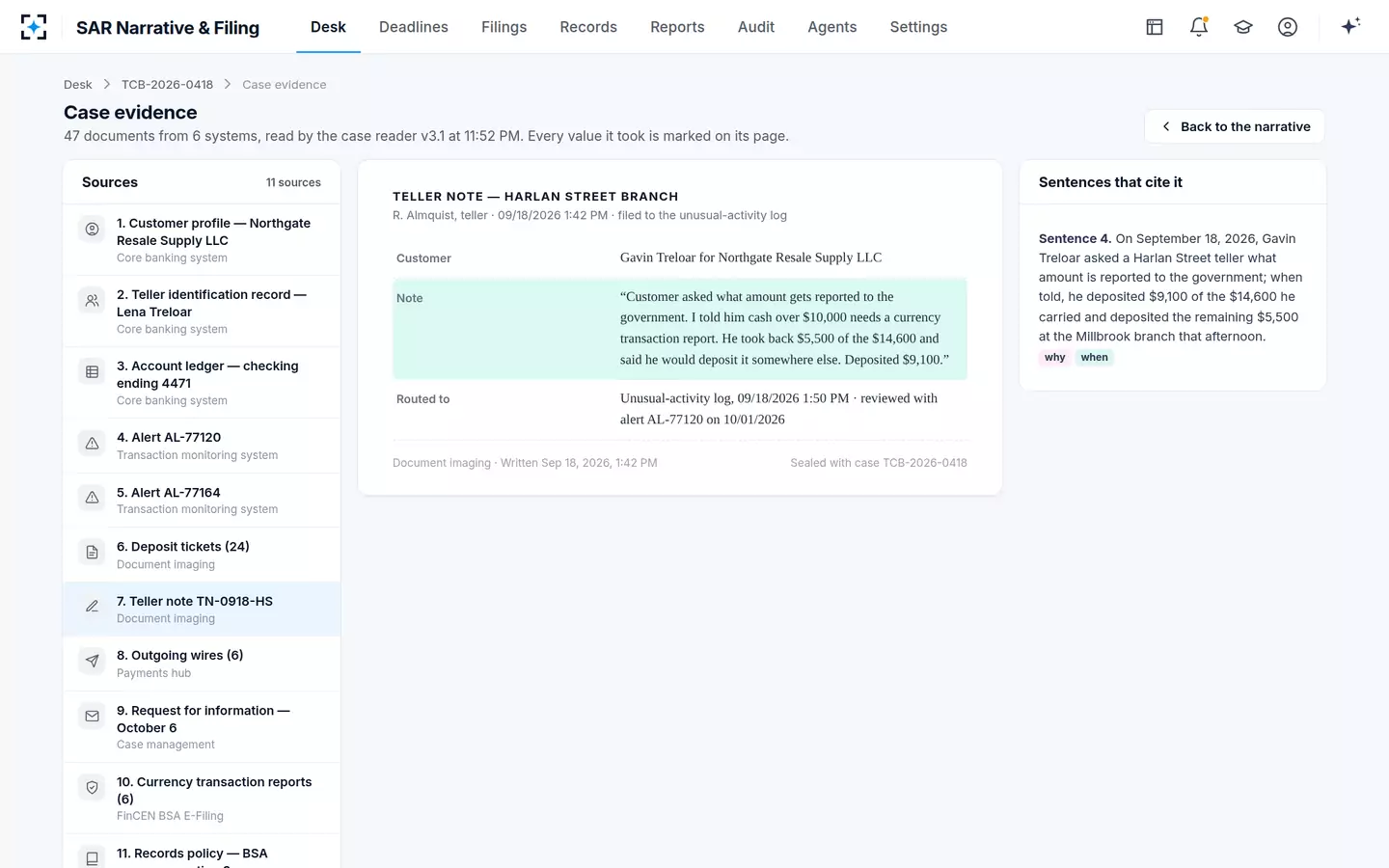
The solution turns the four answers into a check, a setting and a choice. The QC checker's structuring check asks for evidence that the activity was designed to evade reporting, not only amounts near $10,000, and cites it; in the sample case it cites the teller's note of September 18, when the customer asked what is reported and then split $14,600 between two branches. The October 2025 FAQ checks are a setting, on by default.
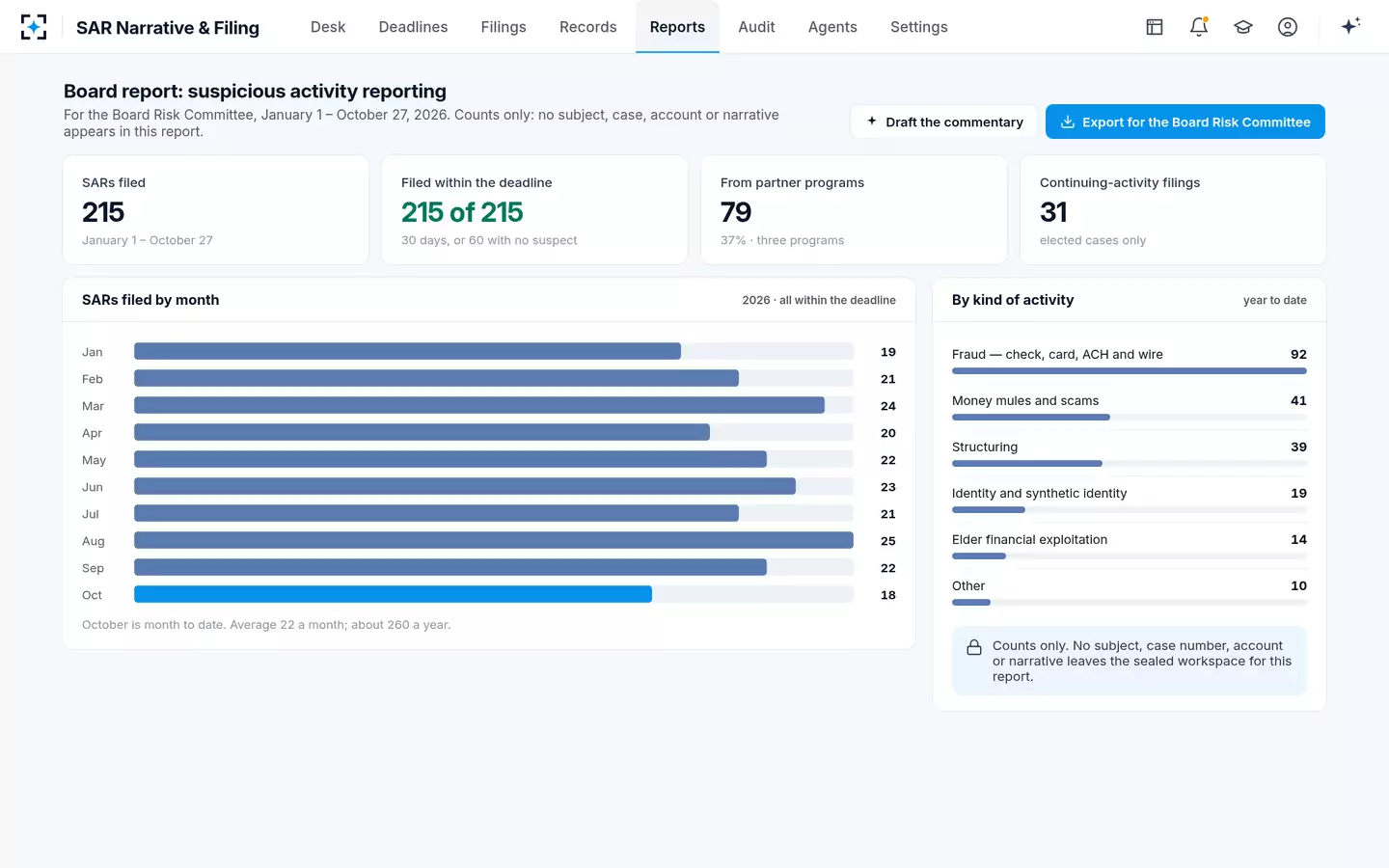
Continuing-activity filings are planned only where the bank's policy elects them; in the sample bank, the BSA officer marks the cases, and its board report shows 31 continuing filings this year, "elected cases only". And the BSA officer can decide not to file, with a reason code, which is the short, concise statement the FAQ describes. For the thresholds that still apply, see the SAR threshold for an unknown suspect, a known one, or an insider.
The structuring 'why' is evidence of intent, not amounts
Continuing-activity filings, counted for the board
Questions people ask
Where can I find the October 2025 SAR FAQs PDF?
On FinCEN's site, titled "Frequently Asked Questions Regarding Suspicious Activity Reporting Requirements" and dated October 9, 2025. It is four pages, issued jointly with the Federal Reserve, the FDIC, the NCUA and the OCC, and each agency published its own notice of it.
Did the October 2025 FAQs change the SAR thresholds or deadlines?
No. The $5,000 threshold for banks, the bank-regulator thresholds for insider abuse and unknown suspects, and the 30- and 60-day deadlines are unchanged. The FAQs say they do not alter existing requirements or establish new supervisory expectations.
Is structuring still a SAR trigger after the FAQs?
Yes. A bank must file when it knows, suspects or has reason to suspect transactions of $5,000 or more were designed to evade reporting, and structuring is a crime under 31 U.S.C. 5324 in any amount. What the FAQs remove is filing on amounts near $10,000 with nothing more.
Can a bank keep its 90-day continuing activity reviews?
Yes. The FAQs remove the requirement, not the option; a bank may keep a scheduled review where its risk assessment supports it, for example for higher-risk relationships. If it does, its procedure should say so, because examiners test whether a bank follows its own procedures.
Do the October 2025 SAR FAQs apply to credit unions and other filers?
Yes. The NCUA is one of the five issuing agencies, and the FAQs list every type of institution with a SAR rule: banks, casinos and card clubs, money services businesses, broker-dealers, mutual funds, insurance companies, futures firms, loan or finance companies and the housing government-sponsored enterprises.
What were the January 2021 SAR FAQs?
An earlier joint set of SAR answers from the same agencies. The FFIEC manual's banner lists the January 19, 2021 and October 9, 2025 sets together as "the most current guidance" on topics such as continuing activity, no-file documentation and keeping a customer relationship after a SAR, ahead of the manual's own older text.