The difference between a corrected and an amended SAR is what was wrong with the first one. A corrected SAR "must be filed whenever errors are discovered in the data reported" in a SAR already filed; an amended SAR "must be filed ... whenever new data about a reported suspicious activity is discovered and circumstances will not justify filing a continuing report" (FinCEN SAR Filing Instructions, April 2026). Both are filed the same way: check box 1b, "Correct/Amend prior report", enter the prior report's BSA ID in field 1e, complete the whole report again, and describe the corrections or amendments at the beginning of the narrative. A continuing SAR is different again: it reports new activity, not new facts about old activity. Botminds' SAR Narrative & Filing works on the step before all three, checking every amount, date and name against the bank's records so that fewer errors are filed in the first place.
Where the product appears, the examples come from a fictional sample bank, Tessaly Community Bank.
Correct, amend, continue or file: a four-way choice
1Is the information in the filed SAR wrong?
Corrected SAR
An amount, date, name, identifier or category was reported in error. Check 1b, enter the prior BSA ID in 1e, refile the whole report, and describe the corrections at the start of the narrative.
2Did you learn something new about the activity already reported?
Amended SAR
New data about the same suspicious activity, such as a subject's identity or another account, where the circumstances do not justify a continuing report. Same boxes and same rules as a correction.
3Has the suspicious activity continued after the SAR?
Continuing SAR
New activity in a new period. Check 1c and enter the prior BSA ID; report only the new period, its amount in Item 29 and the running total in Item 31.
4Was a reportable SAR never filed at all?
Initial SAR, late
Backfiling unreported activity is a first report, not a correction, and the lateness is a compliance question for the BSA officer.
What is the difference between a corrected and an amended SAR?
A corrected SAR fixes data that was wrong when it was filed; an amended SAR adds data the bank did not have. The filing instructions draw the line in one paragraph, General Instruction 6.1.3, and then treat the two identically: "Both corrected and amended reports must be completed in their entirety, with the necessary corrections or amendments made to the data. In both cases box 1b 'Correct/Amend prior report' must be checked."
So the difference matters for the narrative and the bank's own records rather than the form. The opening of the narrative says which it is and what changed: "All corrections or amendments must be described completely at the beginning of the Part V Suspicious Activity Information – Narrative section." A reader in FinCEN's database will see two reports on the same activity, and the first lines of the second must tell them how the two relate.
Corrected and amended SARs, side by side
Corrected SAR: Errors are discovered in data already reported.
Amended SAR: New data about the reported activity is discovered.
Corrected SAR: The total in Item 29 double-counted a transaction; a date of birth was mistyped.
Amended SAR: A subject reported as unknown has since been identified; another account was involved.
Corrected SAR: 1b, Correct/Amend prior report.
Amended SAR: 1b, Correct/Amend prior report.
Corrected SAR: In field 1e; 14 zeros if unknown.
Amended SAR: In field 1e; 14 zeros if unknown.
Corrected SAR: Complete in its entirety, corrected.
Amended SAR: Complete in its entirety, with the new data.
Corrected SAR: Describe every correction first.
Amended SAR: Describe every amendment first.
Corrected SAR: The facts were right and something new happened.
Amended SAR: The new facts are new activity that justifies a continuing report.
When do you file a corrected SAR?
Whenever errors are discovered in data the bank has reported. The instructions do not set a materiality test, so the practical question is what counts as data: anything on the form, from Part I identifiers to the Item 29 amount and the Item 30 dates, to the narrative. A misspelt street name and a total that counts a deposit twice are both errors in reported data; the second is the one an investigator would act on.
Errors also come from software. FinCEN's FAQ addresses filers whose system could not include known information in a non-critical field: they should file single reports through BSA E-Filing until the software is fixed, which FinCEN expects within a reasonable time, and "if a filing has been submitted in which such information was not included because of such a limitation in the filing software, an amended filing should be completed" once the fix is in (FinCEN SAR FAQs, item 2). FinCEN calls that an amended filing, since the missing data was known but never sent.
All corrections or amendments must be described completely at the beginning of the Part V Suspicious Activity Information – Narrative section.
FinCEN SAR Filing Instructions, April 2026, General Instruction 6.1.3
When do you file an amended SAR?
When new data about activity already reported comes to light and "circumstances will not justify filing a continuing report". The common cases are facts about the same transactions: a subject the bank could not identify within the 60 days and has since identified, an alias, another account that received the same funds, the result of a request for documents that arrived after filing. The activity is the same; the bank knows more about it.
The amended report is still a complete report. The instructions are explicit that it "must be completed in its entirety", including items "that apply to the suspicious activity but were not present on the prior FinCEN SAR version", which "need not be described in the narrative". Only the amendments themselves are described at the top.
Is a continuing SAR an amendment?
No. A continuing SAR reports activity that has carried on after the earlier report, for a new period; an amended SAR adds information about the earlier period. They use different boxes: 1c "Continuing activity report" for the first, 1b for the second, both with the prior BSA ID in 1e. A continuing report's narrative covers "the 90-day period encompassed by the report", must "not reproduce the narratives from prior reports", and gives the period's amount in Item 29 and the cumulative amount in Item 31 (General Instruction 6.1.4).
Since the October 9, 2025 interagency FAQs, the continuing-activity schedule of a SAR every 90 days is optional (SAR FAQs, Questions 2 and 3). A bank that does not elect it reports continuing activity as it would any new suspicious activity, within 30 days of the determination. The October 2025 SAR FAQs sets out the schedule for banks that elect it.
The form, for each kind of follow-up filing
| Corrected | Amended | Continuing | Correction of a continuing SAR | |
|---|---|---|---|---|
| Box 1b | Checked | Checked | — | Checked |
| Box 1c | — | — | Checked | Checked |
| Field 1e | Prior BSA ID, or 14 zeros | Prior BSA ID, or 14 zeros | Prior BSA ID, or 14 zeros | Prior BSA ID, or 14 zeros |
| Item 29 | Corrected amount for the report's period | Amount for the report's period | Amount for the new period only | Corrected period amount |
| Item 31 | Blank | Blank | Cumulative, all related reports | Corrected cumulative |
| Narrative opens with | The corrections | The amendments | The new period's activity | The corrections |
| New BSA ID | Yes | Yes | Yes | Yes |
What is the prior report BSA ID, and what if you do not have it?
The BSA ID is the number FinCEN assigns to each accepted report, and it is how a corrected, amended or continuing SAR points back to the report it follows. The bank receives it after filing: FinCEN's FAQ says that within 48 hours of acceptance a report "will be formally acknowledged as having been successfully processed", the status changes to "Acknowledged", and "a secure message containing the official BSA ID assigned to your report will be sent" to the filer's secure mailbox (FinCEN SAR FAQs, item 13).
If the BSA ID is lost, the filing still goes ahead. "If the previous DCN/BSA ID is not known, filers should enter all 'zeros' (14 in total)" (item 7), and the instructions agree: "Enter 14 zeros if the prior report BSA ID is unknown." The FAQ adds a detail that catches people out: acknowledgments go to the general users who filed, and "supervisory users cannot view the contents of the acknowledgements received by the general users" (item 6). A bank that does not copy the BSA ID onto the case file depends on whoever happened to submit the report.
How do you correct a SAR in BSA E-Filing?
Start from the saved copy of the original, because BSA E-Filing will not give one back: FinCEN's FAQ says filers cannot open or view reports they have already filed (item 8). The steps from there are short.
Filing a corrected or amended SAR, step by step
- Open the bank's saved copy of the original SAR
The bank must keep it five years from filing, with its supporting documents.
- Check box 1b, "Correct/Amend prior report"
Add 1c as well if the report being corrected was a continuing report.
- Enter the prior BSA ID in field 1e
From the acknowledgment; 14 zeros if it cannot be found.
- Complete the whole report
Every item, corrected or with the new data, including items not on the prior version.
- Open the narrative with the corrections or amendments
Completely, before the narrative itself.
- Validate, sign with PIN, save, submit
Save the copy before submitting; it is the bank's record.
- Record the new BSA ID on the case
The corrected or amended report receives its own BSA ID in the acknowledgment.
- Keep the trail
What was wrong, who found it, and why; the next examiner will ask.
How long do you have to correct a SAR?
The instructions set no separate deadline; they say a corrected report must be filed "whenever errors are discovered", which a prudent bank reads as promptly once they are. Two clocks still matter. If the new information reveals new suspicious activity, that is a new or continuing SAR, due within 30 days of the determination like any other. And an error found before the original is filed is not a corrected SAR at all: the bank fixes it and files once.
A late SAR is not a correction. When a bank finds suspicious activity it never reported, the remedy is an initial SAR filed late, often called backfiling. FinCEN's 2023 order against Bancrédito shows how that can go wrong: told by its regulator to backfile SARs on more than 300 transactions, the bank "only agreed to backfile SARs on 182", and "a significant number of these 182 SARs included language in the narrative disputing whether OCIF properly identified the activity as suspicious", which FinCEN said "undermines the value and integrity of suspicious activity reporting" (FinCEN Consent Order 2023-02). Late or corrected, a SAR's narrative is for the investigator, not for the bank's argument with its examiner.
Catching the error before it is filed: SAR Narrative & Filing
The cheapest corrected SAR is the one never needed. Most correctable errors are copying errors: the same amount typed into the narrative, Item 29 and the attachment from different extracts, a date read from the wrong document. SAR Narrative & Filing checks for them before anyone signs. A consistency checker compares every amount, count, date and name across the narrative, the FinCEN fields and the bank's systems of record, with a $0 tolerance on amounts, and names the cause of each disagreement. It never resolves one; the analyst corrects from the system of record with a correction code, or keeps the draft with an override code that the BSA officer sees at signature.
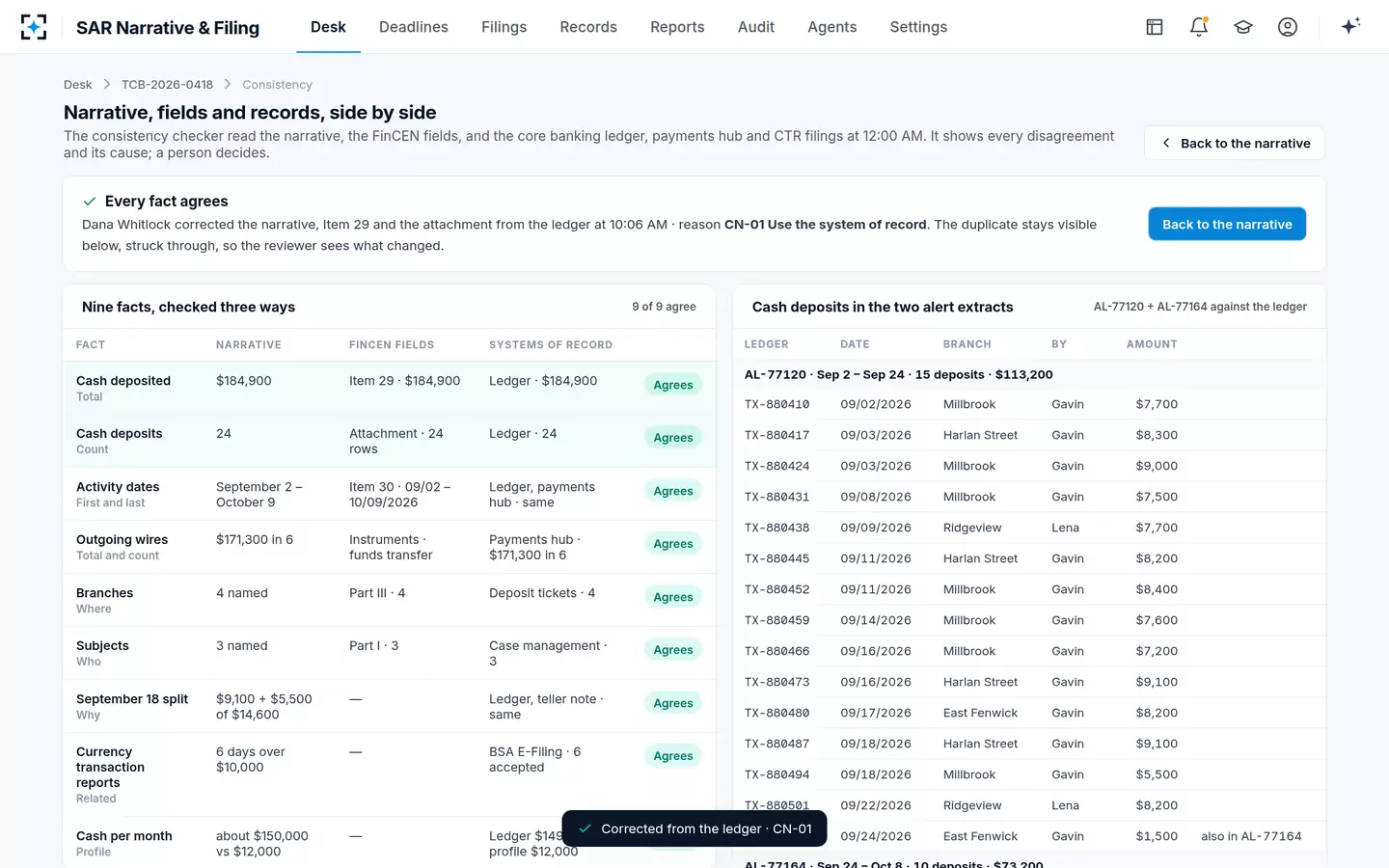
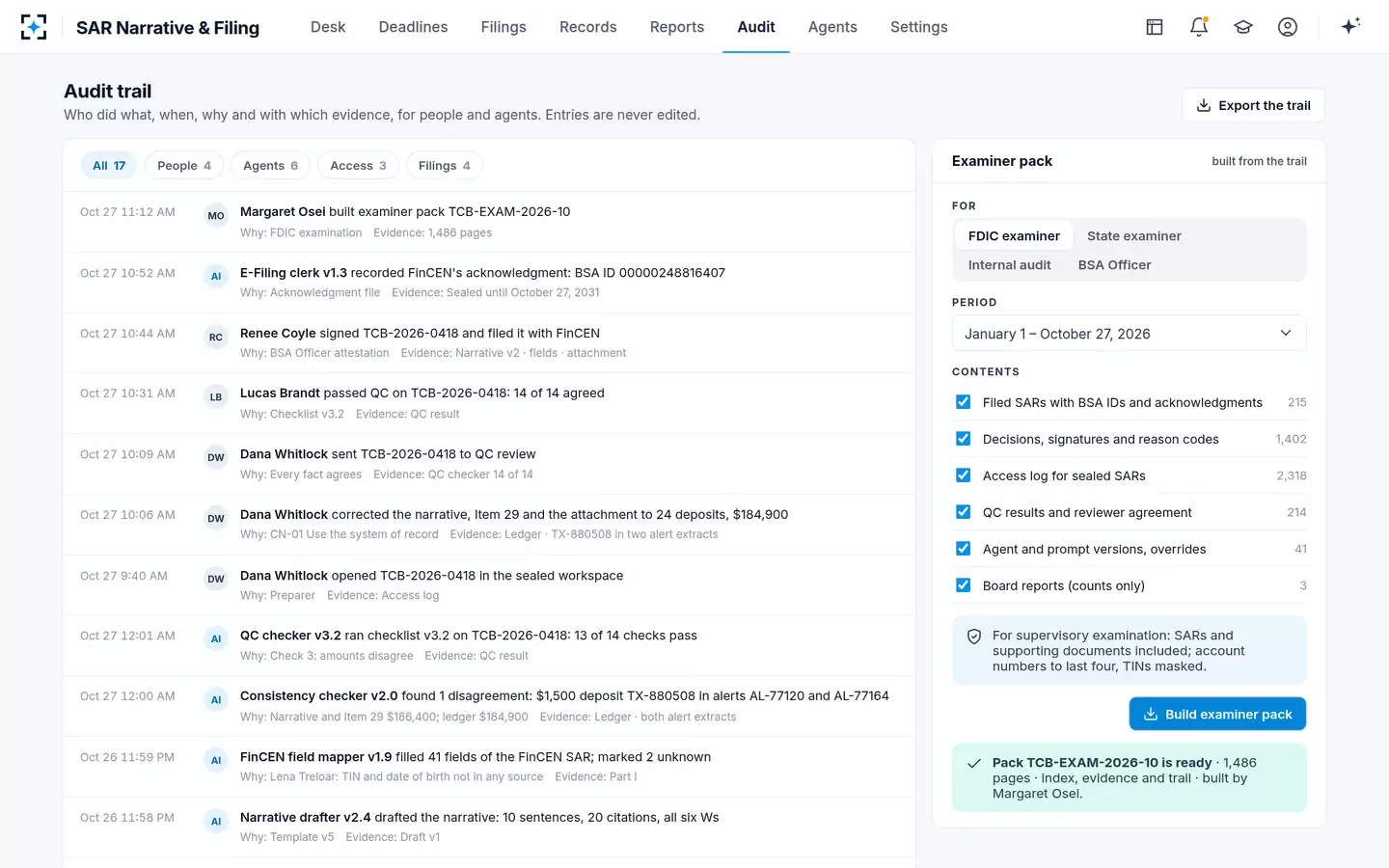
The sample case shows the kind of error that otherwise becomes a corrected SAR. Two monitoring alerts overlapped on September 24, a $1,500 cash deposit sat in both, and the draft totalled 25 deposits and $186,400 where the bank's records held 24 and $184,900. The analyst chose the records at 10:06 AM, and the narrative, Item 29 and the attachment changed together; the SAR was filed at 10:44 and acknowledged at 10:52, with its BSA ID written to the case. For why that check must be separate from the agent that drafts, see why a SAR narrative generator should never check its own work.
Corrected before filing, with the reason on the trail
Filed, acknowledged, and the BSA ID on the trail
Questions people ask
What is FinCEN's corrected SAR guidance?
It is General Instruction 6.1.3 of the FinCEN SAR Filing Instructions, current version April 2026, with the Item 1 instructions and items 6 and 7 of FinCEN's online SAR FAQ. Together they define corrected and amended reports, the box and BSA ID to use, the full refile, and where the corrections are described.
Does a corrected SAR restart the 30-day clock?
Nothing in the filing instructions ties a correction to the 30-day clock, which governs the original report and any new suspicious activity. A correction is due whenever an error is discovered; it does not extend the original deadline or cure a late original filing.
Can you delete or withdraw a SAR?
FinCEN's instructions provide for correcting or amending a filed SAR, not deleting it. If information in a filed SAR was wrong, the bank files a corrected report that says so at the start of the narrative, and keeps both reports with their supporting documents.
Do you need to correct a SAR for a typo?
The instructions say a corrected report must be filed "whenever errors are discovered in the data reported", without a materiality threshold. Errors in identifiers, amounts and dates matter most because investigators search on them, and a bank's procedure should say who decides and how quickly.
Is an amended SAR the same as a supplemental SAR?
"Supplemental SAR" is older wording, still seen in FinCEN's 2003 narrative guidance. Today's form has three follow-up types: corrected and amended reports (box 1b) and continuing activity reports (box 1c). Use whichever matches what changed: an error, new facts, or new activity.
How long must the original and the corrected SAR be kept?
Each for five years from its own filing date, with its supporting documentation, under 31 CFR 1020.320(d). The original stays relevant: the corrected report describes how it differs, and an examiner may ask to see both.