SAR narrative drafting is the step in which the facts of an investigation become the narrative and fields of a FinCEN SAR, and it is the step agents now offer to take over. The safe way to find out whether they can is a pilot on SARs your bank has already filed: give the agents the case files exactly as they stood at the decision to file, have them draft each narrative and set of fields, and have your own reviewers score the drafts against the filed SARs without knowing which is which. Nothing reaches FinCEN, no live deadline is at risk, and the bank learns how the drafts compare with its own work on its own cases. This is the pilot we propose for Botminds'SAR Narrative & Filing, and it is a fair test of any SAR drafting tool.
Figures from the product describe a fictional sample bank, Tessaly Community Bank, and its sample cases. The regulatory statements and research are linked where they appear.
Six weeks, no live SAR touched: the pilot week by week
- Choose the fifty, set access, agree the sheetWeek 1
- Agents draft from the case filesWeek 2
- Blind scoring by two reviewersWeeks 3–4
- Reconcile and analyseWeek 5
- DecideWeek 6
- Written, reviewed and filed exactly as todayWeeks 1–6
What is SAR narrative drafting, and why pilot it on SARs you already filed?
Drafting is the part of SAR completion that turns a case into prose and fields: who, what, when, where, why and how in the narrative, and the subjects, amounts, dates and activity types in Parts I to III. It follows the decision to file and comes before review and signature. A drafting tool is useful only if its drafts are at least as complete and as accurate as the bank's, in less of the analyst's time.
Filed SARs are the right test set because they come with an answer. Each has a case file, a narrative the bank stood behind, a reviewer who passed it and, sometimes, a later correction. Re-drafting them asks the tool to do the job the analyst did, from the same evidence, and compares the result with the bank's own standard rather than a vendor's sample. A demonstration on a vendor's case shows what the tool can do with data it was built around; a re-draft of your structuring case from three years ago shows what it does with your teller notes, your core system's extracts and your branch names.
What a demo proves, and what a pilot on your own files proves
A vendor demonstration: Chosen by the vendor, often clean and complete.
A pilot on your filed SARs: Chosen by you, including the hard and the corrected ones.
A vendor demonstration: Sample data shaped for the product.
A pilot on your filed SARs: Your case files, as they stood at the decision to file.
A vendor demonstration: The vendor's idea of a good narrative.
A pilot on your filed SARs: The SAR your bank actually filed and signed.
A vendor demonstration: You, watching, without the case file.
A pilot on your filed SARs: Your reviewers, blind to which draft is which.
A vendor demonstration: Whether the tool works.
A pilot on your filed SARs: Whether it works on your cases, and what it finds that you missed.
How do regulators view AI pilots in AML?
Favourably, and in writing. The five federal agencies' December 2018 joint statement on innovation treats pilot programs as a legitimate way to test whether a new approach works, and adds: "While the Agencies may provide feedback, pilot programs in and of themselves should not subject banks to supervisory criticism even if the pilot programs ultimately prove unsuccessful" (Joint Statement on Innovative Efforts to Combat Money Laundering and Terrorist Financing, 2018). FinCEN's April 2026 proposal on AML/CFT programs still cites the statement.
The statement goes further, in words written about monitoring that carry over to drafting. When an AI system finds something the existing process did not, "the Agencies will not automatically assume that the banks' existing processes are deficient", and "the implementation of innovative approaches in banks' BSA/AML compliance programs will not result in additional regulatory expectations." A pilot that finds an error in a filed SAR is not, by that finding alone, evidence that the bank's process failed. It is still an error in a filed report, and the bank has to deal with it, as the last section explains.
Pilot programs in and of themselves should not subject banks to supervisory criticism even if the pilot programs ultimately prove unsuccessful.
Federal Reserve, FDIC, FinCEN, NCUA and OCC, Joint Statement, December 3, 2018
Two frameworks help document the pilot for model risk and internal audit, though neither is a rule. Treasury's Financial Services AI Risk Management Framework, released February 19, 2026, "adapts the NIST AI Risk Management Framework to the specific operational, regulatory, and consumer protection considerations of financial services" (U.S. Treasury). NIST's own framework is voluntary and has a generative AI profile, published in July 2024 (NIST AI RMF). The interagency model risk guidance of April 2026 leaves generative and agentic AI out of scope, so these voluntary frameworks are the nearest thing to a common vocabulary.
Is it safe to use SAR data to test AI?
It can be, if the pilot runs inside the bank's controls and the tool is the bank's agent. The confidentiality rule binds the bank and every director, officer, employee and agent of the bank (31 CFR 1020.320(e)). The examination manual adds that "a bank or its agent may reveal the existence of a SAR to fulfill responsibilities consistent with the BSA, provided no person involved in a suspicious transaction is notified", and that the agencies "take the position that a bank's internal controls for the filing of SARs should minimize the risks of disclosure" (FFIEC manual, Prohibition of SAR Disclosure).
In practice that means four conditions, each worth writing into the pilot plan and the contract. The case files and the drafts stay in an environment the bank controls. Access is by named role, and every opening of a sealed case is logged with a reason. Nothing from the pilot is used to train a model shared with anyone else. And at the end the drafts are kept or destroyed under the bank's records policy, with the filed SARs and their supporting documents untouched; those must be kept five years from filing, and the supporting documents count as part of the filing (31 CFR 1020.320(d)). Counsel should review the arrangement; a pilot is the cheapest time to settle the confidentiality design.
Choosing the fifty: a sample that includes the hard cases
Choose the fifty to test the tool where a reviewer would worry, not where it will look good. A sample of easy single-subject fraud cases proves little. The table suggests a mix for a community or mid-size bank; adjust it to the bank's own filing profile, and draw the cases from a recent period so that systems and staff are current.
Fifty filed SARs, chosen to test the hard parts
| Group | Count | What it tests |
|---|---|---|
| Cash structuring | 15 | Evidence of intent, not only amounts near $10,000; deposits across branches; related CTRs |
| Check, ACH and wire fraud | 10 | Victims kept out of the subject fields; losses and recoveries; who benefited |
| Elder exploitation and scams | 8 | Several subjects and counterparties; money moved out quickly; completed or attempted |
| Continuing-activity SARs | 5 | Only the new period in the narrative; period and cumulative amounts in Items 29 and 31 |
| Subject not identified | 4 | Unknown boxes on critical fields; the 60-day clock |
| Later corrected or amended | 4 | Whether the draft avoids, or flags, the error the bank later corrected |
| Joint, 314(b) or partner-program cases | 4 | Joint filer details; the 314(b) statement; what may be shared |
Freeze each case file as it stood when the decision was made, not as it stands today. Documents added after filing, such as a law enforcement request or a later account closure, would let the draft know things the analyst did not. And give the tool the same systems the analyst had: if the analyst checked the core banking system and the payments hub, the tool should be able to as well, or the comparison is unfair in one direction or the other.
How do you score an AI-drafted SAR narrative?
Score both texts on the same sheet, blind, by two reviewers, and count facts before style. Each reviewer receives two narratives per case, the filed one and the draft, in random order and identical formatting, and scores each against the bank's quality checklist; the SAR quality scoring sheet built from the FFIEC and FinCEN guidance is a reasonable start. Then, separately, every amount, count, date and name in the draft is compared with the bank's systems of record, and every disagreement is classified: the draft is wrong, the filed SAR is wrong, or the records disagree with each other.
Be wary of scores produced by whoever built the tool. The most detailed published evaluation of agentic SAR drafting reports a "Narrative Completeness" score of 3.52 out of 5, or 70%, and 3.06 (61%) for "Efficiency Gains in Investigation", rated by "a team of six domain-expert investigators from a leading global fintech company", the same company as the authors (Naik et al., arXiv:2509.08380, 2025). The paper is not peer reviewed. The numbers are a useful reference point; they are not your reviewers' verdict on your cases.
What to measure in a SAR drafting pilot
- Unsupported facts in the drafts
Any statement with no source in the case file. The target is zero.
- Wrong facts the check did not flag
Amounts, dates or names that disagree with the records and were not shown as disagreements. The target is zero.
- Errors found in the filed SARs
Disagreements where the records show the filed SAR was wrong.
- Score against the quality sheet
Draft against filed SAR, by element, from two blind reviewers; record where they disagree.
- Reviewer preference
Which narrative each reviewer would rather sign, with a one-line reason.
- Reviewer minutes per draft
Time to bring each draft to a signable state, against your own preparation estimate.
- Questions the drafter asked
Where the case had no answer to a W, did the draft ask or invent?
- Confidentiality events
Access outside named roles, data outside the environment. The target is zero.
How long does a SAR drafting pilot take? Six weeks
About six weeks, and most of it is the bank's reviewers, not the agents. Week one is set-up: choosing the fifty, freezing the case files, granting read access in the bank's environment and agreeing the scoring sheet with the BSA officer and whoever will validate the result. Week two the agents read the cases and draft; in the sample bank the case reader reads a case's documents overnight, so fifty cases take days. Weeks three and four are blind scoring, two reviewers, fifty pairs. Week five reconciles the reviewers' disagreements and classifies every factual difference. Week six is the decision and the write-up for model risk, internal audit and the board committee.
The pilot should not borrow time from live SARs. If the reviewers are the same people who prepare and review the bank's current filings, schedule their scoring in blocks and keep the live clock visible; the OCC has already flagged banks moving BSA staff into fraud work as a risk to the continuity of BSA operations (OCC Semiannual Risk Perspective, Spring 2025). A pilot that makes a live SAR late has failed on a measure nobody wrote down.
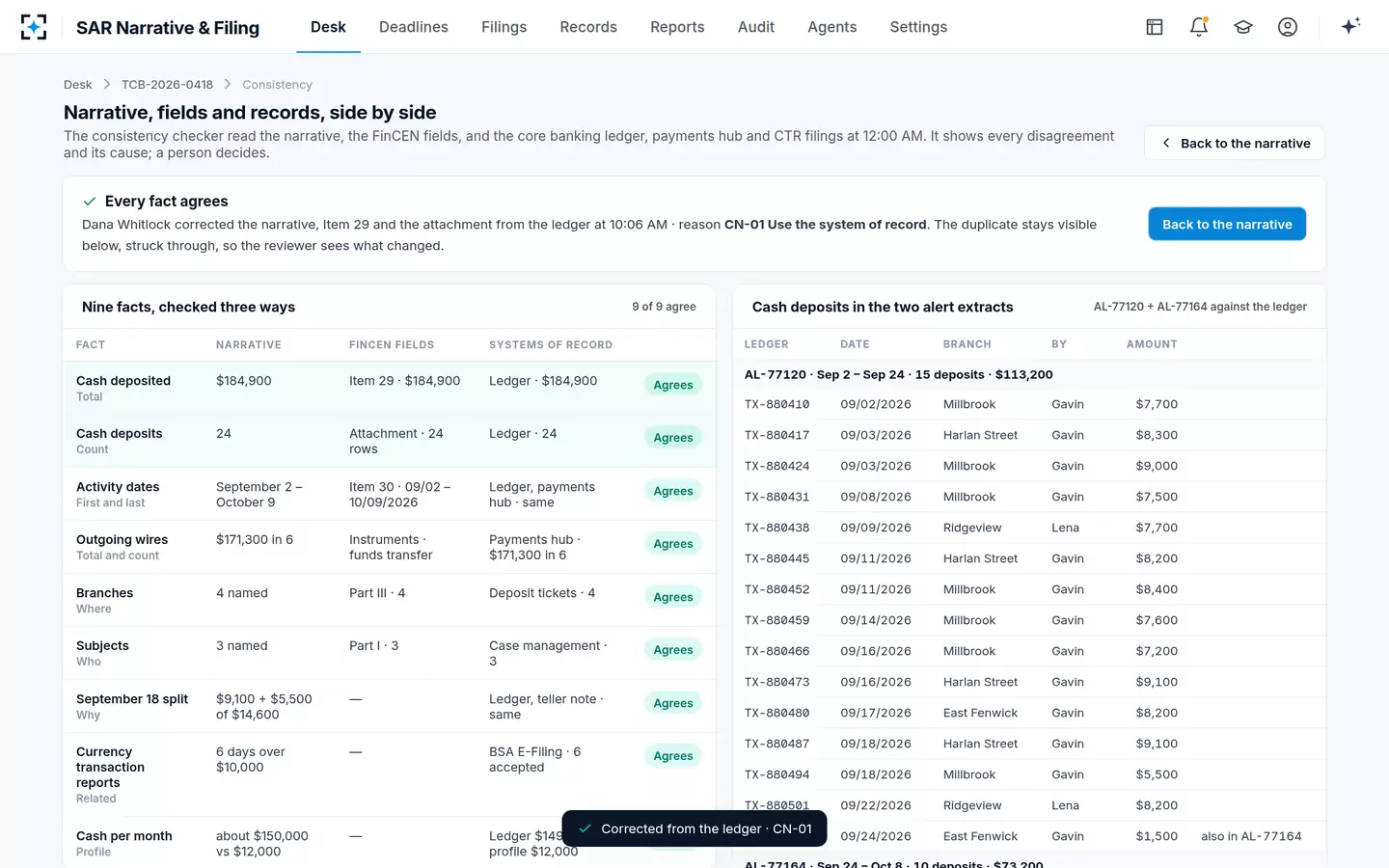
Corrected from the bank's records, with the duplicate left visible
What counts as a pass, and what to do with what the pilot finds
Set the pass criteria before week two, in writing, so the result cannot be argued into a pass afterwards. A reasonable bar: no unsupported facts in any draft; no wrong amount, date or name that the check failed to flag; draft scores at or above the filed SARs' on the must-pass elements; reviewers able to bring a draft to signature in clearly less time than writing it. A tool that drafts beautifully and lets one wrong total through has failed the only test that cannot be fixed by editing.
The pilot may also find errors in SARs the bank filed. Treat them as findings, not as embarrassment. FinCEN's filing instructions call for a corrected report when errors are found in data already reported (FinCEN SAR Filing Instructions, April 2026), so a material error found in a filed SAR should go to the BSA officer for a decision on a corrected SAR, through the usual process. Corrected vs amended SAR explains which applies. The 2018 statement's point stands: finding the error is the pilot doing its job, not proof that the old process was deficient.
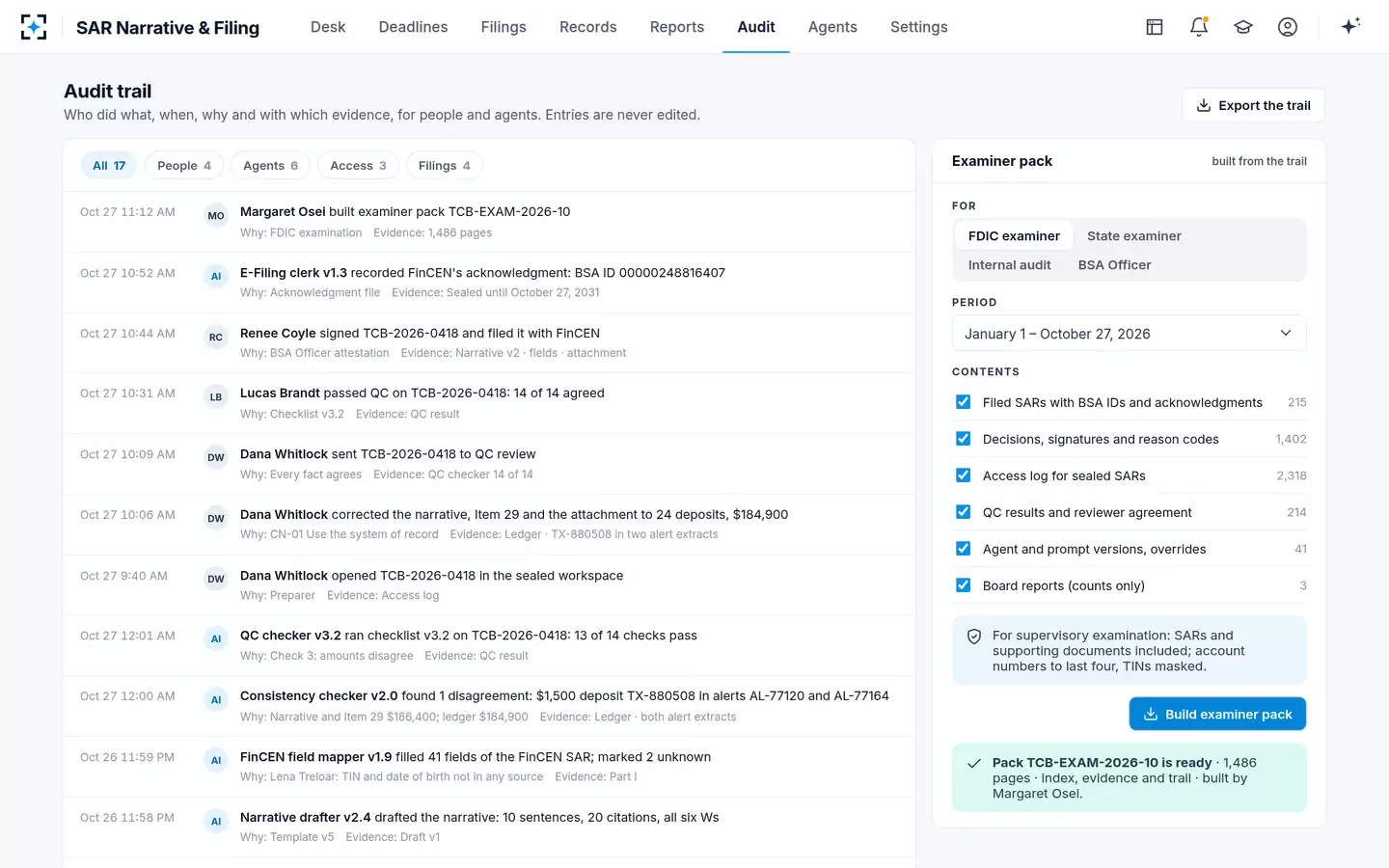
The evidence for model risk and audit, built from the trail
Running the pilot in SAR Narrative & Filing
The solution runs the pilot the way it runs live SARs, with filing switched off. Its case reader reads each frozen case file and cites every value to its page; values read below the bank's confidence threshold, 0.90 by default, go to a person. The narrative drafter writes the introduction, body and conclusion, and the field mapper fills the FinCEN SAR parts, marking "unknown" where no source holds a critical value. The consistency checker compares the draft with the bank's systems of record and names the cause of every disagreement; in the sample bank's Northgate case it found one deposit counted twice because two alerts overlapped.
Every agent action, with its agent and prompt version, and every person's decision, with a reason code, is on the trail, which is what model risk and internal audit will ask for. We will walk a bank through it on a sample of its own past SAR cases before anything touches a live SAR. For the arithmetic that decides whether the pilot is worth passing, see what a SAR costs to write, three ways.
Questions people ask
Can you pilot AI on past SARs?
Yes, and it is the safest place to start: filed SARs have a known answer and no deadline. Run the pilot inside the bank's controls, with the tool acting as the bank's agent, and keep the filed SARs and their supporting documents unchanged for their five-year retention.
How many SARs should a drafting pilot use?
Enough to cover the bank's main activity types and the hard cases; fifty is a practical number for a community or mid-size bank. Include continuing-activity SARs, cases with no identified subject and SARs the bank later corrected, because those test the details a fluent draft can get wrong.
Will regulators criticize a failed AI pilot?
Not for the failure itself. The 2018 interagency statement says pilot programs "should not subject banks to supervisory criticism even if the pilot programs ultimately prove unsuccessful", though the agencies may give feedback. The bank's live SARs must still be filed correctly and on time throughout.
Who should score the drafts?
The bank's own SAR reviewers, two per case, blind to which narrative is the filed one. Scores produced by the vendor's staff, or by an evaluation panel from the vendor's own sector, are a reference at most.
What if the pilot finds an error in a filed SAR?
Send it to the BSA officer. FinCEN's instructions require a corrected SAR whenever errors are discovered in data already reported, and an amended SAR when new information about the reported activity comes to light. The 2018 statement says the agencies will not assume the existing process was deficient merely because an innovative approach found something it missed.
What is SAR narrative drafting and filing?
The stage of the SAR process after the decision to file: writing the narrative and the FinCEN fields, checking and reviewing them, signing, and submitting through BSA E-Filing within 30 days of the determination, or 60 when no suspect has been identified.