Under Regulation E, whether a relative's transfer is authorized or unauthorized depends on one question an investigator must answer from the customer's account and the bank's records: did the customer furnish that person the access device, and had the customer told the bank to stop them? A transfer is unauthorized when "initiated by a person other than the consumer without actual authority to initiate the transfer and from which the consumer receives no benefit," but the definition excludes a transfer "by a person who was furnished the access device to the consumer's account by the consumer, unless the consumer has notified the financial institution that transfers by that person are no longer authorized" (12 CFR 1005.2(m)). Household claims are hard because the bank's records show the household, not the person: a shared phone on the home network looks the same whoever holds it. Botminds' First-Party Fraud Detection pairs each statement in a claim with the record that answers it and states the household limit beside any proposal that rests on device evidence, while an investigator decides and a supervisor checks every denial.
The rule text is quoted from the eCFR, the Official Interpretations and the statute. The claims shown are fictional sample claims at a fictional bank and its two fintech partners.
Authorized or unauthorized: four household cases
Almost every family-member claim falls into one of four cases, and each has a different answer under the rule and its commentary. The investigator's first job is to place the claim, because the case decides who bears the loss before any arithmetic about reporting time.
Reg E authorized vs unauthorized, in four household cases
| What happened | Under Reg E | Who bears the loss |
|---|---|---|
| A relative took the card, phone or PIN without the customer's permission | Unauthorized: initiated by someone other than the customer, without actual authority | The bank, apart from a customer share of up to $50, or up to $500 if reported late |
| The customer gave a relative the card for groceries; the relative emptied the account | Not unauthorized until the customer notifies the bank (comment 2(m)-2) | The customer, until notice; after it, unauthorized |
| A relative tricked or forced the customer into handing over the card or code | Unauthorized: a device obtained "through fraud or robbery" (comment 2(m)-3) | The bank, within the liability tiers |
| The customer and a relative arranged the transfer, then disputed it | Not unauthorized: "fraudulent intent by the consumer or any person acting in concert" (1005.2(m)(2)) | The customer, but the bank must prove it |
Note what is absent from the table: the relationship itself. A son living at home is not authorized by being a son, and a parent who once held the card is not a thief by being a parent. A procedure that denies household claims because "the transfer came from inside the family" is applying a test the rule does not contain.
What does "furnished the access device" mean in a modern household?
It means the customer gave the person the means to make transfers, and the means are wide. Regulation E defines an access device as "a card, code, or other means of access to a consumer's account, or any combination thereof, that may be used by the consumer to initiate electronic fund transfers." In a household that reaches a debit card and PIN, an online banking password, and a phone set up to approve payments with a face or fingerprint the relative can also unlock.
So the investigator's questions are concrete: who had the card, phone or code; how they got it (given, borrowed, taken, tricked out of the customer); and what they were allowed to do with it. A card lent for groceries is furnished. A PIN learned by watching, a card taken from a drawer, or a phone unlocked while its owner slept is not.
Exceeded authority: when the customer is liable for the relative's transfers
When the customer furnished the device and the relative went beyond the limit, the customer is liable until he revokes the authority. The Official Interpretation is explicit: "If a consumer furnishes an access device and grants authority to make transfers to a person (such as a family member or co-worker) who exceeds the authority given, the consumer is fully liable for the transfers unless the consumer has notified the financial institution that transfers by that person are no longer authorized" (comment 2(m)-2).
The rule is blunt because the bank had no way to know the limit. The card and PIN worked as the customer meant them to; only the customer knew the boundary he set, so only he can end it. That makes the date of his notice the most important fact in an exceeded-authority claim, and the one the investigator should pin down first.
Authority given, exceeded, then revoked: where liability moves
- Card lent for groceriesAuthorized use
- Withdrawals beyond the limitExceeded
- After the customer tells the bankRevoked
- The customercomment 2(m)-2
- The bank, from the noticeunauthorized
When does the customer's revocation take effect?
When the customer takes reasonable steps to tell the bank, whether or not the right employee hears it. Notice is given "when a consumer takes steps reasonably necessary to provide the institution with the pertinent information, whether or not a particular employee or agent of the institution actually receives the information"; it may be "in person, by telephone, or in writing," and written notice counts from when it is mailed (12 CFR 1005.6(b)(5)).
Notice can also be constructive: it "may be considered constructively given when the institution becomes aware of circumstances leading to the reasonable belief that an unauthorized transfer to or from the consumer's account has been or may be made." For investigators this cuts both ways. A branch note that the customer's grandson "has been using his card again," or a fraud alert the bank itself raised, may fix the revocation date earlier than the customer's formal claim, and every transfer after it is unauthorized.
Fraud, force and household pressure
A device obtained by fraud or robbery was never furnished. The commentary says an unauthorized transfer "includes a transfer initiated by a person who obtained the access device from the consumer through fraud or robbery," and an ATM withdrawal the consumer was "induced by force to initiate" is unauthorized too (comments 2(m)-3 and 2(m)-4).
That matters most where the relative is also a caregiver or holds a power of attorney. A customer pressured into sharing a code by someone they depend on did not furnish it in the rule's sense, and the investigator should ask how the code was shared before treating it as given. The Federal Reserve's FraudClassifier model has a category for this pattern, embezzlement: "theft or misuse of funds legally placed in one's trust" (FedPayments Improvement, FraudClassifier model). A claim that looks like friendly fraud may be elder financial exploitation, which needs a different response from the bank.
Who has to prove a household transfer was authorized?
The bank. In any action involving a consumer's liability for an unauthorized transfer, "the burden of proof is upon the financial institution to show that the electronic fund transfer was authorized" (15 U.S.C. 1693g(b)). For an exceeded-authority finding, that means the file must show the customer furnished the device to that person and had not revoked the authority before the transfers.
The bank's records rarely prove it on their own. A transfer from the customer's registered phone, on the home network, after a biometric sign-in, is exactly what a relative with access to that phone produces. Device and location evidence can rule out a stranger; inside a household it usually cannot rule out a relative. A denial that rests on device evidence alone, with no account from the customer about who could use the phone, is the weakest denial a bank can write in a household claim.
What device evidence proves, outside and inside a household
Stranger takeover claim: Strong evidence the customer, not a stranger, made the transfer.
Household claim: Consistent with the customer or anyone in the home who can unlock the phone.
Stranger takeover claim: Strong evidence against a remote takeover.
Household claim: Weaker: some household members can pass, or the customer unlocked it for them.
Stranger takeover claim: Points away from takeover.
Household claim: Says nothing about who held the existing device.
Stranger takeover claim: The records, usually.
Household claim: The customer's account of authority, tested against the records.
What not to require, and what not to rely on
Two procedural rules protect household claims in particular. A bank "may request a written, signed statement from the consumer relating to a notice of error," but "it may not delay initiating or completing an investigation pending receipt of the statement" (comment 11(b)(1)-2), and it must begin promptly on oral notice rather than wait for written confirmation (comment 11(c)-2). Many customers will not sign a statement accusing a relative, and the investigation runs regardless.
The rule also caps the customer's liability whatever his carelessness: "Negligence by the consumer cannot be used as the basis for imposing greater liability than is permissible under Regulation E," and writing the PIN on paper kept with the card is the commentary's own example (comment 6(b)-2). The exception the commentary names is the furnished-device rule itself, which is why placing the claim in the right case matters more than judging the customer's habits.
The clocks that still run in a household claim
2days
business days from learning the device was taken, to keep the share at $50 or less
$500
the most the customer can owe for a late report inside the statement window
60days
from the statement showing the transfers, to keep later ones covered
10days
business days for the bank to decide, or credit provisionally while it investigates
Five questions that settle most family-member claims
Investigators who ask these five questions before proposing a decision rarely have to reopen the claim. The answers place the claim in one of the four cases and fix the dates the liability tiers need.
The household interview: five questions and why each matters
- Who had the card, phone, PIN or password, and since when?
Places the claim: furnished, taken, or obtained by fraud or force.
- What was that person allowed to do?
A limit, such as groceries or one bill, makes it an exceeded-authority case.
- When did the customer tell the bank to stop them, and how?
Fixes the revocation date; check branch notes and alerts for an earlier constructive notice.
- When did the customer first learn the money was gone?
Starts the two-business-day clock for the liability tier.
- Was the relative a caregiver or agent?
A trusted person misusing funds may be exploitation, not friendly fraud, and needs a different referral.
How First-Party Fraud Detection handles household claims
The solution looks for what would make a claim genuine before it proposes a denial, and it states the household limit on the screen the investigator decides from. On one sample claim, a disputed $740.00 P2P payment, the Evidence agent found no new device this year, no password or PIN reset and no takeover signs, and proposed "Deny with evidence." Beside the proposal it stated the limit: Face ID cannot rule out someone in the customer's household with his phone; the customer had said no one else uses it.
The household limit stated beside the proposal, not left for the customer to discover
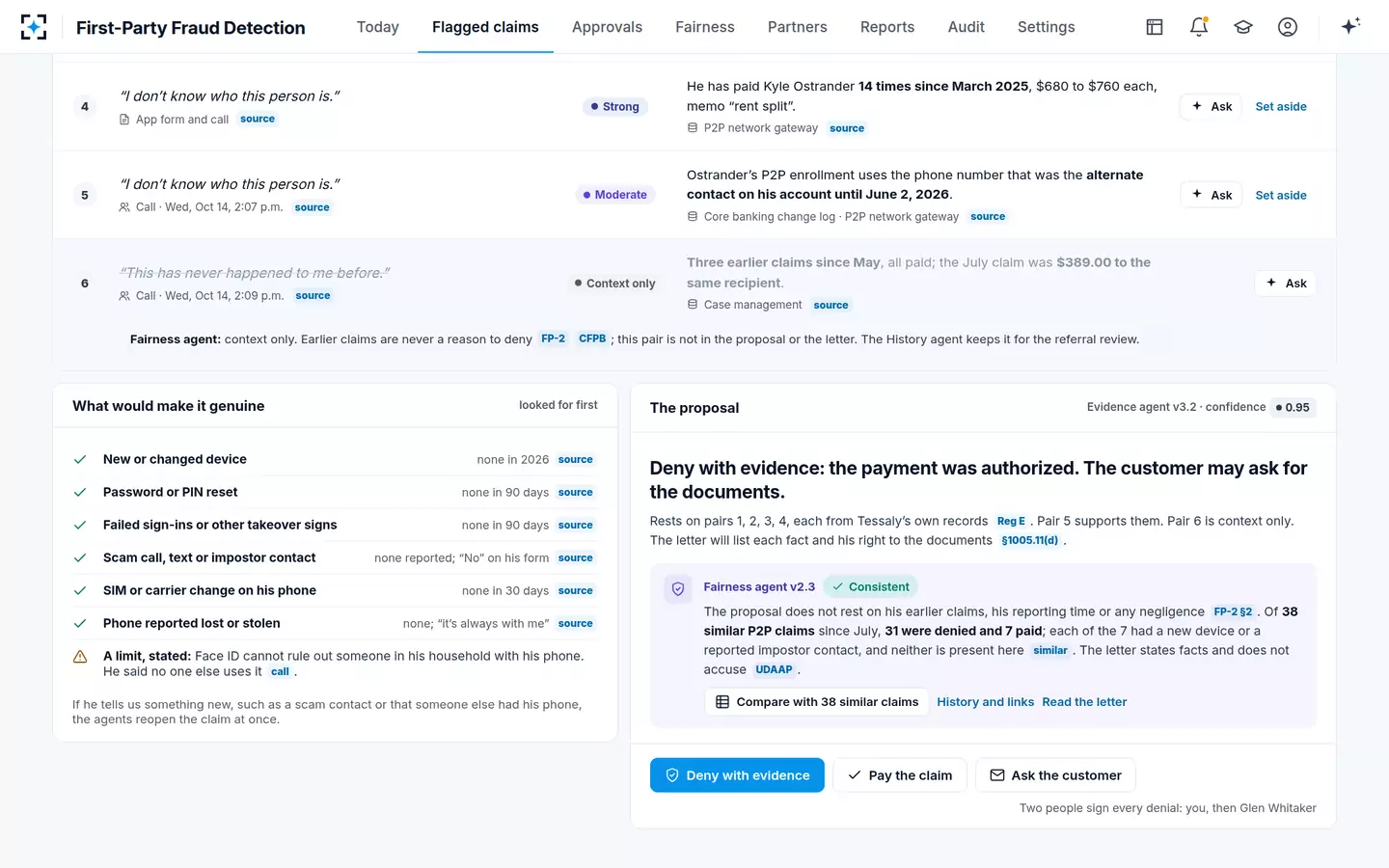
The bank's claims policy lists reasons that may never support a denial, including "negligence or a shared PIN" and earlier claims alone, and the Fairness agent returns any proposal that leans on one. "Household member" is one of the five override reason codes. In the sample bank's September review, investigators paid six claims the agents had proposed to deny, and in two the recorded reason was that a household member had the phone: the investigator asked, the customer answered, and the answer changed the finding.
After a decision: ask for the documents, or tell us something new
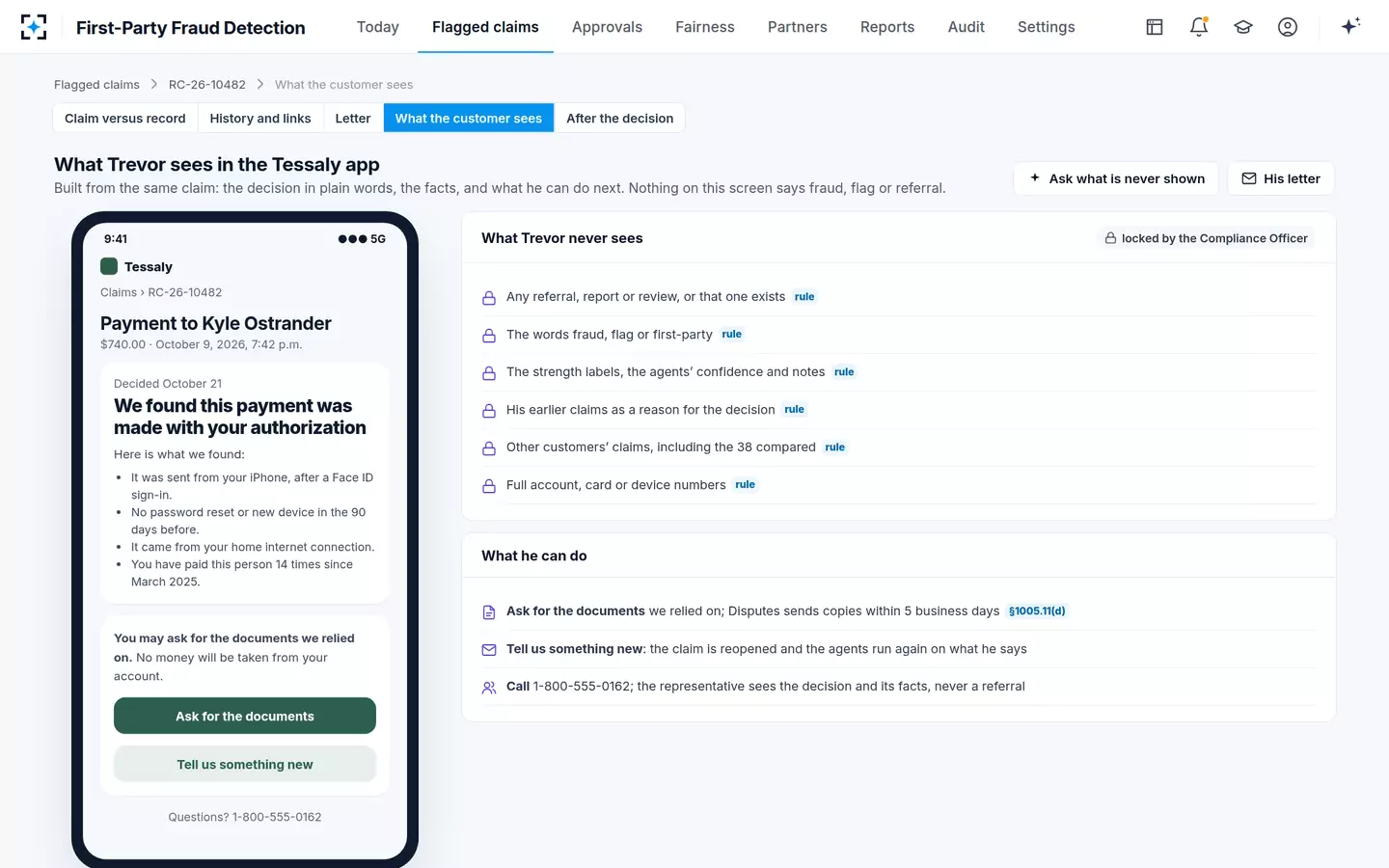
Every denial needs a maker and a different checker, uncertain claims below 0.75 confidence are proposed for payment, and the agents never decide, post, debit, send or refer. For the regulation's definitions in full, see what Reg E says about friendly fraud; for the reasons a denial may never rest on, Reg E denial reasons. The whole solution is on the First-Party Fraud Detection page.
Questions people ask
Is a transfer by a family member authorized under Reg E?
Only if the customer furnished that person the access device and had not revoked the authority. A relative who took the card, learned the PIN or used the phone without permission made unauthorized transfers, and the customer's liability is limited as for any theft.
Can a bank deny a claim because the transfers came from the customer's own phone?
Not on that alone in a household claim. The bank carries the burden of showing the transfer was authorized, and device evidence usually cannot distinguish the customer from a relative who can unlock the phone.
Does the customer have to file a police report against the relative?
No. A bank may ask for a signed statement but may not delay starting or completing the investigation while it waits, and the claims policy in the sample bank lists a missing police report among the reasons a denial may never rest on.
What if the relative was a caregiver with access to the account?
Ask how the access was obtained and what was allowed. Access obtained by pressure or deceit was not furnished, and misuse by a trusted person may be elder financial exploitation that calls for a referral as well as a Reg E decision.
When does a customer's revocation of a relative's authority take effect?
When the customer takes reasonable steps to tell the bank, by phone, in person or in writing, and written notice counts from mailing. Notice can also be constructive, when the bank becomes aware of circumstances pointing to unauthorized use.
Does a shared PIN make the customer liable?
Negligence, such as writing the PIN down, cannot raise liability beyond the Reg E tiers. A PIN deliberately given to a relative is different: that is a furnished device, and the exceeded-authority rule applies until the customer revokes it.