Remediation governance is the structure a bank puts around a customer remediation program: a named senior person accountable for it, documented roles for the people who build, approve and pay, an oversight line that never reviews its own work, enough resources for the size of the harm, and records that let an examiner follow every decision. It matters because remediations fail less often on arithmetic than on ownership. A population nobody owned, a method changed without approval, or a payment file released by the person who built it is what turns one finding into a second. Botminds' Customer Remediation gives the team agents that build, compute, draft and track, while every population, method, letter, payment file and close-out is approved by a different person from the one who prepared it.
The regulatory expectations below come from the OCC, the FDIC, the UK's Financial Conduct Authority and the Australian Securities and Investments Commission, whose Regulatory Guide 277 is the most detailed published guidance on remediation governance. Worked examples come from the solution's fictional sample bank and its sample programs.
"Remediations must have adequate resourcing and governance arrangements in place, including commitment from senior management."
ASIC Regulatory Guide 277, Consumer remediation, key principle 9
What is remediation governance, and what do regulators expect of it?
Regulators expect three things: a senior owner, documented roles, and oversight that is independent of the work. ASIC's guide says roles and responsibilities "should be clearly understood" by the firm and by those with oversight, and that the arrangements "should be documented and made readily accessible internally." Large remediations "should have a level of oversight by a senior person who is able to make, and is experienced in making, decisions for the business on a day-to-day basis" (ASIC RG 277.211–213).
US supervisors frame the same expectation as part of a compliance management system. The OCC's handbook says "the board should be apprised of material issues and resolution strategies, and hold management accountable for correcting issues and validating corrective actions," and expects root cause analysis to decide whether an issue is isolated or systemic (OCC, Compliance Management Systems). The FDIC expects the board and management to give the compliance officer "sufficient authority and independence to: cross departmental lines; have access to all areas of the institution's operations; and effect corrective action" (FDIC Consumer Compliance Examination Manual, II-3).
None of these sources prescribes an organisation chart. They prescribe outcomes: a person who answers for the program, decisions that can be traced to whoever made them, and an assurance step by someone who did not do the work. Everything below is a way to deliver those three outcomes at a bank that runs several programs a year.
Who owns customer remediation in a bank?
A named senior executive owns the program, usually the chief compliance officer or the head of the business line that caused the harm, with the board or a board committee receiving its reporting. ASIC puts it as "reporting to the board or appointing a director or senior executive as the person responsible for the remediation." Day to day, the program manager runs it in that person's name.
Where ownership sits is a real choice. When the business that caused the harm owns the program, the people who understand the product run the fix, but they are also judging their own error. When compliance owns it, the program is more independent, but the analysts may not know how the core posts the fee. Many banks split it: compliance owns scope, method and letters; the business provides product expertise and pays for the remediation from its own budget; finance controls the money; internal audit validates. The table shows that split as the sample bank uses it.
Five seats in a customer remediation program, and what each approves
| Seat | Usually sits in | What they own | What they approve |
|---|---|---|---|
| Remediation analyst | Consumer compliance or the business line | Population builds, calculations, exception proposals, payment file preparation | Nothing alone: every proposal is made as maker |
| Remediation program manager | Consumer compliance | Scope, lookback, method, timeline and commitments to the regulator | Populations, methods and check reissues |
| Consumer compliance officer | Compliance | The rules that apply and every customer-facing word | Letters and templates |
| Remediation finance controller | Finance | Reserve, credits, official checks and unclaimed property reports | Release of the payment file |
| Internal audit validation lead | Internal audit | Independent re-performance and the close-out opinion | Validation before completion is reported |
Five seats, and the decision each keeps
Each seat exists because a decision has to be made by someone who did not make the one before it. The analyst proposes; the program manager decides what is in scope; compliance decides what customers are told; finance decides when money moves; audit decides whether it all held. A team smaller than five seats folds two of them together, and the governance question is which two and with what compensating control.
Customer Remediation: five seats, before and with the agents
Today
Writes the query against the core, computes refunds and interest in a spreadsheet, keeps the method in a memo and builds the payment file by hand.
With agents
Reviews two cited population builds, proposes how to resolve each difference and decides exception groups with a reason code.
Still theirs: every proposal as maker, and the judgement on estates, bankruptcy and joint owners
Today
Signs a population built from one extract and learns about the customers it missed from the next finding.
With agents
Approves the population only when two blind builds agree, and sees every program's next decision on one screen.
Still theirs: approval of populations, methods and reissues across all open programs
Today
Reads letter templates by hand before a vendor prints them.
With agents
Approves or returns plain-language letters in each language, every fact cited to the account history.
Still theirs: the governing rules and every word a customer reads
Today
Books the reserve, posts credits, issues official checks and watches uncashed checks age.
With agents
Releases the payment file only when credits, checks and holds tie to the reserve, and follows each check to its end.
Still theirs: release of money, the general ledger and unclaimed property reports
Today
Samples accounts and re-performs refunds from workbooks with hand-edited rates.
With agents
Signs the close-out after a blind re-performance from source, a rebuilt population and a general ledger tie-out.
Still theirs: the independent opinion before completion is reported
The analyst's seat changes most when the mechanical work moves to agents, and that changes what to hire for. An analyst who no longer writes the extract still needs to know where history lives: in the sample program, a single query against today's core missed 1,184 former customers whose accounts closed before a core conversion, and $18,053.68 of refunds with them. The skill is no longer writing the query; it is knowing why two builds disagree.
Maker, checker, and nobody overseeing their own work
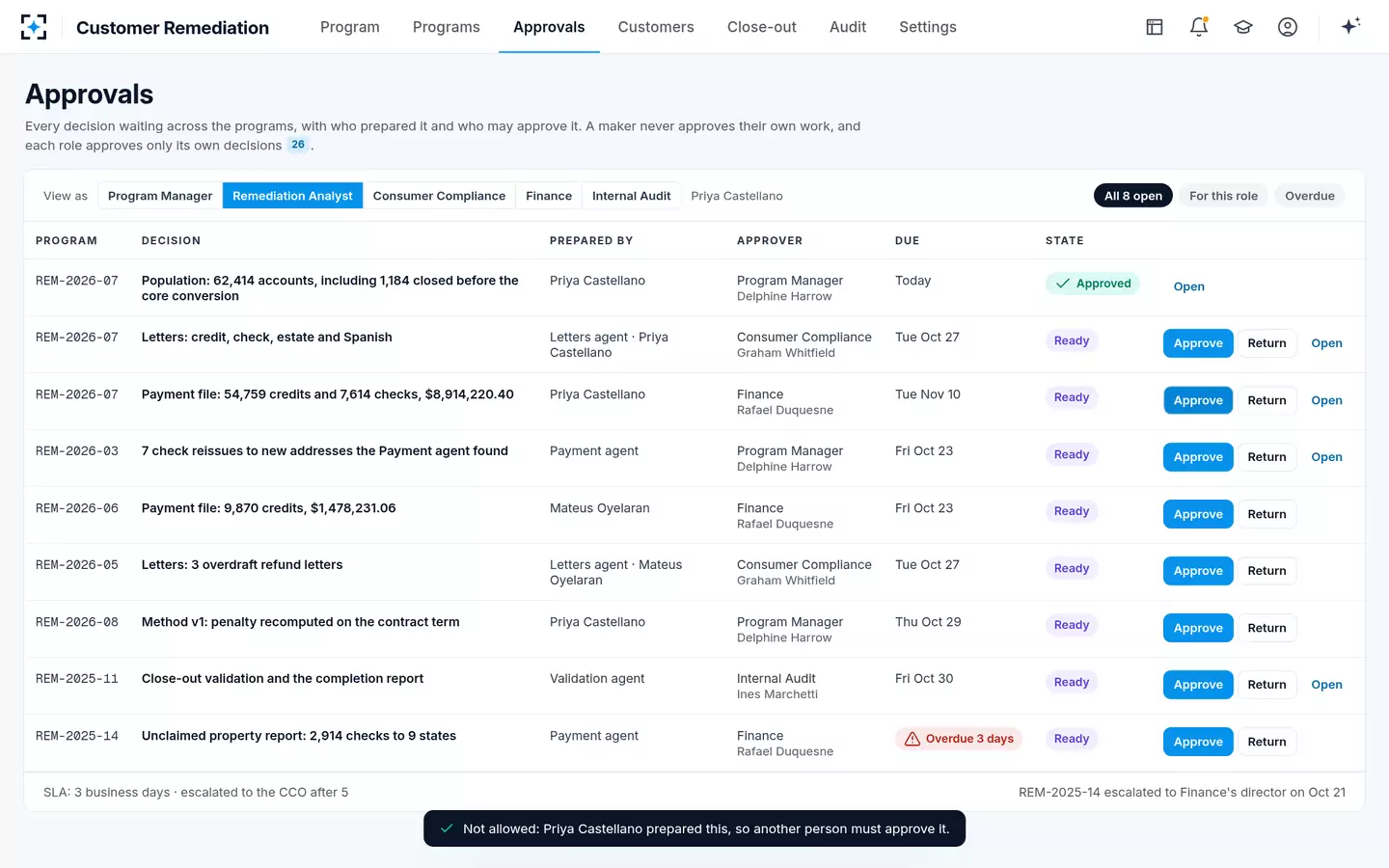
The core control of remediation governance is that each decision has a maker and a different approver. ASIC states it as "the person(s) providing oversight should not oversee their own work" (RG 277.214). In practice that means six approvals per program, each by a seat that did not prepare what it approves.
Six decisions in every program, each with a maker and a different approver
| Decision | Prepared by | Approved by | What the approver checks |
|---|---|---|---|
| Affected population | Analyst, from two blind builds | Program manager | Both builds agree, or each difference is resolved with a reason |
| Method (fees, interest, lookback) | Analyst | Program manager | The version compared on the whole program before approval |
| Customer letters | Analyst, from approved templates | Consumer compliance officer | Every fact cited; plain language in each language used |
| Payment file | Analyst | Finance controller | Credits, checks and holds tie to the reserve to the cent |
| Check reissues | Analyst | Program manager | New address matched; original voided |
| Close-out | Program manager | Internal audit | Blind re-performance, rebuilt population, general ledger tie-out |
Every decision waiting across eight programs, with maker and approver
Where remediation decisions go: the committee and the escalation path
Above the five seats sits a committee that sees all programs together. The UK regulator's 2026 guidance gives a good-practice example: "a firm had an overall compliance board, chaired by their Chief Risk Officer, which brought together key departments responsible for monitoring recurring and systemic issues," including complaints, product, compliance and legal teams, with "clear oversight responsibilities for redress issues, including overseeing redress exercises" (FCA FG26/2). When a colleague found a recurring systems issue, the board estimated the customers affected, the cost of putting it right and the plan to stop it recurring.
For a bank running six to nine programs a year, the committee's job is to decide which issues become programs, approve scope and budget, and watch the few numbers that show whether each program is on track: accounts screened, accounts affected, paid, outstanding, returned and reported as unclaimed. The KPIs that price a program sets those counts out. Decisions that stall below the committee need an escalation path with a clock; in the sample bank, an approval not given in five business days goes to the chief compliance officer.
How big should a customer remediation team be?
Big enough for the number of programs, their size and their exceptions, and no regulator gives a number. ASIC's guide says senior management "should assess, and regularly review, the need for resources and provide them promptly" for larger remediations, and lists what adequate resources can include (RG 277.203–205).
What adequate resourcing for a remediation includes, in ASIC's list
- Financial resources
A budget, and a reserve booked when the harm is estimated.
- The appropriate number of people
Sized to the population and, above all, the exceptions.
- Relevant knowledge, qualifications, experience, skills, training and support
Product and systems knowledge counts as much as compliance knowledge.
- The appropriate mix of specialties
Data, legal for bankruptcy and estates, finance, customer contact.
- Appropriate record-keeping systems
So each decision can be traced to its evidence and its approver.
- Staff with sufficient seniority
Who can make decisions and get access to the systems and data needed.
Headcount follows where the weeks go. By Botminds' estimate for one fee program of 62,414 affected accounts, the team's working weeks from population to payment fall from about ten by hand to about four with agents doing the builds, the calculations and the drafts. The total falls; the share spent on exceptions rises, because that is the work that needs a person.
Where a remediation team's weeks go on one program, by hand and with Customer Remediation
By hand, about 10 weeks
- Population · 30%
- Refunds · 20%
- Letters · 20%
- Exceptions · 15%
- Payment file · 15%
With agents, about 4 weeks
- Population · 25%
- Refunds · 12.5%
- Letters · 25%
- Exceptions · 25%
- File · 12.5%
The sample bank runs eight open programs with five people signing and a second analyst sharing the exceptions. The practical sizing rule is to count the exception groups, not the accounts. A program of 60,000 accounts with clean addresses and no deaths needs less analyst time than one of 6,000 with hundreds of estates and bankruptcies, and a team sized on account counts will be short exactly where judgement is needed.
Independent assurance: internal audit, or an independent expert?
Internal audit for most programs; an independent expert when the program is large, complex or rests on assumptions that move the money. ASIC describes internal oversight by someone "internal to the business but removed from the operation of the remediation (e.g. the internal auditor, compliance officer or internal audit team)," whose work can include reviewing and testing the design, reviewing a selection of files for consistency, checking resourcing and ensuring a strong governance framework (RG 277.214–216).
External assurance is for the bigger cases. ASIC lists large-scale or complex remediations and those where "a number of assumptions are made that may materially affect the scope or amount of compensation" as situations where an independent expert may be appropriate, retained directly by the firm, genuinely independent, and with conflicts documented and managed (RG 277.220–229). The cost of that engagement is a reason to keep the first-line evidence clean: an expert who can re-perform from the bank's own trail spends weeks, not months.
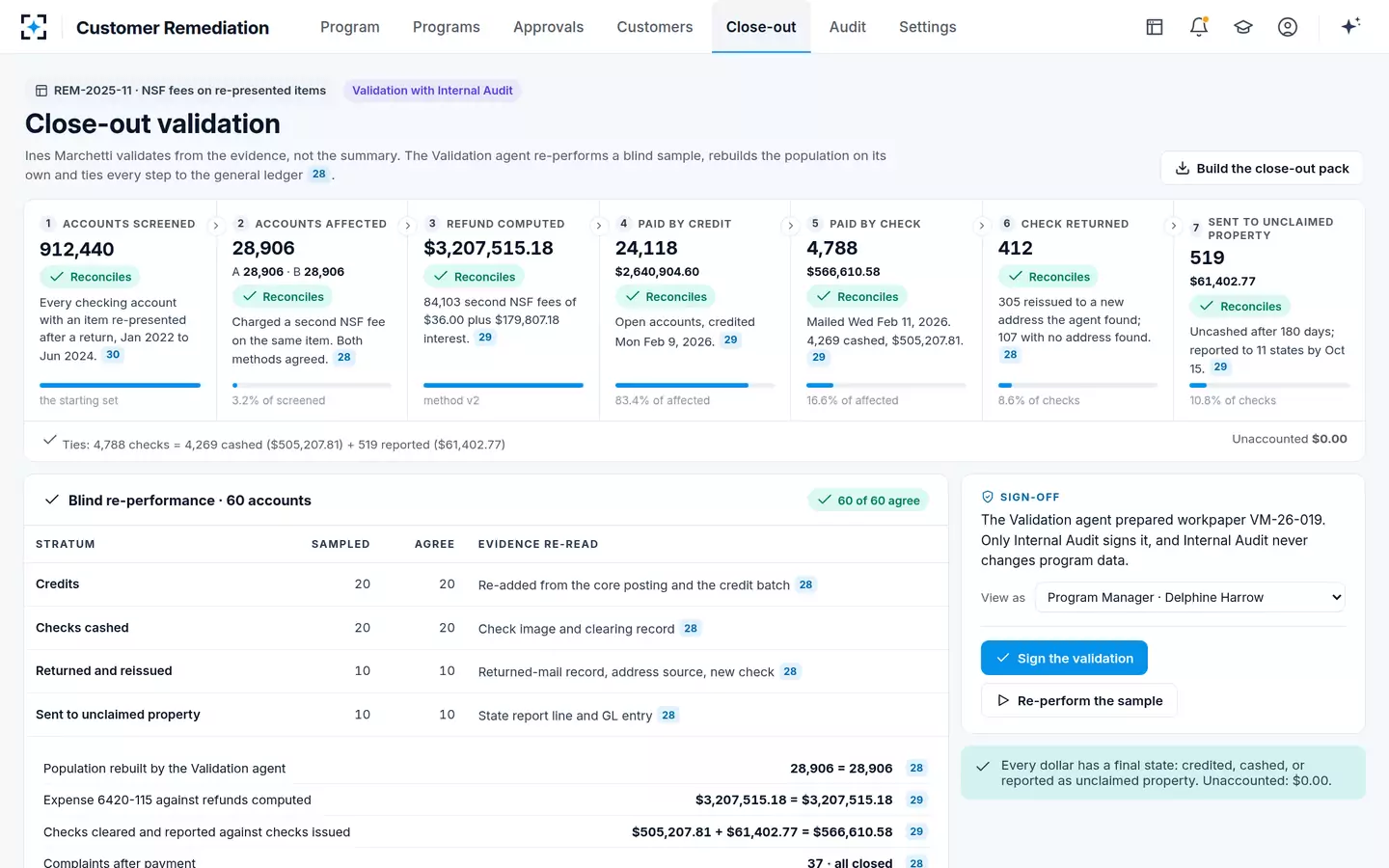
Whichever it is, the assurance step needs its own evidence, not the team's conclusions. In the sample bank, internal audit signs the close-out only after a blind re-performance of 60 accounts in four strata, a rebuilt population and a general ledger tie-out. Remediation testing in audit shows that work, and why two population builds must agree covers the control that comes before it.
A closed program, validated by internal audit before completion is reported
Working with finance: the reserve, the payment file and the general ledger
Finance is a seat, not a service. It books the remediation reserve when the issue is estimated, trues it up when the population is approved, releases credits and official checks against it, and keeps outstanding checks on its books until each is cashed, reissued or reported to a state as unclaimed property. In the sample program, approving 1,184 more former customers trued the reserve up by $18,053.68 the same day.
The working rule is that the person who prepares a payment file never releases it. In the sample bank the analyst who built the file was stopped by the system when she tried to approve it herself, and the finance controller released it after $8,914,220.40 of credits, checks and holds tied to the reserve with $0.00 unaccounted. Finance also owns the measure that matters most at the end: how much of the money reached customers.
Where remediation governance fails
Governance failures are usually visible in the trail before they are visible in a finding. The common ones are below; each is a question a committee can ask of any open program.
Seven signs a remediation program's governance is weaker than its chart
- One person built and approved the population
Often because the program manager is the only one who knows the systems.
- The method changed without a version
A new interest rate or lookback applied to some accounts and not others.
- Letters went out without compliance approval
Usually a template edited "only slightly" for one group.
- The payment file was released by its preparer
The first thing an auditor tests, and the easiest to prove from the trail.
- Exceptions decided case by case with no reason
Estates and bankruptcies treated differently from one week to the next.
- No owner above the program manager
Escalations go nowhere, and the committee hears about the program at close-out.
- Audit validating its own design
Internal audit advised on the method, then signed the close-out.
How Customer Remediation supports the governance model
Customer Remediation is built around the five seats. Two population agents build the affected list blind from different systems, and a difference tolerance of zero means the waterfall says "Does not reconcile" until a person decides. Calculation and validation agents compute each refund independently, letters are drafted with every fact cited to the account history, and payment files are tied to the reserve before finance sees them.
Every decision has a maker and a different approver, the rule cannot be switched off, and each action by a person or an agent is recorded with who, what, when, why and the evidence, kept seven years, with export packs for examiners and internal audit. Agents and methods are versioned, and each new version runs on a closed program before it goes live. For the full program from issue to close-out, see what customer remediation in banking involves, or start from Customer Remediation.
Questions people ask
Should the business line or compliance own a customer remediation?
Either can, if the arrangement is documented and oversight is independent. A common split gives compliance the scope, method and letters, the business the product expertise and the cost, finance the money, and internal audit the validation.
Who approves the remediation method?
The program manager or the accountable executive, never the analyst who wrote it. ASIC expects oversight by a senior person able to make decisions for the business, and any change to the method should be versioned and approved the same way.
When should a bank hire an independent expert for a remediation?
When the program is large or complex, or when assumptions materially affect who is paid or how much. ASIC's guide also expects the expert to be retained directly by the firm and to document and manage any conflicts.
Does internal audit have to validate every remediation?
No rule requires it for every program, but someone independent of the work should provide assurance. For larger programs internal audit or an independent expert validates before completion is reported to the regulator or the board.
How do you size a remediation team?
By the number of programs a year and the exceptions in each, not by account count alone. Deceased, bankrupt, joint and unreachable customers take most of the judgement time, and that is the work that does not shrink when extraction and arithmetic are automated.
Who should a remediation team report to?
Usually the chief compliance officer, with regular reporting to a risk or compliance committee and the board. Internal audit, which validates the work, reports separately to the audit committee, which keeps its opinion independent.