The senior loan officer survey, formally the Federal Reserve's Senior Loan Officer Opinion Survey on Bank Lending Practices (SLOOS), asks a panel of banks each quarter whether they tightened or eased their lending standards and terms over the past three months and how demand changed, with separate questions for construction and land development, nonfarm nonresidential and multifamily loans. Through 2025 and into 2026 it has shown banks easing CRE standards on balance, led by the largest banks, with competition the main reason. The survey describes the market's direction; it cannot tell a credit committee whether its own bank has drifted with the market, ahead of it or behind it. That requires the bank's own terms, assumptions and exceptions by quarter, which is what Botminds' CRE Loan Comps Search reads from approved credit memos and servicing.
The bank examples on this page are fictional sample data from Calder Point Bank, a sample bank with 1,284 closed CRE loans. The survey findings are quoted from the Federal Reserve, linked where they appear.
What is the senior loan officer survey?
The senior loan officer survey is a voluntary Federal Reserve survey, normally run each quarter, of senior lending officers at large domestic banks and US branches of foreign banks about changes in their lending standards, terms and loan demand. The April 2026 round, for example, drew "responses … from 64 domestic banks and 18 U.S. branches and agencies of foreign banks", and was in the field from March 23 to April 3 (Federal Reserve, April 2026 SLOOS).
Its results are reported as net percentages: for standards, "the fraction of banks that reported having tightened … minus the fraction of banks that reported having eased". A positive number means more banks tightened than eased; the summary describes the size of the balance in words such as modest, moderate, significant and major. It is an opinion survey of direction, not a measurement of loan terms.
SLOOS commercial real estate questions: what banks are asked
Every quarter the survey asks about standards and demand for three CRE categories: construction and land development, loans secured by nonfarm nonresidential properties, and loans secured by multifamily properties. Twice a year it adds special CRE questions. Each April it asks how banks changed specific loan terms over the past year, questions "asked in each April survey for the past 10 years"; each July it asks where the current level of standards sits relative to the range since 2005.
The survey's CRE questions, and what each can and cannot tell a lender
| Question set | When | What it reports | What it cannot say |
|---|---|---|---|
| Changes in CRE standards and demand | Every quarter | Net share of banks tightening or easing, by CLD, nonfarm nonresidential and multifamily | How much any bank changed, or on which terms |
| Changes in CRE loan terms over the past year | Each April | Direction of maximum loan size, spreads over cost of funds, loan to value, coverage, interest-only periods and other terms, with reasons | Levels: the actual coverage or loan to value anyone accepted |
| Level of standards against the range since 2005 | Each July | Whether standards sit at the tighter or easier end of each bank's own historical range | Whether that range was prudent to begin with |
Senior loan officer survey data for 2026: easier, and led by large banks
Across the three 2026 surveys published by the autumn, banks reported CRE standards easier or unchanged on balance, with the largest banks easing and other banks mixed. In January, covering the fourth quarter of 2025, a modest net share eased standards for multifamily loans, but "large banks reported having eased and other banks reported having tightened standards for CRE loans on balance" (January 2026 SLOOS).
In April, standards were basically unchanged on net for all three categories, but the split by size widened: "Among large banks, moderate net shares reported having eased standards for all three CRE loan categories. By contrast, moderate net shares of other banks reported having tightened standards for CLD loans." In July, covering the second quarter, "moderate and modest net shares of banks reported having eased standards for loans secured by nonfarm nonresidential (NFNR) properties and multifamily properties, respectively", with construction unchanged (July 2026 SLOOS).
What three surveys said about CRE standards in 2026
| Survey (quarter covered) | All domestic banks, on net | Large banks | Other banks |
|---|---|---|---|
| January 2026 (Q4 2025) | Multifamily eased, modestly; CLD and NFNR basically unchanged | Eased | Tightened |
| April 2026 (Q1 2026) | Basically unchanged in all three categories | Eased all three, moderately | Tightened CLD (moderate) and multifamily (modest) |
| July 2026 (Q2 2026) | NFNR eased (moderate), multifamily eased (modest), CLD unchanged | Eased all CRE types | Multifamily and CLD basically unchanged |
The April special questions are the most useful for an underwriter, because they name the terms. Over the year to April 2026, "the most widely reported changes in terms, cited by significant to moderate net shares of banks across all CRE loan categories, were higher maximum loan sizes, narrower spreads of loan rates over the bank's cost of funds, and longer interest-only payment periods", and modest net shares "reported having lowered debt service coverage ratios for CLD and MF loans". The most cited reason, by major net shares, was "more aggressive competition from other banks or nonbank lenders".
The terms banks loosened most over the year to April 2026
↑size
higher maximum loan sizes, across all CRE categories
↓spread
narrower spreads of loan rates over the cost of funds
↑IO
longer interest-only payment periods
↓DSCR
lower coverage requirements, for construction and multifamily (modest net shares)
Are banks tightening CRE standards?
No, not on balance in 2026: the surveys show CRE standards eased or unchanged, after steady tightening from 2022 through 2024. The level is a different matter. In July 2026, "a significant net share of banks reported that lending standards were at the tighter end of their range for CLD loans, while moderate net shares reported relatively tight levels of standards for NFNR and multifamily loans", though fewer than a year before. Standards are loosening from a tight position, which is when drift is easiest to miss: each easing looks like a return to normal.
The split by size matters for a community bank. Easing has been led by banks with $100 billion or more in domestic assets, while other banks tightened construction and multifamily standards in early 2026. A community bank competing for the same multifamily borrower may be under pressure from a lender that is easing faster than it is, which is exactly when its own exception counts start to rise.
How to read the senior loan officer survey without over-reading it
Read the survey as a direction and a reason, not as a level or a benchmark. Three cautions apply. Its panel is, in the Federal Reserve's words, "up to 80 large domestically chartered commercial banks and up to 24 large U.S. branches and agencies of foreign banks", so its CRE answers describe large lenders' books more than a community bank's. It reports the share of banks that changed, not how much; a modest net easing can hide a few banks easing sharply. And it is self-reported opinion, collected before any loan it describes has had time to perform.
The useful questions for a credit committee are therefore comparative. Are we easing on the same terms the survey names, and at the same pace? Are our exceptions rising on those terms? And for the loans where we eased, what has happened since? None of those can be answered from the survey; all of them can be answered from the bank's own files.
Reading the survey against your own book
To read the survey against its own book, a bank builds a small internal mirror of the April terms questions: for each quarter, the median coverage, loan to value, interest-only period, spread and loan size it actually underwrote, by the same three CRE categories, with the count of exceptions on each term. The survey then becomes a question the bank can answer with evidence: moving with the market, ahead of it or behind it.
What the survey reports, and what the bank's own book can show beside it
Senior loan officer survey: Net share of banks easing or tightening, by CRE category.
The bank's own loans, from CRE Loan Comps Search: Assumption ranges by property type and market, by period, from approved memos.
Senior loan officer survey: Direction of maximum loan sizes.
The bank's own loans, from CRE Loan Comps Search: Loan amounts and the binding test on each, coverage, loan to value or debt yield.
Senior loan officer survey: Direction of spreads over cost of funds.
The bank's own loans, from CRE Loan Comps Search: Not priced by the solution; the memo's rate and terms are read for each loan.
Senior loan officer survey: Direction, with the net share.
The bank's own loans, from CRE Loan Comps Search: Every interest-only and coverage exception, approver and mitigant, with how the loan covers today.
Senior loan officer survey: None: opinion at the time.
The bank's own loans, from CRE Loan Comps Search: Occupancy, coverage and rating since closing, so easing can be judged by results.
Building an internal mirror of the survey's CRE terms questions
- Use the survey's three categories
Construction and land development, nonfarm nonresidential, multifamily, so the comparison is like for like.
- Measure levels, not just direction
Median and range of coverage, loan to value, debt yield and interest-only months per quarter.
- Count exceptions on the same terms
Coverage, loan to value, interest-only and vacancy exceptions per quarter, against loans closed.
- Note the reason
The survey asks why banks eased; the bank's own memos say why each exception was granted.
- Attach outcomes
For each quarter's loans, how many are at or above plan, and how many have been downgraded.
- Put it in front of the board
The OCC lists policy, credit and collateral exceptions among what boards should see.
Where the bank's own exceptions tell the same story
A bank's exceptions are its private senior loan officer survey: they show which standards it has been loosening, on which property types and on whose approval. The OCC's 2026 lending booklet notes that limits "are often set on the level of exceptions in aggregate, by portfolio, and by type" and that "some banks track exceptions by loan officer, broker, or dealer" (OCC, Lending and Loan Portfolio Risk Management).
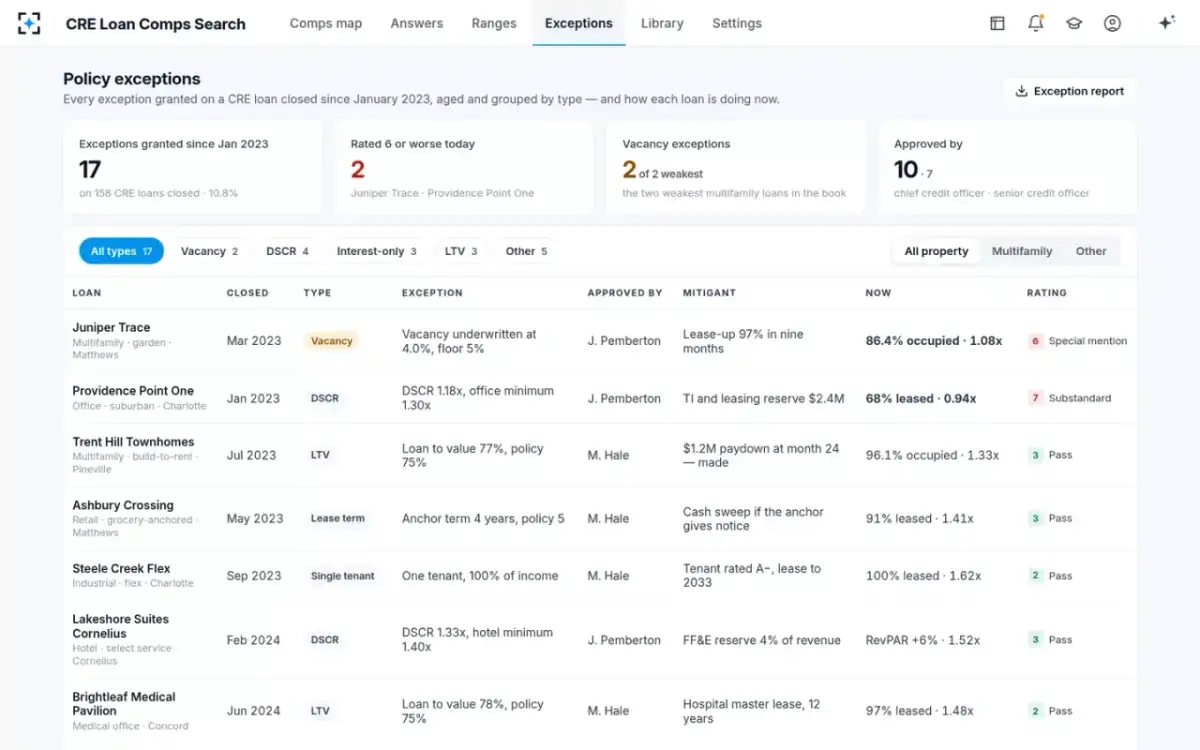
The sample bank's exceptions echo the survey's April findings closely. Since January 2023 it granted 17 exceptions on 158 CRE loans closed, 10.8%: four on coverage, three on interest-only periods, three on loan to value, two on vacancy and five others. Among its nine comparable apartment loans, one carries a 24-month interest-only period against a 12-month policy and one a coverage exception at 1.24x against 1.25x: the same terms the survey says the market has been easing. Both loans are performing; the vacancy exception on a third is the one that failed. That is the context a credit officer needs when the next request asks for longer interest-only, and the survey cannot supply it.
The bank's own exceptions in CRE Loan Comps Search, by type, with how each loan is doing now
Where CRE Loan Comps Search fits beside the survey
CRE Loan Comps Search gives a bank the levels and outcomes the survey lacks: what it actually underwrote by property type, market and period, every exception with its approver and mitigant, and how those loans have performed since. It does not reproduce the survey, forecast standards or price loans; the spread column in any internal mirror comes from the bank's pricing system. And it does not judge whether easing is wise: the chief credit officer and the board do, with the evidence in front of them.
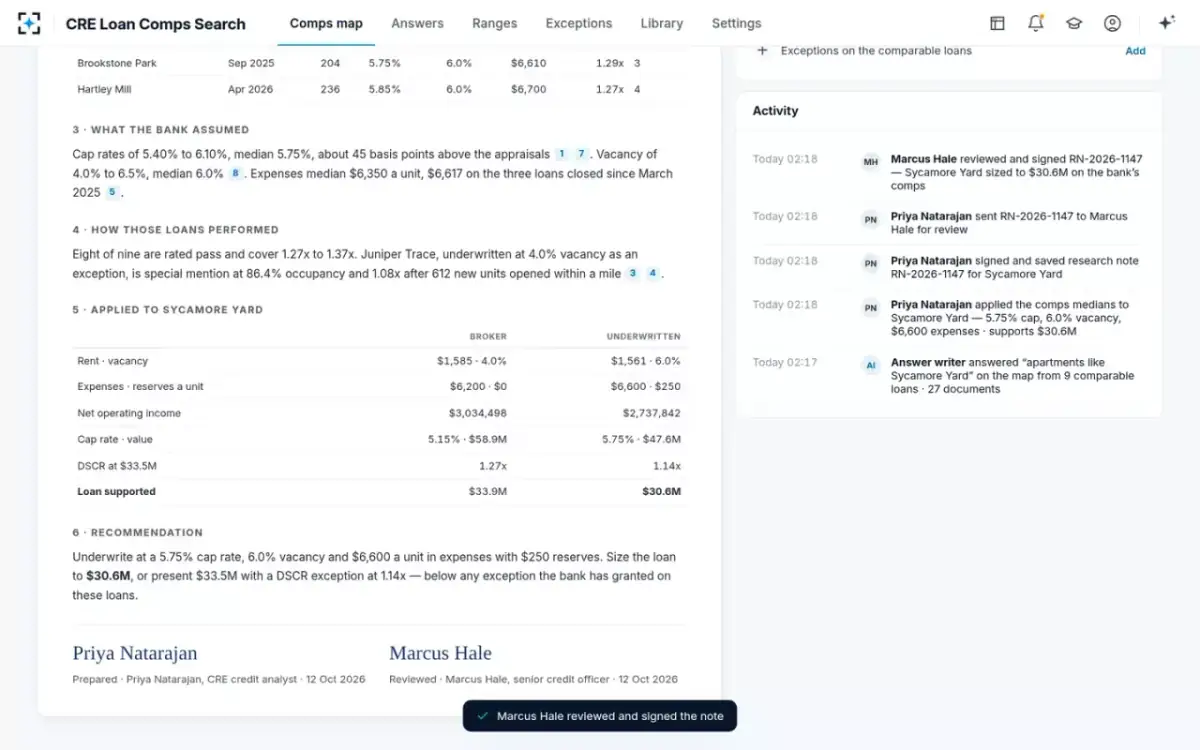
The research note an analyst signs for each loan carries the exceptions on its comparable loans and how each turned out, which puts the survey's question, are we easing, into every committee pack without anyone having to ask it. Five common beliefs about CRE lending standards tests the market picture further, and the pricing model page takes up the spreads. The sample bank's book is on CRE Loan Comps Search.
Exception history carried into the signed research note
Questions people ask
How often is the senior loan officer survey published?
Usually four times a year, in January, April, July and October, each asking about the previous three months; the Federal Reserve's authority allows up to six surveys a year. Responses are collected over about two weeks: the April 2026 survey went out on March 23 with responses due April 3.
Where can I find senior loan officer survey data?
On the Federal Reserve Board's website, under Data, where each survey has a summary, two tables of responses and chart data. The net percentages are also carried as time series in the St. Louis Fed's FRED database, which is the easiest way to chart them over time.
What does net percentage tightening mean in the SLOOS?
It is the share of responding banks that tightened standards minus the share that eased. A net percentage of +20 means a fifth more banks tightened than eased; a negative number means easing on balance. It says nothing about how far any bank moved.
Does the senior loan officer survey cover community banks?
Not directly. The panel is up to 80 large domestically chartered banks, and the summary reports the largest, those with $100 billion or more in domestic assets, separately from the rest. Its CRE results lean toward bigger lenders, which is one reason a community bank should read it against its own book.
Why did banks ease CRE terms in 2025 and 2026?
In the April 2026 survey the most cited reason for easing CRE lending policies over the past year, reported by major net shares of banks, was more aggressive competition from other banks or nonbank lenders. Banks citing stronger demand pointed to more acquisitions and development, more refinancing of maturing loans and lower interest rates.