Commercial real estate lending standards are the criteria a bank applies before it lends against income property or construction: the maximum loan to value, the minimum debt service coverage and debt yield, the term, amortization and interest-only limits, and the assumptions it accepts about rents, vacancy, expenses and cap rates. In 2026 they are easing on balance after tightening steadily from 2022 through 2024, according to Federal Reserve surveys, while bank CRE lending keeps growing. Each bank sets its own standards under regulatory ceilings, and the standard that matters for the next loan is the one it actually applied on its last similar loans. Botminds' CRE Loan Comps Search shows exactly that: the cap rate, vacancy, expenses and coverage a bank underwrote on comparable loans, read from its approved credit memos, and how each loan has performed since.
Five beliefs about CRE lending standards come up again and again, from borrowers, directors and analysts. Each is checked below against regulators' own data; the bank examples are fictional sample data from Calder Point Bank, a sample bank with 1,284 closed CRE loans.
Five myths about commercial real estate lending standards, and what the data say
Myth 1
Banks have stopped lending on commercial real estate.
What the data sayBank CRE loans reached $3.14 trillion in September 2026 and grew at a 5.1% annual rate that month.
Myth 2
Regulators set CRE lending standards.
What the data sayRegulators set ceilings and expectations; each bank sets its own standards, below the supervisory limits.
Myth 3
Loan to value shows how strict lending is.
What the data sayFederal Reserve research finds aggregate LTV a poor proxy for standards unless risk perceptions are controlled for.
Myth 4
CRE lending standards are loose.
What the data sayThey are loosening, from the tight levels reached after steady tightening from 2022 through 2024.
Myth 5
Banks extend CRE loans to hide losses.
What the data saySome weakly capitalised banks did; across large banks, extensions after 2023 came with tougher terms and performed well.
What are current commercial real estate lending standards?
Current CRE lending standards are moderately conservative and easing: banks report standards near the tighter end of their post-2005 range, but looser over the past year on loan size, spreads and interest-only periods, mainly because of competition. The Federal Reserve's May 2026 Financial Stability Report summarises the turn: "banks' lending standards on new CRE loans, which tightened steadily from 2022 through 2024, have eased over the second half of 2025" (Federal Reserve, Financial Stability Report, May 2026).
Behind that summary sit thousands of separate standards. Every bank writes its own CRE policy, with loan-to-value limits by property type, coverage and debt-yield minimums, and an exception process, and every analyst applies it with assumptions the policy does not set. That is why the myths below matter: each confuses the market's average with what any one bank does.
Are banks still lending on commercial real estate?
Yes. US commercial banks held $3.14 trillion of CRE loans in September 2026, seasonally adjusted, and the book grew at a 3.6% annual rate in the third quarter and 5.1% in September (Federal Reserve H.8, October 23, 2026). The FDIC reports that "CRE loans held by banks grew 3.1 percent in 2025", with nonfarm nonresidential and multifamily loans increasing while construction and development loans fell 5.8% (FDIC, 2026 Risk Review).
Bank CRE lending slowed, then picked up again in 2026
The myth has a real source: construction lending did shrink, and some banks pulled back from office. The FDIC notes that acquisition, development and construction loans were "down 8.8 percent since their recent peak at year-end 2023". But the book as a whole kept growing, and the refinancing of maturing loans means banks are re-underwriting large volumes of existing CRE debt every year. Most of that work is done by banks outside the 25 largest, which hold about 70% of domestically chartered banks' CRE loans.
Do regulators set lending standards?
No; regulators set ceilings and expectations, and each bank sets its own standards beneath them. The Interagency Guidelines for Real Estate Lending Policies say it in their first instruction on loan to value: "Institutions should establish their own internal loan-to-value limits for real estate loans. These internal limits should not exceed the following supervisory limits" (12 CFR 34 subpart D, appendix A).
The supervisory loan-to-value limits: ceilings for each bank's own limits
| Loan category | Supervisory LTV limit |
|---|---|
| Raw land | 65% |
| Land development | 75% |
| Construction: commercial, multifamily and other nonresidential | 80% |
| Construction: 1-to-4 family residential | 85% |
| Improved property | 85% |
The same is true of concentration. The 2006 interagency guidance on CRE concentrations, still in force, "does not establish specific CRE lending limits" and "does not establish a CRE concentration limit that applies to all institutions"; it asks each bank to set internal limits and manage them (71 FR 74580, December 2006). Coverage minimums, debt-yield floors, vacancy floors and cap-rate practice appear in no regulation at all. They are the bank's own, which is why two banks lending on the same building can offer very different loans.
The regulation itself warns against reading its ceilings as a standard. "The establishment of these supervisory limits should not be interpreted to mean that loans at these levels will automatically be considered sound," the Interagency Guidelines say, and for "any subcategory of loans that exhibits greater credit risk than the overall category, a lender should consider the establishment of an internal loan-to-value limit for that subcategory that is lower than the limit for the overall category." A bank lending on older suburban office at the 85% improved-property ceiling would be within the rule and outside its spirit.
So when a borrower says "the regulators allow 85%", the accurate reply is that the regulators allow the bank to decide, and expect it to decide lower where the risk is higher. The sample bank's own multifamily limit is 75% of the lesser of price and appraised value, ten points inside the ceiling, and its policy adds a 1.25x coverage minimum, a 5% vacancy floor and a 12-month interest-only limit that no regulation mentions. Those choices, not the supervisory table, are its standards.
Is LTV a good measure of lending standards?
Not on its own. Loan to value moves with property values and with how risky lenders think property is, so a falling average LTV can mean tighter standards or simply that lenders see more risk. Federal Reserve economists studying securitized commercial mortgages concluded that "the aggregate LTV level should be interpreted as a proxy for lending standards only after controlling for aggregate risk perceptions, among a host of asset and lending market factors" (Firestone, Godin, Horvath and Sagi, FEDS 2024-019).
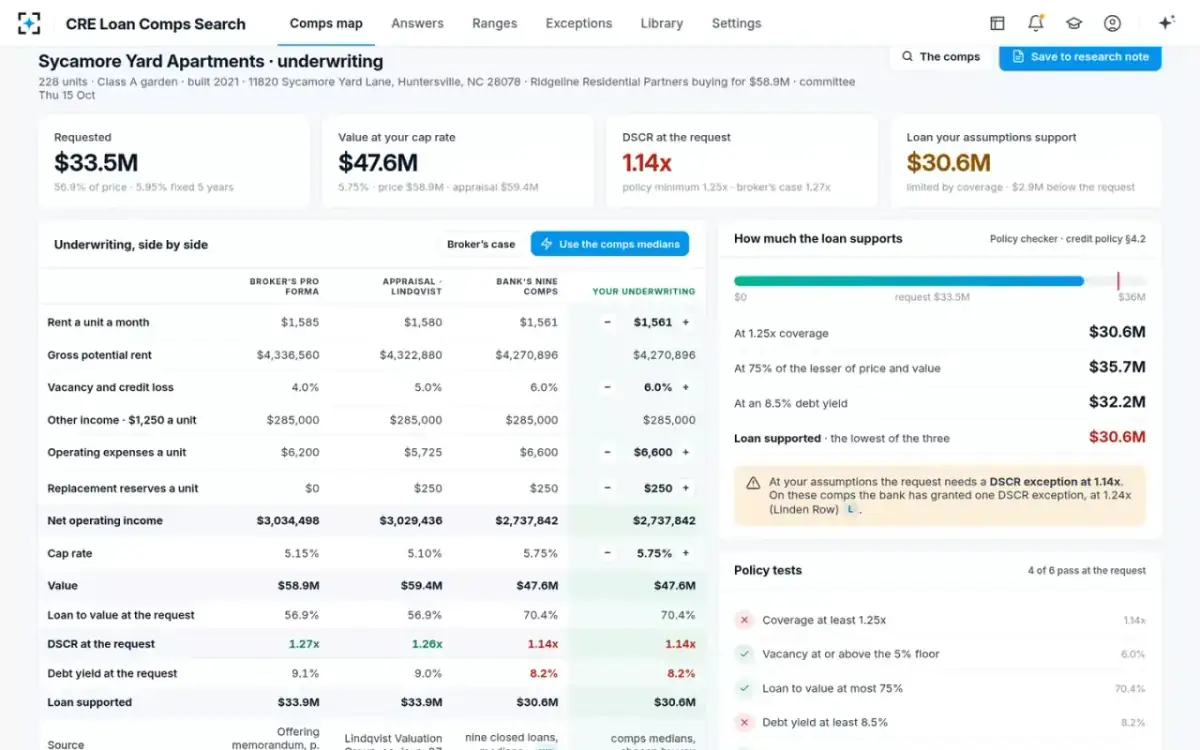
Their finding is pointed: although LTVs fell after the financial crisis, LTVs "conditioned on implied volatility and other theoretically motivated fundamental determinants of optimal leverage show no conclusive trend before or after the crisis". At a single bank the same trap appears inside a loan. The sample loan Sycamore Yard shows a 56.9% loan to value on the broker's numbers and 70.4% on the bank's own, from the same request; the standard did not change, the cap rate and vacancy assumptions did.
One request, two loan-to-value ratios: the assumptions moved, not the standard
56.9%
loan to value on the broker's 5.15% cap rate and 4.0% vacancy
70.4%
loan to value on the bank's own comps: 5.75% cap rate, 6.0% vacancy
75%
the sample bank's policy limit, of the lesser of price and value
CRE lending standards in 2026: loose, or loosening from tight?
Loosening from tight. The Federal Reserve's surveys show standards easing on balance since the second half of 2025, led by the largest banks, but in its July 2026 survey banks, on balance, still placed their CRE standards toward the tighter end of their range since 2005, though less so than a year earlier. The direction is easier; the level is not yet easy. Reading the senior loan officer survey against the bank's own book walks through the 2026 results.
The distinction matters for credit officers because drift from a tight position feels like normalisation. Each exception granted to match a competitor's interest-only period looks reasonable against last year's caution, and the cumulative change only shows up when someone counts. The sample bank's own count, 17 exceptions on 158 CRE loans since January 2023, with both vacancy exceptions sitting on its two weakest multifamily loans, is the kind of evidence that turns the market's direction into a bank-specific question.
Do banks extend and pretend on CRE loans?
Some did, but the evidence across large banks points the other way. A 2026 Federal Reserve study using supervisory loan data found that "contrary to concerns about banks 'extending-and-pretending' following that episode", the spring 2023 bank stress, "banks increased income and principal paydown requirements for extensions, contributing to strong ex-post performance for extended loans" (Glancy, FEDS 2026-025). The FDIC reports modified CRE loans of $11.6 billion in 2025, 0.38% of the CRE-secured portfolio, of which 82% was performing.
The counter-evidence is real and narrower. New York Fed researchers found that "weakly capitalized banks provided maturity extensions and granted payment relief to distressed commercial real estate (CRE) borrowers to preserve capital, leading to credit misallocation and a buildup of financial fragility" (Crosignani and Prazad, New York Fed Staff Report 1130). The two findings fit together: extension is a normal servicing tool, and it becomes a problem at banks with too little capital to recognise losses. Which kind a given extension is can only be judged from the loan's own terms and outcome.
Where a bank's real standards live: in its own loans
A bank's real CRE lending standards are the ones it applied, and they are written in its approved credit memos, not in its policy: the cap rate it accepted, the vacancy it underwrote, the expenses it allowed and the exceptions it granted, loan by loan. Every CRE loan rests on a handful of those assumptions, and the bank has made each of them before on a similar building. The policy sets the outer limits; the memos show where inside them the bank actually lends.
On the sample bank's nine comparable apartment loans, that inner standard is visible: cap rates underwritten from 5.40% to 6.10% with a median of 5.75%, about 45 basis points above the appraisals; vacancy from 4.0% to 6.5% with a median of 6.0%; one coverage exception at 1.24x and one interest-only exception at 24 months, both performing; and one vacancy exception at 4.0%, the loan that missed. A director asking "have our standards slipped?" gets a better answer from that table than from any survey.
The bank's standard as applied, in CRE Loan Comps Search: nine loans and their outcomes
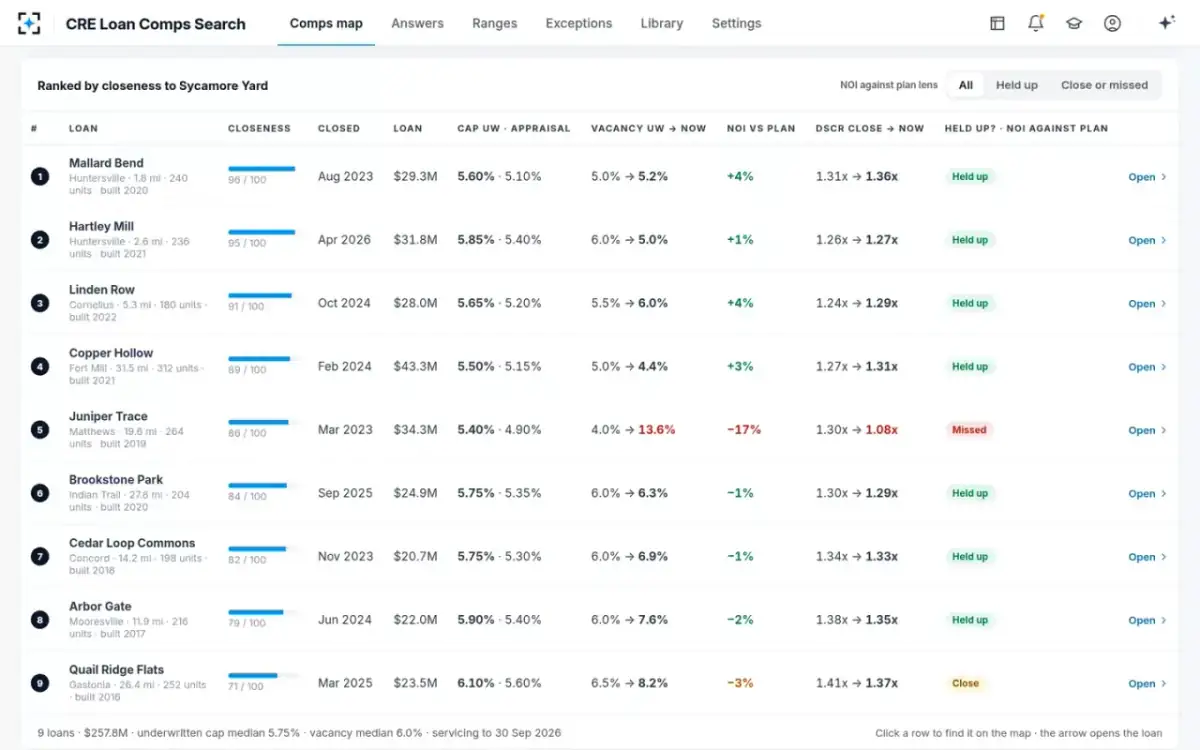
How CRE Loan Comps Search shows a bank its own standards, and what it leaves to people
CRE Loan Comps Search shows a bank its own CRE lending standards as practised: comparable loans with the assumptions from their approved memos and appraisals, their outcomes from servicing, exceptions with approvers and mitigants, and assumption ranges by property type and market. The policy checker tests a new request against the bank's credit policy and the supervisory loan-to-value limits and reports which test binds; it never waives or reinterprets a policy.
It does not set standards, forecast the market or decide loans. The analyst chooses the assumptions, a named credit officer signs the research note, and committee approves. Where the bank has little history the answer says how little. For the question underneath most standards debates, which cap rate to believe, see determining a cap rate from the bank's own loans; the full sample book is on CRE Loan Comps Search.
The policy tests on the loan in hand, against the bank's own numbers
Questions people ask
What is the maximum LTV for a commercial real estate loan?
Under the federal supervisory limits, 85% for improved commercial property, 80% for commercial construction, 75% for land development and 65% for raw land. Most banks set their own limits lower, often by property type, and many lend at well below them; the sample bank's multifamily limit is 75% of the lesser of price and appraised value.
What DSCR do banks require for commercial real estate?
Typically 1.20x to 1.50x, depending on property type, amortization and cash-flow stability; the Federal Reserve's stress-test documentation puts the usual minimum in that range. Hotels and properties with volatile income sit at the high end; long net leases to strong tenants can justify less.
Who sets CRE lending standards at a bank?
The board approves the real estate lending policy at least annually, the credit committee sets risk appetite and limits, and credit administration writes the procedures. Within those, analysts and credit officers apply the standards loan by loan, and exceptions are approved by named authorities and reported to the board.
Did banks tighten CRE lending in 2026?
On balance, no. The Federal Reserve's 2026 surveys show CRE standards eased or unchanged, led by banks with $100 billion or more in assets, while some smaller banks tightened construction and multifamily standards early in the year. Over the year to April 2026, banks most often reported larger loan sizes, narrower spreads and longer interest-only periods.
Are CRE loans riskier than other bank loans?
They concentrate risk: CRE losses drove most small-bank failures in 2008–2011, and supervisors watch CRE concentrations closely. Today's performance is benign on average, with industry past-due and nonaccrual rates of about 1.3% to 1.5% across CRE categories in mid-2026, but uneven across banks and property types, with office the weakest.