AI for commercial lending, in 2026, mostly means software that reads: it extracts figures from financial statements and leases, drafts parts of a credit memo, and searches the bank's documents for an answer. The use that carries least risk and the most immediate value is retrieval over the bank's own book, because every answer can be checked against a document the bank already approved. Botminds' CRE Loan Comps Search is built that way: ask what the bank has lent on before, and six agents find the bank's comparable CRE loans, read the credit memo, appraisal and review report behind each, join how each loan has performed, test the loan in hand against policy and write an answer in which every sentence cites its page. The agents may not rate, price or approve a loan; the analyst chooses the assumptions and a credit officer signs.
The examples below run on a fictional sample bank, Calder Point Bank, with 1,284 closed CRE loans, and a fictional $33.5 million apartment acquisition, Sycamore Yard, going to committee on a Thursday. The regulatory statements are linked where they appear.
One question to CRE Loan Comps Search, answered from the bank's own files
16s
from the question to a cited answer, six agents in sequence
27
documents read: nine memos, nine appraisals, nine review reports
486
figures extracted, each with its document and page
100%
of sentences in the answer cite a source: a design target
How is AI used in commercial lending today?
Banks use AI in commercial lending mainly for reading and drafting, under human control, and regulators describe adoption as cautious. The OCC's Spring 2026 Semiannual Risk Perspective says "banks are taking a measured approach to the adoption of generative AI (genAI) and agentic AI, with usage generally limited to specific use cases with guardrails and human-in-the-loop accountability to manage risk", and that so far "use cases are primarily productivity and customer experience enhancement tools" (OCC, Semiannual Risk Perspective, Spring 2026).
Credit is among the named uses. The FDIC's director of risk management supervision told Congress in March 2026 that "banks have increasingly utilized AI and machine learning in a range of areas, including fraud detection, anti-money laundering … and credit underwriting" (FDIC testimony, March 26, 2026). The same OCC report notes banks "may consider expanding their use of genAI and agentic AI for material financial decisions", which is precisely where a buyer should slow down.
In commercial real estate specifically, the work AI is good at is the work analysts like least: finding the right documents, reading forty pages to find one vacancy assumption, and lining figures up across loans. The work AI is least suited to is the judgment those figures feed, choosing an assumption for a building no one has seen and deciding whether the bank should lend.
Why the bank's own loan book is the safest place to start
A search over the bank's own loans is the safest first use of AI in commercial lending because its output is verifiable. Every figure it reports exists in an approved memo, an appraisal or a servicing report; a reviewer can open the page and see whether the agent read it right. A model that predicts a default probability or a fair cap rate offers no such check: the only test is time.
It is also where the bank's information is unique. Market data vendors sell what buildings traded for; only the bank knows what it assumed when it lent and whether that assumption held up. The OCC expects that knowledge to be used: underwriting analysis should consider "comparable rental rates, operating expenses, and sales prices", and "inadequately supported or questionable analysis should be challenged" (OCC, Commercial Real Estate Lending). A challenge is easier to make, and to answer, when the challenger can point to nine of the bank's own loans.
Two kinds of AI in a credit file: one predicts, one retrieves
AI that predicts: A score, a probability or a recommended value.
AI that retrieves and cites: Loans, figures and passages the bank already approved, each with its page.
AI that predicts: Back-testing over months or years; the reasoning may not be explainable.
AI that retrieves and cites: Open the cited page and compare; a wrong figure is visible the same day.
AI that predicts: Often part of the decision itself.
AI that retrieves and cites: Nothing: the analyst chooses assumptions, a credit officer signs, committee approves.
AI that predicts: Quietly, when conditions differ from its training data.
AI that retrieves and cites: Visibly: a missing citation, a stale date, or a stated lack of history.
AI that predicts: Closest to "credit decisions", where compliance challenges are greatest.
AI that retrieves and cites: A productivity tool under human-in-the-loop accountability.
Can AI search past credit memos?
Yes, provided the AI reads the memo the way an analyst would: the approved version, the right section, the figure with its page. A credit memo is a long, inconsistent document, written by many analysts over many years in different templates, so the reading has to cope with a vacancy assumption that appears as a percentage in one memo, as a dollar loss in another, and as an exception paragraph in a third.
In the sample search, the memo and appraisal reader read 27 documents in six seconds and extracted 486 figures, each tied to its document and page, while other agents handled the criteria, the loan selection and servicing. The answer it wrote opens with what a credit officer would ask first: nine comparable loans, underwritten at cap rates of 5.40% to 6.10% with a median of 5.75%, about 45 basis points above the appraisals on the same loans.
A plain-words question, answered with a citation on every sentence
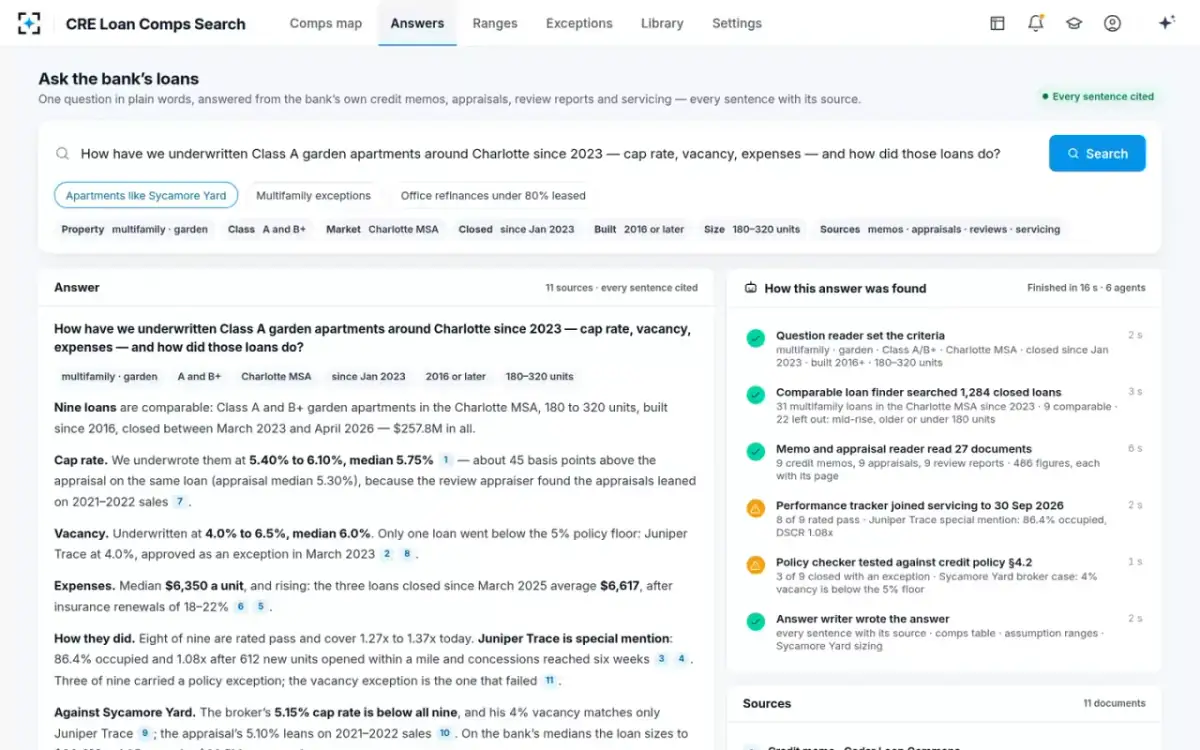
Six agents, six limits: what each one does in CRE Loan Comps Search
An agent is a piece of software given one job, the tools for it and explicit limits. Splitting the work into six makes each limit enforceable: the agent that finds loans cannot see a loan the user may not see, the agent that reads documents cannot report a figure without its page, and the agent that tests policy cannot waive it.
How CRE Loan Comps Search answers one question, and where people decide
Agent
Question readerTurns the question into criteria (property type, class, market, vintage, size, period) and shows them as chips.
Never: Applies a criterion it does not show; it asks instead when one is ambiguous.
Agent
Comparable loan finderSearches the closed loans, scores closeness, and says why each loan is in or left out.
Never: Includes a loan the user may not see.
Agent
Memo and appraisal readerPulls cap rate, rent, vacancy, expenses, coverage and exceptions from memos, appraisals and reviews.
Never: Reports a number without its document and page, or reads a draft memo.
Agent
Performance trackerJoins occupancy, coverage, rating and payments from servicing, each with its date.
Never: Presents a stale figure as current.
Agent
Policy checkerTests the assumptions and the sizing against credit policy and supervisory LTV limits.
Never: Waives or reinterprets a policy.
Agent
Answer writerWrites the cited answer, the comps table and the research note; says where history is thin.
Never: Writes a sentence without a source, or chooses an assumption.
A person decides
CRE credit analystChooses the cap rate, vacancy and expenses, recommends the amount, signs the note.
A person decides
Senior credit officerReviews and signs the research note before it enters the credit memo; committee approves the loan.
The limits matter more than the capabilities. A finder that could see every borrower's name would be a confidentiality problem at any bank with relationship entitlements; a reader that could summarise without a page would let a misread figure travel into a memo unseen; a writer that could pick the assumption would quietly become the underwriter. Each limit is a line a buyer can test.
What should AI not do in commercial lending?
AI should not make or effectively make the credit decision: rating the risk, setting the price, choosing the assumption that sizes the loan, or approving it. Those are the points where the bank's accountability is personal and where regulators expect a person. Federal Reserve Vice Chair for Supervision Michelle Bowman put the line plainly in July 2026: using AI "in a way that has more direct impact on credit decisions affecting individual customers—presents more substantial legal compliance challenges than other AI use cases" (Bowman, July 14, 2026).
There is a quieter failure too: AI that hides how thin the evidence is. An answer drawn from two loans should say two, and an answer with no precedent should say none rather than generalise from the market. When the sample bank asks about suburban medical office, the answer finds eight loans in four metros and states that the bank has no medical office loan outside those four since 2022, instead of guessing.
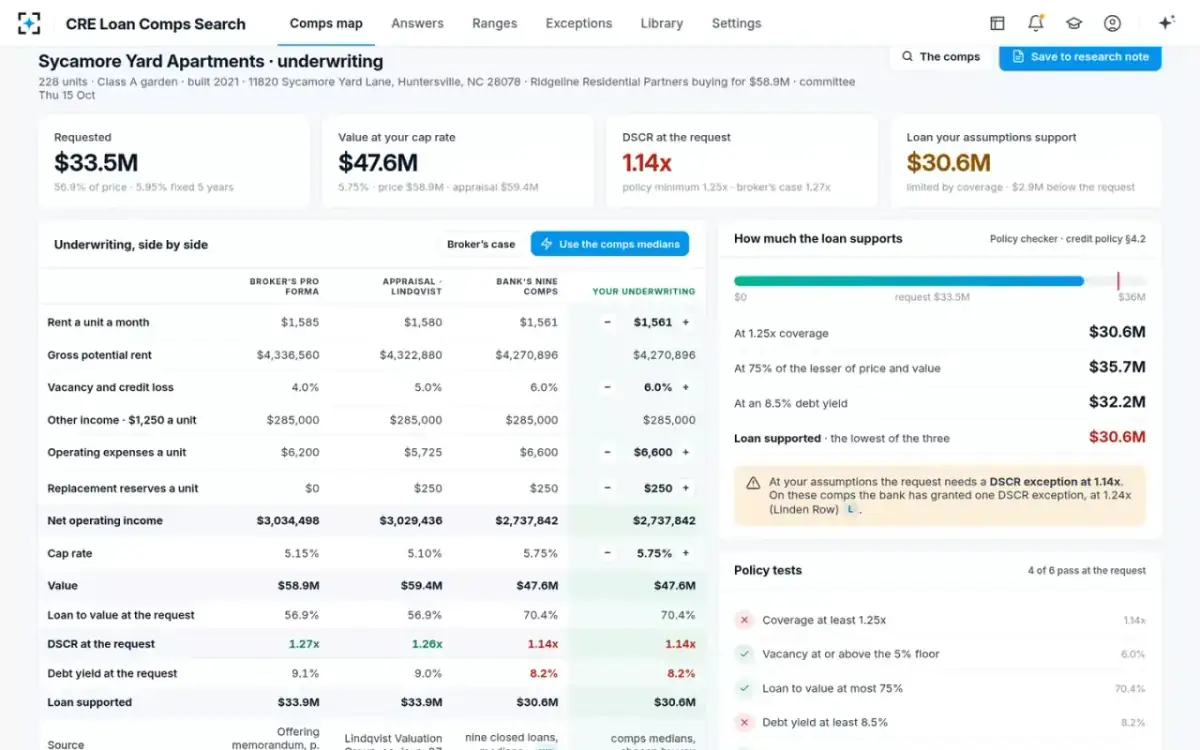
The sample sizing shows the division of labour. Sycamore Yard's broker underwrote a 5.15% cap and 4% vacancy, which supports the $33.5 million requested. On the bank's own comps, at a 5.75% cap, 6.0% vacancy and $6,600 a unit in expenses chosen by the analyst, the request covers only 1.14x against a 1.25x minimum and the loan the assumptions support is $30.6 million. The agents computed both; the analyst chose which to recommend, and the credit officer signed.
The analyst chooses the assumptions; the policy checker shows which test binds
Is AI in lending regulated?
AI in lending is regulated through the rules that already govern the lending, plus guidance on models and vendors; there is no AI-specific federal rule for commercial credit. The newest piece is the April 2026 interagency model risk guidance (OCC Bulletin 2026-13, Federal Reserve SR 26-2), which replaced SR 11-7 and says: "Generative AI and agentic AI models are novel and rapidly evolving. As such, they are not within the scope of this guidance" (OCC Bulletin 2026-13).
Where AI for commercial lending stands under US bank guidance, October 2026
| Guidance | What it says about AI | What a bank still owns |
|---|---|---|
| Model risk management, OCC 2026-13 / SR 26-2 (April 17, 2026) | Generative and agentic AI are outside its scope; a request for information on AI is promised. | Sound governance of any tool that informs credit decisions. |
| Third-party relationships guidance (June 2023, in force) | Applies to any vendor, "especially those using new technologies". | "The use of third parties does not diminish or remove" the bank's responsibility for safe and sound, lawful operation. |
| OCC Semiannual Risk Perspective, Spring 2026 | Adoption is measured, with guardrails and human-in-the-loop accountability. | Explainability, data and validation challenges the OCC names. |
| Interagency Guidelines for Real Estate Lending Policies | Silent on technology. | The written policy, LTV limits, exception approvals and board reporting, whoever prepares the analysis. |
Two practical consequences follow. First, a bank cannot outsource accountability for an AI tool to the vendor; the third-party guidance is explicit, and the burden of explaining what the tool did sits with the bank. Second, until the promised request for information produces guidance, the strongest position is a tool whose every output can be traced and whose decisions are all made by people: citations to the page, versioned settings, an audit trail of every question and answer, and a named signer.
What to look for in an AI commercial lending platform
A buyer should judge an AI commercial lending platform on how it fails, not on its demo. The questions below are the ones we would ask of any product, including ours; each can be tested on the bank's own closed loans before a contract, as replaying a search on loans whose outcomes are known describes.
Eight tests for any AI platform that touches commercial credit
- Every figure cites a document and a page
Open ten citations at random. A citation to a whole document is not a citation.
- Approved versions only
Ask how it treats a draft memo saved next to the approved one.
- Entitlements carry through
Log in as a relationship manager and ask about another officer's borrower.
- It says when history is thin
Ask about a property type the bank barely lends on. The right answer counts the loans or says none.
- Every figure is dated
Servicing figures should carry their as-of date; a stale figure presented as current is a defect.
- It never decides
Check that rating, pricing, assumption choice and approval all stay with named people.
- Settings are versioned
Comparable-loan criteria and policy minimums should be settings on an audit trail, not code.
- It can be replayed
Run it on closed loans and compare with what a senior officer would have cited.
Where CRE Loan Comps Search fits in a lending team's AI, and where it does not
CRE Loan Comps Search fits the analysis between the request and the memo: the precedent research an analyst does for every CRE loan and too often skips. It reads the bank's own approved memos, appraisals, review reports, closed-loan terms, servicing and credit policy, refreshed nightly, and produces a cited answer, a ranked comps table, assumption ranges by property type and market, a sizing of the loan in hand and a research note that a credit officer signs.
It is not a loan origination system, a spreading tool or a pricing engine, and it does not rate risk. It covers commercial real estate, not C&I lending. It cannot manufacture precedent where the bank has none, and its answers are only as complete as the documents the bank can give it; banks with years of memos in scanned images should expect a reading period before the search is useful. For the question it does not answer, what to charge, what a pricing model misses without the bank's own comps explains how the two fit together. And for a bank that wants to own the index before it buys anything, a 30-day plan for a comps database sets out the work.
The test of AI in commercial lending is whether a credit officer would sign what it produced without redoing it. Retrieval with page-level citations gets there first, because the officer can check it in minutes. CRE Loan Comps Search shows the whole flow on the sample bank.
Questions people ask
What is agentic AI in commercial banking?
Agentic AI is software that carries out a multi-step task, choosing tools and steps toward a goal, rather than answering a single prompt. In commercial banking it usually means agents that gather documents, extract figures and draft analysis, with people approving the result. The April 2026 model risk guidance places agentic AI outside its scope, pending a promised request for information.
Can AI underwrite a commercial real estate loan?
AI can do much of the analysis an underwriter needs, reading rent rolls, operating statements, appraisals and the bank's past memos, and computing coverage, loan to value and debt yield. Choosing the assumptions and recommending the loan should stay with the analyst, and approval with the bank's authorities. Regulators describe current adoption as human-in-the-loop.
Is AI used for credit decisions in commercial lending?
Some banks use AI and machine learning in credit underwriting, as the FDIC told Congress in March 2026. For commercial real estate, AI is far more common in reading and drafting than in deciding. Federal Reserve officials have said AI with direct impact on credit decisions carries greater legal compliance challenges.
How do you stop an AI search from making up figures?
Require a document and page for every figure, and make the software refuse to state a number it cannot cite. Then test it: open citations at random, plant a draft memo beside an approved one, and ask about a property type the bank has never financed. A search that answers the last question with a confident figure has failed.
Does a bank need model validation for an AI search tool?
The 2026 model risk guidance excludes generative and agentic AI from its scope, and it excludes "simple arithmetic calculations, such as those found within spreadsheets" from the definition of a model. The bank still owns the tool's risk under third-party and safety-and-soundness expectations, so documented testing on its own files is the prudent substitute.