To determine the cap rate of a commercial real estate property, divide its stabilised net operating income by its value or price: a building with $2.74 million of NOI worth $47.6 million has a 5.75% cap rate. To choose the cap rate for underwriting a loan, you need evidence of what similar properties command, which usually comes from the appraisal's sales comps. A lender has a second, more defensible source: the cap rates it has itself underwritten on similar loans, and how those loans performed. Botminds' CRE Loan Comps Search reads them from the bank's approved credit memos and appraisals, shows the bank's cap rate beside each appraisal's, and builds ranges by property type and market, so the cap rate in a memo can cite the bank's own history rather than a vendor survey nobody can quote.
The worked figures come from fictional sample data: a 228-unit apartment acquisition, Sycamore Yard, at a fictional bank, Calder Point Bank, with 1,284 closed CRE loans.
The cap rate, and the three numbers that sit behind it
| Number | How it is calculated | What it rests on | Whose judgment |
|---|---|---|---|
| Net operating income | Effective gross income − operating expenses − reserves | Stabilised rents and vacancy, expenses as they will run, reserves imputed whether funded or not | The analyst, from the rent roll and statements |
| Value | NOI ÷ cap rate | Direct capitalisation, appropriate when income is stabilised and expected to stay stable | The appraiser, challenged by the bank |
| Cap rate | NOI ÷ value, or NOI ÷ price for a sale | Sales comps, and the bank's own loans on similar buildings | The analyst chooses; the credit officer signs |
How do you determine a cap rate for commercial real estate?
You determine a cap rate either by observing it, dividing a comparable property's NOI by its sale price, or by choosing it for a subject property from such evidence and dividing the subject's NOI by it to get a value. On Sycamore Yard, the broker's NOI of $3,034,498 at a 5.15% cap rate gives the $58.9 million purchase price; the analyst's NOI of $2,737,842 at 5.75% gives $47.6 million. Same building, two cap rates, two NOIs and an $11.3 million difference in value.
The OCC's handbook frames the choice in one sentence that an underwriter should keep in view: "The discount and cap rates used in estimating property income and values should reflect reasonable expectations for the rate of return that investors and lenders require under normal, orderly, and sustainable market conditions" (OCC, Commercial Real Estate Lending). A cap rate drawn from a year of unusually cheap money fails that test, however many sales support it.
How to calculate cap rate with NOI: the NOI is the hard half
Calculating a cap rate with NOI is one division; the hard half is the NOI, because every line in it is an assumption. The OCC defines NOI as "annual gross income less operating expenses", with a vacancy factor that "may be higher or lower than actual" and "should consider vacancies in comparable properties in the same market", and a replacement reserve "imputed for underwriting purposes irrespective of whether it is actually funded". Change the vacancy or the expenses and the cap rate that a given price implies moves with them.
Three NOIs for one building, from three sets of assumptions
| Line | Broker's pro forma | Appraisal | Bank's comps, analyst's choice |
|---|---|---|---|
| Rent a unit a month | $1,585 | $1,580 | $1,561 |
| Gross potential rent | $4,336,560 | $4,322,880 | $4,270,896 |
| Vacancy and credit loss | 4.0% | 5.0% | 6.0% |
| Other income | $285,000 | $285,000 | $285,000 |
| Operating expenses a unit | $6,200 | $5,725 | $6,600 |
| Replacement reserves a unit | $0 | $250 | $250 |
| Net operating income | $3,034,498 | $3,029,436 | $2,737,842 |
| Cap rate applied | 5.15% | 5.10% | 5.75% |
| Value | $58.9M | $59.4M | $47.6M |
The broker's NOI is the highest of the three despite higher expenses than the appraisal, because it carries 4% vacancy and no reserves. That is the pattern the OCC means when it says underwriting should develop "an NOI that represents a stabilized estimate of income and expenses". A buyer's cap rate applied to a broker's NOI double-counts optimism: the income is generous, and the rate that capitalises it was set by buyers who were also generous.
How to find the cap rate of a property from comps
To find a property's cap rate from comps, take recent sales of similar buildings, divide each one's NOI by its price, and adjust for differences in quality, location, age and lease profile; the resulting range brackets the subject. The weakness is whose NOI each sale used. A sale's implied cap rate is only as good as the income figure behind it, and income figures from sellers and brokers lean high.
Academic research shows how high, and how persistently. Studying CMBS loans made between 2013 and 2019, Griffin and Priest found underwritten income routinely above the properties' actual income, by margins that differed persistently from one originator to another; the bank's own loan files are where it can measure its own version of that gap, loan by loan, as replaying a search on closed loans describes. The difference between market sales comps and the bank's loan comps is set out on its own page.
Cap rate in an appraisal: what the reviewer should check
In an appraisal, the cap rate is the appraiser's conclusion from comparable sales and market evidence, and the bank's reviewer must test whether it is supportable. The OCC's appraisal review worksheet asks whether the report includes "appropriate analysis of discount and capitalization rates" and whether "the capitalization or discount rate [is] supportable, and does it appear reasonable in terms of the class, property type, and market conditions?" (OCC, appendix E).
Appraisals are estimates, and their errors are not small. A peer-reviewed study of institutional properties in the NCREIF Property Index from 1997 to 2021 found a mean absolute error of 11.1% between appraised values and later sale prices, lowest for apartments at 8.6% and highest for industrial at 12.5%, with "no evidence" that the error had narrowed over the last decade (Deppner and others, Journal of Real Estate Finance and Economics, 2023).
Appraised values miss later sale prices by about a tenth
11.1%
mean absolute error of appraised value against later sale price, all property types
8.6%
for apartments, the most accurate type
12.5%
for industrial, the least accurate type
On a stabilised apartment, an 8.6% value error is roughly the effect of moving the cap rate by half a point at today's levels. That is the size of the gap the sample bank has been leaving between its own cap rates and its appraisals', which suggests the gap is not excessive caution but a reasonable allowance for the appraisal's own uncertainty.
Why does the bank's cap rate differ from the appraisal?
The bank's underwritten cap rate differs from the appraisal's because they answer different questions: the appraiser estimates market value as of a date from recent sales, while the bank sets a rate it is willing to lend against through the loan's term. On the sample bank's nine comparable apartment loans, the bank underwrote a median 5.75% against an appraisal median of 5.30%, about 45 basis points higher, and its review appraiser had noted that the appraisals leaned on 2021–2022 sales.
The rate environment explains much of it. The Federal Reserve's May 2026 Financial Stability Report notes that cap rates at the time of property purchase "have recovered from historical lows reached in 2022, rising to a level just below its historical average in the most recent data" (Federal Reserve, Financial Stability Report, May 2026). An appraisal whose comparable sales date from those lows carries their cap rates into the file; a bank that underwrites above them is adjusting for the move.
Underwritten 5.40% against an appraisal at 4.90%, and still the loan that missed
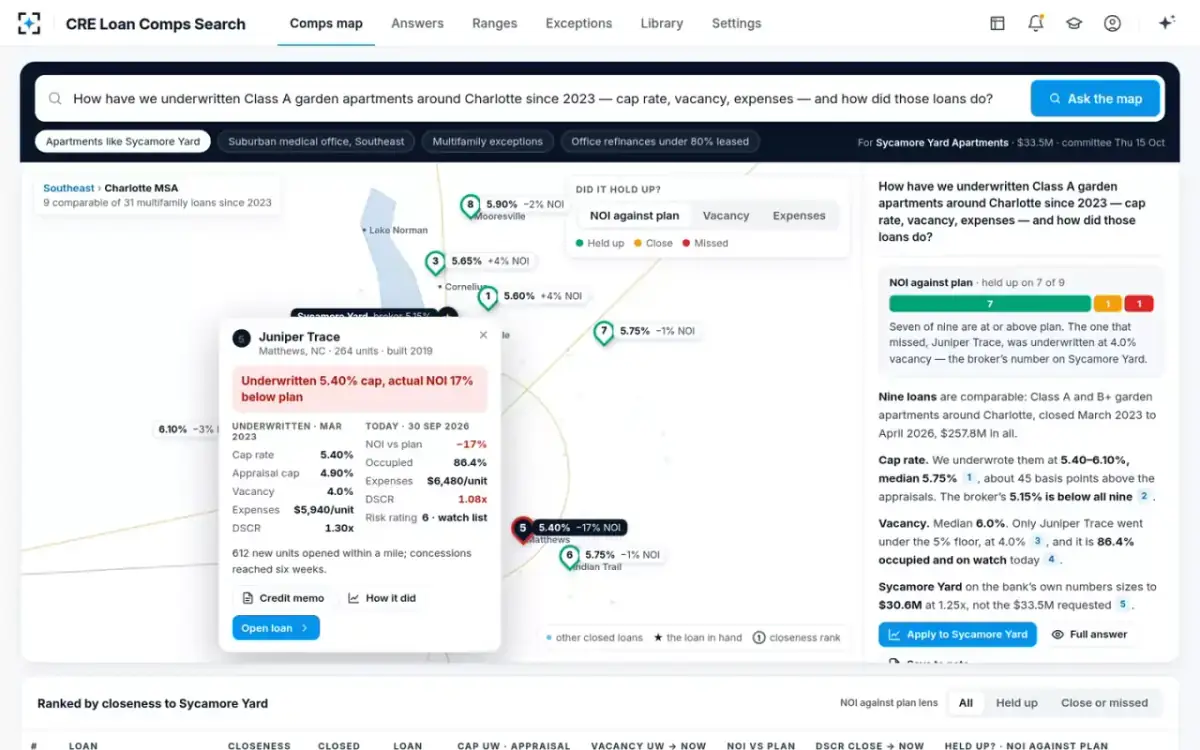
Juniper Trace is the caution. The bank underwrote it at 5.40%, half a point above its 4.90% appraisal, and it is still the one loan of nine that missed, because its NOI rested on 4.0% vacancy in a submarket about to absorb 612 new units. A conservative cap rate on an aggressive NOI is not conservative underwriting.
The cap rate your book implies, by property type
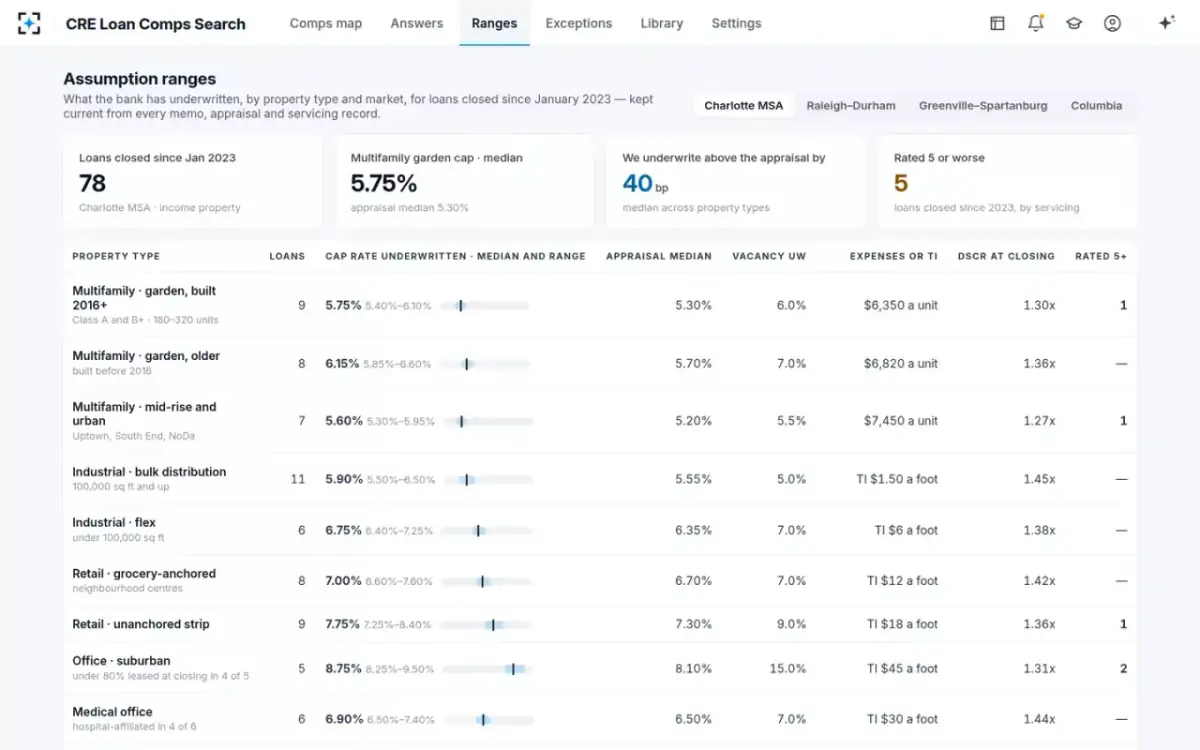
A bank's own loans give it a cap rate history by property type and market that it can cite in a memo, defend to an examiner and update every night. The table below is the sample bank's Charlotte book since January 2023, as CRE Loan Comps Search assembles it from approved memos and appraisals: the median the bank underwrote, the appraisals' median on the same loans, and the gap.
What the sample bank has underwritten against its appraisals, as CRE Loan Comps Search reads it
| Property type | Loans | Bank's median cap (range) | Appraisal median | Bank above appraisal |
|---|---|---|---|---|
| Multifamily, garden, built 2016+ | 9 | 5.75% (5.40–6.10%) | 5.30% | 45 bp |
| Multifamily, garden, older | 8 | 6.15% (5.85–6.60%) | 5.70% | 45 bp |
| Multifamily, mid-rise and urban | 7 | 5.60% (5.30–5.95%) | 5.20% | 40 bp |
| Industrial, bulk distribution | 11 | 5.90% (5.50–6.50%) | 5.55% | 35 bp |
| Industrial, flex | 6 | 6.75% (6.40–7.25%) | 6.35% | 40 bp |
| Retail, grocery-anchored | 8 | 7.00% (6.60–7.60%) | 6.70% | 30 bp |
| Retail, unanchored strip | 9 | 7.75% (7.25–8.40%) | 7.30% | 45 bp |
| Office, suburban | 5 | 8.75% (8.25–9.50%) | 8.10% | 65 bp |
| Medical office | 6 | 6.90% (6.50–7.40%) | 6.50% | 40 bp |
Two readings stand out. The widest gap is suburban office, 65 basis points, where the bank also underwrites 15% vacancy and two of five loans are rated 5 or worse; the bank's caution there is earned. The narrowest is grocery-anchored retail, where appraisals and the bank largely agree. An analyst underwriting a new grocery-anchored centre at the appraisal's cap rate is within the bank's practice; one underwriting a suburban office building at the appraisal's rate is 65 basis points more aggressive than the bank has been.
Cap rates by property type: why a published table cannot go in the memo
Published cap rates by property type come almost entirely from brokers' and data vendors' surveys, which a bank can read but should not lean on as the evidence in a credit memo: they report the market's transactions, mix property qualities and lender types, and cannot be traced to a building. The Federal Reserve's own reports on aggregate cap rates rely on commercial data, and say only where the aggregate sits against history.
The bank's own table has the opposite properties. It is narrow, a few loans per cell, but every cell can be opened to the memos and appraisals behind it, every loan has an outcome, and the population is the bank's own lending. A memo that says "the bank has underwritten nine comparable loans at 5.40% to 6.10%, median 5.75%, and the one at the bottom of that range missed plan" is making an argument an examiner can check.
What 60 basis points of cap rate does to a loan
Sixty basis points of cap rate moves value by more than a tenth at today's levels, which is why the cap rate is the assumption a credit committee argues about most. Holding Sycamore Yard's NOI at the analyst's $2,737,842, the value runs from $53.2 million at the broker's 5.15% to $44.9 million at the top of the bank's own range.
One NOI, four cap rates: the value of Sycamore Yard
At the top of its own range the bank would be within half a point of its loan-to-value limit; at the broker's rate it would have eleven points of room. The choice between those is the analyst's, and in the solution it stays the analyst's: the agents show the range, the outcomes and the arithmetic, and the analyst sets the rate and explains it in the research note a credit officer signs. For the expense line that feeds the same NOI, see a multifamily expense benchmark from the bank's own book; the whole sample book is on CRE Loan Comps Search.
Assumption ranges by property type in CRE Loan Comps Search, refreshed nightly
Questions people ask
What is a good cap rate for commercial real estate?
There is no single good cap rate: it depends on property type, quality, location, lease profile and the interest-rate environment. A lower cap rate means a higher price for the same income and usually lower perceived risk. For a lender, the useful question is whether the cap rate is supportable for this building under "normal, orderly, and sustainable market conditions", as the OCC puts it.
Is a higher cap rate better?
For a buyer, a higher cap rate means more income per dollar paid, usually with more risk. For a lender, underwriting at a higher cap rate produces a lower value and a higher loan to value on the same loan, a more conservative position. Neither is better in the abstract; the cap rate should match the risk of the income it capitalises.
How do interest rates affect cap rates?
Cap rates tend to rise when long-term interest rates rise, because buyers and lenders require more income per dollar. The OCC handbook warns that higher rates can lower property values even when nothing about the building has changed. The Federal Reserve reported in May 2026 that purchase cap rates had recovered from 2022 lows to just below their historical average.
What is the difference between a going-in and a terminal cap rate?
The going-in cap rate is the first year's NOI divided by today's value or price. The terminal or exit cap rate is applied to a future year's NOI to estimate the sale value at the end of a holding period in a discounted cash-flow analysis, and is usually set higher than the going-in rate to allow for an older building and uncertainty.
Should a lender use the appraisal's cap rate or its own?
The appraisal's cap rate is the evidence of market value; the lender's own cap rate history is the evidence of what it has been willing to lend against and how that worked. Where the two differ, the memo should say why. On the sample bank's apartment loans the bank underwrote about 45 basis points above the appraisals, and its loans largely held up.