A commercial real estate comps database, for a lender, is most useful when it holds the bank's own closed loans rather than market sales: for each loan, the property, the terms, the cap rate, rent, vacancy, expenses and coverage the bank underwrote, the appraisal it relied on, the exceptions it granted, and how the loan has performed since. Building one means four things: a list of the loans, access to their approved memos, appraisals and review reports, a reading of each document into fields with the page behind each, and a join to servicing. The reading is the hard part, which is why few banks have such a database. Botminds' CRE Loan Comps Search does that reading with six agents and keeps the result current nightly; this guide is the plan for standing it up, and it applies just as well to a bank that builds its own.
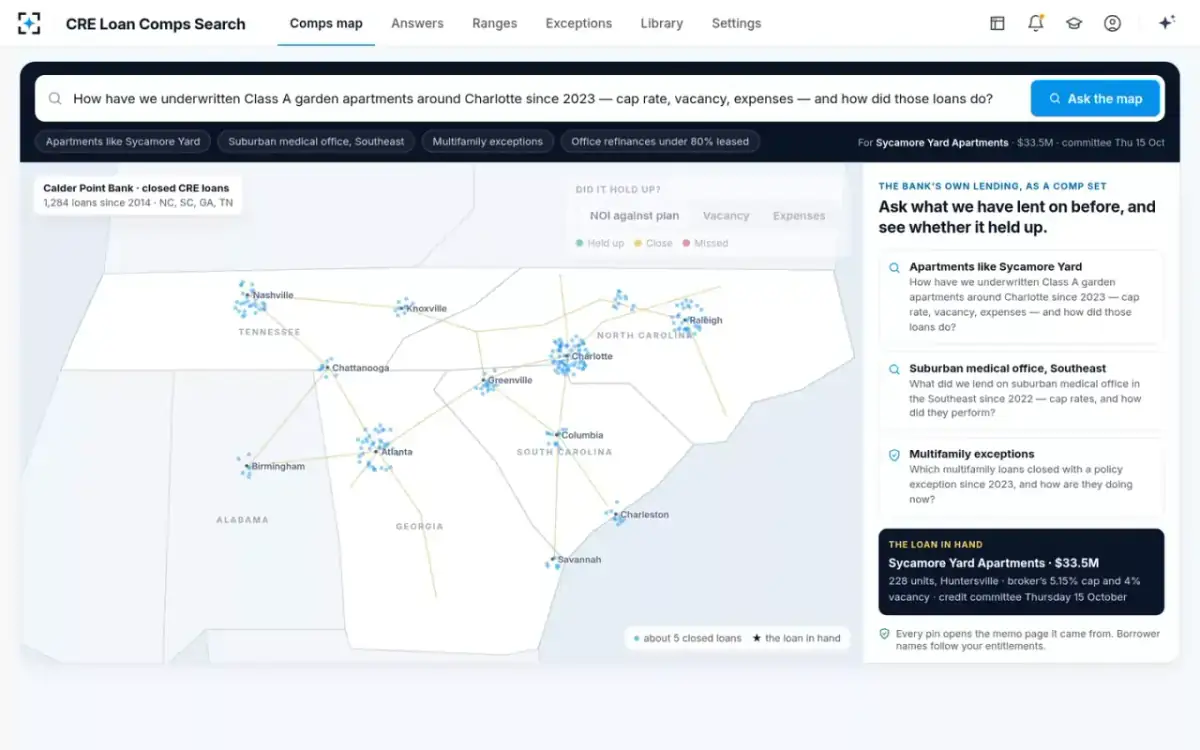
The examples come from a fictional sample bank, Calder Point Bank, whose 1,284 closed CRE loans since 2014 form its comps database in the solution.
Why a lender's own comps matter now: the refinancing calendar
$875B
of commercial and multifamily mortgages scheduled to mature in 2026, 17% of the total
$396B
of it in mortgages serviced by depositories, 21% of their balance
$652B
scheduled to mature in 2027
How do you build a commercial real estate comps database?
You build a lender's comps database by starting from the closed-loan list in the core system, attaching each loan's approved credit memo, appraisal and appraisal review, extracting the underwriting figures from those documents with the page behind each, and joining servicing so each loan carries its occupancy, coverage, rating and payment history. Then you decide who may see what, write the comparable-loan criteria down as settings, and test the result on loans whose outcomes are known.
Each step has a trap. The loan list misses participations and loans booked under a different property code. The document folders hold drafts beside approved memos. The memos express the same assumption in different ways across templates and years. Servicing figures carry different as-of dates. And borrower names in a database every analyst can search create a confidentiality problem the bank did not have when the memos sat in separate folders.
What fields belong in a loan comps database?
A loan comps database needs the fields a credit officer uses to judge comparability, the assumptions the bank underwrote, and the outcome since closing. The OCC's handbook names most of the underwriting fields when it lists what an effective CRE policy sets for each property type: coverage, loan to value, tenor, "minimum debt yield" and amortization (OCC, Commercial Real Estate Lending). The Federal Reserve's loan-level CRE schedule for large banks shows the supervisor's version: property type, origination date, "Net Operating Income at Origination", "Value at Origination", current occupancy and fees, among others (FR Y-14Q, Schedule H.2).
The fields a lender's comps database should hold, and where each comes from
| Group | Fields | Read from |
|---|---|---|
| Comparability | Property type and class, market and submarket, year built, units or square feet, closing date, loan amount, purpose | Core system and memo |
| What the bank underwrote | Rent, vacancy and credit loss, other income, expenses per unit or per foot, reserves, NOI, cap rate, value, coverage, loan to value, debt yield, interest-only period | Approved credit memo, with page |
| What the appraiser concluded | Appraised value, cap rate, market rent, expense conclusion; the review appraiser's conclusion | Appraisal and review report, with page |
| Exceptions | Each exception by type, the standard it breached, approver, written mitigant | Memo and exception log |
| How it performed | Occupancy, NOI against plan, coverage, risk rating, payment history, each with its date | Servicing, monthly |
| Access | Relationship officer, borrower, entitlement group | Core system and the bank's entitlements |
One design rule from the Fed's schedule is worth copying exactly. Origination figures are frozen: the Fed's answer to reporting banks is that "neither the NOI at Origination nor Value at Origination should be updated to reflect collateral additions or releases that occurred after the reported Origination Date". A comps database that overwrites the underwritten NOI with this year's NOI destroys the comparison it exists to make. Keep the underwriting as it was approved, and keep performance beside it, dated.
The second rule is that the cap rate needs two columns. The bank's underwritten cap rate and the appraisal's cap rate on the same loan are different numbers with different authors, and the gap between them is one of the most useful things the database shows. On the sample bank's nine comparable apartment loans, the bank underwrote a median 5.75% against an appraisal median of 5.30%.
Week by week: a 30-day plan for a comps database
Thirty days is realistic for a first useful version if the bank can give access to its document system, core and servicing data in the first week. The reading of documents is machine work; most of the calendar goes to access, permissions, settings and testing, which need people at the bank.
Most of the 30 days goes to access, settings and testing, not reading
- Access and scopeWeek 1
- Spot-check figuresWeek 2
- Entitlements and policy settingsWeek 3
- Replay and sign-offWeeks 3–4
- Waiting for accessWeek 1
- Read memos, appraisals, reviewsWeek 2
- Join servicing; refresh nightlyWeeks 2–4
Week 1, scope and access. Agree which loans count: closed CRE loans since a chosen year, income property and construction, participations included. Give read access to the document system, the core's closed-loan terms and monthly servicing. Name the reviewer for research notes and the people who own the credit policy settings.
Week 2, reading and spot checks. The memo and appraisal reader works through the approved documents, extracting every field with its page. Credit staff open a random sample of figures and check them against the pages, especially in old templates, where vacancy and expenses were written differently.
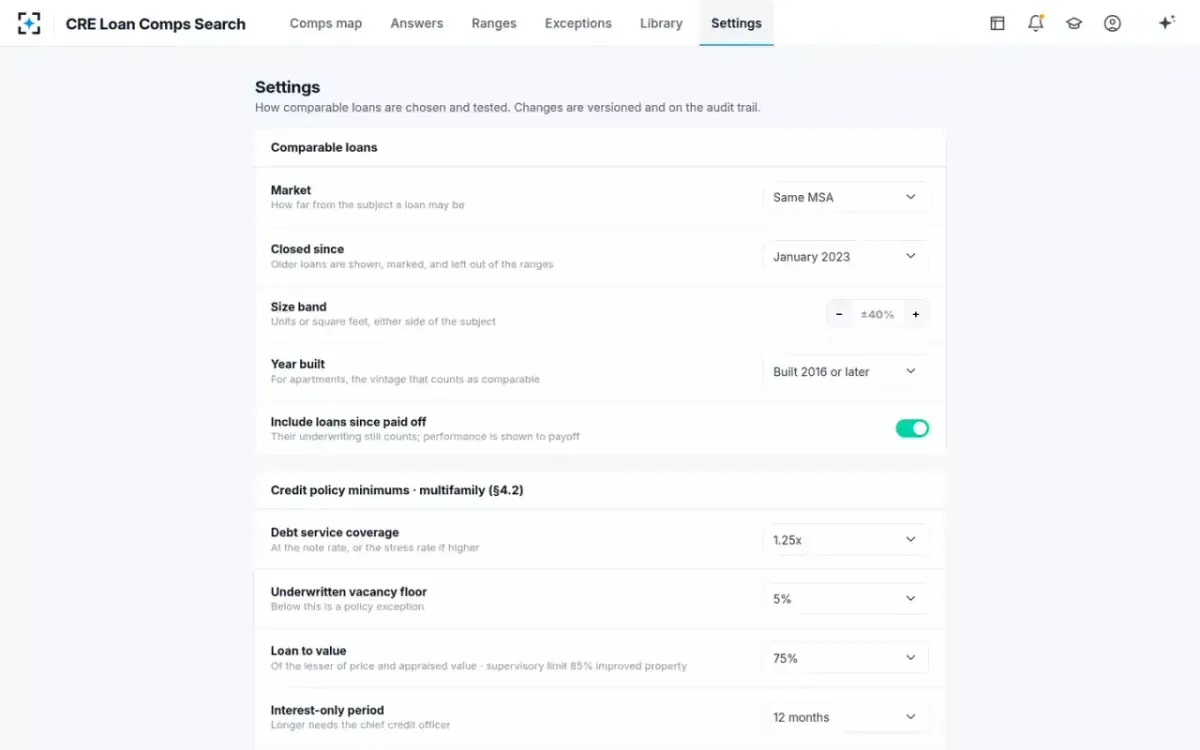
Week 3, outcomes, entitlements and policy. Servicing is joined so each loan carries its occupancy, coverage and rating history. Borrower names are tied to the bank's relationship entitlements. The policy minimums the loan in hand is tested against, coverage, vacancy floor, loan to value, interest-only period, are entered as settings, with the comparable-loan criteria: market, closed-since date, year built and size band.
Week 4, replay and sign-off. The search is replayed on closed loans whose outcomes are known, as described in testing a loan search on closed files. The chief credit officer reviews the results, the reviewer signs a first research note on a live request, and the search opens to analysts.
How long does it take to index credit memos?
Reading a bank's credit memos is the shortest part of building a comps database: once the documents are accessible, the reading runs in hours or days depending on volume and format, and afterwards new memos are read nightly. In the sample search, one question was answered from 27 documents in six seconds of reading. The constraints are elsewhere: finding which version of a memo was approved, dealing with scanned pages, and confirming that a figure printed in a 2016 template means what the same figure means in a 2024 one.
That last point is why a spot check by a credit person in week 2 is not optional. A vacancy line labelled "economic vacancy" in one template and "vacancy and collection loss" in another is the same field to a reader who knows the bank, and two different fields to a reader who does not. The solution reads approved memo versions only, and every figure carries its page, so a reviewer can see in seconds what was read.
What does a comps database need before go-live?
Before anyone relies on a comps database in a credit memo, it needs to pass a short list of checks that protect the bank, not the software. The OCC's lending booklet, describing how examiners analyse a portfolio, lists "loan committee packages" and "lending policy exception and override reporting" among the sources of underwriting data (OCC, Lending and Loan Portfolio Risk Management); a database built from the same documents should be at least as reliable as the packages themselves.
Go-live checks for a lender's own comps database
- Approved versions only
Drafts excluded; every figure traceable to the memo the committee approved.
- A page behind every figure
A random sample checked by credit staff, with misreads counted and fixed.
- Origination figures frozen
Underwritten NOI, value and coverage kept as approved; performance dated beside them.
- Entitlements in force
Borrower names visible only to people entitled to the relationship.
- Criteria and policy as settings
Market, period, vintage, size band and policy minimums versioned, with an audit trail.
- A named reviewer
A credit officer reviews and signs research notes before they enter a memo.
- Replay passed
Precedents found on closed loans match what a senior officer would cite.
- Thin history said plainly
Questions with few or no comparable loans return a count, not a guess.
The criteria and policy minimums are settings, versioned and on the audit trail
Commercial real estate comps for free: the comps the bank already paid for
Free commercial real estate comps are scarce: sales and lease comps are mostly sold by data vendors, and public deed records give prices without income. But every lender already owns a large set of comps it paid for: each appraisal in its files contains the appraiser's comparable sales and rent comparables, and each memo contains the bank's own conclusions. A comps database built from the bank's own documents costs nothing in data licences.
Those comps have a limit worth stating. An appraiser's comparable sales are dated to the appraisal, so an appraisal from 2022 carries 2021 and 2022 sales into the file forever. In the sample search, the review appraiser had noted that appraisals leaned on 2021–2022 sales, which is part of why the bank underwrote cap rates above them. Market sales comps against the bank's loan comps explains when each kind should lead.
Build it, buy it, or both?
A bank can build a lender's comps database itself, buy a solution that builds and keeps it, or license market data and keep its own loans in a spreadsheet. The honest answer depends on volume and on whether the bank has people who can read memos into fields for months without losing interest.
Building comps in-house, or with CRE Loan Comps Search: what each leaves to people
Build in-house: Licensed separately from a data vendor.
CRE Loan Comps Search: Not provided; the appraisals in the bank's files carry the appraisers' comps.
Build in-house: Typed from memos by staff, usually for recent loans only.
CRE Loan Comps Search: Read from approved memos, appraisals and reviews, each figure with its page; new ones nightly.
Build in-house: A periodic servicing extract, if someone maintains it.
CRE Loan Comps Search: Joined from servicing, each figure dated; NOI, vacancy and expenses against plan.
Build in-house: Spreadsheet filters on the fields someone thought to capture.
CRE Loan Comps Search: Plain-words questions turned into visible criteria; loans left out are explained.
Build in-house: Everything, including the reading.
CRE Loan Comps Search: Choosing assumptions, signing the research note, approving the loan.
CRE Loan Comps Search as a comps database: what it holds and what it leaves out
CRE Loan Comps Search is a comps database that reads itself and answers questions: it holds the bank's closed CRE loans with the underwriting extracted from approved documents, the outcomes joined from servicing, the exceptions with their approvers, and assumption ranges by property type and market, kept current nightly. Analysts ask in plain words; the answer cites every sentence; the research note is signed by a named credit officer before it enters a memo.
It is not a market data product and does not sell sales comps. It does not decide comparability on its own: the criteria are the bank's settings, and the analyst can change them per question. It cannot read documents the bank cannot provide, and a bank with years of memos only on paper has a scanning project first. For what the database is ultimately for, the defensible cap rate and expense line on the next loan, see an expense benchmark from the bank's own book. The sample bank's book is on CRE Loan Comps Search.
1,284 closed loans on one map, with the loan in hand beside the question bar
Questions people ask
What is the difference between a comps database and a loan origination system?
A loan origination system manages the current request: application, documents, approvals and closing. A comps database looks backward across closed loans, holding what was underwritten and how each loan performed, so the next request can be compared with them. The two connect at the credit memo, where the comps research is cited.
Should paid-off loans stay in a comps database?
Yes. A loan that paid off early still tells the bank what it underwrote, and dropping paid-off loans biases the database toward loans that are still outstanding, which over a long period means toward the weaker ones. Show their performance up to payoff and mark them clearly.
How far back should a lender's comps database go?
Far enough to cover at least one change in the rate environment, but with recent loans weighted for comparability. The sample bank holds loans since 2014 and sets its comparable window to January 2023, so older loans are shown and marked but left out of the assumption ranges. That window is a setting a credit officer can change.
Who should own a lender's comps database?
Credit administration or the chief credit officer's team, not IT or the business line. The database encodes what the bank counts as comparable and which policy minimums apply, which are credit judgments. IT provides access and security; credit owns the settings and signs the notes.
Can a comps database include loans the bank declined?
It can, if the declined requests have memos, and they are useful for seeing which assumptions the bank refused. They should be marked clearly and kept out of assumption ranges, because the bank never lent on them and they have no performance to show.