Commercial real estate underwriting guidelines are the written standards a bank lends against: for each property type, the minimum debt service coverage, the loan-to-value limit, the minimum debt yield, the maximum term and amortization, the pricing structure, the documentation required and the way exceptions are approved. That is the half the board signs. The other half is precedent, the cap rates, vacancies and expenses the bank has actually accepted on similar buildings and how those loans performed, and at a community bank it often sits with one chief credit officer who remembers. Botminds' CRE Loan Comps Search exists for that second half: it searches the bank's own closed loans, reads the approved credit memos, appraisals, review reports and servicing behind each, and shows what was assumed and whether it held up, with the page behind every figure.
The worked examples on this page come from a fictional sample bank, Calder Point Bank, whose 1,284 closed CRE loans since 2014 run through the solution. The research and the rules come from regulators, linked where they appear.
Community banks carry a share of CRE lending far larger than their size
29%
of the industry's CRE loans held by community banks at year-end 2024
15%
of the industry's total loans held by the same community banks
30%
of community banks counted as CRE-concentrated by the FDIC
What should commercial real estate underwriting guidelines include?
At a minimum, CRE underwriting guidelines should set, for each property type, the maximum loan amount and maturity, the amortization schedule, the pricing structure and the loan-to-value limit; and, for completed income property, minimum standards for net worth, cash flow, debt service coverage and debt yield. That list is not a matter of taste. The Interagency Guidelines for Real Estate Lending Policies, an appendix to the OCC's real estate lending rule, say the underwriting standards "should address at a minimum" the first five items (12 CFR 34 subpart D), and the OCC's examiner handbook adds the rest.
The handbook's description of an effective CRE policy is the best checklist a bank has, because it is the one examiners carry. It asks for "minimum standards for borrower or project net worth, support provided by guarantees (if applicable), borrower and guarantor cash flow, and debt-service coverage ratio (DSCR)", "LTV limits by property type", "maximum loan tenor", "minimum debt yield", amortization criteria and "pricing and profitability objectives" (OCC, Commercial Real Estate Lending, version 2.0). The Interagency Guidelines also require the policy to be reviewed and approved by the board at least annually, and the bank's own LTV limits may not exceed the supervisory ones.
What CRE underwriting guidelines must cover, per property type
- Loan-to-value limit
At or below the supervisory limits: 65% raw land, 75% land development, 80% commercial and multifamily construction, 85% improved property.
- Minimum debt service coverage
The test that binds most income-property loans; set by property type because cash-flow volatility differs.
- Minimum debt yield
NOI over the loan amount: a measure independent of the interest rate, amortization and cap rate.
- Maximum loan amount, tenor and amortization
Including limits on interest-only periods and non-amortizing loans.
- Pricing structure
How rates and fees are set for each type of real estate loan, and the bank's profitability objectives.
- Net worth, guarantees and global cash flow
Who stands behind the property when its income falls short.
- Documentation and valuation
What must be in the file, and when an appraisal or an evaluation is required.
- The exception process
Who may approve which exception, the written justification required, and how exceptions are reported to the board.
Notice what the list contains: limits and minimums. It does not, and cannot, tell an analyst what vacancy to underwrite on a 228-unit garden complex in a suburb where 600 new units are about to open, or what cap rate the bank has accepted on similar buildings over the last three years. Those are the numbers that decide whether a loan clears its minimums, and no policy document holds them.
Who writes a bank's underwriting guidelines, and who really holds them
The board approves the policy, the credit committee sets the risk appetite and the limits, and management writes the procedures. The OCC's 2026 lending booklet describes the credit committee's role as to "establish and guide the bank's lending strategy, credit risk appetite, and risk limits" and to "review and approve lending policies and underwriting standards that reflect the bank's risk appetite" (OCC, Lending and Loan Portfolio Risk Management, 2026). It also says where the detail goes: "Policies often include outer limits, with procedures or guidelines including more granular instructions or inner targets."
The inner targets are where a community bank's guidelines thin out. A policy may say vacancy is underwritten at no less than 5%, but the bank's real practice for Class A garden apartments in one metro, say 6% because the last three deals there all took 6%, is written nowhere. It lives in the head of the officer who approved those deals, and it is applied when that officer reads the next memo.
That arrangement works while the officer is in the building. It fails three ways. A new analyst underwrites to the outer limit because the inner target is invisible. A second officer, approving a deal across town, applies a different inner target, and two loans a mile apart carry two different cap rates. And when the officer retires, the inner targets go with them, together with the memory of which exceptions turned out badly.
The one-officer bank: where precedent goes when nobody writes it down
In a one-officer shop, precedent is a person, not a file. The analyst who wants to know how the bank underwrote the last suburban medical office building asks the chief credit officer; the chief credit officer remembers the deal, roughly, and perhaps the loan officer's name. The memo exists, approved and filed, but finding it means knowing it exists, and reading it means opening a forty-page PDF to find one vacancy assumption on page nine.
The official job description of a credit analyst already assumes this comparison is part of the work. The Department of Labor's O*NET profile lists among the analyst's tasks to "compare liquidity, profitability, and credit histories of establishments being evaluated" with "those of similar establishments in the same industries and geographic locations" (O*NET 13-2041.00). For CRE, the similar establishments are the bank's own past loans, and the comparison is only as good as the analyst's ability to find them.
Who carries CRE precedent today, and who carries it with CRE Loan Comps Search
Today
The bank's memory of past deals and past exceptions; asked about every unusual assumption.
With agents
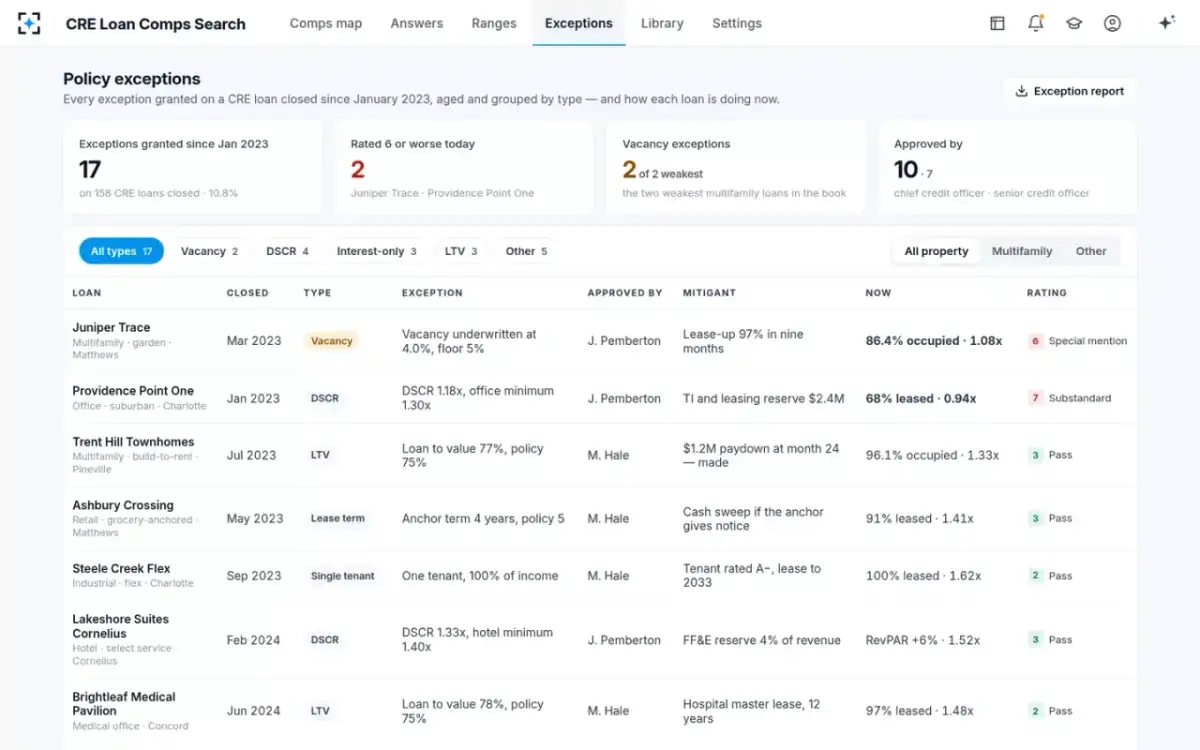
Sees every exception since January 2023 by type, approver, mitigant and how the loan is doing now.
Still theirs: Approves exceptions and owns the policy.
Today
Starts from the broker's pro forma and the appraisal; asks around for how the bank did it last time.
With agents
Asks in plain words and sees the bank's comparable loans, what each assumed and how each performed.
Still theirs: Chooses the assumptions and recommends the amount.
Today
Reads a memo whose assumptions cannot be traced to any earlier deal.
With agents
Reviews a research note in which every sentence cites a memo, appraisal or servicing report.
Still theirs: Signs the note before committee.
Today
Questions appraisal cap rates against market memory.
With agents
Sees the bank's underwritten cap beside each appraisal's on every comparable loan.
Still theirs: The review conclusion.
Today
Samples files for postmortems by hand.
With agents
Starts from every loan whose NOI, vacancy or expenses missed plan, with the memo passage that assumed otherwise.
Still theirs: Independent judgment on ratings and practices.
What is a policy exception in commercial real estate lending, and why examiners count them?
A policy exception is a loan approved outside one of the bank's own underwriting standards, such as a vacancy assumption below the floor, a coverage ratio below the minimum or an interest-only period longer than the policy allows. Exceptions are legitimate; the Interagency Guidelines expect them, provided "the approval of any such loan should be supported by a written justification that clearly sets forth all the relevant credit factors that support the underwriting decision", kept in the permanent loan file, with significant ones reported individually to the board.
What examiners watch is the pattern. "An excessive or significantly increasing number of exceptions to the CRE lending policy could indicate that the bank is unduly relaxing its underwriting practices, needs to revise its loan policy, or that its policies are inconsistent with the board's risk tolerance," the OCC tells its examiners, and "it is prudent for the bank to consider aging of all exceptions with sufficient stratification to identify trends in volumes, loan officer, and types" (OCC CRE booklet, pp. 28–29).
The one-officer bank struggles here for a simple reason: the officer who approves the exceptions is also the only person who remembers how they turned out. An exception report that lists the waiver and the mitigant, but not today's occupancy and coverage, answers the examiner's first question and none of the chief credit officer's.
Every exception since January 2023, with how the loan is doing now
What is a loan postmortem, and why it belongs in the guidelines
A loan postmortem is a structured look back at a problem loan or a loss, asking what the bank assumed when it lent, what actually happened and what the guidelines should learn. The OCC names it plainly: "An important part of the collections and loan workout processes is postmortem reviews to understand how problem loans and losses develop. Postmortems can inform strategic execution and changes in risk selection" (OCC, Lending and Loan Portfolio Risk Management).
The booklet's list of what a postmortem covers reads like a list of documents the bank already holds but rarely puts side by side. Each item points to a different file, which is why postmortems are expensive by hand and often skipped for loans that are merely weak rather than lost.
A postmortem asks six questions; each answer lives in a different file
| What the OCC lists | Where the answer sits | On the sample loan, Juniper Trace |
|---|---|---|
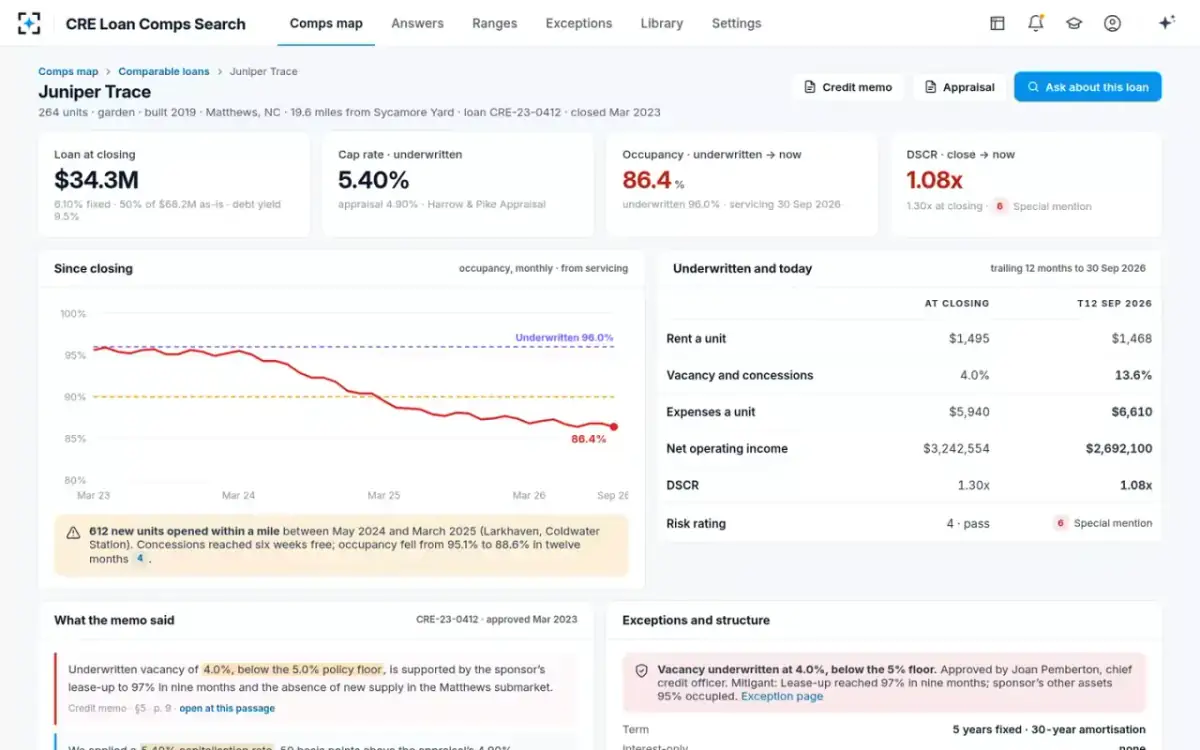
| Comparing each loan's terms and characteristics with underwriting guidelines | The approved credit memo and the credit policy | Vacancy underwritten at 4.0% against a 5.0% floor, approved as an exception |
| Reviewing the borrower's financial condition at approval and over time | Memo at closing; servicing and annual reviews since | NOI $3,242,554 at closing; $2,692,100 on the trailing twelve months to September 2026 |
| Assessing the timeliness of risk-rating changes | Servicing rating history | Rated 4, pass, at closing; 6, special mention, today |
| Assessing the adequacy and timeliness of collateral valuations | Appraisal and review report | Appraisal cap 4.90%; the bank underwrote 5.40% |
| Assessing the effectiveness of the loan and covenant structure | Loan agreement and memo | Five years fixed, 30-year amortization, no interest-only |
| Assessing collections and workout activities | Servicing and watch-list minutes | On the watch list since the downgrade |
Juniper Trace is the kind of loan a postmortem should catch early. It closed in March 2023 at a 4.0% vacancy, an exception justified by the sponsor's lease-up history. Then 612 new units opened within a mile between May 2024 and March 2025, concessions reached six weeks free, and occupancy fell from 95.1% to 88.6% in twelve months. Coverage is now 1.08x against 1.30x at closing. The lesson, that a vacancy exception in a submarket with a supply pipeline failed, is precisely the sort of inner target a guideline should carry and usually does not.
One comparable loan: what the bank assumed, and what happened
Writing down the unwritten half: precedent the next analyst can read
Precedent becomes part of the guidelines when it is written as ranges with outcomes attached, not as anecdotes. For each property type and market the bank lends in, that means the range and median of what it underwrote, how far its cap rates sat from the appraisals', what the exceptions were and how each loan has done since. A policy says 5% minimum vacancy; precedent says what the bank actually took and whether it was right.
What the written policy says, and what the bank's own precedent adds
| Standard | The policy (outer limit) | Precedent from the sample bank's nine comparable loans |
|---|---|---|
| Vacancy | At least 5% of gross potential rent | Underwritten 4.0–6.5%, median 6.0%; the one loan below 5% is the one that missed |
| Cap rate | Not set by policy; supported by the appraisal | Underwritten 5.40–6.10%, median 5.75%, about 45 basis points above the appraisals |
| Debt service coverage | At least 1.25x for multifamily | One exception granted, at 1.24x; that loan covers 1.29x today |
| Interest-only period | Up to 12 months | One exception at 24 months; that loan covers 1.27x today |
| Expenses | Not set by policy | The five loans closed before mid-2024 ran 4–9% over plan after insurance renewals |
Two rows in that table are new knowledge, not restatements of policy. The cap-rate row shows the bank systematically underwriting above the appraisals, which is a practice worth writing down because a new analyst who starts from the appraisal will be 45 basis points too aggressive. The expense row shows the bank's older loans under-reserving for insurance, which is a correction the policy can make explicit. Neither exists until someone reads nine memos, nine appraisals and nine review reports and joins them to servicing.
How do small banks document underwriting precedent?
Most small banks document precedent in one of four ways: a folder of approved memos organised by borrower, a spreadsheet of key terms kept by the credit department, the loan review function's sample files, or the chief credit officer's memory. Each holds part of the answer, and none joins the assumption to the outcome without a person doing the reading.
Precedent kept by hand, and precedent kept by CRE Loan Comps Search
By hand: Ask the chief credit officer, or filter a spreadsheet that holds amount, rate and property type but not the assumptions.
With CRE Loan Comps Search: Ask in plain words; the criteria come back as chips the analyst can change, and each loan left out says why.
By hand: Open each memo and appraisal and hunt for the vacancy, expense and cap-rate lines.
With CRE Loan Comps Search: Read from approved memos, appraisals and review reports, each figure with its document and page.
By hand: A separate request to servicing, often for current figures only.
With CRE Loan Comps Search: Occupancy, coverage, rating and payment history joined, each figure dated, coloured by whether NOI, vacancy or expenses held up.
By hand: An exception log with the waiver and mitigant; outcome rarely kept beside it.
With CRE Loan Comps Search: Every exception by type and approver, with how that loan is doing now.
By hand: Precedent leaves too.
With CRE Loan Comps Search: Precedent stays with the bank, refreshed nightly from new memos and servicing.
The by-hand column is not wrong, only slow, and slowness decides what gets done. The solution's own estimate for one loan's precedent research is about 19 hours by hand, most of it finding and reading, against a little over 2 with the search; that is Botminds' estimate, not a measurement at any bank. When precedent costs two days, it is consulted for large or unusual loans only, which is exactly where a one-officer bank already relies on memory.
Where CRE Loan Comps Search fits a one-officer shop, and where it does not
CRE Loan Comps Search fits a bank that has the documents but not the time to read them: approved credit memos, appraisals and review reports in its document system, closed-loan terms in its core, and monthly servicing data. Six agents find the comparable loans, read the documents, join servicing, test the loan in hand against the credit policy and write a cited answer and a research note. The analyst chooses the assumptions; a named credit officer signs the note; committee approves the loan. What each agent may and may not do is set out on its own page.
It does not write the policy, and it does not invent precedent the bank lacks. Where the bank has few loans of a kind, the answer says how few; where it has none, it says so, as when the sample bank asks about medical office outside its four metros. It searches approved memo versions only, never drafts, and borrower names follow the bank's relationship entitlements. Banks that want to start small can build the underlying index first, as described in building a comps database from your own loans.
The guideline it changes most is the unwritten one. Once precedent is a search rather than a person, the chief credit officer can write the inner targets into procedures, because they can be shown and checked, and the next analyst inherits ten years of the bank's own judgment instead of a phone number. CRE Loan Comps Search shows the whole sample bank's book.
Questions people ask
What is the difference between CRE underwriting guidelines and a credit policy?
The credit policy is the board-approved document: limits, authorities and the risk appetite. Underwriting guidelines or procedures carry the detail, which the OCC describes as "more granular instructions or inner targets" inside the policy's outer limits. A bank needs both, and examiners read both.
What are the supervisory loan-to-value limits for commercial real estate?
Under the Interagency Guidelines: 65% for raw land, 75% for land development, 80% for commercial, multifamily and other non-residential construction, and 85% for improved property. A bank's own limits may be lower but should not exceed them, and loans above them are capped in aggregate at 100% of total capital, of which 30% for commercial, agricultural and multifamily.
How often should CRE underwriting guidelines be reviewed?
The Interagency Guidelines require the real estate lending policy to be reviewed and approved by the board at least annually. In practice the exception trend and postmortem findings are the evidence that a guideline needs changing between reviews, which is why the OCC wants exceptions aged and stratified.
Is it a problem if a bank has no policy exceptions?
It can be. The OCC's 2026 lending booklet says "the absence of policy exceptions could indicate the policy is overly broad", meaning the limits are loose enough that nothing breaches them. A healthy pattern is a modest number of documented exceptions whose outcomes the bank tracks.
What should a CRE loan postmortem include?
The OCC lists comparing the loan's terms with the guidelines, the borrower's condition at approval and over time, the timeliness of rating changes, the adequacy of collateral valuations, the loan and covenant structure, and the collections and workout response. The aim is a change to risk selection, not a file note.
Do small banks need underwriting guidelines by property type?
Yes. The Interagency Guidelines ask for LTV limits by type of property, and the OCC booklet asks for coverage, debt yield and tenor standards "for each type of loan or property". A bank lending on apartments, offices and retail under one set of minimums is underwriting very different cash-flow volatility to the same test.