The SAR filing timeline for a bank is set by 31 CFR 1020.320(b)(3): a suspicious activity report is due within 30 calendar days after the date of initial detection of facts that may constitute a basis for filing, and if no suspect is identified the bank may take up to 30 more days to identify one, never more than 60 in all. The FFIEC examination manual adds the point most timelines get wrong: an alert is not detection. The clock starts when a review determines the activity is suspicious, and that review itself must happen within a reasonable time. In practice a case's timeline runs from the first suspicious transaction, through the alert and the Level 1 review, to the determination, the investigation, the decision, an approval and the filing, and banks that lose control of it file late for years. Botminds' AML Case Management builds the cited case file before the investigator opens it, counts the clock from the recorded detection date, escalates at day 20 and day 25, and keeps the file-or-no-file decision with two people.
This guide follows one case at a fictional bank, every customer and amount fictional, from the first cash deposit to the filing deadline. The rules and enforcement figures are real and linked where they appear.
The clock, in four numbers
30days
from initial detection to filing, with a suspect identified
60days
at most, if no suspect is identified
120days
after a prior SAR, the filing deadline FinCEN's guidance gives for continuing activity, if a bank elects to follow it
90days
the timeline one bank FinCEN penalised generally took to file a SAR
When does the SAR filing timeline start?
At the determination, after review, that the activity is suspicious. The FFIEC manual says a flag from a monitoring system or a system report is not initial detection; the period runs from the review that determines the activity may be reportable (FFIEC BSA/AML Examination Manual, Timing of a SAR Filing). The same section expects the review before that point to be done within a reasonable time, so a bank cannot buy itself days by leaving alerts unreviewed.
That makes the detection date a decision someone must make, record and defend. In the case below, the alert fired on September 29 and the investigator determined the activity was suspicious on October 5, so day 0 was October 5. A bank that cannot show who set day 0, when and why, will have its timeliness judged on whatever date an examiner reconstructs, usually the earliest one available.
The case: what happened before the clock started
The customer was a furniture importer, a business checking customer since 2019, rated Medium risk, whose profile expected about $5,000 a month in showroom cash and wires to suppliers in Sweden and Denmark. Between September 8 and 26 it made 23 cash deposits, every one between $8,600 and $9,700, at six branches, $211,100 in all. From September 11 it wired $203,500 in four payments to a Hong Kong trading company that appeared nowhere in its profile, while its regular suppliers were paid less.
Since October 9, 2025, cash near $10,000 has not been enough on its own. The interagency SAR FAQs say "The mere presence of a transaction or series of transactions by or on behalf of the same person at or near the $10,000 CTR threshold is not information sufficient to require the filing of a SAR" (SAR FAQs, October 2025). The case had to show design: on eight days the cash was split between two branches; a teller recorded the depositor asking whether two deposits on one day are added together; and other customers' cash was arriving at the same branches within the hour.
Where the case's 57 days went, and where the 30-day clock sits
- Before the alert21 d
- Alert to day 06 d
- Day 0 to decision17 d
- Decision to deadline13 d
- Open and assign a case30 d
- Investigate and recommend30 d
- Supervisor prepares and files30 d
The timeline, day by day
The table is the case log as the bank kept it. Read the second column: everything before October 5 happened outside the clock, and everything after it was counted against the 30 days.
The SAR filing timeline of one case, from first deposit to deadline
| Date | Day of clock | What happened | Who |
|---|---|---|---|
| Sep 8 | – | First of 23 cash deposits under $10,000 | Customer |
| Sep 11 | – | First wire to the Hong Kong trading company: $46,500 | Customer |
| Sep 14 | – | A teller notes the depositor asked whether two deposits on one day are added together | Branch |
| Sep 22 | – | Another customer wires $48,000 to the same trading company account | Another customer |
| Sep 29 | – | Structuring alert fires on the cash deposits | Monitoring |
| Sep 29 to Oct 5 | – | Level 1 reviews and escalates | Level 1 analyst |
| Oct 5 | Day 0 | Level 2 determines the activity is suspicious and confirms the detection date | Investigator |
| Oct 9 | Day 4 | 314(b) request sent to another bank about the second customer and the trading company | BSA officer approves |
| Oct 19 | Day 14 | The other bank replies: a further $77,000 went to the same account | Other bank |
| Oct 22 | Day 17 | Linked customers accepted, draft verified, file decided and approved, hand-offs sent | Investigator, senior investigator |
| Nov 4 | Day 30 | Filing deadline | SAR filing team |
Days 0 to 17: what the investigator spends the clock on
On a manual desk, the first days of the clock go on gathering: statements and account history from the core, wires from the payments hub, the profile, prior alerts and SARs, deposit tickets from imaging, 314(a) results. In this case the agents built the file before the investigator opened it: 41 items from six systems, each cited. Imaging failed to return 2 of the 23 deposit tickets; the file named the gap and noted that the draft did not rely on them, because the core recorded both deposits.
The case on day 17: the money laid out, one lane per counterparty
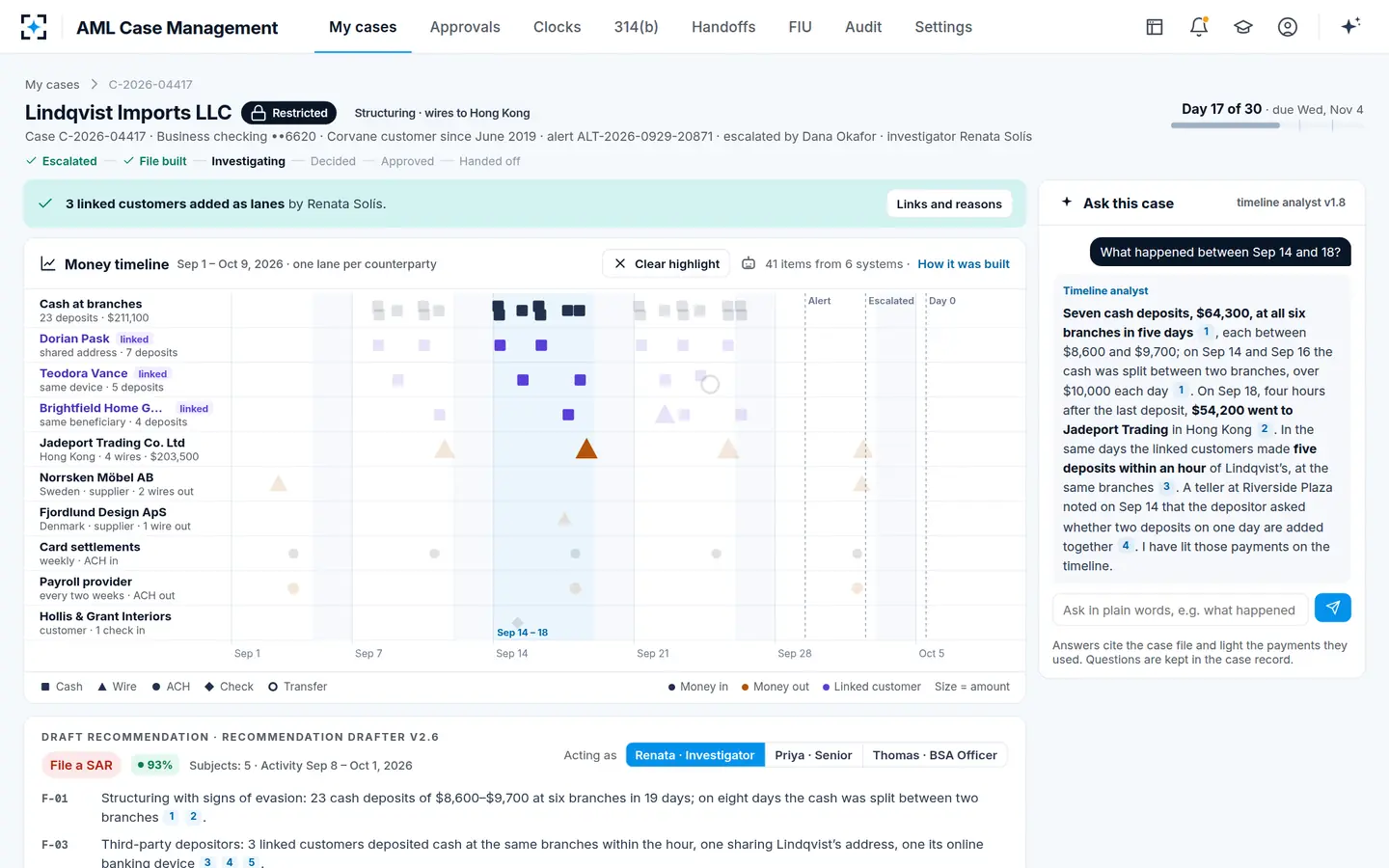
The days the clock cannot compress are the ones that depend on others. A 314(b) request needs the other bank's registration verified and the BSA officer's approval before it goes; this one went on day 4 and the answer came on day 14. The network took judgement too: the link finder proposed three customers who deposited cash at the same branches within an hour, shared an address or a device, or wired the same trading company, and the investigator opened the branch log behind the links, 16 deposits worth $147,200, before accepting them.
The decision and its approval: day 17
A recommendation drafter wrote File a SAR at 93% confidence under three reason codes, with five subjects. A verifier on a second model checked 38 amounts, counts, dates and names against the sources with zero tolerance; 37 agreed, and one count was corrected before anyone signed. The investigator chose File a SAR over No SAR or Need more, and a senior investigator approved the same day after three checks: each value agrees with its source, the maker and checker are different people, and the case is within its clock.
The file-or-no-file decision, with the clock beside it
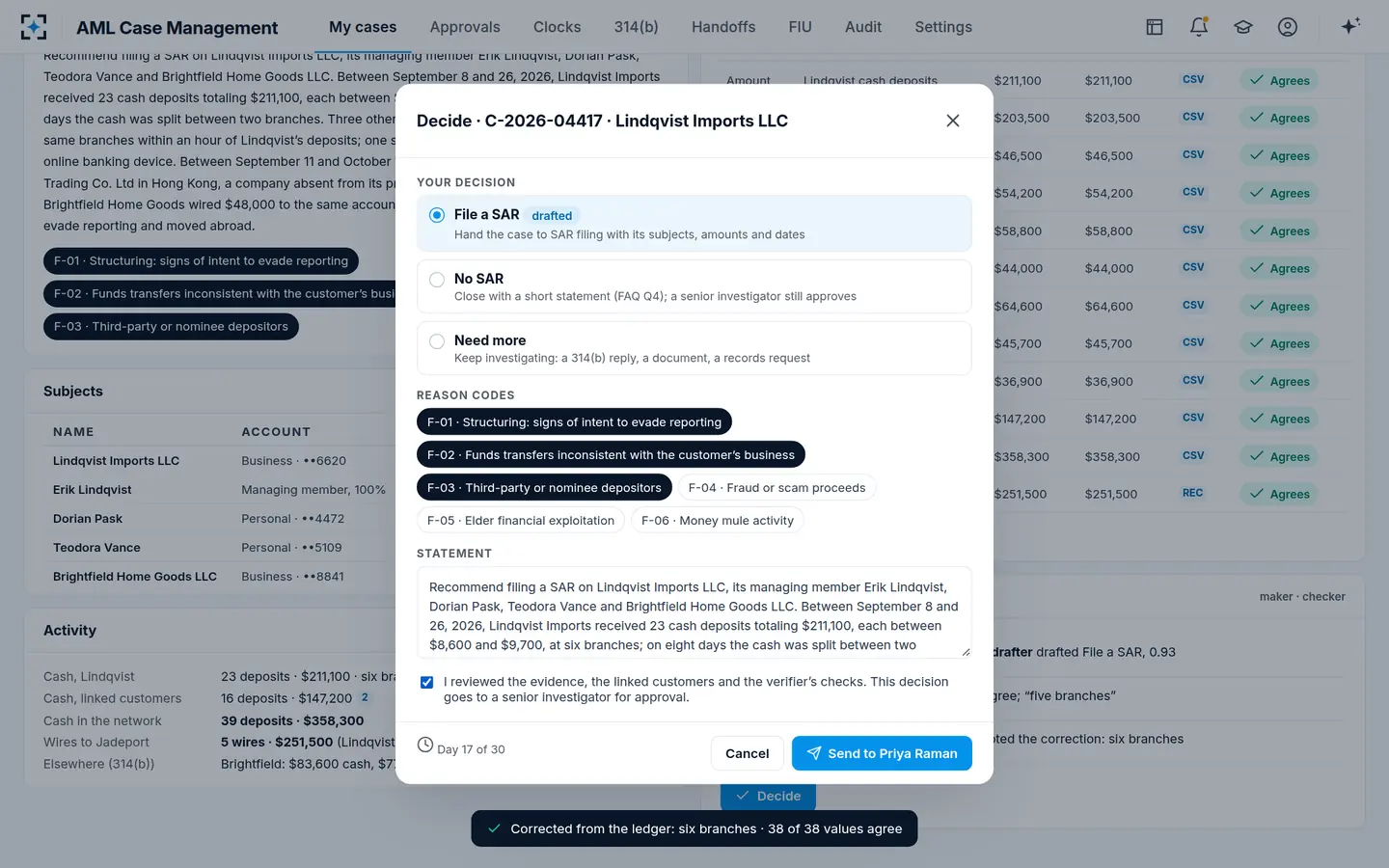
Approval is where timelines slip in practice. Shinhan Bank America's procedure gave a supervisor 30 days to prepare and file after an analyst recommended filing, and FinCEN found "significant delays, sometimes over 100 days, between an analyst recommending that a SAR be filed and a supervisor approving and filing the SAR" (FinCEN, Shinhan Bank America, 2023). The order also found the bank "filed several hundred late SARs." A clock that stops at the investigator's recommendation measures the wrong thing.
How should a bank escalate a case that is running late?
Automatically, at fixed points on the clock, to someone with the authority to reassign or decide. The sample bank escalates to the FIU manager at day 20 and to the BSA officer at day 25, caps each investigator at 24 open cases, and routes new cases above the cap elsewhere. The escalation is not a reminder; it moves accountability for the date to a more senior person.
The sample bank's clock settings
| Setting | Value | What it prevents |
|---|---|---|
| SAR clock | 30 days from detection, 60 with no suspect identified | A clock counted from the wrong date |
| Escalation | Day 20 to the FIU manager, day 25 to the BSA officer | Late cases discovered on day 31 |
| Assignment cap | 24 open cases per investigator; above it, new cases route elsewhere | One investigator holding too many clocks |
| Detection date changes | Need the FIU manager's approval, with a reason | Day 0 moved quietly to fit a late filing |
| Continuing activity | Elected for filed cases whose account stays open | Continuing activity reviews forgotten |
Every case ranked by its SAR clock
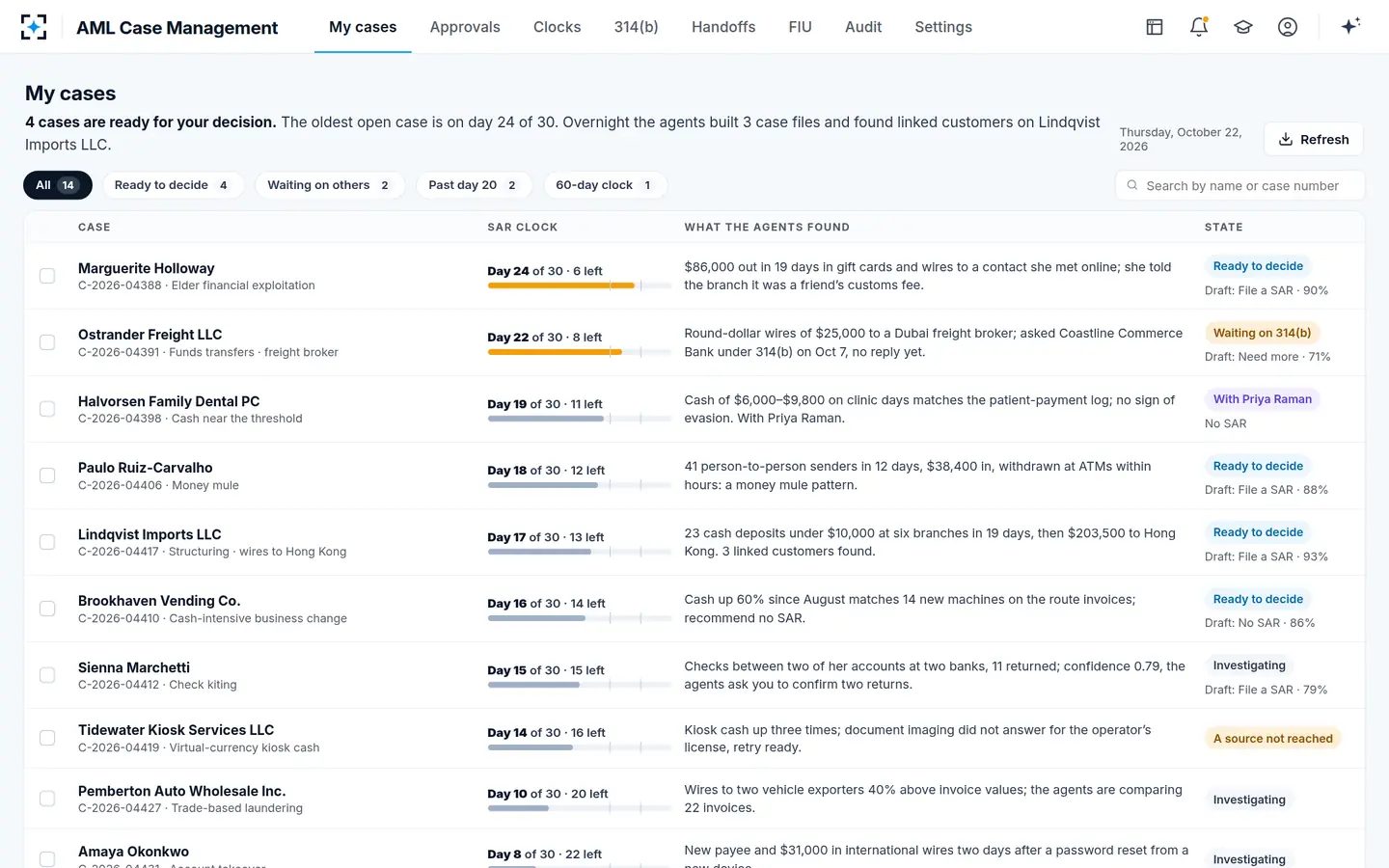
What about continuing activity after the first SAR?
It is now a choice for the bank, with a published timeline if it elects one. FinCEN's earlier guidance suggested filing for continuing activity at least every 90 days, with the deadline 120 days after the previous SAR. The October 2025 FAQs say financial institutions "are not required to do so and may instead file SARs as appropriate in line with applicable timelines," and for those that elect the guidance give the sequence: day 0 detection, day 30 initial SAR, day 120 end of the 90-day period, day 150 continuing SAR (SAR FAQs, October 2025).
Two ways to handle continuing activity after a SAR
Elect FinCEN's continuing activity guidance: On a fixed cycle after each SAR
File as appropriate under the general timelines: When new facts arise from monitoring or other sources
Elect FinCEN's continuing activity guidance: Day 150 from the original detection, then every 90 days
File as appropriate under the general timelines: 30 days from detection of the new facts, 60 with no suspect
Elect FinCEN's continuing activity guidance: The whole 90-day period
File as appropriate under the general timelines: The period of the new activity
Elect FinCEN's continuing activity guidance: Who runs the cyclical review and how it is tracked
File as appropriate under the general timelines: How continuing activity is detected and routed
Either choice needs a written procedure and a tracker. The worst outcome is the one the guidance was written to prevent: an account left open after a SAR, with no one assigned to look again.
After the decision: hand-offs that run on the same clock
The decision is not the filing. In the sample case the SAR filing team received a packet with five subjects, the activity dates, 39 cash deposits totalling $358,300 and five wires to the trading company totalling $251,500, 41 cited items and the due date: 13 days in hand. Three customers' risk ratings went up to High, waiting for a senior investigator, and the BSA officer approved an account exit with a closure notice checked for any mention of an investigation.
Enforcement records show late SARs arising from the joins between teams as well as from the investigation itself. FinCEN's TD Bank order describes over 70,000 backlogged detection alerts and roughly 3,000 aged subpoena responses and further investigation cases in 2018 (FinCEN, TD Bank, 2024), and the OCC's October 2026 action against Bank of America found the bank "file[d] large numbers of late suspicious activity reports" after years of "failing to escalate potentially suspicious activities to investigators for review" (OCC News Release 2026-89).
In practice, the Bank generally adhered to a 90-day timeline to file SARs.
FinCEN, In the Matter of Shinhan Bank America, 2023
What to measure on the SAR filing timeline
Measure each segment, not just whether SARs were filed by day 30. Alert to day 0 shows whether reviews happen within a reasonable time; day 0 to decision shows investigation capacity; decision to approval shows the supervisory queue; approval to filing shows the filing team. A bank that tracks only on-time filing learns about a problem when it is already late.
Timeline measures, and the problem each reveals
| Segment | Measure | A rising value means |
|---|---|---|
| Alert to detection date | Median and 90th percentile days | Level 1 review is not happening in a reasonable time |
| Detection to decision | Days, and share past day 20 | Investigators are overloaded or waiting on evidence |
| Decision to approval | Days in the senior investigator's queue | Approval is the bottleneck, as at Shinhan |
| Approval to filing | Days; share filed in the last three days | Filing team capacity or packet quality |
| Detection date changes | Count and reasons, by approver | Day 0 is being moved to fit |
| Continuing activity reviews due | Count past their cycle | Open accounts after a SAR are not being looked at |
AML investigation steps re-divides the investigation between agents and people step by step, and the AML investigation team sets out who holds each decision on this timeline. For the narrative itself, the SAR filing process covers drafting and submission.
Questions people ask
Is the SAR deadline 30 calendar days or 30 business days?
Calendar days. The rule requires filing no later than 30 calendar days after the date of initial detection of facts that may constitute a basis for filing, extended by up to 30 more calendar days only if no suspect is identified, to 60 at most.
Does the SAR clock start when the alert is generated?
No. The FFIEC manual says a system flag is not initial detection; the clock starts when a review determines the activity is suspicious. The review itself must be completed within a reasonable time, so long-aged alerts are a finding of their own.
What happens if a bank files a SAR late?
A late SAR is a violation of the reporting rule, and patterns of late filing appear in enforcement actions. FinCEN found Shinhan Bank America filed several hundred late SARs, and the OCC's 2026 action against Bank of America cited large numbers of late SARs among its findings.
Is near-threshold cash enough to require a SAR?
Not since the October 9, 2025 interagency FAQs. Transactions at or near $10,000 are not on their own sufficient; a filing is required when the bank knows, suspects or has reason to suspect they were designed to evade currency reporting, such as deposits split across branches on the same day.
How often must a bank file on continuing activity?
The October 2025 FAQs say banks are not required to follow FinCEN's 90-day continuing activity guidance and may file as appropriate under the general timelines. Banks that elect the guidance file on day 150 from the original detection, then every 90 days while the activity continues.
Can the detection date be changed after the fact?
A bank may correct it when the record supports a different date, but the change should carry a reason and an approver. In the sample bank, the FIU manager approves any change, and every change is kept on the trail so a pattern of moving day 0 would be visible.