An AML investigation team is the part of a bank's financial intelligence unit that takes alerts the first line has escalated, investigates them as cases, and reaches a decision on whether to file a suspicious activity report within 30 days of the bank determining the activity is suspicious. Its structure is the bank's choice; regulators require that it be defined. The FFIEC examination manual expects "a clear and defined escalation process from the point of initial detection to disposition of the investigation," named owners for each part of the process, and a decision maker, "whether an individual or committee," with "the authority to make the final SAR filing decision." Most teams that fail examinations fail on capacity and expertise rather than design. Botminds' AML Case Management supports the team by building the cited case file before an investigator opens it, ranking cases by their clocks, and enforcing the split between the investigator who decides and the senior investigator who approves.
This guide is for the BSA officer and the FIU leader who design and staff the team. The worked figures come from a fictional sample bank with 85 investigators in six teams and 1,742 open cases, as it runs through the solution.
The scale an investigation team works at
4.8M
SARs filed with FinCEN in fiscal 2025, by all filer types
30days
from initial detection to filing; 60 only to identify a suspect
24
open cases per investigator, the sample bank's cap before new cases route elsewhere
How is an AML investigation team structured?
Most banks with dedicated staff use tiers: Level 1 analysts clear alerts, Level 2 investigators work escalations as cases, and a senior investigator, the BSA officer or a SAR committee makes the final filing decision. Around them sit an FIU manager who owns the clocks and staffing, a filing team that completes and submits SARs, and quality control. No regulation names the tiers. The FFIEC asks that policies identify who is responsible for producing alerts, managing them, deciding whether to file, completing and filing, and monitoring continuing activity, and notes that smaller banks may have one or more employees cover several of those tasks.
The five parts of a SAR program, and who usually owns each
| Component (FFIEC) | What it covers | Typical owner at a two-tier bank |
|---|---|---|
| Identification of unusual activity | Monitoring output, employee referrals, law enforcement inquiries, 314(a) and 314(b) | Monitoring team; Level 1 analysts |
| Managing alerts | Escalation from detection to disposition; research; documented conclusions | Level 1, then Level 2 investigators |
| SAR decision making | A final decision maker or committee with authority to decide | Senior investigator, BSA officer or SAR committee |
| SAR completion and filing | A complete, accurate narrative, filed on time | SAR filing team, from the investigator's packet |
| Continuing activity | Repeat filings, relationship review, account exits | Investigators; the BSA officer for exits |
Structure follows volume and typology. A community bank may have one or two people who do everything from reviewing reports to filing; a regional bank separates Level 1 from Level 2 and adds a senior tier; a large bank routes cases by typology to specialised teams. The sample bank routes Level 2 cases to six teams by typology, so structuring, trade and payments, fraud-related and other cases each go to people who see them every day.
Level 1 vs Level 2 AML investigations: where the hand-off goes wrong
Level 1 decides whether an alert deserves a case; Level 2 decides what the case shows and whether to recommend a SAR. The hand-off between them is where most lost days hide, because the 30-day clock in 31 CFR 1020.320(b)(3) runs from "the date of initial detection of facts that may constitute a basis for filing", not from the day Level 2 picks the case up. If an alert sits five days in an escalation queue after the analyst saw what made it unusual, the investigator starts on day five.
Three defects recur at the boundary. An escalation note that says "unusual cash activity, please review" makes the investigator repeat the analyst's work; a useful note names the transactions, the pattern and what the analyst ruled out. A detection date set at case creation rather than at the analyst's finding makes the clock look healthier than it is, and an examiner who reads the alert history will see the gap. And alerts on the same customer escalated separately become separate cases, so two investigators each see half the activity and neither sees the pattern.
The fixes are procedural. The bank's procedure should define the detection date, the content of an escalation note and the rule for merging alerts on a customer or linked customers into one case, and the FIU manager should measure the hand-off: median days from escalation to first investigator action, and the share of escalations returned to Level 1 for missing information. At the sample bank, a change to a case's detection date is reserved to the FIU manager and kept with the reason, so the clock the team reports is the clock an examiner would reconstruct.
The seats on the team, and what each one signs
Every seat owns a specific decision, and the team works when each owner has the evidence and the time to make it. The figure takes the sample bank's unit seat by seat, before and after the case file is built by agents.
Six seats in the life of one case, and what stays with each
Today
About 14 open cases, each on its own clock; the first days of each go on pulling statements, wires and tickets from six systems.
With agents
Opens a case already built, with the money laid out by counterparty, linked customers proposed with reasons and a draft whose numbers have been checked.
Still theirs: Whether the activity is suspicious, which links to accept, the decision to recommend
Today
Approves decisions for eight investigators by rereading the evidence behind each.
With agents
Sees each decision with the value check and the separation-of-duties check, and approves or returns with a reason.
Still theirs: Final approval of every file and no-file decision
Today
Learns which cases are near day 30 in status meetings, after the time to rebalance has passed.
With agents
Sees every clock across 85 investigators in six teams, with escalation at day 20.
Still theirs: Staffing, routing, any change to a detection date
Today
Checks every letter, script and reply leaving the unit for anything that would reveal a SAR.
With agents
Approves account exits, 314(b) replies and export packs that arrive drafted and checked.
Still theirs: The program, board reporting, exits, anything sent outside the unit
Today
Retypes subjects, amounts and dates from the recommendation into the form.
With agents
Receives a packet with subjects, dates, amounts and every cited item.
Still theirs: The filing and its accuracy
Today
Escalates with a note; the case starts from scratch at Level 2.
With agents
Escalates the same way; the case file starts building at once.
Still theirs: The disposition of every alert
Who has the authority to decide whether to file a SAR?
Whoever the bank's procedures name, provided that person or committee has the authority to make the final decision. The FFIEC manual is specific: "The decision maker, whether an individual or committee, should have the authority to make the final SAR filing decision. When the bank uses a committee, there should be a clearly defined process to resolve differences of opinion on filing decisions." The investigator usually recommends; the decision maker decides or approves.
An individual decision maker or a SAR committee
Individual decision maker: Decides as cases arrive, within the clock
SAR committee: Meets on a schedule; urgent cases need a path between meetings
Individual decision maker: One view, which needs QC to test
SAR committee: Several views; needs a written way to resolve disagreement
Individual decision maker: Higher volumes, routine typologies
SAR committee: Complex, high-profile or insider cases
Individual decision maker: Delegated authority, approvals, separation from the maker
SAR committee: Charter, minutes, how differences were resolved
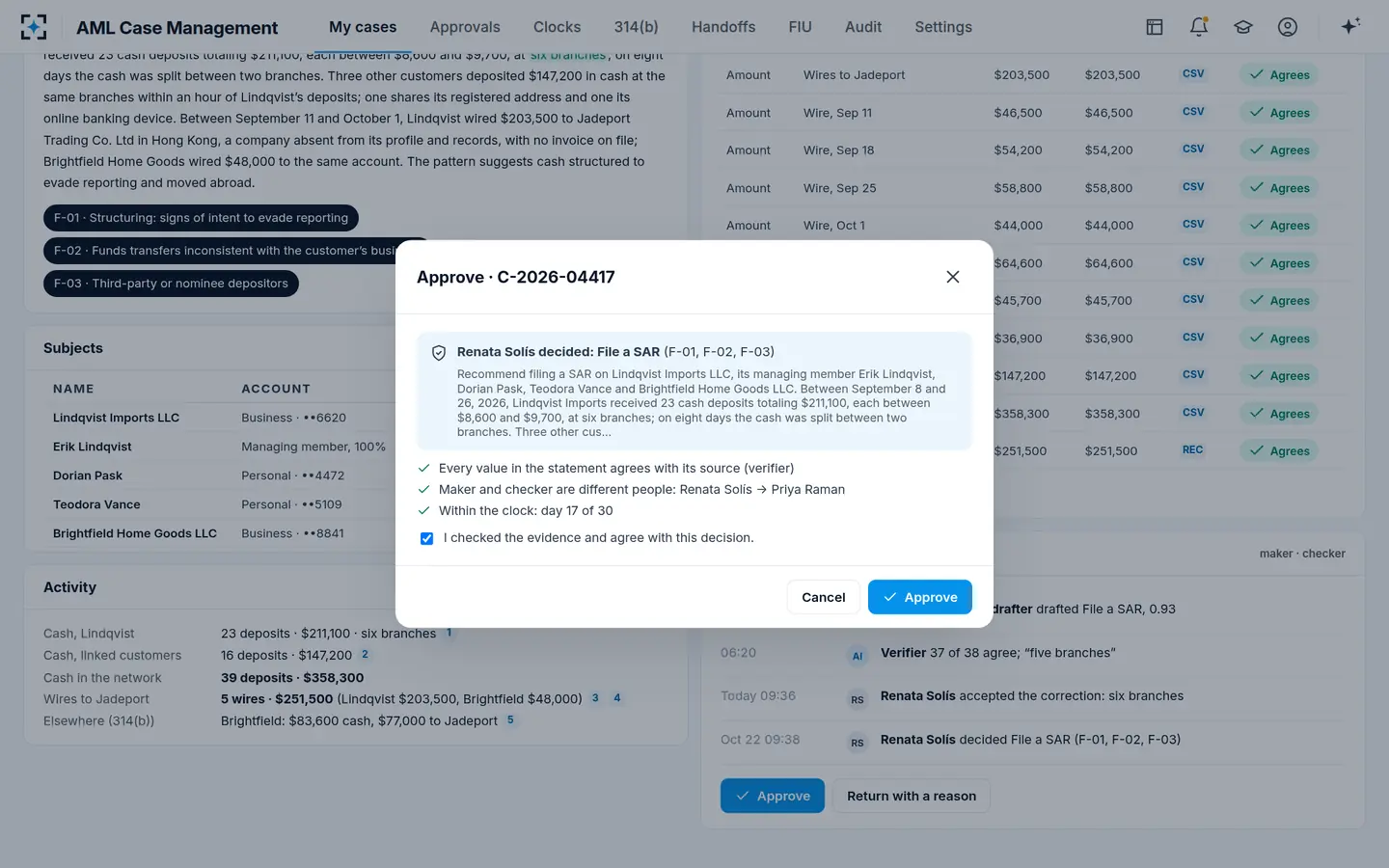
Whichever form a bank chooses, the maker should not be the approver. At the sample bank, the investigator who decides cannot approve their own decision; the button says why. The senior investigator sees each value checked against its source, the maker-checker split and the case's position on its clock before approving.
The second signature: a senior investigator approves the decision
No-file decisions need a defined path too, though the record they need is lighter since October 2025. The interagency SAR FAQs say the BSA and its regulations do not require a written record of a decision not to file, and that where a bank keeps one, a short statement will usually suffice (SAR FAQs, October 2025). Examiners judge the process: the FFIEC calls the filing decision "an inherently subjective judgment" and directs examiners to "focus on whether the bank has an effective SAR decision-making process, not individual SAR decisions."
Sizing the team: caseloads, clocks and routing
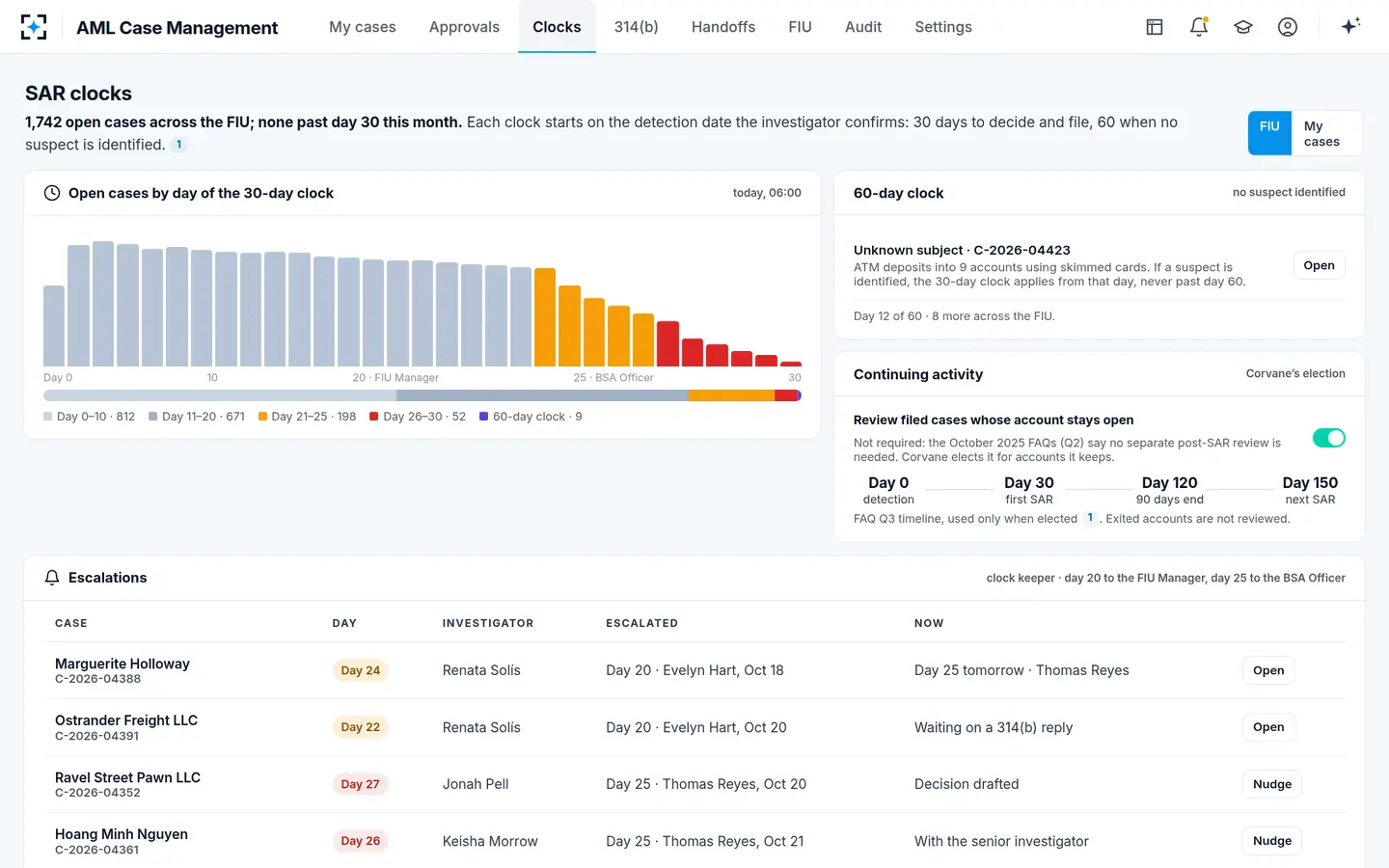
An investigation team is sized by cases, days and hours: how many cases arrive, how long each takes to work, and whether every case can be decided before day 30 with time left to approve and file. The FIU manager's question is not whether each investigator is busy but whether the cases sitting between day 21 and day 25 can all be decided in time. At the sample bank, 198 of 1,742 open cases sat in that band on the day shown below.
The whole unit's cases by day of the clock
Levers the FIU leader controls, and what each changes
| Lever | Sample bank setting | What it changes |
|---|---|---|
| Caseload cap | 24 open cases per investigator | Above it, new cases route to another investigator, not the queue |
| Routing | By typology to six teams | Cases reach people who know the pattern |
| Escalation points | Day 20 to the FIU manager, day 25 to the BSA officer | Late cases surface while there is time to act |
| Approval capacity | One senior investigator per eight investigators | Whether decisions wait in the approval queue |
| Evidence assembly | Case file built before the investigator opens it | How many of the 30 days go on gathering |
Approval capacity is the lever banks most often miss. FinCEN found that at Shinhan Bank America, delays "sometimes over 100 days" opened between an analyst recommending a SAR and a supervisor approving and filing it (FinCEN, Shinhan Bank America, 2023). A team with enough investigators and too few approvers files late anyway. The SAR filing timeline follows one case through every segment of the clock.
How many AML investigators does a bank need? A worked capacity model
Divide the investigative hours the case inflow needs by the investigative hours one person actually has, then check approval capacity separately. No regulation sets a ratio, so the model has to come from the bank's own case history. An illustrative unit, with round numbers chosen to show the method rather than any bank's result:
- Inflow: 1,100 cases a month escalated from Level 1.
- Hours per case, by complexity: 60% routine at 6 hours, 30% complex at 14 hours, 10% multi-party or cross-border at 30 hours, an average of 10.8 hours and 11,880 hours a month.
- Hours an investigator has: about 160 paid hours a month, less leave, training, team meetings, quality reviews and law enforcement requests, leaving roughly 115 for cases.
- Investigators needed: 11,880 ÷ 115 ≈ 103, before any allowance for vacancies.
- Approvers needed: 1,100 decisions at 40 minutes each is about 730 hours, or six to seven senior investigators at the same 115 hours. Approval hours follow the number of decisions, not the number of investigators, so a ratio fixed to headcount misleads when cases get simpler and decisions per investigator rise.
Three adjustments separate a plan that survives from one that does not. Vacancies: with a 15% vacancy rate, a 103-seat plan delivers 88 people, and the shortfall lands on the cases closest to day 30. Continuing activity: the interagency SAR FAQs say a separate review after a filing is not required, but a bank that follows FinCEN's continuing-activity guidance files a further SAR by day 150 on the same subject, and every such review is hours the inflow figure does not show. Mix drift: a new typology or a monitoring change moves cases from the 6-hour band into the 14-hour band, so a team sized on last year's mix is short this year with no change in volume.
The most useful single measure is hours per case by typology, recorded from case history rather than estimated. It is also the honest way to judge any change to how cases are assembled, including this solution: count the hours spent before the investigator first reads the evidence, before and after, on the same typologies.
What staffing failures have regulators penalised?
Vacancies, turnover, reliance on undertrained contractors and missing expertise, more than any choice of structure. USAA Federal Savings Bank had determined it needed 178 permanent positions; "As of early 2021, the Bank had 62 vacant positions, including the head of the Bank's Financial Intelligence Unit (FIU)," and it "supplemented approximately 76% of its compliance staffing needs with third-party contractors," whom it "failed to properly train" (FinCEN, USAA FSB). Shinhan Bank America "had five different BSA compliance officers in 2019 alone."
The bank's BSA Officer and staff lacked sufficient skills and expertise to effectively manage the bank's BSA/AML program.
OCC, News Release 2026-89, on Bank of America, October 13, 2026
The OCC's October 2026 action carried a $750 million penalty, the largest in its history, and added that key BSA personnel "did not receive appropriate training regarding suspicious activity identification, investigation, and reporting." Earlier, the OCC had warned that "banks are leveraging BSA staff to help manage related risks in other areas of the bank, e.g., fraud investigations, which could affect continuity of BSA operations" (OCC Semiannual Risk Perspective, Spring 2025). An investigation team that is also the bank's fraud team needs to be sized for both.
Training and expertise: what the rules require
The rules require training, not certificates. The bank AML program rule lists "Training for appropriate personnel" among its required elements (31 CFR 1020.210(a)(2)(iv)), and the FFIEC expects investigation staff to "possess the requisite experience levels" and to receive "comprehensive and ongoing training to maintain their expertise." Private certifications are common in hiring; they are the bank's choice.
What a strong team needs is the expertise the enforcement orders found missing: reading a customer's business well enough to see what does not fit, knowing typologies and the October 2025 change on near-threshold cash, writing a recommendation someone who never saw the case can act on, and knowing exactly what may never be said outside the unit. Routing by typology builds that expertise faster than a single queue does.
Quality control and independent testing: how the team's work is checked
Two different checks apply, and a team needs both. Independent testing is a required element of the program: the rule calls for "independent testing for compliance to be conducted by bank personnel or by an outside party" (31 CFR 1020.210(a)(2)(ii)). Quality control is the unit's own, continuous check on its decisions, run by people who did not make them, so that problems surface before the independent tester or the examiner finds them.
A quality control program that tells the BSA officer something samples three populations separately. Filed SARs, for completeness of the narrative, the accuracy of subjects, amounts and dates against the evidence, and timeliness against the detection date. No-file decisions, for whether the reasons hold up against the activity, since these are the decisions with the least scrutiny and the greatest exposure if a pattern was missed. And closed alerts at Level 1, for escalations that should have happened. Each sample is scored by investigator and by typology, so a finding points to a training need or a procedure gap rather than a general warning.
The results feed the levers above. A typology with a high rework rate needs more experienced people or clearer procedures; an investigator whose no-file decisions keep failing quality control needs coaching before an examiner reads the same files. The same separation that governs approvals governs quality control: the reviewer cannot be the maker or the approver of the decision under review, and the sample, the score and the follow-up are kept, because the independent tester will ask to see that the unit checks itself.
The confidentiality boundary around the team
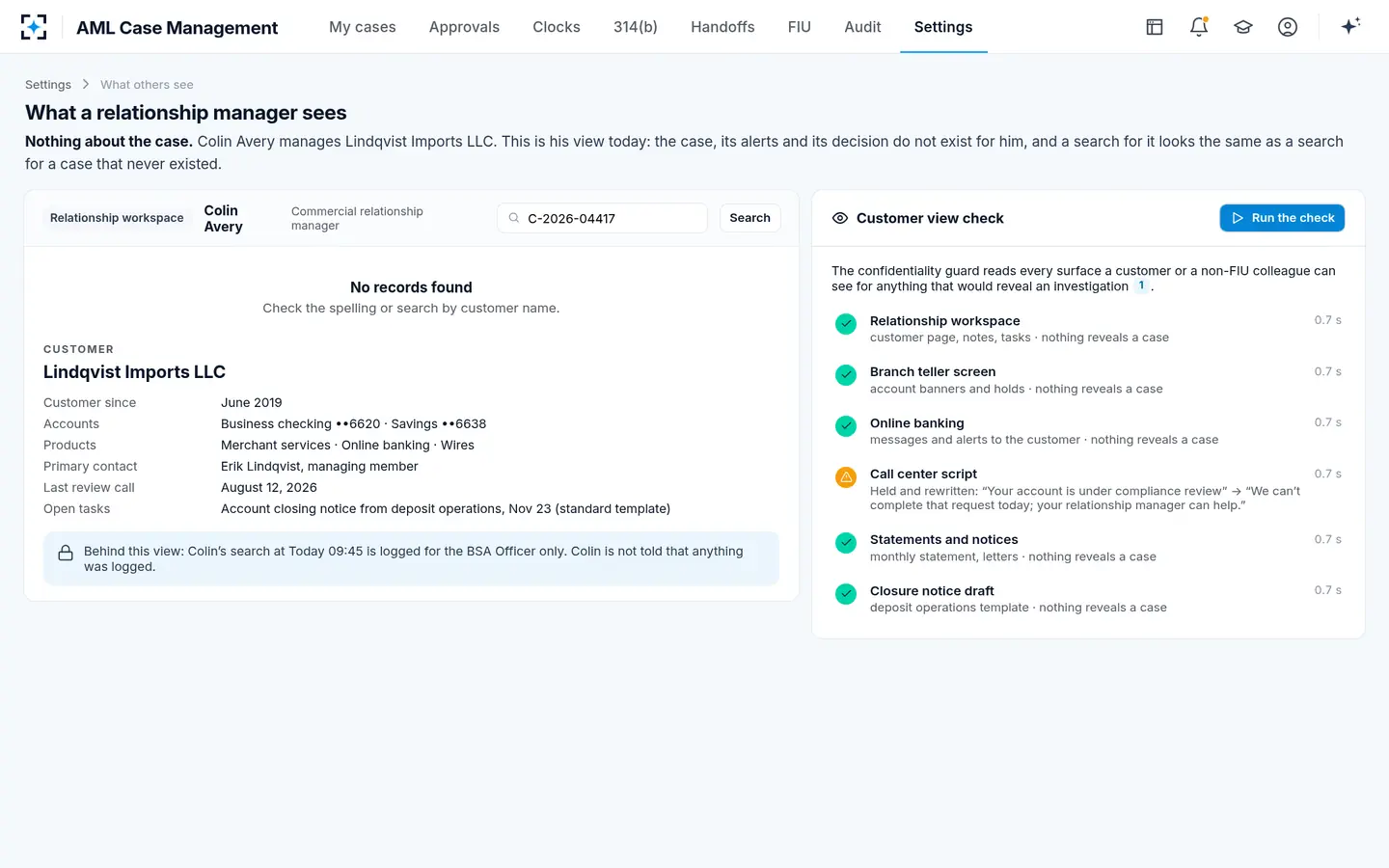
The investigation team is the boundary of a secret. "A SAR, and any information that would reveal the existence of a SAR, are confidential," the rule says (31 CFR 1020.320(e)), so nothing about a pending or filed case should be visible to the customer's relationship manager, a branch or the contact center. The FFIEC adds that board reporting on SARs must bend when the subject is an insider: the notification policy "should not be followed" for that person, and the deviation documented.
What the relationship manager sees: nothing
Everything that leaves the team passes through the BSA officer at the sample bank: account exit notices, 314(b) replies to other banks with their registration verified, and export packs for examiners or law enforcement, each checked for any mention of a SAR. Keep open letters and grand jury subpoenas cover the two outside requests that most test this boundary.
Questions people ask
What is the difference between an AML analyst and an AML investigator?
Depth and authority. A Level 1 analyst reviews alerts and closes or escalates each one; a Level 2 investigator works escalations as cases across accounts, counterparties and linked customers, and recommends whether to file. A senior investigator, the BSA officer or a committee usually makes the final decision.
Does a bank need a SAR committee?
No. The FFIEC requires a decision maker, "whether an individual or committee," with authority to make the final decision, and a clearly defined process for resolving disagreements if a committee is used. Many banks use a named individual for most cases and a committee for sensitive ones.
How many cases should an AML investigator carry?
No regulation sets a number; it depends on case complexity and the time left on each clock. The sample bank in this guide caps open cases at 24 per investigator and routes new cases elsewhere above the cap, with escalation at day 20 and day 25.
Who should approve a decision not to file a SAR?
The same decision maker who approves filings, under the same procedure. Since October 2025 the interagency FAQs say a written record of a no-file decision is not required, and a short statement usually suffices where a bank keeps one.
What does a financial intelligence unit do in a bank?
It investigates suspicious activity and decides what the bank reports: analysts, investigators, decision makers and the filing team. It is also the boundary of SAR confidentiality, so the rest of the bank should not be able to tell a case exists.
Can an AML investigation team also handle fraud cases?
Many do, but the OCC warned in 2025 that lending BSA staff to fraud investigations could affect the continuity of BSA operations. A combined team should be sized and measured for both workloads, with SAR clocks tracked separately.